Introduction
Every festival dance floor is more than just a space for revelers – it’s critical infrastructure. Seasoned festival producers know that a well-built dance floor keeps the crowd safe and energized, whether it’s a small folk festival in New Zealand or a massive EDM rave in Germany. Treating the dance floor with the same care as a stage or sound system can prevent injuries and ensure everyone has a great time. This guide explores how to construct and maintain dance floors with an emphasis on sprung decks, surface safety, and structural integrity – sharing hard-earned wisdom from festivals around the world.
Sprung Decks and Safe Surfaces
A comfortable, sprung dance floor isn’t a luxury – it’s a safety feature. Sprung decks (floors with slight give or shock absorption) reduce stress on dancers’ joints and minimize injury during high-energy performances. For example, a salsa festival in Singapore provided a modular sprung wooden floor in its main tent; dancers praised the comfort and fewer twisted ankles were reported. Festival producers should consider portable sprung flooring or professional dance mats, especially for events featuring folk dancing, hip-hop battles, or any form of intense choreography.
When figuring out how to build a dance floor for a temporary event, producers often turn to modular systems. A high-quality portable sprung dance floor setup typically consists of interlocking wooden or composite panels resting on dual-density elastomer blocks. These professional sprung dance floors distribute kinetic energy laterally, preventing the localized bounce that can destabilize staging. Rather than trying to make a dance floor from scratch using raw lumber—which rarely meets safety compliance—experienced organizers rent or invest in these purpose-built portable systems. They assemble quickly over a leveled sub-floor, ensuring consistent shock absorption across the entire footprint.
For organizers researching how to make a dance floor for custom VIP activations or specialized performance areas, understanding the anatomy of these systems is crucial. A reliable setup relies on a multi-layer approach: a firm base, a shock-absorbing middle layer (often closed-cell foam or dual-density pads), and a durable, slip-resistant top surface. While DIY construction is tempting, utilizing professional sprung dance floors guarantees that the biomechanical needs of the performers and attendees are met without risking structural failure.
For boutique event producers considering a DIY outdoor dance floor, the approach must still prioritize biomechanics and weather resistance. While building a custom wooden deck from scratch might seem cost-effective for a small gathering, it often lacks the necessary shock absorption and can warp under the elements. Instead, a safer “DIY” method involves renting interlocking all-weather tiles that snap together over a graded, compacted surface. This ensures that even a self-assembled sprung dancefloor provides the professional-grade give and traction required to keep attendees safe under the open sky.
Equally important is choosing the right surface material with proper grip. The top layer of the dance floor – be it finished wood, vinyl, or engineered panels – must provide traction even when conditions get challenging. Avoid overly polished or slick surfaces that become slippery with a little moisture. At a UK folk festival, festival organizers learned this the hard way when a freshly varnished wooden floor turned into a skating rink once dew and foot traffic made it slick. They quickly applied rosin powder to add grip, but the lesson was clear: test your floor’s traction before the festival begins, and keep anti-slip compounds on hand. In tropical climates like Indonesia or during rainy seasons in the UK, anticipate dampness or condensation in tents – use non-slip coatings or textured surfaces designed for all-weather use. The goal is a floor where dancers can twirl and jump confidently without fear of sliding out of control.
Planning a Festival?
Ticket Fairy's festival ticketing platform handles multi-day passes, RFID wristbands, and complex festival operations.
Load and Deflection: Engineering for Safety
Dance floors must withstand the weight of a crowd moving in unison. This means meeting specified load-bearing and deflection tolerances just like any stage or grandstand. A flimsy platform can bounce dangerously or even collapse under hundreds of jumping festivalgoers. Structural standards for public assembly often require floors to support live loads around 4 to 5 kN/m² (roughly 400–500 kg per square meter) – and rhythmic dancing can effectively amplify the forces. Festival producers should consult structural engineers or use trusted staging systems when installing large dance platforms. For instance, an electronic music festival in Mexico City brought in a professional staging company to install their massive open-air dance deck, ensuring it had steel under-structure and cross-bracing to limit deflection (bounce) when thousands danced to the bass drops.
Ignoring load specs can lead to disaster. In 2018, a coastal festival in Spain saw a wooden platform collapse under a packed crowd, injuring hundreds when the boardwalk structure failed. The old floor simply wasn’t designed for the stress it endured. Likewise, even smaller events have seen dance floors give way at house parties and clubs due to overloading. The takeaway: always err on the side of caution with temporary flooring. If you’re reusing older wooden decking or renting modular panels, inspect them for rot, cracks, or metal fatigue. Make sure the subfloor (ground or supports beneath the dance surface) is solid and level – uneven ground can concentrate stress on certain panels. It’s wise to post a maximum capacity for enclosed dance areas and have security monitor overcrowding to protect both the floor and the crowd.
Seamless Installation: No Gaps, No Trips
Executing a proper sprung floor installation requires meticulous site preparation before the first panel is even laid. Festival production teams must ensure the underlying ground—whether it’s a grassy field, a concrete warehouse floor, or a graded dirt lot—is completely level and free of debris. A compromised subfloor will inevitably translate to uneven shock absorption and misaligned seams. Professional installers often lay down a protective moisture barrier and a rigid sub-base to create a perfectly flat foundation, ensuring the modular elastomer blocks function correctly across the entire footprint.
However, festival sites rarely offer perfect topography. When installing an outdoor dance floor on uneven ground, production teams must utilize adjustable sub-framing or staging systems rather than laying panels directly on the earth. Using screw-jack leveling legs and heavy-duty base plates allows organizers to create a perfectly flat, stable platform over rolling hills, dips, or sloped fields. This elevated approach not only protects the modular sprung components from ground moisture but also ensures that the structural integrity of the floor remains uncompromised, regardless of the terrain beneath it.
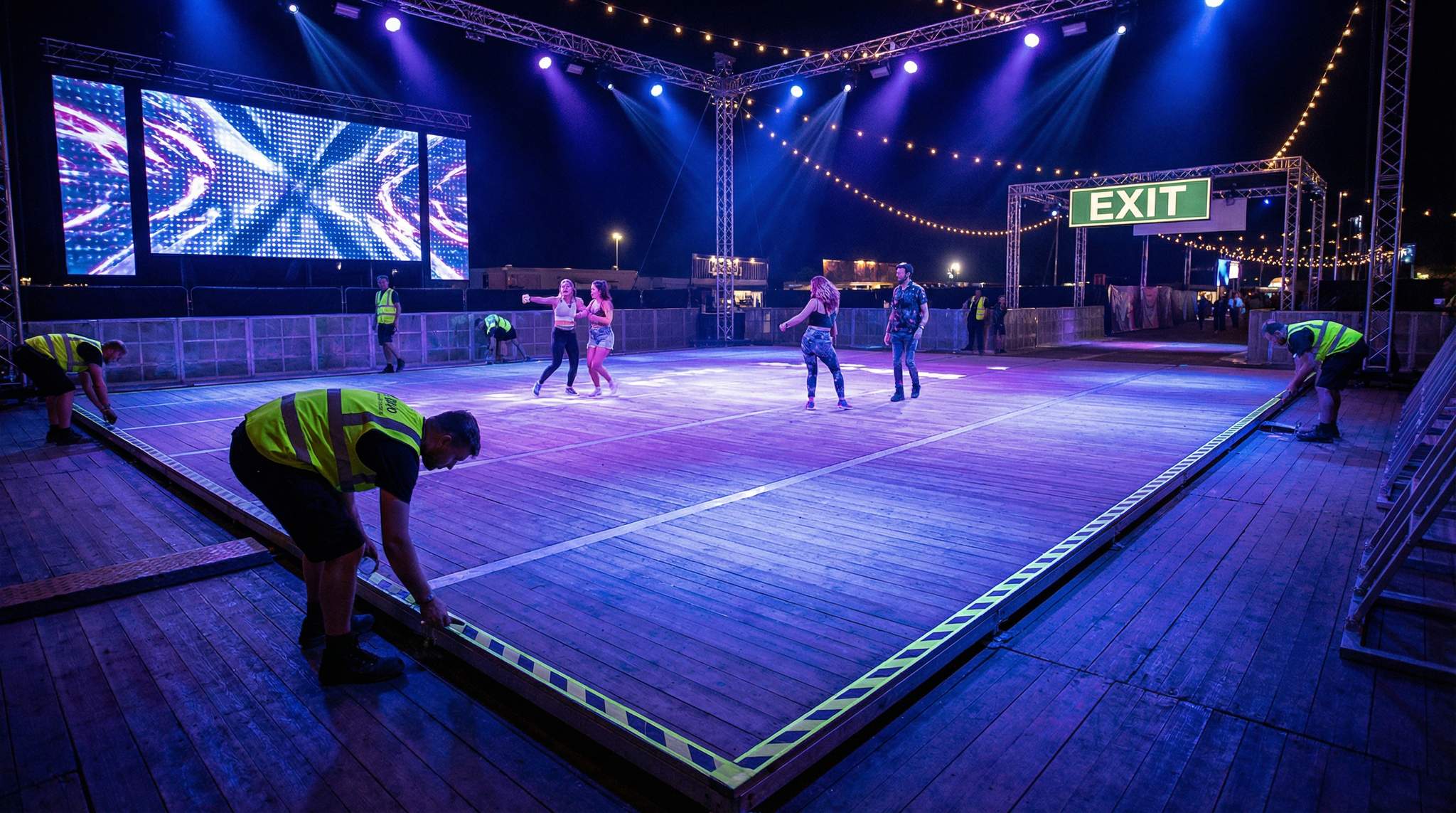
Nothing spoils a dance vibe like someone tripping on a loose plank or a raised edge. Treat seams and edges of the dance floor with care. If your floor is made of interlocking panels or sections, ensure they fit together tightly with no gaps. Use proper dance floor tape or edge trims to seal seams so that a dancer’s shoe won’t catch. Even a small “lip” – where one panel sits slightly higher than the adjacent one – is a hazard that can cause trips or twisted ankles. During an Australian outdoor folk festival, festival organizers noticed a slight height difference where the portable floor met the ground, forming a small ledge. Anticipating the risk, they installed small transition ramps and bright gaffer tape to smooth out the edge, preventing countless stumbles when crowds moved in and out of the tent.
Even minor structural inconsistencies can become highly dangerous on the dance floor once the venue reaches capacity. A loose cable, a separated seam, or a warped panel edge might go unnoticed during a daytime site walk, but under low lighting and heavy foot traffic, these flaws are prime culprits for twisted ankles and crowd falls.
Need Festival Funding?
Get the capital you need to book headliners, secure venues, and scale your festival production.
Regularly inspect the floor for shifting or separation. Hours of dancing can make sections creep apart if not properly secured. Train crew members to look for any widening seams or protruding edges and fix them immediately (with additional tape or by re-locking panels) during breaks. Also, pay attention to cables or equipment crossing near the dance area – any wires running across floors should be covered with cable ramps or rerouted, so they don’t create a bump underfoot. A truly seamless floor is one where festival-goers only notice the music and their moves, not what’s happening beneath their feet.
Clear Exits and Open Pathways
A packed dance floor can be an amazing sight, but safety requires that exits remain visible and paths stay clear. In the frenzy of a concert or DJ set, attendees need to know how to get out easily – whether for a quick breather or in an emergency. Festival producers should mark exit routes around the dance area with signs or banners (using universally understood symbols and multiple languages if your crowd is international). In a dim nightclub-like atmosphere, consider LED-lit exit signs or glow-in-the-dark tape on the floor edges to outline the way. This kind of guidance was effectively used at a large indoor dance festival in Germany, where glowing floor markers showed routes to the tent doors, helping prevent bottlenecks when thousands exited after a headline set.
Keeping paths clear also means preventing any blockages in and out of the dance zone. No storage of gear, cables, or speaker cases in emergency exit lanes. If your festival involves seated areas or VIP sections near the dance floor, don’t let chairs or barricades encroach on exit pathways. Train security and volunteers to gently enforce a no-blocking rule – for example, if enthusiastic dancers leave backpacks or drinks on the ground, have staff move them aside to a safe spot. Real-world case: at a folk festival in England, some attendees pushed benches closer to the stage for a better view, inadvertently narrowing the main exit aisle. Stewards promptly repositioned the benches to restore a wide clear path. This kind of vigilance ensures that if the music stops unexpectedly and people need to leave fast, they can do so without obstacles. Remember, crowd safety on the dance floor isn’t only about the floor itself but also the flow around it.
Between Sets: Sweep, Mop, and Check
High-traffic dance floors take a beating, not just from weight but from spills and wear. Build into your schedule short breaks where the floor can be cleaned and inspected between sets. Something as simple as a wet patch from a spilled drink or confetti from a celebration can turn into a slip hazard. At an EDM festival in California, the production team sent out a “floor team” as soon as each DJ finished – armed with brooms, mops, and flashlights. In five minutes, they cleared plastic cups and trash, wiped up any spills, and tightened a few floor panels. This quick housekeeping prevented accidents and kept the next act’s crowd dancing freely.
For outdoor festivals, nature might contribute to mess on the floor – dust, mud, or leaves. If the event is multi-day, overnight you might get dew or rainwater on an open-air dance surface, which should be squeegeed off before the morning kickoff. Always dry a damp floor; a single puddle can be as dangerous as a slick of oil when hundreds are dancing on it. Also, take the chance to examine the structure: look underneath for any support that shifted, and above for any screws or nails that might be working loose on wooden floors. These in-between set checkups are also a perfect time to reapply any anti-slip treatment if needed. Think of it like a pit-stop in racing – fast, efficient maintenance to keep things safe and the “engine” (in this case, the crowd’s enthusiasm) running at full speed.
Budget for Maintenance, Not Just Décor
One common rookie mistake is treating the dance floor as an afterthought or merely a décor element of the festival. In truth, your dance floor demands budget and maintenance akin to a stage. Allocate funds for quality flooring materials or rental systems that meet safety specs – this isn’t the place to cut corners with flimsy plywood or cheap tiles. A festival in Canada learned this when their low-cost dance floor tiles began cracking on day one, forcing an emergency repair that cost more than a proper system rental would have. Investing upfront in a reliable floor system (with proper subfloor, supports, and surface finish) is like an insurance policy against accidents and interruptions.
Maintenance costs should also be expected. Just as a stage might require repainting, bolt tightening, or replacement of damaged boards, a dance floor will need upkeep. Treat it as an asset that lasts for years: if you own modular flooring, clean it thoroughly after each event, store it properly (dry and protected from warping), and inspect for wear so you can replace sections before they fail. If you rent, consider hiring the flooring vendor’s technical staff to be on-site or on-call for any issues – their expertise can be worth its weight in gold when you need a panel swapped quickly. And don’t forget to budget for safety supplies: gaffer tape for seams, slip-mat or rosin for traction, and perhaps spare panels or supports. By budgeting for maintenance, you signal to your crew and sponsors that the dance floor is as integral to the festival experience as the main stage or the sound system. After all, it’s where the audience often spends the most time celebrating.
Additionally, if your festival tours or operates across multiple sites, investing in a portable sprung dance floor offers immense logistical advantages. These modular units pack down efficiently into flight cases or pallets, reducing transport costs while ensuring you can deploy professional sprung dance floors anywhere, from a grassy field to an asphalt parking lot.
Frequently Asked Questions
Why are sprung dance floors important for festivals?
Sprung dance floors serve as critical safety infrastructure by providing shock absorption that reduces stress on dancers’ joints and minimizes injuries. These decks offer necessary give during high-energy performances, preventing twisted ankles and enhancing comfort for attendees at events ranging from folk festivals to hip-hop battles.
What is the standard load-bearing capacity for festival dance floors?
Structural standards for public assembly typically require dance floors to support live loads of approximately 4 to 5 kN/m², or roughly 400–500 kg per square meter. Meeting these specifications is vital because rhythmic dancing amplifies forces, and insufficient load capacity can lead to dangerous bouncing or structural collapse.
How can festival organizers prevent slippery dance floors?
Organizers must select surface materials with adequate grip and test traction before the event begins. To combat slickness caused by humidity, rain, or condensation, production teams should apply anti-slip compounds like rosin powder or use textured, non-slip coatings designed for all-weather use to ensure dancer safety.
How do you prevent trip hazards on temporary dance floors?
Eliminating trip hazards requires ensuring all interlocking panels fit tightly without gaps and sealing seams with specialized dance floor tape. Installers should address any height differences between panels and use transition ramps with high-visibility gaffer tape at the edges to smooth out the drop where the floor meets the ground.
What maintenance does a festival dance floor require during an event?
Crews should sweep, mop, and inspect the floor during breaks between sets to remove debris and dry up spills immediately. This routine maintenance prevents slip hazards from drinks or condensation and provides an opportunity to identify and fix loose panels, shifting supports, or widening seams before the next act begins.
How should emergency exits be managed around dance areas?
Exit routes must remain visible and unobstructed by gear, cables, or furniture at all times. Organizers should use LED-lit signs, glow-in-the-dark tape, or multi-language banners to clearly mark pathways. Security staff must actively monitor these lanes to ensure backpacks or standing crowds do not block safe egress.
How do festival producers build a portable sprung dance floor?
Rather than building from scratch, organizers typically assemble professional sprung dance floors using modular, interlocking panels. These portable systems feature built-in elastomer blocks or foam pads that provide consistent shock absorption. The installation process involves laying a flat, stable sub-floor, locking the sprung panels into place, and securing the perimeter with heavy-duty edge trims or transition ramps to eliminate trip hazards.
What should organizers consider when learning how to make a dance floor for VIP areas?
When researching how to make a dance floor for custom VIP activations, organizers must prioritize safety and structural integrity over aesthetics. A reliable setup requires a leveled sub-floor, a shock-absorbing middle layer, and a high-traction surface. To meet these requirements efficiently, most producers utilize a portable sprung dance floor, which provides the safety of professional sprung dance floors while allowing for rapid deployment and easy storage.
Is a DIY outdoor dance floor safe for festivals?
Building a DIY outdoor dance floor from raw lumber is generally not recommended for commercial festivals due to the high risk of structural failure, warping, and inadequate shock absorption. However, organizers of smaller boutique events can safely create their own setup by utilizing a sprung dance floor portable kit. These modular, interlocking systems can be assembled by a small crew over a properly leveled sub-floor, ensuring professional-grade safety and weather resistance without the need for complex carpentry.
What are the key steps in a professional sprung floor installation for festivals?
A successful sprung floor installation begins with rigorous site leveling and the placement of a moisture barrier to protect the system from ground dampness. Production crews then lay a rigid sub-base before assembling the interlocking modular panels, ensuring the shock-absorbing elastomer blocks are evenly distributed. Finally, the perimeter is secured with heavy-duty edge trims to lock the structure in place and eliminate trip hazards.
How do you install an outdoor dance floor on uneven ground?
To safely install an outdoor dance floor on uneven ground, festival producers must use an adjustable sub-floor system, such as scaffolding or staging decks with screw-jack leveling legs. Laying flooring panels directly over dips or slopes can cause the interlocking mechanisms to fail and create severe trip hazards. By building a leveled, elevated base first, organizers ensure the sprung surface performs correctly and remains stable under heavy crowd loads.