Organising a family-friendly festival requires going the extra mile beyond booking great acts. It means shaping ticketing and pricing strategies that welcome parents, kids, and community members without breaking the bank. Affordable access isn’t just a nice gesture—it’s a savvy investment in growing a loyal, multi-generational audience. This guide draws on decades of festival production wisdom and real-world examples from around the globe, illustrating how family passes, bundles, and equity pricing can turn a festival from a solo adventure into a family tradition.
Encourage Families with Bundled Passes and Child Discounts
One of the most direct ways to attract families is by offering family ticket packages and multi-child discounts. Many successful festivals have found that a simple ticket ladder – from individual tickets up to family bundles – lowers the barrier for parents bringing their children along. For instance, Lightning in a Bottle in California welcomes all ages and offers tiered youth pricing: children 5 and under enter free, kids 6–12 pay just $100, and teens 13–17 pay $200 for a full five-day pass according to official 2024 pricing information. This dramatically reduced pricing (adult passes cost significantly more) shows real commitment to inclusion. The organisers of Lightning in a Bottle, run by The Do LaB, have effectively created a roadmap for families: as parents’ favourite festival, it evolves into a shared family experience as their kids grow.
Other major festivals also use “kids go free” policies to entice families. Glastonbury Festival in the UK allows children aged 12 and under in for free with a ticketed adult as detailed in their ticket registration policy, and events like Lollapalooza (USA) and Austin City Limits (USA) let up to two children (typically under 10) attend free per paying adult based on standard festival child ticket policies. At WOMAD UK, celebrating world music, kids 13 and under attend free as well per the festival’s children’s entry guidelines. These policies aren’t acts of charity; they’re strategic. By removing or reducing the ticket cost for children, festivals make it far more appealing for music-loving parents to bring the whole family. A couple with two kids might hesitate at four full-priced tickets, but when the kids’ entry is free or discounted, attending becomes an easier decision.
Family bundles are another great approach. Instead of making parents purchase individual tickets for each family member (and possibly second-guess attending), a bundled pass for a set family size simplifies the process. For example, Camp Bestival in the UK – a festival explicitly geared towards families – has offered “family tickets” covering two adults and up to four children at a flat rate. This kind of bundle provides clarity and savings, especially for larger families. Multi-child discounts can also be structured such that the more kids you bring, the less you pay per child. If one child’s ticket is, say, $50, a second child might be $40, and a third is free – designing pricing this way signals that big families are welcome.
Let Fans Pay Over Time
Offer flexible payment plans that split ticket costs into manageable installments, making higher-priced events accessible and boosting conversions.
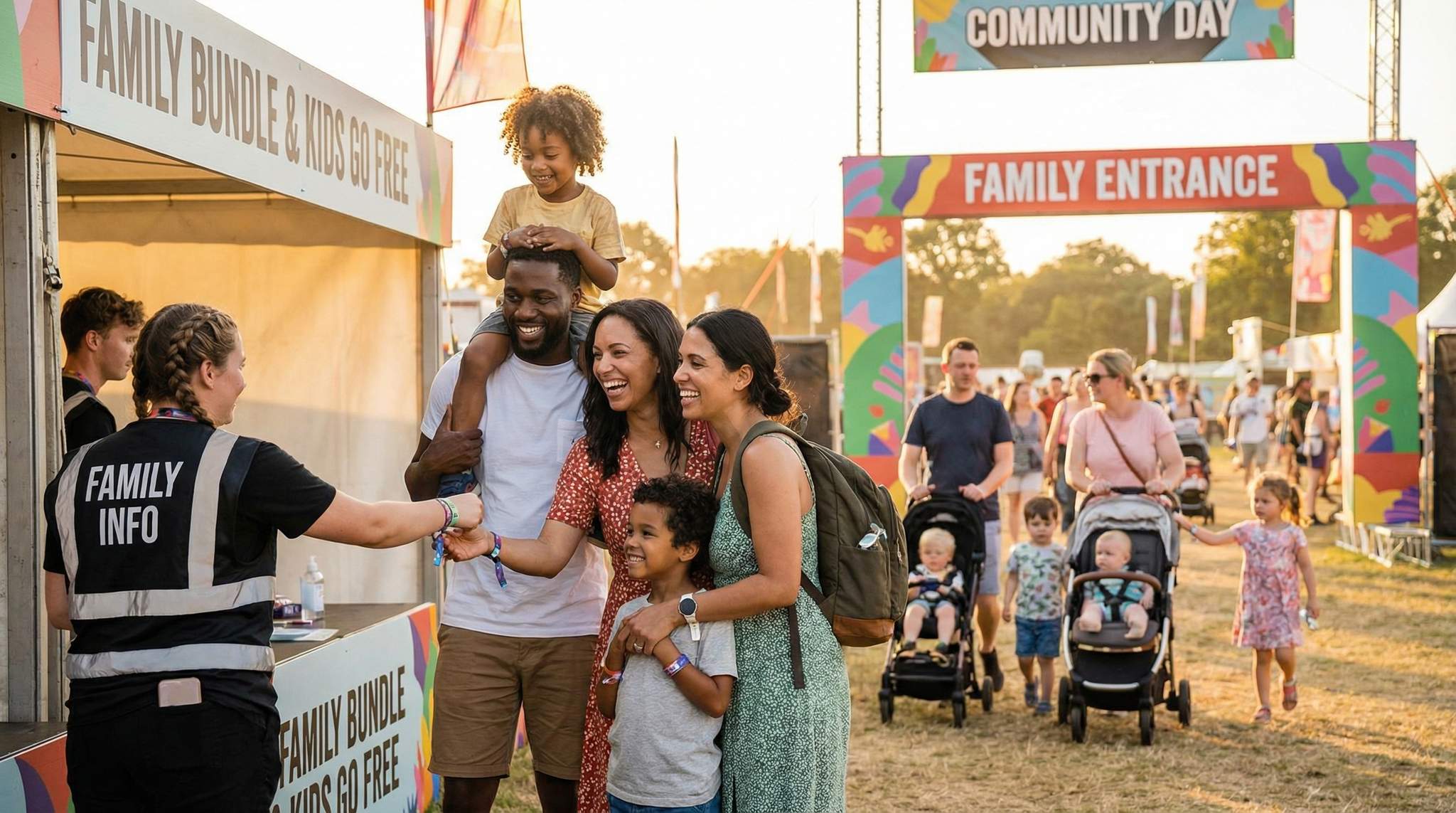
Importantly, if you offer free entry for young children, be sure to communicate any limits or requirements clearly. Some events cap the number of free kids per adult (for instance, Shaky Knees Music Festival allows two kids under 8 free per adult) to help manage crowd size and capacity. Others require children to be registered or to wear special wristbands for safety. As a festival organiser, think through the logistics: provide child ID wristbands (where parents can write their phone number) at the gate, have a dedicated family entrance (shorter queues help impatient little ones), and consider family camping areas or viewing sections. These operational touches, alongside ticket deals, make attending with kids smoother.
Community Tickets and Equity Pricing: Festivals for Everyone
A truly inclusive festival extends affordability not just to traditional families, but to the wider community – including local residents and fans from different economic backgrounds. Community tickets and equity pricing strategies can build goodwill and broaden your audience.
Planning a Festival?
Ticket Fairy's festival ticketing platform handles multi-day passes, RFID wristbands, and complex festival operations.
One approach is offering discounted or special tickets to local residents or community groups. This can repay the support of the host community and encourage those who live nearby (and might otherwise avoid the crowds) to join the fun. A shining example is Electric Picnic in Ireland: the promoters (Festival Republic, led by Melvin Benn) set aside a quota of heavily discounted tickets for people living in the festival’s town, Stradbally. In 2025 they expanded the scheme to 2,000 local tickets (two per household), with those closest to the site paying only €30 each according to local news reports on the scheme – a token fraction of the full price. This kind of community pricing not only thanks residents for their tolerance of festival traffic and noise, it actively brings them into the festival family. When locals can afford to attend, a festival transforms from an imposed event into a source of local pride.
Beyond local residents, consider groups that merit support or face barriers to entry. Some festivals partner with organisations to reach these audiences – for example, Boundary Brighton festival in the UK ran a cost-of-living initiative with “pay what you can afford” tickets as low as £10 for young adults hit by economic hardship reported by the BBC regarding the initiative. They also teamed up with the Tickets for Good charity to provide free or heavily discounted tickets to NHS health workers as a thank-you to support those navigating the cost of living crisis. These efforts earned great public goodwill and media coverage, positioning the festival as a community ally.
Another powerful model is equity pricing based on economic context. Festivals with international or diverse audiences have pioneered tiered pricing to level the playing field. A case in point is Portugal’s Boom Festival, which consciously adjusts ticket prices for fans from different countries. Boom’s co-director Artur Mendes explains that with attendees from 169 nations, they felt compelled to take different economic realities into consideration as noted in a case study on inclusion. Since the early 2000s, Boom has reserved roughly 10% of tickets at a “friendly price” for people from financially weaker countries, while 90% are sold at the standard price. In 2023, a regular ticket for Boom cost €275, whereas the friendly-tier ticket was €200 demonstrating their commitment to economic equity – a significant discount aimed at inclusivity. Boom even offers 500 free tickets each edition to residents of a selected “guest country,” chosen as part of a cultural exchange. Mendes calls it a political statement as much as a business strategy. He notes that “what enables us to offer reduced and free tickets is a thorough business model that allows this revenue to be balanced with other incomes like tickets, bar sales, renting of food vendor stalls” regarding their diversified revenue model. In other words, Boom subsidises the discounted tickets by optimising other revenue streams – a creative budgeting approach that keeps the festival inclusive and financially sound.
For smaller festivals or those serving specific communities, equity pricing might mean offering concession rates (for students, seniors, or low-income attendees) or a certain number of volunteer or community-service tickets. You could allocate a block of tickets each year to local youth organisations, or run a scheme where fans can apply for a reduced-price ticket if they’re in financial difficulty. The key is to integrate these offers in a way that feels natural and fair, rather than an afterthought. Not only do these programs spread goodwill, they can also fill your venue: an affordable family or community ticket sold is often four happy people attending (instead of zero if they’d been priced out), buying food, buying merch, and contributing to the atmosphere.
No Hidden Fees, Just Honest Pricing
One all-inclusive fee covers the platform, payment processing, support, and every feature. Free events are always free. No setup costs, no surprises.
Crucially, when implementing community and equity tickets, be transparent about it. Announce these initiatives proudly – it shows that your festival values its community and stands for something beyond profit. The goodwill you earn can translate into eager media coverage and long-term loyalty. Festivals like Roskilde (Denmark) and Shambala (UK) are known not just for music but for their ethos of social responsibility; incorporating equity pricing is one way to build that kind of reputation.
Transparency Builds Trust: Fair Fees and Clear Communication
Few things sour a family’s festival excitement more than surprise fees during checkout. Transparent pricing is essential to keep ticket buyers’ trust, especially when you’re positioning your event as accessible. Fans today are wary of so-called “junk fees” – those extra service charges or mysterious add-ons that inflate the final cost which has led to frustration among ticket buyers. In some countries, regulators are even cracking down on hidden ticket fees. The takeaway for festival organisers is simple: keep fees clear, fair, and up front.
Need Festival Funding?
Get the capital you need to book headliners, secure venues, and scale your festival production.
In practice, this means listing all fees (booking fees, facility fees, taxes, etc.) prominently before the customer clicks “Purchase”. Better yet, consider all-in pricing – incorporate mandatory fees into the advertised ticket price so there are no last-minute surprises. Many modern ticketing platforms (like Ticket Fairy) support displaying an upfront price inclusive of fees. For example, if your family pack costs $200, don’t advertise it as $180 + $20 in “fees” on page five of the checkout. Just call it $200 from the start. This honesty not only prevents cart abandonment (when buyers quit in frustration at the final screen), but it builds credibility. Parents budgeting for a family outing appreciate knowing the full cost early on.
Beyond transparency, keep fees reasonable. Many fans have horror stories of exorbitant service charges – avoid becoming one of those events. Determine your booking fee based on actual processing costs and a modest margin, not whatever you think the market will bear. Some festivals even absorb a portion of fees themselves as a goodwill gesture. If you must charge a per-ticket fee, consider capping it for family purchases (e.g. “service fee is $5 per ticket, capped at $15 per order” so a family of six isn’t penalised excessively). And never tack on odd add-ons that look like gouging – a “children’s ticket handling fee” or “print-at-home fee” will only invite backlash. Fair, simple pricing breeds happier customers.
Also, communicate early about any discounts or special rates. If you offer multi-child discounts or local tickets, make those options easy to find on your website and ticketing page. Confusing pricing structures can turn people off. The goal is a simple ladder of options that people immediately understand: e.g. Adult, Teen, Child, Family 4-Pack, Local Resident Ticket. Each should have a clear description. Providing an FAQ explaining eligibility (like age cut-offs for child tickets, or which postcodes qualify for local rates) can prevent frustration at the gate.
One more word on pricing fairness: avoid overly aggressive dynamic pricing schemes for festivals. Unlike concerts where some platforms raise prices based on demand, festivals that have tried surge pricing often face fan backlash. Your core audience – especially families – plan and save for your event; if they see prices jump unpredictably, you risk alienating them. It’s wiser to use early-bird tiers with set quantities and deadlines (reward those who commit early) rather than hidden algorithms that make customers feel exploited. In short, be upfront and consistent. Remember, you want parents to trust that they can count on bringing their kids to your festival each year without nasty surprises.
Flexible Payment Plans – Without the Pitfalls
As festival tickets get more expensive, payment plans have become a popular way to make attendance affordable. Allowing attendees to pay for passes in installments can be a game-changer for families on a budget – but only if the plans are fair and free of sneaky traps.
A good payment plan is straightforward: break the ticket cost into a deposit and a series of smaller payments over several months. Offer plans early (when tickets first go on sale) so fans have more time to pay down the balance. Crucially, do not charge interest on these installment plans – they are not loans. At most, a very small flat administrative fee can be added for the service (and many festivals waive even that, considering it part of customer service). For example, Coachella offers an advance sale plan where fans put about $49 down and pay the rest over 6–7 months, with a one-time flat fee (around $50) and no added interest as outlined in their advance sale terms. Ticket Fairy’s platform similarly supports interest-free payment plans, reflecting the principle that installment options should help fans, not profit off them.
It’s equally important to make the terms humane. Some installment plans in the past have been overly punitive. In a notorious case, a teenager in the UK paid nearly £100 across multiple deposits for a Truck Festival ticket, but when his final payment failed, the fine print declared he’d lose all the money paid and his ticket highlighting the risks of strict payment plan terms. No mercy, no refund – nothing. That kind of harsh policy not only enrages the customer; it can erupt into bad press (indeed, the story made BBC Radio’s consumer advice programme). To avoid such scenarios, build in grace periods and reminders. If a payment is declined, send prompt emails and even a courtesy phone call before cancelling anything. Consider giving a short window (48–72 hours) for the buyer to resolve a payment issue.
Plan ahead for how you handle defaults. The most customer-friendly approach is a refund minus a reasonable penalty or converting what’s been paid into a credit for future events. For instance, some festivals will refund all installments minus the initial deposit if you miss the final payment – the deposit covers their admin costs and potential resale risk, but the fan doesn’t forfeit everything. Others, like Coachella, convert defaulted payment plan tickets into a credit for next year providing a safety net for defaulted plans – more sympathetic than losing all money paid. Choose a policy that protects your festival’s finances but doesn’t punish genuine mistakes or hardships unnecessarily. Remember, a family might miss a payment due to an expired card or an unexpected expense; working with them builds loyalty, whereas a “lose it all” policy guarantees they’ll never try again (and will tell others about the bad experience).
When advertising your payment plans, keep the schedule and conditions crystal clear. List all installment dates and amounts on the purchase page. Make sure buyers explicitly agree to the schedule. Transparency here is as important as with fees – people should understand what they’re signing up for, including what happens if they need to cancel or if a payment fails. The goal is to let families budget for the festival in a manageable way, not to lure them into a financial catch.
On a practical note, if you do offer installment plans, prepare your finance team and ticketing platform for the ongoing management it entails. Track the uptake: what percentage of buyers opt for the plan? Do families use it more than single attendees? Use that data to adjust the offering in future years (for example, if very few use the 3-month plan but many use a 6-month plan, you know which timeline to favour).
Monitor, Iterate, and Evolve Your Offerings
Creating affordable pathways is not a one-and-done task – the best festival organisers track uptake and adjust annually. Build data collection into your ticketing: note how many family packs sold, how many children under 12 attended, how many local community tickets were redeemed. Survey your attendees (particularly families) about what they valued and what could be improved. This data-driven approach will reveal what works and what doesn’t.
For instance, you might discover that your “family 4-pack” sold out quickly, indicating huge demand – perhaps next year you introduce a “family 6-pack” or increase availability. Or maybe very few local discount tickets were used; that could signal you need to broaden eligibility or that the word didn’t reach the community in the right way (an opportunity to tweak your marketing, or to partner with local councils and schools for promotion). Maybe your installment plan had a high default rate – suggesting you should extend the schedule across more months or send more frequent reminders before deadlines.
Don’t be afraid to experiment in small ways and learn. The beauty of many of these strategies (family bundles, discount tiers, community outreach) is that you can trial them without massive risk. Try a modest batch of community tickets one year and gauge the response. If the program is a hit, expand it next time. If it falls flat, gather feedback and refine the idea. As any veteran producer knows, each festival edition teaches a lesson for the next. Make affordability and access part of that continuous improvement cycle.
Also, stay tuned to wider trends and economic conditions. If inflation is hitting your fanbase hard in a given year, doubling down on affordability measures will be appreciated (maybe that’s the year to freeze ticket prices or increase the child age cutoff so more kids go free). In tough times, festivals that show empathy to fans’ finances often build unshakable loyalty. In contrast, events that appear greedy during a recession (raising prices steeply or adding fees) can suffer reputational damage.
Finally, consider the long-term payoff of turning individual fans into family attendees. A teenager who first fell in love with your festival may return years later with their own children if you’ve cultivated a family-friendly environment. Many iconic events (from Glastonbury to regional folk festivals) now see multi-generational attendance – parents who once came in their youth now bring their kids, even grandparents tagging along. This is the life-cycle of a sustainable festival brand. By making pricing equitable and welcoming, you encourage that evolution. Instead of losing fans as they “age out” or can’t justify the cost once they have kids, you retain them as part of a bigger group.
Deliver a Festival Experience Families Will Love
Price incentives will get families through the gate, but to truly reap the benefits you must ensure they have a great time. Logistics and programming need to align with your family-friendly ticketing. Choose venues with adequate space and facilities: families appreciate things like clean restrooms with baby changing stations, water refill points, shade and seating areas, and safe spaces for kids to play. Festivals like Splendour in the Grass (Australia) and Latitude (UK) provide family camping zones and “kids’ corner” activity areas so that parents and children alike can enjoy themselves. If young ones get bored or tired, having a carnival ride, craft workshop, or kid-friendly performance on hand can be a lifesaver.
In terms of production, consider scheduling some daytime slots or acts that appeal to all ages (many festivals book popular children’s entertainers or themed shows in the afternoon). Keep the most boisterous or adult-themed performances for later at night in separate areas, and clearly communicate any age restrictions for certain stages or times. On the logistics side, coordinate with your security and medical teams on protocols for minors: have a well-marked lost children point, and brief staff on how to handle situations with underage attendees (e.g. if a child is found wandering, how to quickly reunite them with parents). Some festivals implement a tagging system – when families enter, kids receive a wristband or lanyard with the parents’ contact info. Simple measures like this go a long way in managing risk and keeping everyone safe.
From a marketing perspective, don’t hide all these wonderful family features – promote them! Use your social media to showcase smiling families at past events, kids with face paint dancing in front of the stage, and multi-generational groups camping together. Share testimonials from parents about how your festival became their favourite family outing. This not only attracts more families (people need to see that others successfully brought kids and had fun), but also softens your festival’s image overall, making it more appealing to sponsors and local authorities.
On social media and outreach, tailor some campaigns to the channels parents use. For example, engage with parenting blogs or community Facebook groups in your region. If you have a family ticket bundle or community discount, that’s a newsworthy item for a local newspaper or family magazine (“Festival offers special family deal – save 20% on tickets with the kids!”). Getting the word out in the right places ensures your equitable pricing strategy actually reaches your target audience.
In the end, aligning your operations and marketing with your family-friendly pricing completes the picture: affordable tickets get families in, and a thoughtful festival setup keeps them coming back year after year.
Frequently Asked Questions
How do family ticket bundles work for music festivals?
Family bundles simplify purchasing by offering a flat rate for a set group size, such as two adults and up to four children. This approach, used by festivals like Camp Bestival, provides clarity and savings compared to buying individual tickets. Multi-child discounts can also lower costs per additional child, signaling that large families are welcome.
What are common kids go free policies at festivals?
Many major festivals allow children under a specific age to attend for free with a ticketed adult. For example, Glastonbury admits children 12 and under at no cost, while Lollapalooza allows up to two children under 10 per adult. These policies reduce financial barriers, making it easier for parents to bring the whole family.
How does equity pricing work for festival tickets?
Equity pricing adjusts ticket costs based on economic context or location to increase inclusivity. Boom Festival reserves tickets at a friendly price for attendees from financially weaker countries, while Electric Picnic offers heavily discounted tickets to local residents. This strategy helps broaden the audience and builds goodwill within the host community.
Why is transparent pricing important for family-friendly festivals?
Transparent pricing builds trust by eliminating surprise junk fees during checkout, which can cause cart abandonment. Listing all booking fees, taxes, and facility charges upfront—or using all-in pricing—allows families to budget accurately. Honest pricing prevents frustration and ensures parents know the full cost before committing to the purchase.
How should festival payment plans be structured for families?
Fair payment plans break ticket costs into a deposit and interest-free monthly installments. Festivals like Coachella use a small flat fee rather than charging interest. Plans should include grace periods for missed payments and offer refunds or credits rather than total forfeiture, ensuring families are not penalized for financial hiccups.
Is dynamic pricing a good strategy for family festivals?
Aggressive dynamic pricing often alienates families who need to plan and save for events. Unlike concerts, festivals benefit more from stable pricing tiers or early-bird discounts with set deadlines. Unpredictable price jumps can cause backlash among core audiences, making consistent pricing a better strategy for building long-term trust with parents.