Introduction
Large festivals can create unforgettable experiences, but they also carry significant safety challenges. A swelling crowd’s energy can be part of the magic, yet if mismanaged it can turn dangerous in minutes. History has shown that the difference between a successful event and a tragic incident often comes down to crowd management and meticulous planning. Veteran festival organizers emphasize that keeping attendees safe is not only a moral duty but also vital to a festival’s success and reputation.
Effective crowd management starts well before gates open. It involves analyzing how people will move and behave in the space, and anticipating potential problems. This proactive approach goes beyond basic crowd control (reacting to issues on the fly) – it is about crowd management, an ongoing strategy that considers crowd psychology and movement from the planning phase through the live event. By designing safety into the event – through layout, staffing, and procedures – organizers can keep the atmosphere enjoyable while mitigating risks.
Designing a Safe Venue Layout
One of the first pillars of crowd safety is a well-thought-out venue layout. The site design should facilitate smooth movement and prevent overcrowding or bottlenecks. When mapping out the festival grounds, organizers should consider:
- Wide, Unobstructed Pathways: Ensure all main walkways are broad enough for the expected crowd and free of obstructions. Avoid creating dead-ends or narrow choke points where attendees could get trapped or pressed. For example, if a pathway narrows under a bridge or arch, that area could become a dangerous pinch point if not managed.
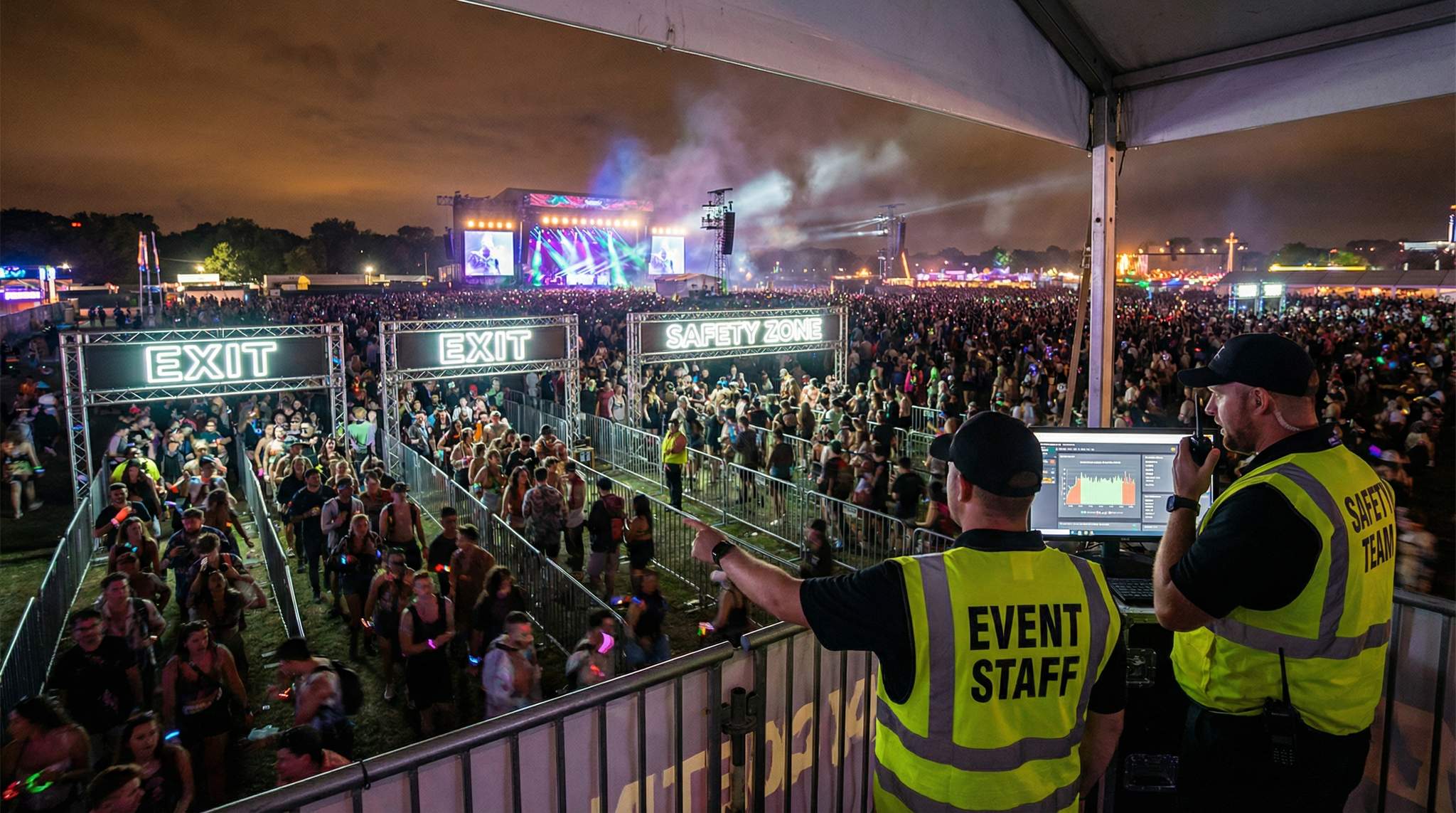
- Multiple Entry and Exit Points: Plan for more than one entrance and exit, spaced out around the venue. This helps disperse crowds and prevents everyone from converging on a single gate. Each entry/exit should be clearly marked and capable of handling large flow rates to avoid long queues or exit jams.
- Strategic Placement of Facilities: Distribute stages, food vendors, restrooms, and other attractions so that people naturally spread out rather than all cramming into one area. If one stage or activity will draw a majority of attendees, position other amenities (like popular food courts or merchandise booths) in other sections to encourage movement across the site.
- Designated Zones: In larger festivals, consider dividing the site into zones or sections. Each zone can have its own capacity limit and dedicated facilities. Zoning prevents the entire crowd from moving as one massive unit and makes it easier to manage segment by segment. For instance, a massive field can be sectioned into quadrants with barriers, preventing a single enormous crowd and instead creating safer, smaller groupings.
Good layout design also involves imagining how the crowd will flow throughout the day. Think about peak movement times – like when a headline act finishes and thousands move to the next stage or towards exits. Plan secondary routes and ample space at transition points to handle these surges. Many seasoned producers create one-way routes or loops for foot traffic in tight areas (for example, having a clockwise flow around a stage compound) to keep people from colliding or pushing against each other. Ultimately, a well-designed venue layout guides attendees naturally, reducing points of friction and potential danger.
Go Cashless With RFID Technology
Enable contactless payments, faster entry, and real-time spending analytics with RFID wristbands and NFC-enabled ticketing for your events.
When evaluating site plans, experienced producers often propose dispersing guests around the grounds by scheduling simultaneous high-draw activations. If a main stage is reaching capacity, counter-programming at secondary areas pulls the audience outward, naturally balancing the site’s density and improving overall show and event crowd safety.
For hybrid venues utilizing stadium or arena infrastructure, safety experts also propose dispersing guests around the grandstands and outer concourses by opening additional concession and merchandise areas. This tactic prevents severe bottlenecks near the main field entrances and ensures a much more even distribution of foot traffic throughout the footprint.
Planning a Festival?
Ticket Fairy's festival ticketing platform handles multi-day passes, RFID wristbands, and complex festival operations.
When mapping out these hybrid spaces, effective festival crowd control isn’t just about placing security guards; it’s about architectural psychology. By strategically positioning high-value amenities away from main thoroughfares, organizers naturally reduce density and enhance overall attendee safety without needing physical intervention.
Entry and Exit Flow Management
How attendees enter and leave a festival is a critical aspect of crowd safety. Poor entry or exit management can lead to dangerous crushes at gates and turnstiles. To keep these key moments safe, experienced organizers implement strategies such as:
- Staggered Entrances: Encourage attendees to arrive over a broader time window rather than all at once. This can be achieved by opening gates early, scheduling opening acts to draw an earlier crowd, or even assigning entry times on tickets for very large events. Staggered entry prevents huge sudden influxes that strain security checkpoints.
- Queuing Systems: Use barriers to create organized queue lines at entrances. Well-defined lines with clearly marked directions prevent massing at gate entrances. Staff should guide the lines and communicate expected wait times. Attendees generally remain calmer when they understand where to go and how long it might take.
- Efficient Security Screening: Bottlenecks often occur at bag check or ticket scanning. Ensure you have enough trained staff and equipment to process people quickly without sacrificing thoroughness. Multiple screening lanes and screening points spread out at each entrance can speed up flow. If people are stuck waiting too long at security checkpoints, frustration grows and pushing can start – so invest in a smooth process.
- Controlled Gate Release: For high-demand events where crowds gather outside before opening, implement a controlled entry release. Instead of letting the first rows sprint in (which can cause a dangerous wave), use a metered approach – for example, briefly pause people at internal holding points or use multiple entry waves – so the crowd enters in a measured way. Police or security can help meter this initial flow.
- Clear Exit Routes: Long before the event ends, plan how the crowd will exit safely and swiftly. Open plenty of egress points around the perimeter and light them well. Signage and staff should direct people to all available exits (many will instinctively try to leave the way they came in, even if other exits are closer). If public transportation or shuttles are involved in exit, coordinate with transit authorities to prevent bottlenecks outside the venue (for example, have crowd managers at transit queues as well).
It’s essential to prevent exit waves from becoming crushing stampedes. One tactic is a soft close: playing calmer music or making announcements after the final act ends, signaling people to exit gradually rather than all at once. Staff can gently encourage people to keep moving toward the exits, and if possible, different sections of the venue can be directed to different exit routes. By managing both the ingress and egress with care, festivals avoid chaotic surges at entry gates or congested, unsafe exits at the end.
Using Barriers and Signage Effectively
Physical infrastructure like barriers and signage are indispensable tools for crowd management. They serve as the silent guides that shape crowd behavior:
Data-Driven Event Marketing
Track ticket sales, demographics, marketing ROI, and social reach in real time. Exportable reports give you the insights to make smarter decisions.
- Barriers to Channel Movement: Temporary fencing, barricades, and rope lines help control crowd flow and prevent overcrowding in sensitive areas. Use barriers to create lanes and corridors, keeping foot traffic organized especially in high-density zones. For example, placing barriers in front of a stage can create an open buffer space or “pit” for security and medics, separating the performers from the crowd. Many large festivals also install secondary barrier lines further back in the crowd (often called “wave breakers”) to subdivide a massive audience. These act like breakers in the ocean, absorbing and slowing any surges that might happen in front sections, a technique often cited in discussions regarding safety standards and requirements.
- Preventing Pressure Build-Up: Barriers are also used to section off sound booths, lighting towers, and other structures so that people don’t accidentally block emergency access or create dangerous pressure points against these fixed objects. However, every barrier plan should include emergency access gates or break-away points – you never want to fence people in without an escape route. Plan barrier layouts carefully so that people can always evacuate or disperse if needed.
- Clear Signage and Wayfinding: Good signage goes hand-in-hand with barriers. When attendees know where to find exits, facilities, and key locations, they’re less likely to wander into bottlenecks. Post large, visible signs for Exits, First Aid, Water Stations, and other critical spots. Directional arrows and maps at junctions help disperse crowds by guiding them to less crowded areas. In multilingual or international festivals, use universally recognized symbols and multiple languages on signs to cater to all attendees.
- Information and Rules: Display signage that communicates crowd-related rules or information, such as “No re-entry past this point” or reminders like “Keep moving forward slowly.” LED screens or projectors can also be used to broadcast real-time information or safety announcements to the crowd (for example, notifying which exits are less congested). Clear communication through signs and screens reduces confusion during the event.
- Lighting and Visibility: Don’t overlook lighting as part of signage and guidance. Dim or poorly lit areas can cause crowd hesitation and clumping. Ensure pathways and exit routes are well-lit. Consider using color-coded lights or flags to mark different zones or routes (e.g., a certain color guiding to a particular exit).
By using barriers smartly and providing abundant signage, organizers create an environment where attendees move naturally and confidently. These tools guide the crowd’s instincts – people tend to follow the path of least resistance, so make the safe path the easiest and most obvious one.
Training Crowd Managers and Security Personnel
Even the best-laid plans and infrastructure require the right people on the ground. Trained crowd managers and security teams are a festival’s eyes, ears, and first responders within the crowd. Investing in their training and proper deployment is paramount to prevent incidents:
Need Festival Funding?
Get the capital you need to book headliners, secure venues, and scale your festival production.
- Understand Crowd Behavior: All personnel should be educated on basic crowd psychology and the signs of potential trouble. For instance, security staff at stage front should recognize when the density in their area is too high or if attendees are showing distress (like signs of panic or people fainting). Trained crowd managers are taught to monitor for early indicators of dangerous conditions, such as swaying or surging in a tightly packed audience.
- Adequate Staffing Ratios: The number of crowd safety staff should scale with the audience size. Many safety regulations worldwide recommend a specific ratio (for example, one trained crowd manager for every 250 attendees is a guideline in some fire codes). Ensure you have enough stewards, ushers, and security guards not only at entrances and stage fronts but also roaming through the crowd and monitoring from elevated platforms. Large events typically have a control center where security feeds and crowd density are monitored by a team who can quickly dispatch responders to any hot spots.
- Positioning and Roles: Deploy security and volunteers strategically. High-risk areas – like mosh pits, narrow passageways, or fences that could be breached – should have personnel stationed nearby. Assign some staff specifically to crowd flow management and information: these team members direct attendees, answer questions, and gently correct unsafe behaviors (like clustering in an aisle). Meanwhile, other security team members focus on intervention – ready to step in if a fight breaks out, if there’s a medical emergency, or if a crowd crush is starting. By clearly defining roles (directors vs. responders, for example), staff can act swiftly and not miss issues while multitasking.
- Communication and Authority: Equip your team with reliable communication devices (two-way radios with dedicated channels) and make sure they can all communicate with each other and with local emergency services seamlessly. During the Astroworld 2021 incident, multiple crowd management failures were noted – including poor communication between on-site security and emergency responders – which hindered timely action, highlighting the critical need for seamless communication between event stakeholders. Crowd management staff should have a clear chain of command and the authority to make critical calls, including the ability to pause a performance if needed to address safety concerns. Everyone from the stage manager to the security chief to the artists should be on the same page that if crowd safety is at risk, the show stops – no exceptions.
- Professional Training and Drills: Whenever possible, have staff undergo formal crowd management training or certification. Some jurisdictions require this, and it’s simply a best practice. Conduct safety briefings before the festival each day so the team knows the specific plan (like which exits to direct people to, or where first aid stations are). It can be wise to run through emergency drills or role-play scenarios: e.g., “What if the main stage area starts to get too crowded?” or “How do we handle an evacuation for lightning?” Practicing these responses helps the team react calmly and efficiently if an actual crisis occurs.
A well-trained and empowered staff on the ground can spot problems well before they escalate. Their presence also reassures attendees. Festival-goers are more likely to follow instructions from staff who are calm, confident, and visibly attentive. This human element – a team of knowledgeable crowd managers – works hand-in-hand with layout and barriers to maintain a safe environment.
Preventing Overcrowding and Responding to Surges
Overcrowding doesn’t happen all at once – it builds up as more and more people squeeze into a space. The key is to prevent dangerous density in the first place and to respond quickly if a crowd surge is forming. Strategies include:
- Real-Time Crowd Monitoring: Implement systems to continuously monitor crowd density across the venue. This can be as high-tech as an AI-based camera system that alerts when an area is too full, or as simple as assigning staff to be “crowd spotters” at high vantage points. Many festivals have a central command station with CCTV feeds, radio reports from ground staff, and even drone surveillance in modern events, all to keep eyes on crowd conditions. If one section starts getting too crowded, the team can act before it reaches a critical point.
- Regulating Access to Popular Areas: For certain high-demand zones (like a front-of-stage pit or a tent where a superstar DJ is playing), consider an access control system. This could be wristbands that allow entry to a limited area, or one-in-one-out rules when a section is at capacity. Never ignore capacity limits – if an area is designed for 5,000 people, don’t let 10,000 cram in. It’s better to have some disappointed fans at the perimeter than an unsafe crush inside.
- Active Crowd Communication: If you sense a potential surge or observe a bottleneck building, communicate with the crowd immediately. Use the public address system or the performer’s microphone to calmly address the situation (“Everyone, take a step back from the stage and give your neighbors some room”). People will usually respond if they understand it’s for safety. Similarly, if a certain exit is jammed, announce alternative exits (“Please be patient and move slowly. There are additional open exits to your right and left that have more space.”).
- Diversion and Delay Tactics: Crowd surges can sometimes be diffused by removing the trigger. If a surprise event or announcement caused a sudden rush, you might delay that activity or re-route the crowd. For example, if too many people are flooding into one attraction, temporarily pause the program there and encourage attendees to visit food stalls or other areas until the density is down to safe levels. At the end of a night, staggering the exit by having multiple end-points (like a brief encore on a second stage after the main stage ends) can naturally split the crowd’s departure.
- Emergency Intervention: In extreme cases – like a crowd crush forming or people panicking – act decisively. This might mean stopping the music, turning up the lights, and having security systematically pull individuals out of a packed area to relieve pressure. Trained medical teams should move in quickly if people are injured or collapsing. Always have a protocol for stopping the show: event officials, audio/visual crews, and performers should know the signal that triggers a temporary halt. It’s a tough call to interrupt a performance, but swift action can literally save lives if a crowd is at risk.
Real-world incidents have proven the importance of these measures. In the 2021 Astroworld Festival tragedy, multiple factors aligned to create a deadly situation: overcrowding due to uncontrolled entry, lack of zoned barriers, and slow response even as distress became apparent. The concert continued for over half an hour after a mass casualty situation had unfolded. This tragedy underscores the importance of ensuring event safety with top strategies regarding communication and rapid response. The lesson is clear – never wait when crowd conditions are becoming unsafe. It’s far better to pause an event and fix the issue than to hesitate and let a dangerous situation escalate.
On the flip side, many festivals have avoided disaster by heeding warning signs: noticing a section getting too dense and proactively rerouting attendees, or briefly pausing a show to make sure fans who fell down are helped up and given space. Attendees themselves often cooperate once they realize safety is at stake – but they rely on staff and leaders to guide them in those moments.
Adapting to Different Scales and Audiences
Crowd management strategies are not one-size-fits-all. A boutique local food festival for 500 people will require a different approach than a multi-stage music festival for 100,000 – yet the underlying principles remain the same. Here’s how organizers can adapt strategies:
- Small Events: Smaller festivals might not have the luxury of high-tech systems or large security teams, but the fundamentals still apply. Use whatever resources available to clearly mark entrances/exits (even if just with flags or banners), and have volunteers act as guides. At a community fair, for example, one could create simple barriers with cones or tape to organize lines for popular booths. The key is that even a small crowd can become unsafe if overlooked – so designate a person or team responsible for monitoring the crowd and enforcing safety (like preventing a crowd from blocking an exit path or stage front).
- Large-Scale Festivals: Massive events need layers of crowd management. This means multiple crowd management teams (each responsible for a zone), extensive fencing and barricades forming a structured grid of movement, and advanced monitoring (such as a dedicated safety operations center). Big festivals often employ professional crowd science consultants to model crowd flows and identify risks in advance. For instance, at mega-festivals like Glastonbury or Coachella, organizers map out crowd movement patterns for peak times and station hundreds of stewards to direct traffic. More attendees also means more medical tents, information booths, and water stations to take pressure off any single point.
- Different Genres, Different Behaviors: Tailor your tactics to the event’s audience profile. A music festival with younger, high-energy fans might anticipate moshing or dancing crowds – here you ensure extra security at the front, lot of free water distribution (to keep people hydrated and prevent fainting), and possibly relief zones at the sides of the crowd where people can step out. In contrast, a family-oriented festival or a wine tasting event will have calmer movement but needs other considerations (like more seating areas, stroller-friendly routes, and lost child centers). Know your audience’s likely behavior and plan accordingly. Always ask: will they mostly stand, sit, constantly move between attractions, or line up for one thing? Use that insight to design the safest experience.
- Venue Constraints: Adapt to the venue type. An outdoor field gives more freedom to create new exit routes and wide-open lanes (just be mindful of terrain hazards), whereas an urban street festival or indoor convention has fixed infrastructure that might cause bottlenecks. In a city street fair, you may need to monitor sidewalk and street capacities and have police ready to shut off access if a block gets too full. In a venue like a cruise ship or a theme park, the management might rely heavily on staff guiding people, since physical space is constrained. Whatever the setting, do a dry run walk-through of the venue from a crowd’s perspective – identify any spot where people might rush, bunch up, or get confused, and address it with barriers, signage, or staff before event day.
The best festival producers stay flexible. They have a toolbox of crowd management tactics and deploy the ones that fit the specific event’s scale and style. They also remain ready to adjust on the fly – if a tactic isn’t working during the event (say, a particular entry gate is getting overloaded), they adapt quickly rather than stick rigidly to the initial plan.
Ultimately, mastering crowd management at festivals requires a blend of rigorous pre-planning and dynamic on-site execution. While music festival crowd control often focuses on high-energy pits and front-of-house pressure, other event types might prioritize managing long queues or seated transitions. Regardless of the format, the core objective remains the same: protecting the well-being of every person on site and ensuring comprehensive attendee safety.
Specifically regarding live music environments, the dynamic nature of performances requires rapid tactical shifts. When a surprise guest appears or a highly anticipated set begins, passive crowd management at festivals must instantly transition into active control. This means deploying rapid-response teams to the pit barriers and utilizing dynamic digital signage to redirect the sudden influx of fans, ensuring that high-energy moments remain secure.
Leveraging Technology for Advanced Crowd Monitoring
In the modern era of live entertainment, maintaining optimal show and event crowd safety increasingly relies on digital tools and real-time data. Forward-thinking promoters and venue operators are moving beyond manual headcounts by integrating technologies like RFID wristbands, mobile app tracking, and thermal imaging cameras. These systems provide a live heat map of the festival grounds, allowing organizers to pinpoint exactly where density is building before it becomes a physical hazard.
Furthermore, leveraging ticketing analytics prior to the event can forecast peak arrival times and popular stage draws. By understanding which artists have the highest pre-event engagement, producers can allocate security resources and adjust barrier configurations proactively. This data-driven approach to music festival crowd control not only streamlines operations but also ensures a frictionless, secure environment for every guest.
Developing a Comprehensive Attendee Safety Plan
To elevate attendee safety from a basic compliance checklist to a core operational standard, producers must develop a comprehensive, site-specific safety plan. This document serves as the master blueprint for all crowd management at festivals, detailing everything from severe weather protocols to active threat responses. A robust plan requires collaboration with local authorities, medical teams, and private security contractors months before the site build begins.
Key elements of this framework include dynamic risk assessments and real-time incident reporting structures. By establishing a unified command center, organizers ensure that all stakeholders—from stage managers to local law enforcement—share a single source of truth. When everyone operates under a cohesive strategy, overall show and event crowd safety is significantly enhanced, allowing teams to preemptively address minor bottlenecks before they escalate into critical hazards.
Ultimately, successful crowd management strategies for events rely on continuous evaluation and adaptation. After every festival, operators should conduct a thorough debrief with all department heads to review incident logs and operational friction points. Refining your overarching crowd management strategy based on this post-event data ensures that your safety protocols evolve alongside changing audience behaviors, new technologies, and varying venue configurations.
Post-Event Protocols: Ensuring Safety After an Event
The responsibility of a festival producer does not end the moment the headliner unplugs. In fact, ensuring safety after an event is one of the most vulnerable phases of crowd management. As thousands of exhausted attendees head toward the exits simultaneously, the risk of accidents in parking lots, transit hubs, and surrounding neighborhoods spikes. A comprehensive egress strategy must extend beyond the venue perimeter.
Effective post-show protocols involve maintaining high visibility and active staffing until the site is fully cleared. Keep all pathway and parking lot lighting illuminated, and ensure that security personnel and traffic marshals remain at their posts to guide vehicles and pedestrians safely. Coordinating with local public transportation authorities to handle the sudden surge of riders is also crucial for smooth dispersal. Once the public has departed, operators must secure the perimeter to safely transition the grounds into a teardown site, protecting both the breakdown crews and any lingering guests.
Conclusion
Crowd management is both a science and an art, honed by experience and guided by empathy for the audience. A festival’s success isn’t measured only by ticket sales or headline acts, but also by the safety and comfort of its attendees. By sharing hard-earned wisdom – from the layout of a field to the training of a security guard – experienced organizers pass the torch to the next generation of festival producers.
At its core, ensuring attendee safety is about foresight and vigilance. It means asking “what could go wrong here?” at every planning step, and then taking steps to prevent it. It means being willing to invest in safety infrastructure like barriers and additional staff, even when those don’t seem as glamorous as booking an extra artist. And it means learning from past incidents and near-misses: each close call at another event is a lesson to be applied, and each success story is proof that effective crowd strategies save lives.
Aspiring festival organizers should take these strategies to heart. Whether orchestrating a small local fest or a giant international spectacle, the goal is the same – a joyful, memorable event where every attendee feels secure. With careful planning, real-time management, and a commitment to safety at all levels, crowd management becomes less of a daunting challenge and more of a second nature. In the end, the highest praise a festival can earn might be that everyone went home happy and unharmed – and that is a legacy worth striving for.
Frequently Asked Questions
What is the difference between crowd management and crowd control?
Crowd management is a proactive strategy that considers crowd psychology and movement during the planning phase, whereas crowd control involves reacting to issues on the fly. Effective safety relies on designing the event layout and procedures beforehand rather than just responding to problems as they occur during the live event.
How can festival organizers design a safe venue layout?
Organizers should ensure wide, unobstructed pathways and plan for multiple entry and exit points to disperse crowds. Strategic placement of stages and facilities encourages natural movement, while zoning large sites into smaller sections with capacity limits prevents dangerous overcrowding and facilitates easier management of specific areas.
What strategies prevent dangerous overcrowding at festival entrances?
Effective entry management involves using staggered entrance times and organized queuing systems with barriers to prevent crushes. Organizers should implement efficient security screening with multiple lanes to avoid bottlenecks and use controlled gate releases to meter the initial flow of attendees into the venue safely.
How are barriers used to improve crowd safety at events?
Barriers channel crowd movement, create organized lanes, and prevent overcrowding in high-density zones like stage fronts. They establish buffer spaces for security and medics, while secondary wave breaker barriers subdivide massive audiences to absorb surges. Crucially, barrier layouts must always include emergency access gates for evacuation.
What training do festival crowd managers and security personnel need?
Personnel require training in crowd psychology to spot early signs of distress or dangerous density. They must understand their specific roles, whether directing flow or intervening in conflicts, and have clear communication protocols. Staff must also have the authority to pause performances if safety is compromised.
How should organizers respond to crowd surges at festivals?
Organizers must monitor density in real-time and communicate immediately with the crowd to relieve pressure. Tactics include delaying or re-routing activities to divert people, enforcing access limits to popular areas, and, in extreme cases, stopping the show to allow security to extract individuals safely.
Why is proactive crowd management at festivals critical for attendee safety?
Proactive crowd management at festivals is critical because it prevents dangerous density before it occurs. By anticipating movement patterns and implementing robust show and event crowd safety protocols, organizers can mitigate risks, reduce bottlenecks, and ensure a secure environment for all guests.
What are the core components of an attendee safety plan?
A comprehensive attendee safety plan includes dynamic risk assessments, detailed site layouts with emergency egress routes, clear communication protocols for all staff, and coordinated response strategies with local emergency services. Prioritizing these elements ensures that crowd management at festivals remains proactive rather than reactive.
How does ticketing data improve show and event crowd safety?
Ticketing analytics and pre-registration data allow organizers to forecast peak arrival times and anticipate which stages will draw the largest audiences. By analyzing these trends before the gates open, producers can proactively allocate security personnel, adjust barrier layouts, and optimize entry flows to prevent dangerous bottlenecks.
What are the most effective crowd management strategies for events?
The most effective crowd management strategies for events combine proactive venue design, real-time density monitoring, and comprehensive staff training. By anticipating attendee flow, utilizing strategic barriers, and establishing clear communication protocols, organizers can mitigate risks and maintain a secure environment throughout the festival.
What are the best practices for ensuring safety after an event concludes?
Ensuring safety after an event involves managing the crowd’s dispersal well beyond the venue gates. Best practices include coordinating with local transit authorities to prevent bottlenecks, maintaining adequate lighting in parking lots and exterior pathways, and securing the site perimeter to safely transition into the teardown phase without putting remaining guests or staff at risk.
How do organizers handle crowd control during high-energy music festival performances?
During peak moments, music festival crowd control shifts from passive monitoring to active intervention. Security teams are deployed to stage barriers to monitor pit density, while organizers may use dynamic digital signage and stage announcements to manage surges. If density reaches critical levels, trained personnel will temporarily halt the performance to ensure attendee safety.
Why do safety experts propose dispersing guests around the grandstands in hybrid venues?
In stadium or arena-based events, experts propose dispersing guests around the grandstands and outer concourses to prevent severe bottlenecks on the main field. Opening additional concession and merchandise areas in these elevated or peripheral zones naturally draws foot traffic away from congested entry portals, balancing site density.