Cross-Industry Innovation: Why Look to Disney & the World Cup?
Massive Audiences, Masterful Operations
The world’s biggest theme park company and the planet’s most-watched sports event both manage mind-boggling crowds with ease. Walt Disney World in Florida welcomes tens of thousands of visitors every day, totaling over 50 million annually, requiring massive workforce management strategies to maintain operations. The 2018 FIFA World Cup in Russia drew 3.57 billion TV viewers and over 3 million stadium spectators, offering strategies to thrive during a global spectacle. These figures dwarf even the largest festivals – yet the strategies Disney and World Cup organizers use to handle these crowds can directly inspire festival operations. Major parks like Disneyland orchestrate entertainment, food, safety, and transportation with military precision, similar to family-friendly festival takeovers at amusement parks, essentially running mini-cities of fun each day. Similarly, a World Cup match day involves coordinating stadium ingress, security forces, live broadcasting, and fan services across multiple cities in unison. By studying how these non-festival events excel operationally, festival producers can discover proven tactics to elevate their own on-site management.
Raising the Bar for 2026 Festivals
Today’s fan expectations are higher than ever. Attendees in 2026 have experienced the seamless guest service of Disney parks and the impressive logistics of global sporting events – and they now expect the same level of professionalism at festivals. Industry veterans note that fans judge events holistically: smooth entry lines, plentiful amenities, and safe crowd flow are as important as the lineup. As infrastructure becomes the new headliner, fans judge events holistically. In fact, major festivals now sell out even before announcing headliners purely on the reputation of providing a flawless experience, reflecting upgraded festival basics for 2026 expectations. The takeaway is clear: investing in operations isn’t just a backstage concern, it’s a core part of your festival’s brand. By borrowing ideas from Disney’s and the World Cup’s playbooks, 2026 festivals can meet these sky-high expectations for comfort, safety, and efficiency.
Learning from the Best: Key Tactics at a Glance
Experienced producers know that innovation often comes from thinking outside the festival bubble. Let’s look at a few standout tactics from Disney theme parks and World Cup stadiums – and how a festival might adapt them:
| Innovation (Source) | How It Works There | Festival Adaptation |
|---|---|---|
| Virtual Queuing (Disney Parks) |
Guests use FastPass/Lightning Lane to reserve ride times, avoiding long physical lines. | Offer timed entry reservations for popular attractions or merch areas via the festival app, to cut down on on-site queues. |
| One-Way Crowd Routes (Stadiums & Cities) |
Stadiums and city events create one-way pedestrian flows to prevent head-on crowd congestion. Preventing surges and keeping attendees safe often involves politely reinforcing these routes. | Map one-way pathways around stages or exits during peak times. Clearly mark “Entrance” and “Exit Only” routes with signs and staff to keep crowds moving in one direction. |
| “Cast Member” Training (Disney) |
Disney “cast members” (80,000+ employees at WDW create unique Disney experiences for guests) undergo extensive customer service training to deliver magical guest experiences. | Train festival staff and volunteers to adopt a hospitality mindset – friendly greetings, proactive help, and going “above and beyond” to make attendees feel welcome. |
| Mass Volunteer Program (World Cup) |
The World Cup deploys armies of volunteers (over 17,000 volunteers in 2018 published in volunteer campaign results) across roles like info guides, ushers, and logistics, all unified by uniforms and training. | Build a structured volunteer program with defined roles (entry greeters, water station teams, etc.), training sessions, and perks (free tickets, merch) to harness community help at scale. |
| Tech-Enabled Monitoring (Qatar 2022) |
Qatar’s World Cup used an AI-powered command center – with facial recognition CCTV and real-time crowd density analytics – to spot issues and dispatch response teams instantly. This included undercover officers dressed as fans. | Invest in a festival operations center with CCTV, drone feeds, and crowd heat-mapping. Monitor entry lines, stages, and choke points live; empower the team to send alerts or open extra exits at the first sign of crowding. |
These are just a few examples of the cross-industry knowledge that can transform festival operations. In the sections below, we’ll dive deeper into specific areas – from crowd flow to guest services – highlighting practical lessons from Disney’s theme parks and World Cup-scale events that any festival can use.
Go Cashless With RFID Technology
Enable contactless payments, faster entry, and real-time spending analytics with RFID wristbands and NFC-enabled ticketing for your events.
Crowd Flow by Design: Theme Park Strategies on Festival Grounds
Wide Walkways and Zoning to Prevent Choke Points
One hallmark of theme park design is wide, well-placed pathways that keep people moving. Disney parks are built with generous thoroughfares and a “hub-and-spoke” layout (e.g. paths radiating from the central castle) so crowds can disperse to different “lands” without bottlenecks. Festivals should similarly analyze their site layout for potential chokepoints. Ask: where would congestion form if attendance doubled? Adapting festival operations for massive crowds requires analyzing site layout for potential chokepoints. Are there narrow corridors or single gates that would overflow with more people? It is crucial to switch venues or expand as you grow. Pro producers often expand festival grounds or add alternate routes as they grow. For example, Serbia’s Exit Festival redesigned its fortress venue to open more side entrances and spread attendees out, scaling up operations across historic venues. Even at a fixed size, mapping out multiple routes to popular areas (multiple paths to the main stage, parallel routes to campsites and parking) will avoid forcing everyone down the same funnel.
Designated zones can also regulate crowd density. Disney separates its parks into distinct themed areas which naturally spread guests out (not everyone is in one place at one time). Festivals can emulate this by creating enticing programming or amenities in different corners of the site. Think of your event map in terms of “neighborhoods” – e.g. a dance music stage on one end, a food court or art installations on the other – to pull the crowd in different directions. If one stage is expected to draw 70% of attendees at peak, consider adding a secondary attraction (a spectacle or surprise set) on the opposite side to balance foot traffic. The goal is to avoid a single massive swarm: spread out entry points and attractions so people flow naturally rather than clumping.
Planning a Festival?
Ticket Fairy's festival ticketing platform handles multi-day passes, RFID wristbands, and complex festival operations.
Elimininating Dead-Ends and Multi-Access Routes
Nothing triggers crowd chaos faster than a dead-end or too few exits. In park design, nearly every area has multiple exit routes – for example, Disneyland’s parades end with backstage “escape” routes opening to let crowds exit the viewing streets efficiently. Festival sites should be examined for any sections that could trap a crowd. A classic hazard is a single pathway into a stage area that doesn’t allow easy turnaround; if it gets packed, people in the back might push not realizing those in front can’t leave. To prevent this, provide at least two-way access to every major area or an open loop where people can keep moving forward. One proven tactic is implementing one-way pedestrian flows in the most crowded zones. Just as city officials make streets one-way on New Year’s Eve to handle tens of thousands of revelers. Preventing surges and keeping attendees safe often requires designating loops: e.g. enter the main stage pit from the left, exit on the right. Attendees won’t feel it’s imposed if it’s clearly communicated (more on signage shortly) and if pathways are wide enough. Implementing a one-way system where it is safe ensures attendees won’t feel imposed upon. Done right, people barely notice they’re being directed – they just experience smoother walking from stage to stage, making the walk between stages safer and easier.
Critically, no public area at your event should end in a fence with no outlet. Even in high-security zones, always plan a way out. After some well-publicized tragedies where crowds were funneled into bottlenecks, many events now ensure multiple exit points and remove needless barriers. Lessons from Astroworld 2021 regarding crowd zones highlight the need for redundancy. As a lesson, the infamous Love Parade 2010 in Germany had a single tunnel entry that caused a fatal crush – a stark reminder that backups and alternate exits are literally lifesavers. These are lessons all organizers must learn regarding flow systems in tight areas. Modern festivals have learned to build redundancy: if one path is closed or too busy, there’s another option. Walk your site map and imagine: If I close this path, where can everyone here go instead? If the answer is not obvious, redesign that area before it becomes a problem.
Guiding the Flow with Signage and Staff
Disney and Universal Studios have spent decades mastering the art of subtle crowd guidance. It’s no accident that in Disney parks you see directional signs at every junction, and employees (“cast members”) stationed wherever confusion might arise. Festivals should similarly invest in abundant, clear wayfinding signage and friendly crowd guides. Signage should start well before a decision point. As one crowd management guide puts it, “forewarned is forearmed.” Utilizing early signage and cues allows attendees to make decisions early. If there’s a fork where one path leads to camping and another to the main stage, place a big sign 50 meters before the split – not just right at the junction, a key part of gentle crowd control techniques. This gives people time to choose the correct route without abrupt last-second pushes.
The tone of instructions also matters. Compare a harsh “DO NOT ENTER – EXIT ONLY” sign versus a polite “Thank you for going around – exit only ?” message. Disney favours positive, friendly phrasing, and festivals find this keeps crowds calmer. Using friendly language in signage sets a positive tone. Whenever possible, have staff actively assist: a few smiling volunteers waving and saying “This way to Stage B!” can replace a dozen static signs. During the 2019 Notting Hill Carnival in London (which sees over a million attendees), organizers used stewards with megaphones and cheerful signage to invite people down alternate egress routes, even calling one the “scenic route home.” This strategy of turning tricky egress into a pleasant walk proved highly effective. The result? The crowd split more evenly and cleared out faster, with many revelers appreciating the guided detour as part of the fun. It’s a perfect example of gentle guidance: by using encouragement and clear information, you set a tone of trust and cooperation. Relying on polite staff to prevent chaos is often more effective than barriers. Festivals can achieve the same by training staff to give upbeat directions and making sure signs are informative and respectful. When attendees sense that the festival respects them (no barking orders unless truly necessary), they’re more likely to comply peacefully with crowd control measures.
Data-Driven Event Marketing
Track ticket sales, demographics, marketing ROI, and social reach in real time. Exportable reports give you the insights to make smarter decisions.
Real-Time Monitoring and Quick Adjustments
Even with great design, crowd dynamics can change in a flash – a sudden downpour, a surprise guest appearance on a side stage, or an unexpected bottleneck can disrupt flow. This is where theme parks and mega-events truly excel: continuous monitoring and rapid response. Disney parks, for instance, have managers watching congestion points and can deploy extra staff or open backstage passages when the park gets too crowded on holidays. At large events like the World Cup, organizers set up command centers with wall-to-wall CCTV feeds and crowd density sensors. This level of security planning and strategic development allows for instant tracking. They track how people are moving and can detect if one fan zone is getting overcrowded while another is half-empty.
Festivals can adopt a similar approach by establishing a Central Ops Hub. Equip it with CCTV cameras covering key areas (gates, stages, main thoroughfares) and consider new tech tools: drones for aerial crowd shots, or even thermal imaging cameras that show heat maps of crowd density. Some festivals in 2026 are using AI software that alerts when a cluster is growing dangerously dense (a lesson from Qatar’s World Cup tech arsenal), often developed in collaboration with veteran national security. But even low-tech monitoring helps – e.g. assign team members to do regular “crowd sweeps” by walking the grounds and reporting back by radio. The critical part is having a protocol to act quickly: if cameras or staff report a crush building at one exit, immediately pause performances or send security to open an emergency gate. One veteran crowd manager suggests defining thresholds that trigger action, for example: “If the main stage front section exceeds X people per square meter or if egress flow drops below Y people per minute, initiate crowd release protocol.” This might involve pausing the show to make adjustments. That could mean stopping music for a few minutes, broadcasting an announcement for people to take three steps back, or opening additional exit lanes. Knowing when a venue needs to be evacuated quickly is a critical threshold. Major festivals now often employ spotters and real-time density monitoring to intervene before a surge becomes deadly. Many events have implemented new crowd monitoring systems to intervene early. By having these eyes on the crowd and empowering the operations team to make instant adjustments (like turning a walkway one-way on the fly or using staff to divert foot traffic). Teams must be ready to implement an impromptu one-way system, festivals can avert disasters and keep attendees comfortable. This prevents the crowd from becoming an uncontrolled blob of people.
Need Festival Funding?
Get the capital you need to book headliners, secure venues, and scale your festival production.
In essence, think of crowd flow management as an ongoing dance: design the floor well, guide the dancers, and be ready to change the choreography if the rhythm shifts. With theme park-inspired layout planning and constant vigilance worthy of a World Cup final, even a festival of 100,000 can feel as orderly as a day at Disney.
Smooth Ingress & Exit: Stadiums Know-How for Festival Gates
Fast, Efficient Entry Gates
Getting tens of thousands of people into a venue quickly and safely is something sports stadiums have refined over decades. At a World Cup match, 80,000 fans can clear security and be in their seats within a couple of hours – an efficiency festivals should strive for at the front gate. The key is meticulous entry planning: enough lanes, trained staff, and the right technology. First, study your entry capacity. How many people can you process per minute per lane? If a single staffed lane can scan, say, 8 tickets a minute (480 people/hour), and you expect 40,000 people in 3 hours, you’d need at least ~28 lanes open. Big stadiums use this math to ensure they don’t end up with half the crowd still outside at kickoff. Many festivals learned this the hard way: insufficient gate staffing can lead to massive bottlenecks and angry crowds waiting hours. Solving the festival staffing crisis is essential to prevent these bottlenecks.
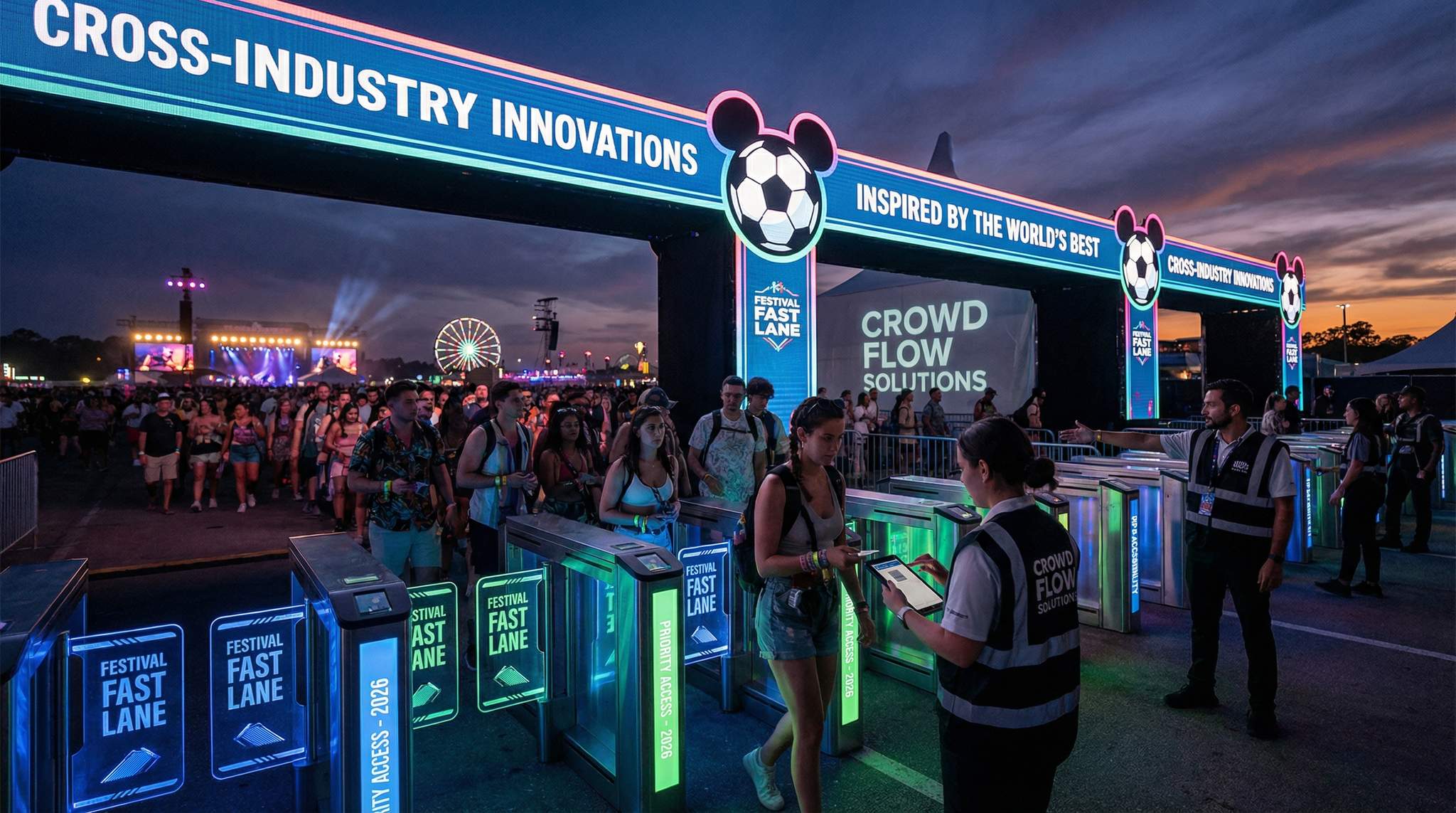
Increasingly, events are turning to automated scanning systems like the turnstiles in sports arenas. Modern stadiums use walk-through medal detectors and turnstile scanners that read tickets (or RFID wristbands) with minimal human help. The advantage is speed and accuracy – machines don’t get tired or make errors checking IDs. In fact, some 2026 festivals are piloting this approach: installing self-scan kiosks at entrances, much like an arena or transit station. Using automation to fill labor gaps allows attendees to scan their own credentials. Attendees simply scan their own QR code or wristband at a pedestal and get a green light, under the watch of a few staff. As events move from short-staffed to self-sufficient, automated kiosks are becoming standard. If one attendant can oversee 3 kiosks handling ~30 people each per minute, that’s up to 90 people/minute, far surpassing a manual lane. At large events, one attendant can oversee multiple kiosks, skyrocketing throughput. The throughput per staffer skyrockets, as shown below:
| Entry Check Method | Estimated Throughput per Staff | Example Scenario |
|---|---|---|
| Manual check w/ staff | ~500 people per hour | 1 staff scans tickets & inspects bags for one line. |
| Self-scan kiosks + staff | 1,500–1,800 people per hour | 1 staff monitors 2–3 automated kiosks (each 20–30 scans/min). |
Throughput will vary, but automated gate systems clearly allow far more entrants per staff member. Stadium-style turnstiles can dramatically shorten festival lines.
Of course, technology is only as good as its implementation. Festivals adopting self-scan gates or RFID turnstiles must test thoroughly and train staff on override procedures. For example, what if someone’s digital ticket isn’t scanning? Staff should be ready to redirect them to a help desk or use a handheld scanner as backup. It is vital to train your reduced gate team on override procedures. It’s wise to keep a few human-operated lanes alongside the machines for those less tech-savvy or any hiccups. Companies like Axess and Intellitix provide self-scan solutions that are becoming industry standard. When done right, the combo of high-speed tech and human hospitality is powerful. Even with self-scanning, keeping a couple of staffed lanes ensures accessibility. In 2022, Tomorrowland (Belgium) successfully used RFID wristbands for entry and had virtually no gate queues; attendees reported it was smoother than entering some theme parks. The bottom line: borrow the stadium approach by investing in sufficient entry infrastructure – whether more lanes or better scanners – and your audience will start the festival experience on a positive note instead of stewing in a 2-hour line.
Security Screening the Theme Park Way
Bag checks and metal detectors are standard at both stadiums and big theme parks, and festivals can’t skimp here either. The challenge is balancing thorough security with speed. Disney parks, for instance, have refined a system where guests pass through screening quickly: security staff politely but efficiently check bags and use walk-through detectors, pulling aside only those who trigger alarms. Clear signage prepares guests to have bags open and electronics out, speeding up the process. Festivals should adopt a similar checkpoint design: well before the gates, have signs (and staff announcements) instructing attendees to use clear bags if possible, unzip all pockets, and empty metal from their pockets. Many events now even ban large bags outright to streamline searches – a practice borrowed from sports venues’ “clear bag policies.”
Hiring professional security firms with event experience (think companies that staff major concerts or games) is critical. They will know how to scale screening lanes based on crowd size and do it without undue hassle. For example, at a 50,000-person sports event, it’s typical to have dozens of magnetometers and a secondary manual check for flagged individuals, achieving a throughput of several thousand people per hour. If your festival is expecting 20,000 attendees at peak entry, consider on the order of 15-20 screening lanes (some can be simple bag check tables if no metal detectors). Also, position enough staff to guide people into all lanes – often lines back up simply because attendees don’t realize there are empty lanes further down. Use signage like “More Entry Lines This Way ->” to fill every station.
One lesson from stadiums: perimeter screening. Rather than one chokepoint at the main gate doing everything (ticket scan + bag check), large venues sometimes split tasks – e.g. first do bag checks at a wide perimeter (multiple points around the venue), then scan tickets at the inner gate. This reduces congestion by spreading out the process. A festival can similarly have an outer layer (before people reach the front gates) where security visually inspects for prohibited items, followed by inner turnstiles for tickets. This two-step entry keeps the flow moving and adds a layer of security. It’s exactly how Disneyland handles busy mornings: they check bags at several checkpoints, then let guests queue at ticket turnstiles separately.
For cutting-edge security, look at Qatar 2022: they integrated spectator IDs (Hayya cards) with ticketing and biometric checks. Each visitor to Qatar had their biometric data integrated with ticketing. This biometric data integration helped filter out banned individuals and enhance safety. While a small festival won’t issue “fan IDs”, you can still tighten entry by linking tickets to IDs (e.g. require name on ticket match ID at wristband pickup) as a deterrent to fraud and troublemakers. Some festivals in Europe have started doing personalized tickets to prevent resale scams and have better knowledge of who is on-site – a page from the World Cup’s book of controlled access. Overall, the lesson is to treat entry like the first act of your show. Plan it in detail, overstaff it if anything, and communicate clearly. When fans walk in smoothly and feel safe, you’ve set the perfect tone for the event.
Managing Exit Waves and Avoiding Post-Show Chaos
At the end of a Sports game or a long theme park day, everyone leaves around the same time – a scenario festivals face each night when headliners finish. Disney World handles park closing with tactics like gently leading guests toward the exits with a closing parade or keeping shops open late to stagger departures. Stadiums manage egress by opening every possible exit gate and having a small army of ushers and security directing traffic outward. Festivals should develop a peak egress plan with the same level of detail as ingress. Simply unlocking an exit gate isn’t enough – you may need to guide thousands of tired, possibly intoxicated attendees out safely and efficiently.
A great strategy is to slowly ramp the audience down rather than cutting them off. For instance, after the final act ends, consider playing calm, exiting music over the speakers (many festivals play gentle tunes or even humorous pre-recorded exit messages). This keeps people relaxed and signals that the event is ending. Keep ample lighting on – flood lights or tower lights should illuminate all main paths to the exits so people feel safe and can find the way. Festival staff can borrow the stadium approach by announcing exit information clearly: “Thank you for coming – exits are to your left and right, shuttles are straight ahead. Good night!” repeated in intervals.
If possible, open extra exit lanes or sections of fencing to create wide-outflow channels. One common mistake is leaving the entry setup in place for exit; those same chutes that organized people coming in can become choke points when everyone rushes out. Many experienced organizers will remove barriers near the main gate or convert multiple entrance lanes into exit lanes at the end of the night. For example, after a 2021 football championship game at Wembley Stadium, stewards opened a normally locked service gate to let tens of thousands flow directly to the transit station, reducing crowd pressure outside. Festivals can mirror this by having “egress teams” ready with wrenches to pop out segments of barrier and funnel people out through staff/service areas if needed.
Another technique from big events is egress entertainment or incentives. Disney sometimes projects fun nighttime visuals on park walls or has characters bid farewell, encouraging people to linger just a bit rather than all jam the transportation at once. In a festival context, you might keep a small stage near the exit or food court running with chill music for 30 minutes after the main stage ends. This gives a reason for a portion of the crowd to hang back and decompress instead of everyone leaving simultaneously. Some festivals set up late-night food or coffee stalls at the exits – grab a snack for the road while traffic dies down. Not only does this stagger departures, it also creates additional revenue and a nicer send-off for attendees.
Regardless, plan for the worst-case: everyone leaving in a hurry. Staff must be in position to manage queues for shuttles, rideshares, or parking lot traffic. Take a page from World Cup host cities: after matches, they had meticulously planned transport hubs with signage directing fans to taxis, buses, or trains, and attendants organizing lines for each. The transport hubs were meticulously planned to direct fans efficiently. For instance, Qatar 2022’s new metro system was heavily advertised and managed, whisking thousands of fans away within minutes. The metro system whisked thousands away thanks to heavy advertising and management. A festival should similarly coordinate with local transit to run extra late-night buses or trains, if available, and definitely communicate where to go. If you provide shuttles, create orderly queues with barriers and have staff keep people informed (“Next bus in 5 minutes, please form 3 lines”). Attendees will be tired; clear direction prevents frustration and pushing.
Finally, always keep emergency scenarios in mind. Stadium safety regulations often require that spectators be able to reach an exit gate from their seat within about 8 minutes in an emergency. Stadium fire and life safety regulations suggest spectators should be able to reach a place of safety quickly. While a festival is more spread out than a stadium, it’s a good rule of thumb: design your site so that no point is more than a few minutes’ brisk walk from an exit, and ensure exits are clearly lit and marked “EXIT” (with multilingual or symbolic signage where relevant). Train your crew on an evacuation plan: how would you get everyone out if severe weather hit or if there’s a security threat? Practicing this mentally (or via tabletop exercises) will expose any weaknesses in your exit strategy. The hope is you’ll never need a full emergency egress, but if you do, you’ll be executing a plan refined with stadium-grade precision rather than scrambling.
In summary, smooth ingress and egress are about planning for volume and guiding human behavior. Turnstiles, crowd control barriers, exit maps – they’re all tools that need smart operators. By thinking like a World Cup stadium manager at the gates and a Disney cast member at closing time, festival organizers can get huge crowds in and out with minimal stress, setting up a safe and enjoyable experience from start to finish.
Queue Management Innovations: FastPasses & Fun Waits
Virtual Queues and “FastPass”-Style Systems
In the theme park world, one revolutionary idea has been the virtual queue – letting guests wait for their turn without physically standing in line. Disney’s FastPass was the pioneer: instead of spending 2 hours in a winding queue, you grab a FastPass ticket (or now a digital reservation) and come back at a designated hour to essentially skip the line. For festival organizers, long queues are an inevitable pain point – whether it’s waiting to enter, to buy merch, or to use an attraction like a sponsored VR experience. Implementing a festival version of FastPass can dramatically improve the attendee experience.
Start by identifying any high-demand, limited-capacity offerings at your event. This might be a popular artist meet-and-greet, a small stage in a tent that fills up, a carnival ride, or even the merch tent at peak times. Rather than accepting a massive first-come-first-served line that eats into fans’ day, consider a reservation system. With today’s tech, this could be integrated into your festival mobile app: attendees could log in, select a time slot for the activity, and receive a digital pass (QR code) for that window. Some festivals have already piloted this – for example, a New Zealand food festival used an app to book tasting session slots, reducing on-site waits. Another approach is the analog version: hand out numbered tickets or pagers to the first X people and then call them when it’s their turn (like restaurants do with buzzer pagers). Interestingly, Disney used a similar trick for the Dumbo the Flying Elephant ride queue redesign: they give families a pager and let kids run around a playground until it’s their turn. This family-friendly festival takeover strategy resulted in happier kids and parents, and a more free-flowing line.
Festivals can adapt this to, say, a silent disco that only fits 200 people at a time – let people join a virtual queue and enjoy other attractions until their phone alerts them to come dance. The tech must be robust (and you’ll need to communicate clearly how it works), but the payoff is huge. If executed well, fans will praise how “I never waited more than 10 minutes for anything!” rather than complaining about spending half the day in line. One caution: have a backup for those who aren’t using the app (e.g. a small first-come line or a staffer who can book a slot for someone on site). Also, manage expectations – if something does run out of slots, communicate that early (“All merch drop reservation times are now booked – but you can still swing by later in case of no-shows”). The success of FastPass at Disney – which cut standby wait times and increased guest satisfaction – suggests that giving people freedom while they wait is always worth exploring.
Making Waiting Part of the Fun (or at Least Comfortable)
No matter what, some queues at a festival are unavoidable. Restrooms, food trucks at dinner rush, entrance at opening time – there will be lines. The trick is to make those waits as painless as possible or even entertaining. Disney parks are masters of this: their ride queues often feature interactive decor, themed music, and fun little surprises to discover. Festival queue entertainment that helps not hypes can transform the waiting experience. For instance, the Haunted Mansion line has spooky portraits and interactive crypts that react when touched, keeping guests intrigued. Festivals can take a page from this playbook by injecting some delight or comfort into waiting areas.
Simple example: if people are queuing for entry, have performers or brand ambassadors roam the line to engage with them. It could be stilt walkers high-fiving people, a clown handing out balloons to kids, or a DJ on a mobile cart playing upbeat tunes. At a UK festival, organizers once sent costumed actors into the security line – it turned an annoying wait into an impromptu show, and attendees actually gave positive feedback about the line experience. Even gentle background music can help; Disney often pumps subtle music into queue areas to keep mood upbeat. Disney parks are experts at using music and decor in queues.
Comfort is equally important. Provide basic amenities for any line expected to last 30 minutes or more. That means shade in the sun, shelter in the rain, and access to water. Many top festivals now station water refill tanks or at least hand out water bottles to those in very long lines (e.g. at the gates when opening). Queue signage can also help set expectations: a sign like “15 minutes from this point” or staff informing people of wait times can reduce stress because at least fans know what to expect. At entry, if there’s a delay, have a staff member walk down the line apologizing and explaining the cause (“We’re opening a bit late to ensure everyone’s safety, thanks for your patience – we’ll be moving in 10 minutes”). Honest, calm communication keeps people from getting restless and rowdy. Large festivals brim with potential for crowd surges, so honest communication is key.
Another idea is to turn queues into mini-games or engagement opportunities. Some festivals deploy digital screens in merch or food lines that display fun facts, video clips, or even live tweets from the event. Others use the festival app to push out a “queue quiz” – trivial questions about artists with a small prize for winners, giving people something to do on their phones while they wait. For family-friendly events, take inspiration from Universal Studios and Disney: they have interactive elements in line (wands that trigger effects, touchscreens, etc.). Interactive and themed queues keep guests engaged. A festival could have, say, a graffiti wall or photo-op spots along a slow-moving line so people can snap pictures to kill time.
At minimum, keep queues from being miserable: ensure there are no overflowing trash cans or foul odors right by where people wait, and consider placing staff at regular intervals to monitor guest comfort. If someone in line looks unwell, your team should spot them quickly and assist (perhaps bring them out of the line to a shaded area and let them back in later – a kindness that people remember). Theme parks even design seating elements into very long queues, knowing folks might need a break; a festival can similarly position a few benches or leaning rails if a merch line regularly takes an hour. In sum, every minute a fan spends waiting is a minute they’re not actively enjoying the festival – but with some creativity, you can make those minutes enjoyable in their own way. As one festival operations guide put it, “we can’t eliminate all lines, but we can eliminate the boredom and discomfort that come with lines.” Top festivals make waiting in line fun to keep attendees happy.
VIP, Express, and Accessible Queuing
Not all attendees experience lines equally, so it’s important to plan for different needs – another lesson we can adapt from theme parks (which offer things like express passes, single-rider lines, and disability access queues). Many festivals already have VIP passes that promise faster entry or separate restroom lines. If you offer this, ensure it’s truly a benefit – e.g. dedicate a couple of entry lanes purely to VIP/RFID fast-track, and mark them clearly so general attendees don’t accidentally queue there and slow it down. Some events also create a “jump the line” perk for an extra fee at popular attractions or rides, similar to Universal’s Express Pass. This can be a revenue generator, but use sparingly to avoid seeming like you’re forcing an upcharge for basic experiences. A good approach is to apply it to secondary attractions: for example, general admission can queue for the free ferris wheel, but a limited “fast lane” pass sold on-site lets people skip that line. This way, the core festival (music stages) remains equal access, but optional perks can be expedited for those who value their time more than their money.
More critically, consider accessible queuing for those who need it. Disney and other parks have systems where guests with disabilities who cannot endure long waits are given a return time similar to FastPass. Festivals should absolutely implement a form of this: if someone has a mobility issue or a condition (like autism) that makes waiting in dense crowds difficult, have a policy where they can check in with staff at an attraction or entrance and then be allowed to wait in a calmer spot. For example, an attendee in a wheelchair might be brought through a separate gate to bypass a long entry line (after verifying their credentials of course), or a neurodivergent guest could receive a text when they can come back to the front of a meet-and-greet queue rather than standing in the thick of it. It’s crucial to publicize these accommodations in advance on your website and on signage (“Accessible Entry – inquire here”). Train your team on the procedure so that anyone who asks for help gets clear instructions instead of blank stares.
A related concept is the “Rider Switch” from theme parks, where parents with a small child can take turns on a ride without each waiting in line from scratch. At Disney, Rider Switch allows parents to swap without losing their place. At festivals, parents might also appreciate flexibility: for instance, if only one parent can go into the crowd at a time while the other watches the kid from a distance, maybe allow the one who stayed back to swap in without losing their spot up front. It could be as informal as a friendly security guard at the stage rail facilitating the swap during set breaks. These little considerate touches go a long way for families.
Finally, don’t forget artist and crew lines. Festivals often neglect that artists or their guests may show up at public entrances or VIP areas. Consider a separate queue or check-in for artist guests, media, and vendors so they don’t clog up consumer lines (and so they themselves aren’t stuck waiting forever). This is akin to how backstage staff at a stadium have their own entrance. It keeps things smoother for everyone.
In all, managing queues is about fairness and empathy. Borrowing the FastPass idea introduces fairness by scheduling access, and borrowing Disney’s queue entertainment adds empathy – acknowledging that fans are human and get bored or tired. By 2026, more festivals will treat queue management as a key part of experience design, not an afterthought. Top festivals make waiting in line fun by treating it as part of the event. Adopt that mindset and you’ll turn line hell into a manageable, even mildly enjoyable, part of the day.
Security and Safety: Stadium-Level Vigilance at Festivals
Stadium-Style Security Protocols for Festivals
Football World Cups and Olympic games face some of the highest security stakes of any events on earth. While most festivals aren’t dealing with heads of state or international terrorism threats, robust security planning is still non-negotiable – as recent incidents have shown. Here, festival organizers can learn a ton from the playbooks of stadium security teams and global event policing.
First, intensive pre-event planning and risk assessment is a must. Before a World Cup, security committees conduct detailed threat assessments for each venue, coordinate intelligence with multiple countries, and put resources in place for various scenarios. Operations like Watan employed thousands of additional staff for security. The Operation World Cup initiative focused on training and strategic readiness. A festival should similarly work with local authorities well ahead of time: consult police on any potential threats (local crime, potential unruly groups), and have them looped into your plans. Many big festivals now hold multi-agency tabletop exercises before the event – bringing together festival staff, police, fire, and medical to walk through “what-ifs” (active shooter, severe weather, etc.) and ensure everyone knows their role. This is exactly how major sporting events do it, practicing everything from evacuation to communications.
On the ground, layered security zones are a stadium hallmark. There’s an outer perimeter (where initial checks or patrols happen), a controlled inner perimeter (ticketed area), and sensitive zones (like field of play or, for festivals, the stage and backstage). Festivals should emulate this by clearly defining e.g. a public zone, a VIP/crew zone, and stage secure zones, each with credential checks. Use wristbands, laminates or RFID passes to enforce who can go where. For example, the World Cup has color-coded badges for staff that only allow them into specific areas; at a festival, a catering supplier might have access to the kitchen and vendor zone but not the stage pit, whereas a photographer might get stage pit access but not artist compound. These distinctions prevent breaches and keep the event safer.
Stadiums also deploy visible security presence to deter bad behavior – think teams of uniformed guards and police officers in and around the venue. Festivals benefit from this too: a strong but friendly security presence. Ensure you have enough licensed security personnel (the ratio might vary, but a common benchmark is 1 guard per 250 attendees for a low-risk crowd, increasing for higher-risk scenarios. Scaling up operations for massive crowds requires adjusting security ratios. At Australia’s Splendour in the Grass, for instance, security numbers were increased after reports of crowd issues, aiming for higher visibility and quicker response. The key is strategic placement: position security at choke points, in front of stages, and roaming through campsites and parking lots. Take inspiration from Qatar’s “Watan” initiative which unified 32,000 security personnel nationwide for the World Cup. This included undercover officers dressed as fans and thousands of additional personnel – in a festival context, that might mean drawing on local police, contracting private security firms, and even bringing in specialist teams (canine units for drug detection, for example) under one coordinated command.
High-Tech Surveillance and Intelligence
Global sports events now leverage cutting-edge tech to monitor security, and festivals can absolutely benefit from doing the same. We’re talking CCTV networks, drone surveillance, facial recognition, and real-time intelligence sharing. Qatar 2022 notably built an integrated command center with 15,000 cameras across stadiums, AI that could flag “abnormal events” in crowds, and even facial recognition tied to their mandatory fan ID system. In collaboration with veteran national security, advanced monitoring was developed. Each visitor’s biometric data was used for verification. While a local festival won’t have a nation-state’s resources, scaled-down versions of these technologies are increasingly accessible.
For example, setting up a mobile CCTV system is becoming common for events: some festivals deploy trailers with pole-mounted cameras that cover entrances, main stages, and other critical areas. These can feed into a central command tent where security staff and police liaisons keep watch. Even better, newer crowd monitoring software can run on these video feeds to measure crowd density and movement. If you can’t afford that, simply having someone watch and radio observations is fine – the key is to actively surveil so you catch issues early. For instance, seeing a surge of people running can alert you to a fight or fire before anyone calls it in.
Drone detection and defense is another stadium-grade measure that festivals should consider, especially after incidents of rogue drones nearly hitting crowds. The FAA and various governments strictly enforce no-fly zones over stadiums during big games, and 2026 festivals are following suit by implementing no-fly zones and drone detection systems to keep skies clear. Tools range from radar that pings when a drone is near to radio frequency jammers or “drone guns” that can down the device (where legal). Managing a river of people requires full access to surveillance tools. At a minimum, festivals should post signs and make public announcements that drones are prohibited and coordinate with local law enforcement on how to respond if one is spotted. It only takes one stray drone over a packed crowd to cause panic or injury, so this is a 2020s risk we must manage. (Some forward-thinking festivals even have their own camera drones to both capture footage and monitor the crowd – if you go this route, be sure to follow aviation rules and have a licensed operator.)
Another lesson from high-security events: undercover security and intelligence gathering. At the World Cup, authorities had plainclothes officers mixed into crowds to spot pickpockets or potential hooligans unnoticed. Undercover officers dressed in team jerseys mingled with crowds. Festivals can do the same – assign a few security team members to dress like festival-goers and mingle. They can detect things like harassment, drug dealing, or brewing conflicts without sticking out. Also, keep an ear on social media chatter during the event; some security teams quietly monitor Twitter or local WhatsApp groups for any buzz about unsafe situations or gate-crashing plans. One festival in the US credited a heads-up from a social post for allowing them to thwart a group planning to rush a fence. Being plugged in to intel streams in real time is a definite advantage, just as major sports events work with intelligence agencies to stay ahead of threats.
Crowd Control and Emergency Response: a Proactive Stance
Stadiums have well-drilled procedures for everything from unruly fan behavior to full-scale evacuations. Festivals need similar protocols. One crucial area is crowd surge prevention and intervention – recent festival tragedies (e.g. Astroworld 2021) underscore how vital this is. Here, a mix of design (as discussed in crowd flow) and active monitoring comes in, but equally important is the willingness to pause or stop the show if things look hazardous. After Astroworld, many festivals implemented formal “stop show” policies where security or stage managers can halt a performance if they see dangerous crowd conditions. Astroworld 2021 showed that crowd monitoring is vital. Implementing incident response units and divided crowd zones helps manage density. This mirrors how football matches might be paused by referees for safety reasons (like too many people crowding a fence). Make sure your team and artists know that attendee safety comes first: have agreed hand signals or comms so that if security says “stop,” the artist and audio crew get the message. Some festivals now brief headliners: if you see our staff on stage with a red flag, stop and instruct the crowd to calm down. It’s better to have a brief awkward pause than a trip to the hospital – a philosophy ingrained in sports venues and increasingly in festivals. Lessons from Astroworld 2021 regarding safety policies emphasize the need for stop-show protocols. The goal is to prevent overcrowding and manage giant crowds safely.
Plan for handling aggressive or disruptive individuals too. In sports, if a fan gets violent or runs onto the pitch, security teams swiftly enact a removal. At festivals, gate-crashers, fights, or intoxicated attendees can pose risks to others. Your security should have a clear procedure: usually a quick-response team (QRT) of a few stronger guards who can respond anywhere in minutes to safely detain and remove troublemakers. Use cameras or reports from staff/attendees to pinpoint where they’re needed. Additionally, coordinate with on-site or local police – when do you want police intervention? Often, festivals prefer to handle minor incidents internally (to avoid heavy-handed optics), but for serious crime or threat, police should be ready. This is analogous to soccer matches where stewards handle minor scuffles, but riot police stand by if a full brawl breaks out.
Another World Cup practice is robust volunteer training in crowd management. FIFA volunteers are trained to smile and help, but also to direct crowds, manage queues, and assist in evacuations as needed. Volunteers from diverse backgrounds make up the 33rd team. At a festival, even non-security staff should know basics like: where are the emergency exits? How to politely ask someone to move if they’re blocking an aisle? If a section starts to feel unsafe, who to call? Train your volunteers and food vendors on these points during orientation. Every extra set of eyes helps, and every crew member is part of the safety net.
Finally, have a clear emergency response plan and share it. Stadiums have PA announcements and LED board messages pre-written for emergencies (“Please calmly proceed to the nearest exit or shelter”). Festivals can prepare the same – integrate your stage PA, video screens, and even the festival app push notifications to broadcast instructions if something goes wrong. Regularly reminding attendees via screens helps maintain order. For example, if weather forces an evacuation, immediately announce on stage and on screens, “Lightning in area – please walk to the exit and take shelter in your vehicles or the arena building. Follow staff directions.” Rehearse this with your team. The speed and clarity of response can prevent panic. A shining example is what many events do after learning from past incidents: regularly informing the crowd about safety. Notting Hill Carnival, for instance, uses signage and loudspeakers through the day to remind the million attendees where exits are and to stay hydrated – fostering a sense of order. Adopting policies like signals to halt a show can prevent disaster.
The World Cup in Qatar reportedly had zero hooliganism incidents – a result credited to strong preventive measures (alcohol control, heavy presence, swift handling of small issues). Presenting Qatar’s cultural norms helped manage expectations and behavior. While a festival has a different vibe, the principle stands: if you prepare extensively and respond decisively, most security issues can be handled before they spiral. By bringing stadium-level vigilance – from intelligence to emergency drills – into the festival realm, we not only protect our attendees, we also build trust. Fans who see careful security (and feel safe, not hassled) are more likely to return year after year, knowing your festival takes their well-being seriously.
Volunteer & Staff Management: The World Cup Playbook
Recruiting a Volunteer Army with Purpose
One of the most remarkable aspects of a FIFA World Cup is the volunteer program. For example, over 17,000 volunteers were recruited for the 2018 World Cup in Russia, as detailed in the 2018 FIFA World Cup volunteer campaign results, forming an enthusiastic workforce dubbed the “33rd team.” These volunteers came from 112 countries, ranged from age 18 to 80, and filled 20 different functional areas. This volunteer force included tanker captains and many others – from guiding fans to their seats, to assisting media, to helping at ceremonies. Festival producers might not need such staggering numbers, but they can certainly adopt the scale and structure of this approach.
Firstly, start volunteer recruitment early and cast a wide net. The World Cup volunteer campaign launched a year in advance for 2018 and drew over 150,000 applications globally within weeks. Volunteer recruitment achieved high figures within the first few days. While your festival isn’t a global spectacle, you can still open volunteer sign-ups 6+ months out and promote them via local universities, community groups, and social media. Emphasize what volunteers get (free tickets, swag, a behind-the-scenes experience) and what you’re looking for (friendly, reliable people to help make the event great). Some festivals partner with charities (like Oxfam at Glastonbury, which provides ~2,000 volunteer stewards) to tap into an existing passionate community. Others use dedicated festival volunteer platforms to reach experienced event volunteers who hop from fest to fest. The key is to treat volunteer recruitment with the same seriousness as paid staff hiring – plan how many you need in each department and have a timeline. For instance, by 3 months out, aim to have, say, 80% of your volunteer roles filled and confirmed. Innovative recruitment and retention strategies suggest confirming availability early. This avoids last-minute scrambles. Ideally, ensure all departments are filled 3-6 months out.
Importantly, assign volunteers to specific teams and roles, just like the World Cup does. Instead of a vague “you’ll do whatever we need on the day,” give people roles like Campground Helper, Water Station Attendant, VIP Lounge Host, Stage Runner, etc. Volunteers perform best when they know their purpose and feel it’s important. The World Cup had volunteers sorted into 20 departments (from ticketing support to language services), each with their own training. For a festival, maybe you have 5 main volunteer teams: gate/entry, info & hospitality, eco/cleanup, artist & production runners, and campground/security support. Assign team leaders (could be senior volunteers or paid crew) to manage each group. This structure means each volunteer has a go-to supervisor and a “home” task, which boosts confidence and accountability.
The sense of purpose also comes from culture. The World Cup famously gives all volunteers a uniform, some meals, and a certificate/reference letter – plus the intangible reward of being part of something huge. Festivals can learn here: make your volunteers feel like an integral part of the event’s success. Provide them with event t-shirts or special volunteer badges. Host a welcome session when they arrive on-site, maybe even a modest thank-you party after the festival or a group photo op with the crew. When volunteers feel valued, they’ll go above and beyond (and they’ll come back next year). A community-centric festival in Oregon, for instance, found that when they started publicly acknowledging outstanding volunteers on social media and during the show (“shout-out to our volunteer crew keeping the grounds clean!”), their retention and show-up rate improved significantly.
Training, Training, Training – the Disney Difference
It’s often said that Disney doesn’t just hire employees, they “cast” for a role and train them to perform. Every Disney cast member, from street sweeper to ride operator, undergoes formal training in both the technical aspects of their job and the Disney customer service philosophy. Cast members receive extensive training to create lasting memories. They learn to stay in character, to always point directions with an open hand (never one finger, which can be seen as rude), and to proactively help lost or confused guests. This level of training and culture-building is a big part of Disney’s operational magic, and festivals can benefit by similarly investing in staff and volunteer training.
Practically, this means holding orientation sessions for all volunteers and seasonal staff before the festival begins. If possible, do it on-site so they can physically learn the layout. Go over safety procedures, radio protocol, and customer service tips. For example, teach volunteers how to handle common questions (“Where is Stage 2?”, “Where are the toilets?”) and empower them to assist. A tip from Disney’s approach: instill the idea that we don’t point and say “over there,” we personally guide the guest or give a detailed answer. In a festival context, instead of a staffer shrugging and saying “I don’t know” to an attendee query, you want them to take ownership – if they don’t know, they should find out or direct the person to an info booth that can help. Role-playing scenarios can be effective: have new volunteers practice a scenario like encountering a distressed or angry attendee and coach them on the appropriate response (stay calm, get a supervisor if needed, always be respectful and solution-oriented).
Safety and crowd management training is crucial too. Make sure every volunteer knows the basics of crowd safety (no, they aren’t expected to wrestle rabble-rousers, but they should know not to prop emergency exits open or how to alert security if they see an overcrowding issue). Many festivals brief volunteers on what to do if they notice someone who might be ill or too intoxicated – e.g. how to call medical teams and what info to provide. Some even give basic first aid tips or supply volunteers with a card of emergency phone/radio channels. This mirrors how World Cup volunteers are briefed to handle everything from lost children to medical situations until professionals arrive. These volunteers make up the 33rd team of the tournament.
Don’t overlook specialized training for certain roles. If you have volunteers checking VIP passes at a lounge, walk them through the list or device they’ll use. If volunteer ushers are helping at stages, teach them about not overfilling areas and polite ways to ask people to move along. The more professional you make your volunteers through training, the more they augment your core staff. Experienced festival producers note that when volunteers are well-trained, they stop being a risk and start being an asset – they can troubleshoot little problems on their own and even save the day in some cases. For example, a trained volunteer at a merch booth might notice a queue forming oddly and reorganize it before it blocks a path, whereas an untrained one might not realize until it’s a mess.
A quick but important point: feed and rest your staff and volunteers. Just as Disney provides break rooms and expects cast to take regular breaks to stay fresh, festival crews need respite. Arrange for volunteer meals (or at least snacks and water) and establish break schedules in long shifts. An exhausted, hungry volunteer could become a liability or at least won’t perform well. By caring for them, you enable them to care for your attendees. One festival logistics manager bluntly said, “You can’t expect a volunteer to smile and help guests if they’ve been on their feet 8 hours with no lunch.” Build those needs into the schedule – e.g. have floaters to rotate in while others take 30-minute breaks.
Retention and Leadership
World Cup volunteers often describe the experience as “life-changing” – they make friends, they feel pride in contributing to a massive event, and many sign up for future tournaments. That retention is gold. Similarly, festivals should aim to retain their best staff and volunteers season to season, building up a pool of veteran helpers who know the ropes. To do that, focus on recognition and growth opportunities. Identify volunteers who showed up on time, handled responsibility well, and showed initiative. Thank them personally, maybe give them a small gift or a shout-out in a post-event email. Next year, consider elevating them to team leaders or paid roles. Many festival professionals (stage managers, artist liaisons, even promoters) actually started as volunteers or interns in the festival scene and grew into bigger roles once they proved themselves. Create that pipeline. For example, maybe your volunteer coordinator this year could become a zone manager (paid) next year if they excel.
Also, gather feedback from your crew. Ask volunteers what went well and what could be improved for their role – you might learn that the info booth volunteers felt overwhelmed during peak hours, so next year you add one more person per shift. Show that you’re listening. This not only improves operations (great for E) but also makes volunteers feel heard (great for retention).
One more borrowed concept: team esprit de corps. Disney cast members often feel like a family working together to create magic. Sporting events foster camaraderie with things like pep rallies for volunteers. Bringing a touch of this to your festival can be as simple as holding a pre-show all-staff meeting where you pump everyone up, share the festival vision (“We’re here to give 20,000 people the best weekend of their year!”), and maybe do a fun team chant or group photo. During the festival, supervisors should keep energy up – a small gesture like delivering popsicles to all the parking volunteers on a hot afternoon, or the festival director personally thanking the cleanup crew during the event, makes a huge difference. It combats the “us versus them” mentality that sometimes plagues volunteer programs (where volunteers feel second-class compared to paid staff or artists). Instead, emphasize one team.
Lastly, have a plan to deal with no-shows or weak links. Not every volunteer will turn up or perform well – that’s reality. The World Cup had standby volunteers and reallocated folks as needed. You can similarly recruit a few extra volunteers over your target to fill gaps, and empower team leaders to gently reassign someone if they’re not suited to their initial task (e.g. move a shy, overwhelmed person from a direct customer-facing role to a quieter backstage task, and put a more eager person in their place). Managing the crew dynamically ensures no area is left shorthanded because someone flaked.
By taking a page from the World Cup and Disney in how you recruit, train, and uplift your people, your festival will gain a reputation as not just fan-friendly but crew-friendly. Remember, a well-managed, motivated crew is the engine that makes the on-site experience run smoothly. And just like fans, crew members talk – if you treat them well and run a tight ship, word spreads and you’ll attract the best talent in seasons to come, creating a virtuous cycle of better festivals.
Guest Services & Experience: Bringing Disney’s Magic to Festivals
Information & Guest Relations – Always There to Help
One thing Disney parks are famous for is that help is always easy to find. Lost your kid? Have a question about showtimes? There’s a staffed guest relations kiosk or a uniformed employee in sight who will assist immediately. Festivals can replicate this by bolstering their info points and roaming “ask me” staff. Start with clearly marked information booths in multiple locations – near the main entrance, by the central hub of stages, and in camping areas if applicable. Staff these with friendly, knowledgeable people and post visible signs (like an “i” info symbol and languages spoken if you cater to international crowds). During a large festival, these info booths become lifelines for attendees who are confused, lost, or in need of services (like lost & found, schedules, etc.). Make sure the booths are stocked with festival maps, schedules, and program brochures, and that staff have radios to call for assistance if a situation goes beyond info (e.g. medical or security issues that guests report).
Beyond fixed booths, consider having mobile guest service teams. For example, deploy volunteers with brightly colored “INFO” T-shirts or hats who walk around main areas offering help. Glastonbury Festival has done this with great success – volunteers roam with maps and can personally guide someone who looks disoriented. Coachella, on the other hand, emphasizes static info tents but ensures they’re super obvious with tall flag markers. Either way, the idea is an attendee should never feel like they don’t know where to turn if they have a problem. Train every frontline staff member (ticket scanners, security at gates, etc.) to answer basic questions as well. Even if their job isn’t “info,” they are part of the guest experience. A common Disney mantra is “never say ‘I don’t know’ – find out or guide them to someone who does.” Adopting that can significantly improve festival customer service.
Another aspect to borrow is guest communication channels. Disney has customer service phone lines and now chat support in their apps; festivals can set up simpler but effective channels like a dedicated Telegram or WhatsApp number attendees can message for help during the event. Some festivals have launched help chatbots in their apps that answer FAQs (like “when does parking lot open?”). Even just actively monitoring your official social media or an event subreddit for attendee questions during show days can allow you to solve issues in real time (many attendees will tweet at the festival if something’s wrong). Responding promptly – “We hear the water refill by Stage 2 is empty, we’re sending refill crew now!” – shows attentiveness and keeps guests happy.
Don’t underestimate the power of human-to-human help, though. A lot of festival-goers will remember forever how a staff member helped them find their lost wallet or went out of their way to cheer up their crying child who lost noise-cancelling headphones, etc. Empower your guest services team with a few “magical” tools: maybe they can authorize a small number of merch item replacements if someone’s shirt got ruined, or give out drink vouchers to resolve a complaint. Disney guest relations famously has latitude to “make magic” for guests who had a bad experience (like giving FastPasses or freebies) – in a festival scenario, you could allow your info booth leads to grant someone who had a genuine issue (like security took an hour to resolve a ticket glitch) a gesture of goodwill like a free festival T-shirt or access to a lounge. These cases aren’t frequent, but when they happen, turning a negative into a positive can convert a potential detractor into a loyal fan.
Amenities and Comfort: Little Things Matter
Walking through a Disney park, you’ll notice a plethora of comfort features: benches to sit on, water fountains (now also bottle refill stations), shade from trees or awnings, clean restrooms around every corner, and an overall immaculate environment (Disney’s janitorial staff is constantly sweeping up). Modern festival attendees have come to expect far better amenities than the “bare bones” days of old. In 2026, infrastructure is the new headliner – fans demand comfort and convenience as part of the ticket. As infrastructure becomes the new headliner, upgrading basics is essential. In 2026, a festival’s experience is judged by its infrastructure. So, festivals should strive to meet something close to theme park standards in key areas:
- Rest Areas and Seating: Give people places to rest their feet. It can be as simple as some hay bales or picnic tables, or as fancy as decorated lounge areas. Insufficient seating is a top complaint at many events; meanwhile, Tomorrowland added plenty of seating pods and saw attendees staying on-site longer and spending more on food (because they had somewhere to sit and eat). Even a quiet lawn or an open tent where people can chill on the grass is good. A few shaded structures or umbrellas go a long way on a hot day. Remember, Disney calculated how far apart to put benches and trash cans based on guest behavior – you too should observe where people naturally congregate or get tired and accommodate them there.
- Hydration and Toilets: By now, most big festivals offer free water refill points, emulating theme parks’ water fountains. Ensure these are plentiful and well-marked on the festival map. Have staff keep an eye on them; a station out of water or with a broken tap should be fixed fast before it causes frustration. Likewise, toilets must be abundant, clean, and maintained continuously. Festivals like Glastonbury have 4,000+ toilets and teams cleaning around the clock – they learned after past criticism that nothing ruins comfort more than vile loos. The cost of more and cleaner loos is a necessary investment. Sheer numbers alone won’t impress if maintenance is poor. If Disney can keep park bathrooms sparkling with millions of visitors, festivals can at least aim for decent portable loo conditions through regular pump-outs and cleaning logs posted for accountability. Even porta-potties can become a bragging point if managed well. Adequate sanitation isn’t just comfort, it’s safety (preventing illness) and reputation-saving. Provide hand sanitizer or hand-wash stations generously – fans notice these details and appreciate them. Glastonbury notably improved sanitation beyond just the toilets themselves. Post-pandemic, hand-wash stations have turned into entertainment.
- Waste Management: Disney’s 30-foot trash can rule is legendary – a bin every 30 feet so litter never has a chance. This is known as Disney’s 30-foot trash can rule. While that density might be overkill in a huge outdoor festival field, err on the side of too many bins rather than too few. And empty them before they overflow. Some festivals now deploy “green teams” of volunteers to roam with garbage bags, proactively collecting trash from people or swapping out bin liners midday. Infrastructure upgrades extend to waste management. This keeps the site tidy (which subtly also keeps people in a better mood, as studies show cleaner environments reduce antisocial behavior). A clean festival with well-managed trash impresses attendees much like a pristine theme park – it shows you care. A pristine site creates an ambience that fans love. Fuji Rock in Japan is famous for how clean it is, partially thanks to staff and culturally-engaged attendees mutual effort. Having staff or volunteers who actively clean encourages attendees to do the same. This focus on cleanliness builds an ambience that fans appreciate. Encourage that atmosphere: make announcements like “Let’s keep our festival beautiful – use the recycle bins!”, and have staff model the behavior.
- Accessibility & Special Needs: A truly welcoming festival considers guests of all ages and abilities, just as theme parks do. Provide accessible facilities – wheelchair-accessible toilets in every toilet area, viewing platforms at stages for those who need them, and pathways that avoid deep mud or rough terrain where possible. Accessibility for people with disabilities includes ensuring shuttle services are compliant. Large events like the World Cup and Olympics have entire accessibility teams; you might not need that scale, but have at least one coordinator for accessibility. Organizers should consult with accessibility advocates to ensure plenty of accessible facilities. Offer a contact for attendees to request accommodations in advance (like reserving a spot in accessible camping or getting a sign language interpreter for a deaf patron – some events partner with interpreter volunteers for main stage shows). Also consider older attendees and families: have a few calmer zones for those who need a break from the noise (some festivals set up “quiet tents” or family areas). At least one festival in New Zealand introduced a “sensory chill-out tent” with low lighting and sound for neurodiverse guests to decompress – a practice spreading in 2026 as awareness grows. These touches mirror Disney’s effort to provide for everyone, from stroller rentals for toddlers to captioning on shows for the hard-of-hearing. The result is you broaden your audience and earn goodwill by showing that all are welcome.
- Medical and Wellness Services: While not typically visible at theme parks, behind the scenes they always have first aid and nurses ready. Festivals should station first aid tents centrally and clearly mark them on maps and with feather flags or signage on-site. Additionally, consider wellness services like a pharmacist booth (some European festivals do this for basic meds or earplugs) or mental health support (e.g. an NGO booth where people having a bad trip or anxiety can get help and calm down – Boom Festival in Portugal pioneered this with great success). The World Cup had meditation rooms and prayer areas for fans; a festival might offer a similar quiet space for reflection or spiritual needs if your demographic appreciates that.
In providing all these, think of it this way: the goal is to remove unnecessary discomforts and barriers, so attendees can fully enjoy the music/art and not be distracted by hunger, thirst, exhaustion, or pain. Disney’s philosophy is similar – eliminate the negatives (heat, tired feet, confusion) to accentuate the positives (fun and wonder). A fan who can find a seat, fill their water bottle, and easily locate a restroom when needed is one who will remember how great your festival was, rather than just how sore and sunburnt they felt.
Surprise, Delight, and Fan Engagement
Guest experience isn’t only about solving problems; it’s also about creating moments of joy and connection. Disney excels at this through character interactions, pin trading, parades, and more that go beyond the rides. Festivals can create their own brand of “magical moments” to enchant attendees and build loyalty. For example, some festivals have started random “lotteries” on-site – a staff member might roam and randomly give a pair of upgraded backstage passes to a couple of fans, or invite a group at the back of the crowd to watch the next set from the side-stage. These unexpected surprises get huge positive reactions (and usually social media posts that amplify the goodwill). It’s akin to a Disney cast member handing a free ice cream to a child who dropped theirs – a small cost for the organizer, but a memory those people will cherish and tell everyone about.
Another idea: incorporate interactive elements that engage fans throughout the day. Perhaps a festival-wide scavenger hunt (find 5 art installations or secret symbols, redeem for a prize), or a public voting via the app for an encore song at the end of the night. At some comic-cons and expos, organizers drop Easter eggs or codes around the venue for people to find and claim prizes – a concept that could easily translate to a multi-day festival to keep the adventure spirit alive. Even simpler, something like a big group activity can delight: Burning Man’s “blinky light thumbs up” tradition (people with blinking thumbs up gloves giving out “You’re awesome” gestures), or a coordinated moment like a flash mob, can make attendees feel they’re part of something special. If it suits your vibe, you could plan a festival-wide toast at sunset or a surprise firework show or drone show that isn’t on the schedule.
Human connection is key: encourage your staff, especially those at the front line like stage crews or MCs, to interact positively with fans. A charismatic MC hyping up the crowd and acknowledging people (“how are you feeling out there, let’s give it up for the volunteers keeping us safe!”) fosters community spirit. Some festivals send roving teams with Polaroid cameras to take pictures of attendees and give them the physical photo – a nifty souvenir that creates a warm interaction. Others have “Compliment crew” – volunteers whose sole job is to roam and give high-fives and compliments (it might sound cheesy, but in the right context it leaves people smiling). These cost nothing and can diffuse tense moments and uplift tired attendees.
Learn from theme parks in handling guest complaints or issues too. Disney trains cast members that if a guest’s experience is not up to par, they do what they can to “recover” it. At a festival, things will go wrong for some folks – maybe a miscommunication at the gate or a merch item sold out. Arm your guest services with some recovery options (like we mentioned earlier: vouchers, small merchandise, access upgrades) and the autonomy to use them judiciously. For example, if someone’s VIP ticket didn’t scan properly and they were stuck at the gate for an hour, perhaps offer them a free locker rental or a drink coupon along with a sincere apology once resolved. These gestures turn frustration into gratitude.
Lastly, celebrate your community. Many festivals have built-in traditions that make their fans feel like part of a family, much like Disney enthusiasts share a common love. This could be a yearly theme, encouraging costumes, or a closing ritual song where all staff come on stage to thank the crowd. The more you cultivate that two-way love – you appreciate the fans, and they feel it – the more your festival stands out. Think of how Glastonbury’s Michael Eavis (the founder) comes on stage at the end to sing and thank attendees, or how Electric Daisy Carnival’s founder Pasquale Rotella walks the grounds interacting with fans. These gestures stick.
In sum, bring a bit of Disneyland’s guest-centric sparkle and the World Cup’s unity into your festival. The operational side (discussed in other sections) establishes the foundation of safety and efficiency, but it’s the soft touches of customer experience that turn a good event into an unforgettable one. If you nail both, your festival will be running as smoothly as “the happiest place on Earth” and radiating the excitement of a world championship – a place fans can’t wait to return to.
Technology & Data-Driven Ops: Smart Festivals Inspired by Big Leagues
Embracing Cashless Payments and Fast Transactions
Walk into any Disney park or modern stadium and you’ll notice something: hardly anyone handles cash anymore. From MagicBand payments at Disney to contactless kiosks at sports arenas, cashless is king for speed and convenience. Festivals worldwide have been moving this direction, and by 2026 cashless payment is often expected by attendees. Whether via RFID wristbands linked to credit cards, festival-specific payment apps, or simply widespread use of tap-and-go card terminals – going cashless can seriously reduce queue times at bars and vendors. For example, after Bonnaroo implemented an RFID wristband wallet, they saw transactions speed up so much that concession sales increased (people spend more when it’s quick and easy) and lines shortened, meaning happier fans and more revenue. If Disney can serve tens of thousands of Dole Whips with minimal wait using contactless payments, your festival can sling beers faster, too.
Beyond payments, think about any transaction or verification process and how to expedite it with tech. Ticket scanning we covered, but also consider things like credential checks, age verification for alcohol, etc. Some festivals now have digital age verification during ticket purchase – your ID is confirmed in advance, and your wristband is encoded as over-21, so you don’t get carded at each beer stand. This mirrors how sports arenas might put a wristband on legal drinkers at entry to streamline service inside. The less friction at each step, the more the crowd flow (and spending flow) keeps moving.
One caveat: always have a backup option if technology fails, and offer solutions for those not comfortable with it (like some older attendees may still prefer cash). Disney still has some ticket booths and accepts cash at some locations for this reason. For a festival, maintaining a small cash top-up station for RFID wristbands or a few ATM/bank machines on-site can cover this. But overall, leveraging cashless systems and modern point-of-sale tech (portable card readers, self-serve ordering tablets) will align your operations with what people experience at other cutting-edge events.
Live Data: Dashboards and Decision-Making
Top-tier sports events operate on live data – from turnstile counts to concession sales to security alerts – all feeding into operational decisions on the fly. Festivals are catching up, using tech to replace gut feel with real metrics. Consider building a simple operations dashboard that displays key info during the show: e.g., entry rate (scans per minute), current attendance inside (via unique scans), bar sales, weather updates, social media sentiment, etc. Some large festivals integrate their ticketing and POS systems to achieve this; others start simpler with Google Sheets updated by teams hourly. The idea is to have a “mission control” view so you know rather than guess what’s happening. For instance, if your dashboard shows only 60% of ticket holders have arrived by 5pm and no entry lines, you could decide to redeploy some gate staff to other tasks earlier than planned. Or if merch sales at one stand are far outpacing another, data might prompt you to shift inventory or staff there.
One particularly useful data point from theme parks is wait time tracking. Disney’s app famously tells you the wait time for each ride, calculated by magic band sensors and people counting. A festival could similarly monitor lines – maybe not with fancy sensors (though there are camera-based queue length tools), but even manual check-ins (“food court A line is about 50 ppl long at 7pm”) reported to ops can help. If you learn consistently that one water station has a 10-minute queue while another is free, you might send an announcement or push notification to attendees: “Heads up, the water station by Stage 2 has no line right now!”. This level of responsiveness shows attentiveness and improves crowd distribution. An internal example: a 2022 festival noticed via CCTV that one parking lot was filling and starting to back up onto the road while another lot still had capacity; they sent staff with signs to redirect incoming cars to the emptier lot before a jam formed. That’s data in action.
Many festivals are now investing in crowd tracking technology. The World Cup’s advanced crowd management system boasted real-time occupancy numbers for each venue. The system was developed with veteran national security experts. On a smaller scale, festivals use tools like Wi-Fi or Bluetooth pings from devices to estimate crowd density zones. Even anonymized phone location data (from those who opted in on your app) can show heat maps of where people are congregating. If you see via a heat map that the area by the secondary stage is unusually packed, you might investigate why – is there impromptu crowding to catch a surprise set? Or a blockage? This can supplement on-the-ground reports.
Analytics after the fact are equally valuable. Sports and theme parks constantly analyze what worked and what didn’t, using data to improve. Festivals should debrief using all the collected info: peak entry hours, peak bar hours, which acts drew the biggest crowds, how weather affected things, etc. This can inform next year’s planning (maybe you’ll see that silent disco was underutilized except at 1am, so you adjust hours; or that the new shuttle service wasn’t used as much because most attendees drove, altering your transport strategy). Embracing data is part of making festival operations more scientific and less guesswork. In an oversaturated market, those who fine-tune using facts and figures will have an edge in efficiency and fan satisfaction.
Automation and Self-Service
“Short-Staffed to Self-Sufficient” is a mantra for many 2026 events, given labor shortages. Self-sufficient tech festival operations help address the labor shortage. We’ve touched on automated entry gates; there’s also self-service tech for many other facets. Theme parks and sports venues have led the way with self-serve kiosks for food ordering, automated merch machines, and even robotic bartenders. If Disney can let guests mobile-order a burger and just pick it up when ready, why force festival-goers to stand in a slow food line? Some festivals are now equipping food courts with ordering kiosks or encouraging use of a mobile ordering system: attendees order via app and get a notification to collect when it’s ready. Automation extends to order kiosks at food courts, streamlining the process. Even if multiple orders come in digitally, the system manages the flow. This not only makes attendees happier (waiting in a virtual queue instead of a physical one), it also can increase throughput because kitchens can optimize order flow. In 2022, a major US festival introduced self-order for merch: attendees could browse an online catalog, pay, and then just show a code at a “fast lane” pickup tent to receive their t-shirt, bypassing the merch booth line entirely. Consider these kinds of implementations for high-traffic points.
In bars, self-pour beer taps or cocktail vending machines are emerging – one staffer can oversee several automated taps, verifying age and helping as needed, but the attendees do the pouring. This was trialed at some European festivals and reduced wait times while freeing bartenders to focus on more complex drinks (festival bars often have a “quick beer” line vs. “cocktails” line now, similar to stadiums). Automated options can fill basic high-demand items very efficiently. Automated kiosks handle tasks that truly require less human intervention. A kiosk can mix a drink while staff handle complex interactions.
Don’t forget customer service automation too. Chatbots on your website or app can handle a chunk of common questions (“What time does X stage start?”). Some festivals integrated with voice assistants – you could ask Alexa or Google a festival question and get set times. Voice assistants can answer questions that would otherwise tie up staff. On-site, an info kiosk with a touchscreen FAQ or digital map could assist people if staff are busy. A partner company can supply a small group of experts to manage the tech. These touches supplement your human crew, who can then focus on more complex or high-touch interactions.
Inventory and logistics tech is another area. Big events use RFID or barcodes to track equipment, shipments, even trash collection. If you have the capacity, using asset management software can ensure you don’t lose track of rented golf carts or that each bar has a sensor in its beer kegs telling HQ when it’s low (yes, there are keg monitoring systems!). At minimum, equip your production team with a good communication app or channel (many use Slack or walkie-talkie apps) to coordinate tasks quickly – an analog festival might waste time sending runners to ask if generator fuel was topped up, while a data-driven one logs it in a shared sheet or channel in real time.
One more frontier: AI for crowd safety. We touched on AI cameras; there’s also trials of audio analysis (to detect crowd distress noises) and even wearable devices for staff that vibrate an alert for certain emergencies. While these are experimental, keep an eye on innovation coming from the event safety sector – some of it could become standard in a few years, and early adopters will have a learning advantage.
Of course, every new tech system comes with a cost and a learning curve. It’s important to perform cost-benefit analysis. These technologies require investment but offer long-term savings. Don’t adopt tech for tech’s sake or because it’s flashy – choose what actually solves a pain point. And always have fail-safes for critical tech. For each critical tech, have a backup to ensure continuity. At least they keep the line moving if the main system fails. If your entire gate is RFID-dependent, have a backup plan for scanning tickets offline if the system crashes (like printed lists or handheld devices). If you go cashless, have a contingency to accept cash in a pinch. The World Cup in 2018 had redundancies for everything from power to ticketing; your festival should have at least a basic redundancy plan too (generators for when shore power fails, extra printed wristbands if scanners die, etc.).
In embracing technology, festivals edge closer to the operational excellence of permanent venues and mega-events. A great example of synergy: Ticket Fairy’s own platform integrates ticketing with marketing and on-site analytics, offering promoters a unified toolkit to optimize their event lifecycle – from online sales surges to at-door scanning throughput. Companies like Axess and Intellitix integrate these systems seamlessly. By using such advanced platforms, independent festivals can leverage data just like the big leagues without needing an in-house IT department. The result is smarter decision-making, leaner staffing without sacrificing service, and often a better bottom line as inefficiencies are trimmed. The future of festival ops isn’t just burlap and duct tape; it’s also dashboards and data streams – and those who harness both will run the most resilient, high-performing events in 2026 and beyond.
Looking Ahead: Innovative Event Technology at World Cup 2026
As the industry prepares for the next era of live entertainment, the upcoming North American tournament is set to be a massive testing ground for next-generation infrastructure. Organizers tracking innovative event technology for World Cup 2026 are already seeing a heavy emphasis on frictionless biometric ticketing, augmented reality (AR) stadium wayfinding, and ultra-high-density 5G networking designed to support massive concurrent data usage. For festival producers, this global showcase will demonstrate how to deploy these cutting-edge tools at scale. By observing how these mega-venues handle real-time AR crowd navigation and decentralized biometric entry, independent promoters can identify which scalable tech solutions will eventually become affordable, standard expectations for festival-goers in the late 2020s.
Implementing Cross-Industry Innovations at Your Festival
Assess Your Festival’s Needs and Priorities
With so many potential improvements inspired by theme parks and major sports, it can feel overwhelming. Don’t try to do everything at once. Start by identifying the areas where your festival has the biggest pain points or gaps. Is crowd congestion a recurring issue? Are complaints mostly about long lines, or about unfriendly staff, or lack of info? Use past attendee feedback, staff debriefs, and your own observations to pinpoint 2-3 top priorities. For one festival it might be “entry process and water supply,” for another “crowd flow around the main stage.” Focus your cross-industry innovation efforts there first. This is similar to how an experienced production manager approaches things – you fix the weakest links in the chain to markedly increase overall strength, rather than polishing something that’s already quite good.
It can help to do a mini audit mapped to categories in this article: Crowd Flow, Ingress/Egress, Queueing, Security, Staff, Guest Services, Tech. Rate your event on each (perhaps via team brainstorming or attendee surveys). The lower-scoring ones are where learning from Disney/World Cup will be most impactful. For each of those, choose a few specific tactics from the discussion above that fit your scale and budget. Example: if queue management was poor, maybe implement one virtual queue for the busiest attraction and add shade + some line entertainment elsewhere, rather than overhauling every queue at once.
Also consider your festival’s identity and audience. Adopting stadium tactics doesn’t mean turning your indie folk festival into a high-security corporate-feeling event. It’s about blending improvements with your culture. Communicate to your community why you’re making changes if needed – e.g. “This year we’re introducing RFID wristbands for cashless payments to cut wait times and improve convenience.” When fans understand a change is for their benefit, they embrace it more. Conversely, if your audience values a looser, organic vibe, be careful implementing anything that feels overly restrictive without clear benefit (like suddenly having too many rigid barriers “because safety” could backfire if it’s not actually needed). It’s a balance of tightening operations while maintaining the spirit that makes your festival unique.
Pilot New Ideas and Scale Up
Cross-industry innovations are best tested in small doses before full rollout. Pilot programs are your friend. For instance, try a FastPass-style system for one meet-and-greet session or popular installation to see how it works, gather feedback, and iron out kinks. If it’s successful, expand it next year to more attractions. Similarly, if you want to use tech like self-order kiosks, maybe start with a single food vendor or a single bar and monitor the results (throughput, user feedback, any tech snags). This approach mirrors how Disney trials new concepts at one park or during soft openings before deploying widely, and how the NFL might test a security scanning technology at a few games before league-wide adoption. It’s just smart risk management.
When piloting, collect data and anecdotes. Did the virtual queue reduce wait times as expected? Did people understand the system? Were staff comfortable with the new procedure? Use surveys or informal chats: ask some attendees “How was your experience with X?” and get their honest input. Also debrief the staff/volunteers involved – they often see issues attendees don’t vocalize. Maybe the FastPass line caused confusion among those waiting in the regular line (“why are they cutting?”), indicating you need better signage or communication. These insights are gold for refining the implementation. Be willing to iterate. If something mostly worked but had a few problems, tweak it and try again. If something flopped hard, analyze why – was the execution off, or maybe that innovation isn’t right for your context? Failure in a pilot is not the end; it’s a learning step.
Ensure you also document your processes as they evolve. Write down the crowd management plan including any one-way flows instituted, the tech setups with login info and contingency steps, the training syllabus for volunteers, etc. By codifying these, you create a playbook that can be improved annually. This is what makes operations scalable and less person-dependent. If your star operations person leaves, the practices you’ve put in place can carry on. Big organizations like FIFA or Disney have volumes of standard operating procedures – you don’t need that level of formality, but even a 10-page “Festival Ops Handbook” that’s updated with each new innovation will help institutionalize the gains.
Collaborate and Learn from Others
Just as we advocate learning from Disney and World Cup, also learn from other festivals adopting these ideas. The live events industry is wonderfully collegial; producers often share tips at conferences (like IFEA, Event Safety Summit, etc.) or even informally. If you hear a festival similar to yours implemented something cool – reach out! Many are happy to talk shop. For example, if you know a regional festival that tried an AI crowd monitoring camera, a quick call with their ops manager could provide you with do’s and don’ts that save you time and money. Trade magazines and blogs (Pollstar, IQ Magazine, and indeed Ticket Fairy’s promoter blog) regularly publish case studies; keep reading those to stay inspired and informed.
Also consider professionalizing where appropriate. Bringing in a crowd safety consultant for a site walkthrough, or a guest services expert who’s worked at theme parks to train your team, can inject high-level expertise directly. It’s an investment, but even a one-day consultation could transform your approach to, say, entry flow or staff training. Some festival teams have even visited theme parks or large events as a field trip – observing how they handle peak ingress or how their control room is set up. If you have the means, organizing such a behind-the-scenes tour for your key operations staff can spark new ideas and make the abstract lessons concrete.
Balancing Innovation with Authenticity
Implementing cross-industry innovations should always serve the core purpose: making your festival experience safer, smoother, and more enjoyable. It’s worth stating that authenticity matters, too. You don’t want to turn a boutique arts festival into a Disneyland clone – attendees would see through that and it may break the vibe. The art is to integrate improvements subtly and in tune with your festival’s character. For instance, you can train staff to be courteous and efficient in their own style – a punk-rock festival’s staff might be more casual in tone than a Disney cast member, and that’s okay as long as they are helpful and professional when needed. Signage can be fun and on-brand (use your festival’s voice – maybe humorous or artistic – while still conveying info). Technology can be introduced in a way that feels like an upgrade, not an impersonal intrusion – like a snazzy festival-branded app that fans are excited to use, rather than a mandatory wristband that they were never told about in advance.
Gradual change management is key, especially with fan communities. If you plan a big shift (e.g. going entirely cashless or requiring RFID entry), communicate early and often to attendees why it’s happening and how it benefits them. Offer support for those unfamiliar with it at the event (staff who can help with wristband issues, etc.). The World Cup 2022 had to educate fans about the Hayya card system well in advance, providing online tutorials and help desks. Similarly, any new festival feature – be it an app, a new layout, or policy – should be explained in pre-event emails, your website FAQ, and on social media. When fans arrive informed, they adapt quickly and the new systems work much better.
One more balancing act: innovation costs vs. budget. Tech and infrastructure upgrades can be expensive, so prioritize ones with clear ROI or safety impact. Perhaps renting additional lighting and signage for exits is a no-brainer safety win. An AI camera system might be cool but could blow the budget – maybe focus on simpler crowd management fixes first before that high-tech leap. Do small trials as mentioned, and build a case internally (or to investors/sponsors) for why spending $X on a new system will save money or reduce risk in the long run. Often, you can frame improvements as enhancing resilience – e.g., better trained staff means less chance of costly errors or liability; better crowd control means avoiding the massive costs (human and financial) of an accident. Those justifications resonate.
Continuous Improvement Culture
Perhaps the greatest lesson from world-class operations like Disney and the World Cup is their culture of continuous improvement. Every event, every day, they debrief, analyze, and seek to do it even better next time. Adopt that mindset. After each festival edition, hold a thorough post-mortem with all departments. What went well? What didn’t? What new idea was a hit, and which needs tweaking or scrapping? Encourage candid feedback from crew and attendees. Use surveys or forums to gather fan input on operational aspects (some festivals incentivize post-event surveys with a chance to win tickets – invaluable data). Show that you listen: for example, if fans consistently say more shade, make it a priority and let them know you’re doing it (“Last year you asked for more shade – you got it!” could be a marketing message). Over years, this iterative approach will accumulate into a highly optimized operation and a loyal fan base who feel co-creators of the experience.
Keep eyes open beyond your own industry, too. Today we looked at theme parks and sports; tomorrow it might be airports, cruises, or shopping malls that spark the next innovation for festivals (imagine applying airport crowd simulation models to plan festival transport, or using cruise ship-style wristbands for entry and purchases – those are happening!). Be curious and encourage your team to bring ideas from wherever they find them. Some of the best festival enhancements have come from left field – for instance, one festival improved their radio comms after their production head visited a Formula 1 race and saw how pit crews communicate. Inspiration is everywhere.
In conclusion, by systematically adapting proven tactics from Disney, the World Cup, and other large-scale events, you can significantly up your festival’s operational game. It won’t happen overnight – but each step makes a tangible difference. Start small, think big, and cultivate expert execution. The reward is a festival that runs smoothly, delights attendees, and stands out in the crowded 2026 landscape as an event that truly “has its act together.” And when your peers ask, “How did you pull that off?”, you can smile and say: by learning from the best, wherever they may be.