Introduction
Managing traffic flow during a live festival event can make or break the attendee experience. No matter how amazing the performances or attractions, hours-long gridlock at the end of the night can sour memories of an otherwise great day. In fact, parking and traffic congestion are often cited as major frustrations by festival-goers. Effective transportation management is an unsung art and science that requires meticulous planning, coordination with authorities, and on-the-ground adaptability.
Coordinating with Local Authorities
Successful festival traffic control starts well before gates open. Organizers should coordinate early with local police, transportation departments, and city officials to develop a comprehensive traffic management plan. This often involves temporary road closures and rerouted traffic patterns around the venue. For example, during major festivals in Indio, California, authorities close specific roads and enforce detours to handle the influx and exit of thousands of cars. Working hand-in-hand with officials ensures the event has police officers directing traffic at key highway off-ramps and intersections, preventing dangerous backups. Local authorities can also assist with setting up electronic message boards on nearby highways to alert drivers of event traffic or suggest alternate routes. By engaging law enforcement and city planners in advance, a festival organizer can secure the necessary permits for road closures, establish emergency access lanes, and make sure the entire surrounding community is prepared for the event’s traffic impact.
Beyond official channels, proactive organizers also distribute traffic plans to local businesses, hotels, and hostels. When tourists plan a trip around a big parade or cultural festival, they frequently ask their accommodation providers about road closures and access routes. By supplying these hospitality partners with clear maps and shuttle schedules, event producers ensure that accurate festival transportation information reaches attendees before they even get in their cars.
When drafting a formal concert traffic control document, event producers must outline every phase of vehicle movement. This blueprint should detail the exact number of traffic marshals needed, the placement of variable message signs (VMS), and specific protocols for rerouting public transit. Presenting a highly detailed, professional traffic management plan to city councils not only expedites the permitting process but also builds crucial trust with local law enforcement and community stakeholders.
Data-Driven Event Marketing
Track ticket sales, demographics, marketing ROI, and social reach in real time. Exportable reports give you the insights to make smarter decisions.
Ingress: Smooth Arrivals
For those new to event operations, understanding the precise meaning of ingress and egress in events is foundational. Ingress refers to the comprehensive strategy of safely and efficiently routing vehicles, pedestrians, and vendors into a venue. Mastering this phase of concert traffic control prevents the initial arrival surge from overwhelming local infrastructure.
While ingress focuses on the gradual accumulation of crowds, egress must account for the sudden, simultaneous departure of thousands of attendees. Recognizing the distinct operational requirements of both phases allows promoters to allocate resources effectively, shifting staff from entry gates to exit routes as the event progresses.
Planning a Festival?
Ticket Fairy's festival ticketing platform handles multi-day passes, RFID wristbands, and complex festival operations.
Ingress – the flow of vehicles into the festival – needs as much attention as the headline acts. A smooth arrival process sets a positive tone for attendees. To achieve this, plan for peak arrival times and take steps to spread out the load. Organizers can implement strategies like assigning staggered arrival windows (for example, based on ticket tiers or camping pass numbers) or offering incentives for early arrival. At the very least, open parking lots and campgrounds with plenty of lead time before the main programming starts, so not everyone shows up last minute.
It’s crucial to have clear signage on approach roads directing drivers to the correct entrances and parking areas. Big, highly visible signs (and even some well-placed staff with flags or waving lights) should start miles from the venue, guiding festival-goers along the proper route. This prevents attendees from accidentally driving into residential neighborhoods or no-parking zones, which frustrates locals and causes confusion. Once at the venue gates, maintain multiple lanes for ticket check or vehicle search to avoid backups onto public roads. Inside the parking areas, a trained crew of parking staff should swiftly direct cars into spots. Cars should be parked efficiently (filling one section at a time) to avoid bottlenecks of drivers circling or stopping in aisles. Every staff member needs to know the plan and communication signals – this isn’t the time for improvisation. By front-loading ingress planning with ample staff, signage, and lane capacity, organizers create a stress-free welcome for attendees rather than a chaotic first impression.
To truly master the ingress phase, event producers must track specific arrival metrics. Monitoring the vehicle processing rate per hour at each gate allows operations teams to dynamically reallocate staff if one entrance falls behind. Understanding the operational meaning of ingress in events isn’t just about opening gates; it’s about calculating the exact throughput capacity of your search lanes and box office to prevent queue spillover onto public highways.
Egress: Streamlining Departures
Just as ingress handles arrivals, egress means the systematic and safe exit of all attendees, staff, and vehicles from the event site. Managing this phase is arguably the most high-stakes element of concert traffic control. Remote events face unique hurdles here; for example, managing Beyond the Valley traffic in Australia requires extensive planning to prevent single-lane country roads from becoming completely gridlocked during the mass morning exodus.
Grow Your Social Following With Every Sale
Require social media follows, shares, or playlist adds to unlock presale access or special pricing. Turn every ticket purchase into audience growth.
Organizers of similar remote events must implement strict one-way traffic systems and staggered departure times to mitigate the strain on limited rural infrastructure. Proactive communication about expected delays and designated exit routes is essential to manage attendee expectations during these high-volume periods.
If arrivals are a symphony, departures can feel like a fire drill. At the end of a festival day (or the final festival night), thousands of attendees often leave at once – and without careful control, this mass exodus can turn into a grinding traffic jam. A poorly managed exit will be the last thing attendees remember. Imagine an excited festival-goer leaving on a high, only to spend three hours stuck in the parking lot – it’s a sure way to dampen their mood. Unfortunately, such scenarios do happen: after one large festival in Ireland, attendees reported moving only about 100 meters in the first few hours of departure, with some saying they saw almost no staff guiding the exit. This kind of experience underscores how vital a well-orchestrated egress plan is.
Need Festival Funding?
Get the capital you need to book headliners, secure venues, and scale your festival production.
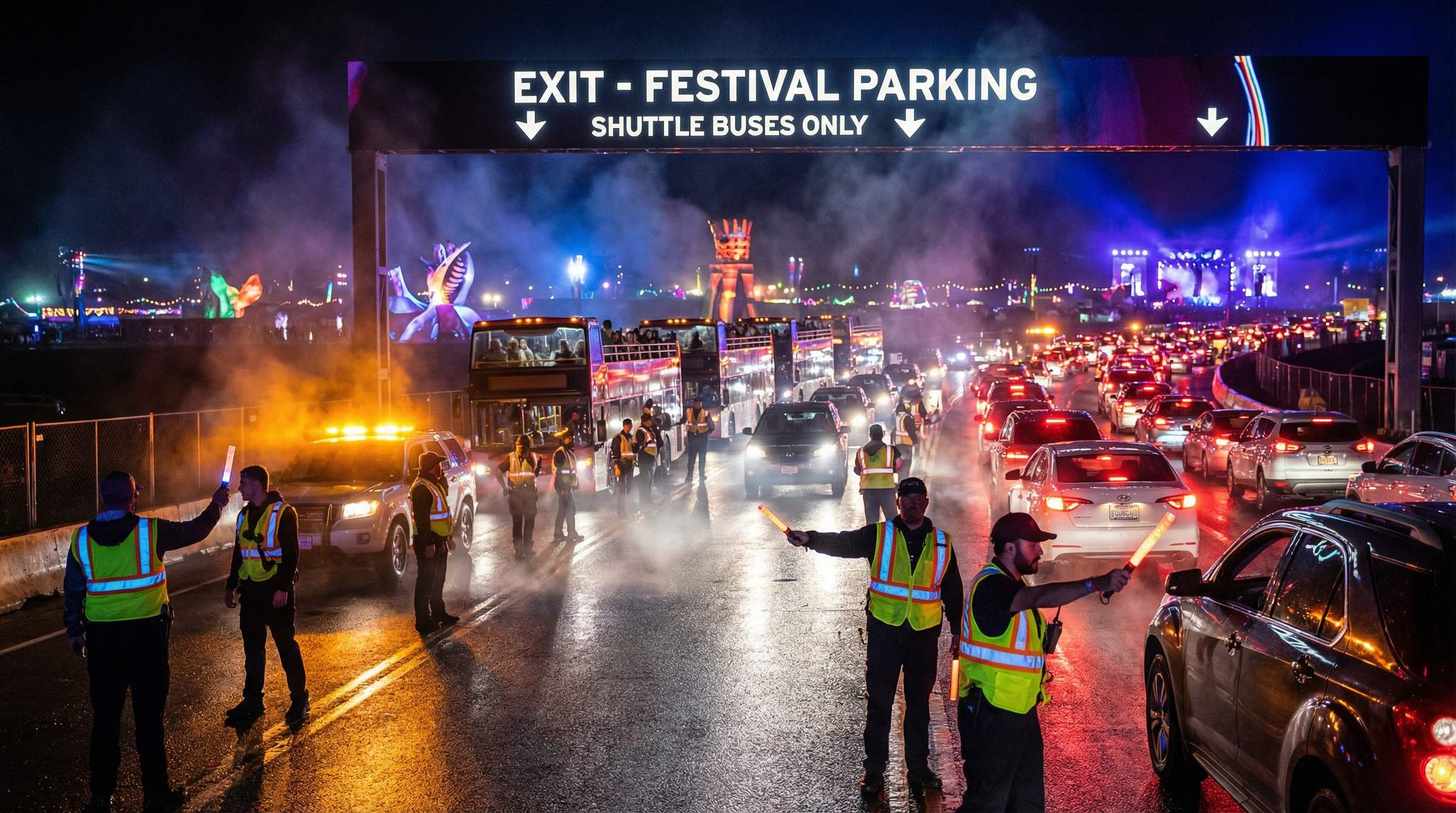
Staffing and organization are paramount during egress. An army of parking attendants and traffic controllers should be on duty as the event winds down. These staff should be wearing high-visibility gear and posted at every key junction: directing cars out of their rows, merging lanes systematically, and preventing unsafe behavior (like drivers cutting across areas or failing to yield). One effective tactic is to meter the flow of cars exiting: for instance, letting one parking lot or row out at a time in a controlled manner, instead of a free-for-all surge. Another strategy used at many big events is to temporarily hold vehicles until pedestrian crowds clear. Immediately after the final act, throngs of people will be walking to their cars or off-site, and mixing moving cars with heavy foot traffic is a recipe for accidents. Holding the cars for even 20–30 minutes (and communicating this clearly to attendees on signage or public announcements) can create a safer, faster exit once pedestrians have dispersed.
For multi-day festivals with camping, egress takes on an extra challenge: the mass departure on the last day. Encourage campers to pack up gradually and perhaps even stagger departures (some events let attendees stay an extra night to leave the following morning). On the final day, consider scheduling a closing activity or staggered exit times so not all 50,000 people hit the road simultaneously. Communication is key here – attendees should be informed of the best times to depart and what to expect. When everyone tries to leave at the same moment, even the best plans can be strained. (One iconic event, Burning Man, refers to its exit traffic as “Exodus,” and in 2022 it saw exit wait times of up to eight hours for thousands of vehicles. Festival organizers never want to see that happen at their event if it can be helped.) The goal is for attendees to leave safely and efficiently, with the positive vibes of the festival intact as they depart.
While ingress is often spread over several hours, the egress phase is typically a compressed, high-intensity operation. The core difference in managing these two phases lies in crowd psychology and lighting conditions. Egress usually happens in the dark with fatigued attendees, making high-visibility wayfinding and aggressive traffic metering non-negotiable. Organizers must calculate their ‘clearance time’—the total minutes required to empty the venue safely—and use this metric to benchmark the success of their concert traffic control efforts year over year.
Shuttles and Remote Parking Solutions
Using shuttle buses and remote parking can be a game-changer for reducing on-site traffic congestion. Festivals with limited parking or urban location constraints often rely on satellite parking lots, park-and-ride systems, or public transit hubs. When implementing a remote parking shuttle system, meticulous planning of shuttle logistics is crucial. First, communicate clearly to attendees where the remote parking or pickup locations are, and encourage their use by highlighting benefits (cheaper, easier, avoids the main traffic crush). Partner with local transit or coach companies to provide high-capacity shuttle buses at peak times. It’s better to have a few buses running empty during off-peak hours than swarms of frustrated attendees waiting in long lines because not enough shuttles are available during rush hour.
To support these shuttle systems, producers frequently negotiate seasonal or temporary parking arrangements during festivals or events. This often involves leasing adjacent farmland, partnering with nearby commercial lots that are empty on weekends, or utilizing municipal spaces. Securing these temporary leases months in advance is a cornerstone of reliable festival transportation, ensuring there is always enough physical space to stage vehicles before loading passengers onto buses.
Drafting clear contracts for these short-term land leases protects both the event organizer and the property owner. These agreements should explicitly outline liabilities, land restoration requirements, and exact usage hours to ensure the temporary parking setup runs without legal or logistical hiccups.
Coordinate shuttle schedules with the event timetable – for example, have more buses on hand right after the headliner set or at the camping kick-off and closing times. Designate specific drop-off and pickup zones for shuttles that are away from the general car traffic to avoid intermixing large buses with regular vehicles. Consider establishing separate traffic lanes into the site: one exclusively for shuttles and buses, so they aren’t stuck behind individual cars. Additionally, if the festival site is near a train station or a city center, organizers should coordinate with transit authorities to extend service hours or run special late-night trains. Many successful festivals use dedicated shuttles from airports, hotels, and central city locations – it not only eases road congestion but also provides a safer option for attendees who may be tired or intoxicated. Organizers should remember that a shuttle system is only as good as its execution. They should assign a team specifically to monitor shuttle operations and crowds throughout the event, and have backup buses or drivers on standby in case of breakdowns or surges in demand.
Beyond standard attendee shuttles, comprehensive festival transportation strategies often incorporate VIP transit options, ADA-accessible vehicles, and dedicated staff transport. Ensuring that artists, crew, and vendors have their own reliable routing prevents backstage bottlenecks and keeps the event’s production schedule running on time.
Signage and Communication on the Ground
Never underestimate the power of clear signage and active communication in preventing traffic chaos. Long before attendees reach the festival gates, they should encounter clear, prominent signs guiding them along approved routes. These can include directional arrows (“Festival Parking this way ?”), lane assignments (“Shuttle Buses Only” or “VIP Parking”), and warnings (“No Event Access for Next 5 Miles” to dissuade drivers from mistakenly entering off-limits areas). If possible, place signs at decision points well in advance – nobody should be slamming on the brakes at the last second because they almost missed a turn. Supplement signs with enthusiastic staff or volunteers acting as human signposts at critical junctions. A person in a safety vest with a flashlight or flag, proactively waving and pointing in the right direction, can clarify any confusion and add a friendly touch of guidance.
On-site, continue this clarity with well-marked pedestrian paths and traffic lanes. Use barriers, cones, and taped-off walkways to separate foot traffic from vehicle roads wherever they intersect. It’s also wise to have a public communications channel for traffic updates: for instance, festival radio announcements, a traffic Twitter feed, or updates in the festival’s mobile app that inform attendees about parking lot egress status or shuttle delays. When people know what to expect (“Lot A is releasing now, Lot B will begin in 15 minutes”), they tend to be more patient and cooperative. Good communication can turn a potentially frustrating wait into a more orderly experience because attendees aren’t left wondering why they’re waiting. In essence, keep the information flowing as smoothly as the traffic should be.
Separating Traffic Streams and Ensuring Safety
At larger festivals, one of the smartest moves is to segregate different types of traffic so they don’t conflict with each other. This means mapping out distinct routes and zones for shuttle buses, rideshare drop-offs, staff/vendors, and general attendee vehicles. Mixing these groups can lead to confusion and gridlock – for example, rideshare cars stopping in the middle of a road to pick up passengers can block hundreds of other vehicles if not given their own zone. Many big events create a dedicated rideshare and taxi lot or staging area, with its own entry and exit path. In the Coachella Valley, for instance, local officials direct Uber and other rideshare vehicles to a separate corner away from the main parking exits, while family drop-offs happen in a different designated area away from main exits. This kind of traffic segmentation prevents bottlenecks by ensuring that each stream (buses, private cars, rideshares, etc.) flows along a controlled path without cross-interference.
Pedestrian safety is an integral part of traffic control. Plan for where attendees on foot will walk as they leave and make sure those paths do not cross moving vehicle lanes without proper control. One approach is to temporarily halt outgoing cars to allow a big wave of pedestrians to cross safely, as mentioned earlier. In other cases, staff or police should actively manage key crossing points, or even restrict pedestrian access on certain busy roadways near the venue. If nearby neighborhood streets are at risk of festival-goers wandering in search of their rides or friends’ cars, consider having security or volunteers posted there to gently redirect people and discourage unsafe crossing or unintended parking in those areas. Good lighting in parking lots and along walkways is also essential for safety during egress at night.
Finally, always maintain an emergency access route that is kept clear at all times. Coordinate with fire and medical services on a plan so that if an ambulance needs to get in or out, it can do so even at the peak of traffic. This might involve an access road that only emergency and staff vehicles can use, or the ability to rapidly divert attendee traffic in a certain direction if needed. Safety should never be compromised for speed; with good planning, both safety and efficiency can be achieved.
Tailoring Plans to Festival Size and Audience
Transportation strategies should scale to the size and nature of each festival. A local boutique festival of 2,000 people might get by with a single parking lot and a few volunteers with flashlights, but a 100,000-person mega-festival demands professional traffic engineers and dozens of officers on duty. Adjust plans to the crowd size – larger crowds mean more robust infrastructure: more signage, more staff, more lanes, and possibly tools like real-time traffic monitoring or even drone surveillance to watch traffic flow from above. For a massive event, it could be worth hiring a specialized traffic management company or consultant to design simulations and contingency plans (for example, how to handle overflow if one lot fills up, or how to instantly communicate a reroute if an accident blocks a primary exit). As one expert notes, very large festivals may require this professional approach to handle the complexity.
Also consider the audience demographics and behavior. For festivals aimed at a younger crowd (like many EDM events), heavy carpooling and rideshare usage is likely – so investing in robust rideshare zones and shuttle options is essential. On the other hand, a family-oriented food festival might see most people driving minivans in for the day; here, organizers should emphasize convenient parking and perhaps handicap-accessible shuttles from distant lots for those with strollers or elderly family members. Urban festivals should coordinate with public transit schedules (encouraging the subway or buses and providing discounts for transit riders if possible) to reduce the number of cars downtown. In contrast, a rural camping festival will need to manage long two-lane country roads – maybe implementing one-way traffic patterns during peak ingress/egress or using highway message boards to separate festival traffic from local commuter traffic. In every case, organizers must understand their crowd and tailor the plan accordingly.
Producers can also draw valuable lessons from sporting event traffic control. Large-scale athletics and stadium matches often excel at rapid, high-volume ingress and egress because their venues are purpose-built for massive crowds arriving and leaving at exact times. While a multi-day music festival has a more fluid schedule, applying these stadium-level event traffic control tactics—such as dedicated express lanes for high-occupancy vehicles and strict directional zoning—can drastically improve the flow of any major traffic event.
When dealing with traveling attractions, special events traffic management for carnivals and community fairs presents a distinct set of logistical challenges. Unlike purpose-built stadiums or sprawling rural campsites, carnivals frequently activate in municipal parking lots, public parks, or downtown squares. This requires rapid deployment of temporary traffic control devices and highly visible pedestrian barricades to separate families walking between rides from active vehicle lanes. Organizers of these mobile events must work closely with city planners to secure short-term street closures and establish safe, accessible drop-off zones that accommodate a high volume of localized, single-day traffic.
Learning from the Past & Continuous Improvement
Even with the best-laid plans, expect the unexpected on event day. Weather, accidents, or higher-than-expected vehicle numbers can throw a wrench in traffic flow. That’s why having contingency plans (extra holding areas, tow trucks on standby for breakdowns, police ready to manual-direct an intersection if signals get overwhelmed) is so important. After each festival day, debrief with your team and with local authorities: What went well? What bottlenecks formed, and why? Did one parking lot empty slower than others? Use these observations to adjust the next day’s operations and to improve plans for future events. If one exit became gridlocked, maybe the plan should change to route some cars to an alternate gate the next day. If attendees were confused about where to go, perhaps the signage or communication needs an immediate boost.
Organizers should not shy away from investing in the exit experience. It’s tempting to focus on the entrance and not give the exit the same attention, but seasoned festival producers know the end-of-night is just as critical. A traffic meltdown at the close can dominate social media chatter and overshadow all the good memories made. Conversely, a speedy, safe exit leaves attendees impressed with the festival’s organization and more likely to return next time.
In the end, effective festival transportation management comes down to proactive planning and real-time management. It’s both a science and an art, requiring data-driven planning, coordination with traffic experts, and on-your-feet decisions when faced with human behavior and changing conditions. By treating traffic control as a priority on par with booking great artists or vendors, the next generation of festival producers will ensure their events are remembered for the music, food, and fun – not for the traffic.
Frequently Asked Questions
How should festival organizers coordinate with local authorities for traffic control?
Successful traffic control requires coordinating early with police and city officials to develop a comprehensive management plan involving temporary road closures and rerouted patterns. This collaboration secures necessary permits, ensures police officers are present to direct traffic at key intersections, and utilizes electronic message boards to alert drivers to detours or delays.
How can festivals prevent traffic jams during attendee arrival?
Preventing arrival congestion requires planning for peak times by assigning staggered arrival windows based on ticket tiers or offering early arrival incentives. Organizers should open parking lots with ample lead time, use clear signage miles from the venue to guide drivers, and maintain multiple lanes for ticket checks to avoid backups onto public roads.
What is the best way to manage festival traffic leaving the event?
Effective egress management involves deploying parking attendants to meter the flow of vehicles, releasing one lot or row at a time rather than allowing a free-for-all. Organizers often temporarily hold vehicles for 20–30 minutes after the final act to allow pedestrian crowds to disperse safely before cars begin moving to prevent accidents.
Why should festivals use shuttle buses and remote parking?
Implementing shuttle buses and remote parking significantly reduces on-site traffic congestion, especially for events with limited parking or urban constraints. High-capacity shuttles running from satellite lots or transit hubs decrease the number of individual vehicles entering the site, while dedicated shuttle lanes ensure these buses avoid getting stuck behind regular car traffic.
How do festivals handle rideshare drop-offs and pickups?
Large festivals segregate traffic streams by creating dedicated zones for rideshare vehicles separate from general parking and shuttle routes. This segmentation prevents bottlenecks caused by drivers stopping in active lanes. Officials direct rideshare services to specific staging areas with their own entry and exit paths to avoid cross-interference with other traffic streams.
How does signage improve festival traffic flow?
Clear signage placed miles from the venue prevents confusion by guiding attendees along approved routes and away from residential areas. Prominent directional signs, combined with staff acting as human signposts at critical junctions, help drivers make early decisions. This reduces sudden braking or missed turns that cause backups and frustrate local communities.
What do ingress and egress mean in event management?
In event management, ingress refers to the strategic process of safely guiding attendees, vehicles, and staff into a venue. Egress is the systematic and safe exit of those same groups from the event site. Both require dedicated concert traffic control plans to prevent bottlenecks.
How do organizers secure temporary parking for festivals?
Producers often negotiate seasonal or temporary parking arrangements by leasing adjacent farmland, partnering with local businesses for weekend lot usage, or working with municipalities. These temporary spaces are essential for staging remote parking and festival transportation operations.
What should a comprehensive concert traffic control plan include?
A robust concert traffic control strategy must detail ingress and egress routing, emergency vehicle access lanes, and pedestrian safety zones. Event organizers should also include staffing requirements for parking attendants, coordination protocols with local law enforcement, and contingency plans for severe weather or unexpected road closures.
How does festival transportation differ from sporting event traffic control?
While both require rigorous event traffic control, sporting events typically experience highly concentrated arrival and departure spikes tied to a game’s start and end times. Festivals often have staggered arrivals over several hours or days, but face similar mass-exodus challenges at the end of a headlining set. Organizers of both types of traffic events rely on heavy coordination with local police, segmented routing, and high-capacity shuttles to manage the load.
How do event organizers measure the success of ingress and egress operations?
Producers track key performance indicators such as vehicle processing rates per hour, average wait times at search lanes, and total venue clearance time. By analyzing these metrics, organizers can refine their concert traffic control strategies, ensuring smoother arrivals and faster, safer departures for future events.
How does traffic management differ for special events like carnivals?
Special events traffic management for carnivals and traveling fairs requires rapid deployment of temporary traffic control devices, as these activations often take place in municipal lots or public parks. Organizers must prioritize pedestrian barricades around rides and coordinate short-term street closures to safely accommodate high volumes of localized, single-day traffic.