Front-of-House (FOH) mixing at electronic music festivals is a high-stakes balancing act of power and precision.
These events – whether a thumping EDM festival in Las Vegas, a techno rave in Berlin, or a bass-heavy outdoor party in Sydney – demand chest-rattling low frequencies and crisp, punchy highs.
Achieving that electrifying sound without distortion or dropouts requires seasoned expertise.
From calibrating limiters to preserving dynamics, to managing loudness for global live streams, to preparing failsafe measures, festival audio teams must plan for every scenario.
This article passes down hard-earned wisdom on mastering FOH dynamics for electronic festivals: keeping the bass big and transients sharp without pumping, aligning loudness so recordings hit as hard as the live show, and implementing panic mute strategies and redundant chains to handle the unexpected.
Understanding the Strategic Role of FOH in Live Sound
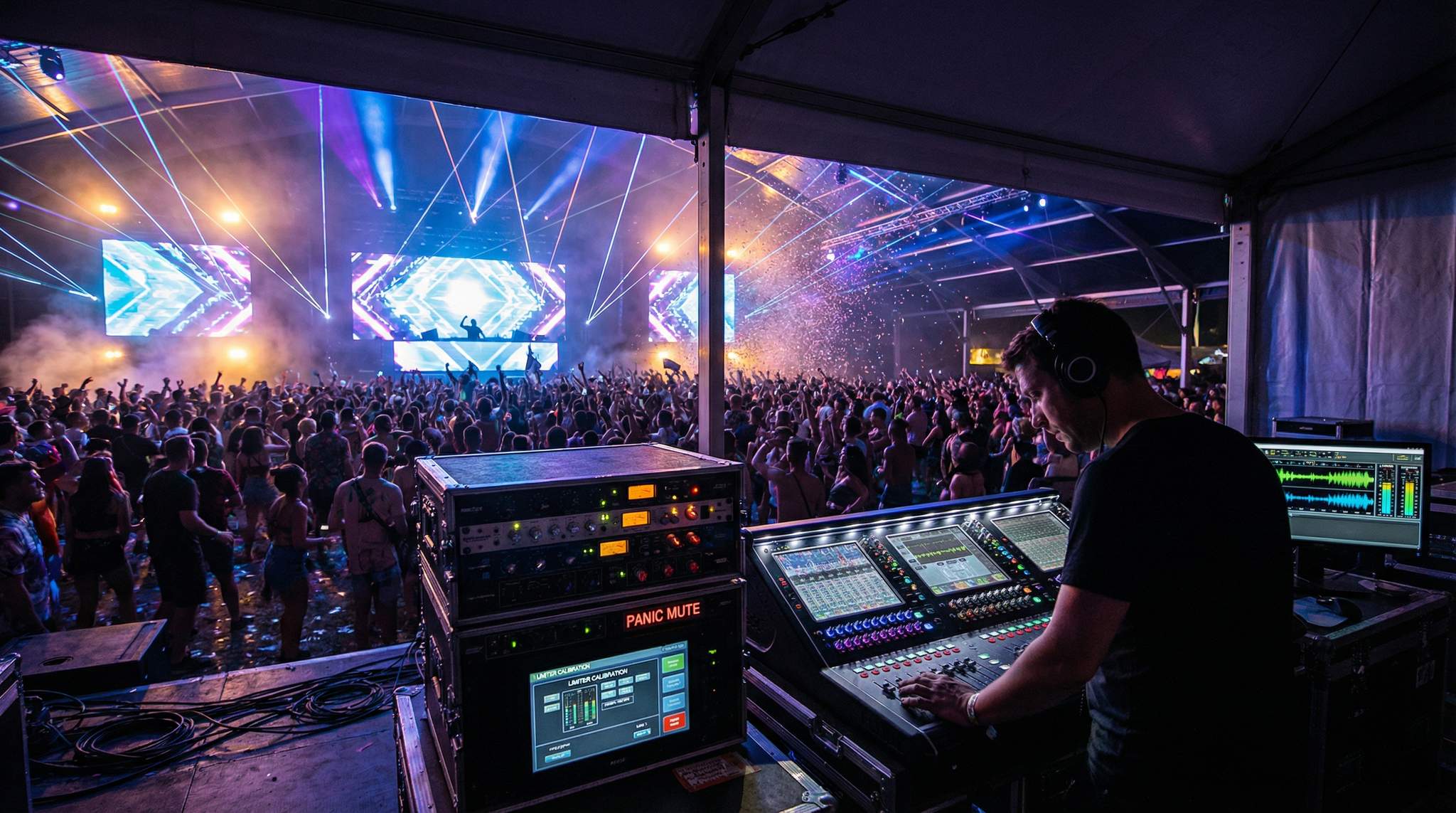
For festival producers and venue operators, understanding exactly what FOH is in music production is critical to delivering a premium audience experience. The Front-of-House position is the primary control center where the live sound mix is crafted for the crowd. Unlike monitor engineers who mix audio specifically for the performers on stage, the FOH engineer is responsible for the sonic translation of the artist’s vision to the ticket buyers. When dealing with electronic genres that are inherently and sometimes extremely loud in music venues, the FOH team acts as the ultimate gatekeeper. They balance the visceral impact of heavy bass with local noise ordinances and audience safety, ensuring the front-of-house music delivery is powerful yet controlled. Investing in top-tier FOH talent and equipment is one of the highest-ROI decisions a promoter can make to guarantee consistent, high-fidelity live sound across a multi-day event.
When evaluating the broader scope of FOH in events, organizers must recognize that this control center handles much more than just the audio mix. In modern festival production, the front-of-house footprint serves as the central nervous system for the entire show. It houses the lighting directors, video jockeys (VJs), laser technicians, and the show caller, all working in tandem with the live sound engineers. This synchronization ensures that when a massive bass drop hits, the visual elements trigger simultaneously, creating a cohesive, multi-sensory experience. For promoters, treating this area as a unified command post rather than just a sound booth is vital for executing complex, high-tier productions.
Designing the Front of House Music Footprint
Beyond the technical mix, the physical placement of the FOH booth is a critical logistical decision for festival producers. When determining the FOH meaning in music event layouts, organizers must balance premium audience space with the audio team’s need for perfect acoustic symmetry. The live sound control center is typically positioned dead-center, about two-thirds of the way back from the stage. While it might be tempting to shrink this footprint to sell more VIP tables, compromising the front of house music perspective can severely degrade the sonic experience for the entire crowd. A properly sized FOH structure must accommodate the main audio console, lighting desks, video control, and the necessary network infrastructure, all while providing a clear, unobstructed line of sight to the PA system.
When scaling up to a massive outdoor front of house festival environment, the logistical demands multiply. Unlike a fixed indoor club where the live sound infrastructure is permanently installed, a temporary festival site requires organizers to build a robust, weather-proof FOH compound from scratch. This means factoring in heavy-duty cable ramps, elevated platforms to ensure the audio team maintains a clear line of sight over tens of thousands of attendees, and dedicated power drops isolated from the stage lighting to prevent ground loops. For promoters, treating the FOH booth as a critical infrastructure hub rather than an afterthought is essential for delivering uninterrupted, high-fidelity front of house music.
Calibrating Limiters for Low-End and Transients (No Pumping)
Electronic dance music pushes sound systems to their limits – literally.
A continuous sub-bass line or a series of rapid-fire kick drums can easily trigger a limiter on the PA system or mix bus, causing audible volume fluctuations known as pumping.
To avoid this, festival sound engineers carefully calibrate limiters so they tame only the truly dangerous peaks without squashing the life out of the music.
Multiband limiting is a common strategy: for example, using separate limiters for subwoofers and high-frequency drivers.
This way, a massive bass drop can be reined in on the sub amps without dragging down the mid and high frequencies – preserving clarity and impact.
Planning a Festival?
Ticket Fairy's festival ticketing platform handles multi-day passes, RFID wristbands, and complex festival operations.
Another technique is to adjust the limiter’s attack and release times to suit electronic music’s profile.
A fast attack will catch sharp transients (like a snappy snare or clap) to protect speakers, but setting it too fast can dull the punch.
Engineers often use a moderately fast attack and a sidechain high-pass filter on the limiter’s detector – so it doesn’t overreact to deep bass content alone.
Release time is equally crucial: if it’s too short, the limiter will jitter and pump with every beat; too long, and it will hold down the volume between beats.
The sweet spot is a release just long enough to smooth out level changes, often timed to the music’s tempo (for instance, around an eighth-note or quarter-note length).
Before the festival, sound teams run calibration tests using tracks with heavy bass and sharp transients.
They observe the limiter’s gain reduction meter and listen critically.
If they hear the whole mix ducking whenever the kick drum hits, they know adjustments are needed – perhaps raising the threshold a bit or tweaking the release.
On the other hand, if transients like snare hits are distorting, they’ll increase the limiter’s ratio or lower the threshold slightly until those peaks are under control.
The goal is a transparent safety net: the limiters quietly protect the system from overload without the crowd ever noticing them work.
Real-world case studies underscore this point.
At a large outdoor festival in Australia, an FOH engineer encountered pumping during a dubstep set – the bass drops were so intense that the system’s full-band limiter clamped down on everything.
His solution was to split the PA feed: he routed the sub-bass to an auxiliary send with its own dedicated limiter, separate from the main mix limiter.
Immediately, the pumping vanished; the subs were kept in check while the vocals and synths remained loud and clear.
Fans on the dancefloor just felt clean, powerful drops with no unnatural swells or dips in volume.
For smaller festival setups without advanced system processors, it’s still possible to manage dynamics smartly.
Using the console’s mix bus compressor/limiter gently (or not at all) and relying on amplifier limiters for last-resort protection is one approach.
Also, consistently gain-stage the DJ mixers or playback devices feeding FOH – avoid sending an already over-compressed signal into another aggressive limiter.
An experienced festival audio tech will coordinate with the performing DJs and artists on soundcheck, ensuring their output levels are reasonable.
When the limiters are calibrated just right, the result is a solid, powerful low-end that stays punchy, and sizzling transients (hi-hats, handclaps, effects) that cut through the air without the whole mix lurching up and down.
Aligning Loudness for Livestreams and On-Site Experience
Today’s electronic music festivals don’t just entertain the crowd on-site – they often broadcast sets via livestream and record them for posterity.
However, anyone who’s watched a festival livestream from home knows that it can sometimes sound underwhelming compared to being in the front row.
A major reason is loudness mismatch.
On the festival grounds, music is felt physically; massive speakers pump out sound at 100+ dB SPL, enveloping the audience.
But a livestream or recording typically goes through loudness normalization, often measured in LUFS (Loudness Units Full Scale), to ensure consistent volume on phones, TVs, or computers.
Top festival audio teams align their LUFS targets for the broadcast mix with the festival’s on-site intensity, so that the recorded audio conveys the same energy as the live show.
This doesn’t mean making the stream as loud in absolute terms – that would violate broadcast standards and listener comfort – but rather preserving the balance and dynamics so the excitement translates.
For example, if a DJ’s set on the dancefloor has deep bass drops that hit hard, the broadcast mix should capture those drops in full, even if at a lower volume.
One practical tip is to maintain a slightly higher loudness target for festival streams (say around -14 LUFS integrated, common for music streaming platforms) instead of the quieter -23 LUFS used in traditional TV.
This ensures the stream isn’t too quiet or overly compressed when played back on consumer devices; viewers can hear the throbbing bass lines and sizzling synths appropriately, especially if they turn up their home subwoofers or headphones.
Need Festival Funding?
Get the capital you need to book headliners, secure venues, and scale your festival production.
Achieving this alignment starts with a separate broadcast audio bus or mixer feed.
Many festivals (from Tomorrowland in Belgium to EDC in the USA) employ a dedicated broadcast sound engineer who takes a matrix or split from the FOH console.
They’ll add subtle processing to bridge the gap between the huge live PA and a pair of stereo speakers at home.
This might include a touch of compression to glue the mix together at lower volumes, and EQ adjustments like a slight bass boost to compensate for the loss of physical sub impact.
Importantly, they also ride and match levels between tracks so that a quiet breakdown on the live stream remains engaging rather than dropping into near-silence.
Another crucial factor is incorporating the crowd ambiance and venue reverb into the stream.
What the on-site audience hears is augmented by the real-world acoustics – the cheers, the echoes, the rumble of the ground during a bass drop.
Recording a pair of ambient microphones at the festival and blending that into the livestream audio can work wonders.
It gives online listeners a sense of “being there,” which psychoacoustically can make the perceived loudness and excitement higher, even if the technical LUFS value is kept in check.
At a recent festival in Singapore, for instance, sound crews discovered that their initial livestream mix sounded sterile.
They solved it by raising the crowd mic levels and slightly widening the stereo image; suddenly, the recordings sounded like the floor felt – conveying that immersive, raucous atmosphere that the fans on-site experienced.
The key is monitoring and referencing.
FOH and broadcast engineers will often test-record a minute of the show during rehearsal or early in the day, then step out of the booming control room and listen to it on ordinary speakers or headphones.
This sanity check helps them adjust loudness and tonal balance.
By matching the subjective impression (does the recording give you goosebumps like the live sound does?) and hitting a sensible LUFS number, they ensure that someone watching the set from thousands of miles away feels a taste of the festival’s energy.
The end goal is that any official recording or livestream playback instantly transports the listener to the middle of that festival crowd, with punchy drops and sweeping melodies hitting just right.
Using panic mute Buttons and Redundant Chains for Safety
Live sound is unpredictable – especially on massive festival stages with complex setups, multiple DJs or live electronic acts, and myriad cables and connections.
In this environment, a smart FOH crew prepares not just for the best-case scenario, but for the worst.
Two lifesavers in a festival sound engineer’s toolkit are the panic mute and a redundant audio processing chain.
These are all about acting fast when things go wrong, and ensuring the show goes on with minimal interruption.
A panic mute is essentially an instant kill switch for the main PA output.
If a horrific noise bursts out of the system – think ear-splitting feedback, a DJ’s mixer sending out a dangerous signal, or an equipment meltdown producing loud hum or distortion – the FOH engineer might have only a second to react.
Instead of scrambling to find the offending channel, they hit one button that mutes all outputs to the mains (while ideally keeping the stage monitors or in-ear feeds alive so performers aren’t blasted).
Modern digital consoles often let you program a mute group or a macro that does this.
Analog desks might require slamming down the master faders or using an external mute switch device.
What matters is that the FOH team has practiced this move. Everyone at the mix position should know, at any moment, how to instantly silence the system.
It’s like a fire drill for audio – you hope you never need it, but when you do, it can save speakers from blowing and protect the audience’s ears.
Equally important is having a redundant processing chain for FOH.
Professional festival productions around the world (from Glastonbury in England to Ultra Music Festival in Japan) often deploy duplicate equipment in parallel, ready to take over if the primary system fails.
For example, the main FOH mixing console might be backed up by a secondary console or an emergency playback system.
In practice, that could mean a full second mixer receiving all inputs simultaneously (through an analog splitter or digital network) sitting powered on and idle.
If the primary console crashes or loses power, a quick flip of a switch or patch change could route audio to the backup mixer without having to replug dozens of channels.
Similarly, critical signal processors – like system EQs, loudspeaker management units, or even power amplifiers – can be set up in A/B pairs.
If one in the chain fails, the audio can be switched to the spare within seconds.
Beyond hardware backups, think in terms of signal path redundancy.
Is the FOH audio traveling to the amplifiers over a single cable or network? Better to double it up.
Many modern sound systems use dual-network protocols (for instance, redundant Dante or MADI lines) so that if one cable is accidentally severed or one network node glitches, the other path carries on seamlessly.
The audience never even knows there was a problem.
At a major festival in Mexico, an incoming thunderstorm momentarily knocked out the stage power to the FOH delays and truss lights – but the main PA kept running on backup power and audio feeds, allowing the crew to restore full operation before the crowd realized anything was amiss.
This kind of resilience comes only from planning and fail-safe designs built into the production.
Even on a smaller scale festival or club stage, redundancy can be a lifesaver.
If you can’t afford duplicate consoles, at least prepare a plan B.
For instance, keep a high-quality stereo music source (like a DJ mix on standby or an iPod with ambient music) plugged into a secondary input that bypasses most processing.
In a pinch, if something freezes or a laptop on stage crashes, you can fade in the backup music bed to avoid dead air while troubleshooting.
Another tip: maintain spare microphones, DI boxes, and cables right at FOH. The faster you can swap out a dead mic or eliminate a bad cable, the less likely the audience will even notice the hiccup.
Finally, the FOH crew should run through fault isolation drills during rehearsals or soundcheck.
Know how to systematically pinpoint a problem: if the sound goes out, is it the mixer output or the system processor? If there’s distortion, is it coming from a specific channel, the DJ’s gear, or a speaker amplifier?
Having a redundant chain means you can cross-check – for example, switch the mix to your backup output and see if the noise disappears, helping identify a faulty component quickly.
These practices turn catastrophic potential failures into minor blips.
Audiences might remember the mind-blowing bass and laser shows of the festival, but not even realize that behind the scenes, a quick-thinking crew averted a sound disaster in seconds.
That’s the hallmark of professional festival audio: prepare for the worst, and the show will always go on.
Wrapping Up: Dynamic Mastery and Preparedness
Mastering FOH dynamics at electronic music festivals is both an art and a science.
It involves finely tuned technical settings – from limiter thresholds to loudness targets – and an almost strategic foresight for handling crises.
The best festival sound teams around the globe share a common philosophy: deliver an unforgettable sonic experience, and do it reliably.
By calibrating systems to respect the music’s power, translating the live energy into recordings, and building in safety nets for the unexpected, they ensure that nothing stands between the audience and the music.
In essence, the goal is to have the crowd feeling every beat in their bones, while the engineers confidently navigate the controls knowing they’re ready for anything.
Key Takeaways:
- Calibrate your limiters (and compressors) so they protect the sound system without audibly pumping the mix. Preserve that deep festival bass and crisp transient detail by using multiband dynamics or sidechain filters as needed.
- Preserve the live energy in recordings. Aim for a reasonable LUFS loudness target for livestreams (e.g. around -14 LUFS) and incorporate crowd ambience, so that online listeners experience nearly the same impact as those on the festival floor.
- Implement a panic mute. Always have a one-touch method to mute the FOH output in case of ear-piercing feedback or technical malfunctions. This quick reaction can save your speakers (and your audience’s ears).
- Use redundant audio paths and gear. Whenever possible, deploy backup consoles, duplicate processors, secondary power sources, and parallel cables/networks. Redundancy means a single point of failure won’t silence the show.
- Plan and rehearse for emergencies. Run through scenarios with the crew – from swapping a bad cable to switching over to backup mixers – so everyone knows their role. Preparedness behind the scenes ensures the audience only ever hears a seamless performance.
Frequently Asked Questions
How do sound engineers prevent pumping in electronic music?
Engineers prevent pumping by using multiband limiting to process sub-bass separately from mid and high frequencies. They also adjust limiter release times to match the music’s tempo and apply sidechain high-pass filters, ensuring the limiter reacts to dangerous peaks rather than constant bass energy. This preserves punchy transients without causing the entire mix to fluctuate volume.
What is the ideal LUFS target for festival livestreams?
A target of approximately -14 LUFS integrated is recommended for festival livestreams to ensure the broadcast conveys the same energy as the live show. This level prevents the audio from sounding underwhelming or too quiet on consumer devices while maintaining enough dynamic range to capture the impact of heavy bass drops and sizzling synths.
What is a panic mute in live sound engineering?
A panic mute is an emergency function that instantly cuts all audio output to the main PA system during critical failures. FOH engineers use this pre-programmed button to immediately stop ear-splitting feedback, distortion, or dangerous signals from equipment meltdowns, protecting both the loudspeaker components and the audience’s hearing before troubleshooting the issue.
How does redundancy work in festival audio systems?
Redundancy involves deploying duplicate equipment and signal paths, such as backup mixing consoles and parallel network protocols like Dante or MADI. If a primary cable is severed or a processor fails, the system automatically or manually switches to the secondary chain. This fail-safe design ensures the performance continues seamlessly without the audience realizing a technical glitch occurred.
Why do engineers use ambient microphones for livestreams?
Ambient microphones are used to blend the sound of the crowd, cheers, and venue acoustics into the broadcast mix. This technique helps replicate the immersive, physical sensation of being on the dancefloor for home viewers. Adding these real-world acoustic elements increases the perceived loudness and excitement of the stream without violating broadcast volume standards.
How should limiter attack and release times be set for EDM?
Limiter attack times should be moderately fast to catch sharp transients like snares without dulling their punch. Release times are best set to match the music’s tempo, such as an eighth-note or quarter-note length, to smooth out level changes. This configuration prevents the limiter from jittering or holding down the volume unnaturally between beats.
What is FOH in music production?
FOH, or Front-of-House, refers to the primary audio mixing position where engineers control the live sound that the audience hears. For festival organizers, the FOH team is responsible for balancing the front-of-house music mix, managing volume levels, and ensuring the audio translates clearly from the stage to the crowd.
How do festival organizers manage extremely loud live music?
Organizers manage extremely loud live sound by employing experienced FOH engineers who use advanced system processors, multiband limiters, and strict SPL (Sound Pressure Level) monitoring. This ensures the music remains physically impactful for the audience without exceeding legal noise ordinances or causing hearing damage.
What is the difference between FOH and monitor mixing in live sound?
While the front of house music mix is directed outward to the audience, monitor mixing is dedicated entirely to the performers on stage. The FOH engineer focuses on delivering a balanced, powerful live sound experience for the crowd, whereas the monitor engineer ensures DJs and musicians can clearly hear themselves through stage wedges or in-ear monitors.
What are the key differences between a club FOH and a front of house festival setup?
A front of house festival setup requires building temporary, weather-resistant infrastructure from the ground up, including elevated mixing platforms, long-run fiber optic or heavy-duty analog cable snakes, and isolated power sources. Unlike indoor venues with fixed acoustics, outdoor live sound engineers must also account for wind, temperature changes, and strict municipal noise limits bleeding into neighboring areas, making system design and real-time monitoring far more complex.
What is the role of FOH in events beyond just the audio mix?
While primarily known for live sound control, FOH in events serves as the central command hub for the entire production. It houses lighting directors, video technicians, laser operators, and show callers. This centralized setup allows the visual and audio teams to synchronize their cues perfectly, ensuring that the front of house music mix aligns flawlessly with the stage production for a cohesive audience experience.