Gamification: Turning Events into Interactive Playgrounds
The Rise of Playful Engagement in 2026
In 2026, live events are becoming interactive playgrounds rather than passive experiences. Organizers are increasingly weaving game elements into conferences, festivals, and trade shows to captivate audiences. This rise of event gamification comes as no surprise – modern attendees are hungry for participation and novelty. Traditional one-way content often isn’t enough to hold attention; instead, adding challenges and rewards turns spectators into players. Research confirms that game mechanics significantly boost engagement, with studies showing that classic tools like points, badges, and leaderboards can dramatically increase user motivation, as gamification statistics become more prevalent. What was once a trendy experiment is now a mainstream strategy for events of all sizes.
Why Games Grab Attendees’ Attention
Gamification works because it taps into basic human psychology: we all love to play. Earning points, achieving goals, and competing for prizes trigger our natural desires for achievement and fun. At events, this translates into higher excitement and involvement. Instead of passively wandering a show floor or sitting through sessions, attendees actively hunt for clues, complete missions, and chase rewards. This not only keeps them engaged longer, it makes the experience more memorable and social. Play drives participation – when attendees are playing a game, they’re fully present and interacting with the content, the environment, and each other. In fact, gamified experiences have been shown to boost attendee engagement by substantial margins (30–60% in some cases), effectively demonstrating the ROI of play. The competitive element also sparks friendly interaction, as people talk about the challenges and collaborate or compete. It’s a formula that events around the globe are embracing to delight attendees and differentiate themselves.
Tech Innovations Enabling Gamified Experiences
Several tech trends converging in 2026 have made on-site gamification more powerful than ever. Smartphone penetration is nearly universal among event-goers, which means organizers can reliably use mobile apps and QR codes for interactive challenges. Event apps have evolved with built-in game modules, from trivia and polls to scavenger hunt features. RFID and NFC technology is now commonplace via wristbands or smart badges, enabling seamless tap-based games and attendance tracking. Meanwhile, high-speed 5G and robust event Wi-Fi networks allow real-time updates, live leaderboards, and rich media experiences (like AR scavenger hunts) without lag. Even if connectivity hiccups occur, many apps offer offline modes or data sync later to ensure the game doesn’t pause. Even simple attractions can work, helping you maximize exhibitor ROI and attendee engagement while you dramatically boost booth traffic. Augmented reality (AR) has matured too – event organizers can overlay digital clues or creatures onto the venue through attendees’ phone cameras, creating a Pokémon Go-style adventure. In short, the tech needed to turn an event into an interactive game – from mobile platforms to sensors and displays – is more accessible and reliable than ever. This has opened the floodgates for creative gamified activations that simply weren’t feasible a few years ago.
Gamification Strategy and Design Principles
Defining Goals and Metrics for Play
Before jumping into high-tech toys, it’s critical to craft a game plan for your gamification initiative. Start by defining what you want to achieve with on-site games. Common goals include increasing session attendance, driving foot traffic to certain areas (e.g., sponsor booths or lesser-known stages), boosting networking among attendees, educating the audience on key themes, or simply enhancing overall satisfaction. Being specific with objectives helps in designing challenges that align with those outcomes. For example, if your goal is to get attendees exploring the whole venue, a scavenger hunt that spans all corners of the site makes sense. If the goal is more attendee networking, a game that rewards meeting new people would be ideal. Alongside goals, decide on metrics to track: number of participants, completion rate of challenges, sponsor booth visits recorded, social media mentions, or even upticks in on-site spending during the game period. These metrics will be your scorecard to evaluate success later. By setting clear goals and KPIs up front, you ensure the gamified elements aren’t just fun for fun’s sake, but actually drive meaningful engagement that you can measure and learn from.
Smooth Entry With Mobile Check-In
Scan tickets and manage entry with our mobile check-in app. Supports photo ID verification, real-time capacity tracking, and multi-gate coordination.
Aligning Games with Event Theme and Audience
The most successful event games feel like a natural extension of the event’s content and vibe. Align the game design with your theme, brand, and audience. A corporate tech conference might incorporate trivia about industry facts or easter eggs hidden in the conference content, whereas a music festival could have quests related to artists or art installations. The gamified elements should reinforce what the event is about. As veteran festival producers have learned, the best interactive challenges fit the festival’s identity, whether that means music trivia at a music fest or interactive challenges to educate attendees about sustainability. Also, consider the demographic: a young, tech-savvy crowd will embrace a smartphone-based AR adventure, while an older or family-oriented audience might prefer a simpler approach (like a paper “passport” to stamp at various stations). It’s wise to offer multiple participation options if your crowd is diverse – for instance, providing both a digital QR code hunt through the app and a physical stamp card version with friendly language instructions. This ensures no one feels left out due to technology comfort levels or accessibility needs. By tailoring the gamification to your event’s theme and attendees, you’ll create an experience that resonates and feels authentic rather than “tacked on.”
Game Mechanics 101: Points, Badges, and Leaderboards
At the heart of any gamified experience are the game mechanics – the rules and systems that make the activity engaging. The fundamental toolkit usually includes points, badges/achievements, and leaderboards. How you implement these should tie back to your goals. Points are the simplest currency of engagement: attendees earn points for each desired action (attending a session, visiting a booth, answering a quiz, etc.). Make sure the point values reward the behaviours you value most – for example, a feedback survey might be worth more points than a simple check-in, to encourage quality participation. Badges or achievements are milestones that recognize attendees for hitting certain goals (like visiting all zones, or completing a specific set of challenges). They provide a sense of progression and collection – some attendees will be motivated to “collect all 10 badges,” for instance. Leaderboards tap into our competitive spirit by publicly showcasing top performers. A live leaderboard (in-app or displayed on screens) can spur friendly competition as people see their names climb (or vow to climb) the ranks. However, use leaderboards thoughtfully: decide whether the competition is individual or team-based, and consider resetting or capping points at times so latecomers don’t feel it’s hopeless to catch up. Done right, these mechanics create a compelling feedback loop – attendees act, get immediate rewards (points/badges), see their progress, and are motivated to continue. The result is continuous engagement throughout the event, rather than just sporadic attention.
Ready to Sell Tickets?
Create professional event pages with built-in payment processing, marketing tools, and real-time analytics.
Keeping It Fair and Fun
While designing the game, ensure the experience remains fun, fair, and safe. Simplicity is key – attendees should be able to understand how to play within a minute or two. Provide clear instructions in your app, on signage, and during announcements. The challenges should be achievable and not overly time-consuming; if it’s too hard or too easy, people will disengage. Balance competitive elements so that it’s not always the same hardcore few participants winning everything. For instance, you can incorporate some random prize draws (so anyone can get a reward just for playing) in addition to skill-based leaderboards. This keeps casual players interested. It’s also important to plan for fairness and safety: avoid any game mechanics that might encourage unsafe behavior (like running through crowds to be first) or cause bottlenecks (e.g., if everyone tries to scan the same checkpoint at once). Stagger challenges or offer multiple locations for tasks to prevent congestion. Monitor for cheating – e.g., someone finding a loophole to earn points repeatedly – and have rules in place (like one scan per booth, app login tied to one user, etc.). Finally, have staff or volunteers designated as “game guides” who can help confused players, verify winners, and gently enforce the rules. By anticipating these factors, you’ll maintain an even playing field and an enjoyable atmosphere for all participants. Remember, the goal is to add joy and excitement to the event, so the gamification should always enhance the experience, not overshadow or disrupt it, perhaps by offering exclusive player perks. Planning with a focus on fairness and fun will ensure your game earns high marks from attendees, utilizing tools to connect attendees and build community.
Mobile App Adventures: Scavenger Hunts and Quests
Venue-Wide Scavenger Hunts via QR Codes
One of the most popular forms of event gamification is the classic scavenger hunt, supercharged with mobile tech. Using the event’s mobile app or simply a smartphone camera, organizers hide QR codes or clues around the venue for attendees to find. Scanning a code can deliver a riddle, a hint to the next location, or award points towards completing the hunt. This approach turns the entire event site into a playground for exploration. For example, the i Light Singapore festival created an interactive quest called “i Quest” that spread 19 unique QR codes across art installations and booths. Scanning each code transported visitors into a virtual mangrove forest on their phone, illuminating one section at a time, and entered them into instant prize drawings. Those who managed to find and scan all 19 codes completed the digital forest and qualified for a grand prize (in their case, a S$1,000 cash draw). The result? Attendees were highly motivated to visit every corner of the festival, and the game reinforced the event’s sustainability theme by engaging players with eco-images. Countless events have adopted similar QR treasure trails – from art exhibitions to comic-cons – because they reliably drive foot traffic and discovery. The keys to success are to make the clues challenging but not frustrating, tie the scavenger items into the event content (themes, sponsor products, etc.), and offer a satisfying payoff for completion (a prize, a badge, public recognition, or a special experience). With a well-designed scavenger hunt, you’ll have attendees excitedly swapping hints and trekking all over, ensuring no part of your event stays overlooked.
Augmented Reality Quests and AR Treasure Hunts
Taking scavenger hunts a step further, some events are using augmented reality to create even more immersive quests. AR treasure hunts let attendees interact with digital objects overlaid on the real-world venue through their smartphone cameras. Imagine using your phone to see a hidden AR mascot pop up on the expo floor, or pointing it at a conference poster to reveal a secret code word. These AR elements add a magical, game-like layer to the physical event space. Major festivals have experimented with AR gamification – for instance, Coachella introduced a gamified quest in 2024 that incorporated AR and Web3 elements, rewarding attendees with digital collectibles for completing challenges. The Coachella Quests had participants use the festival app to solve puzzles and find AR markers, driving engagement across all the stages, art installations, and sponsored activations. With nearly 50,000 quests completed during the festival, it’s safe to say the AR approach was a hit. Smaller events can also leverage AR affordably now, thanks to frameworks like WebAR (which works in a browser, no app install needed) and creative platforms that offer template AR scavenger hunts. The appeal of AR is that it delivers a “wow” factor – it feels like a mini adventure game in real life. However, do ensure that your audience is likely to participate (tech-savvy attendees with newer smartphones) and have a backup for those who can’t or won’t use AR, such as a parallel non-AR version of the game. When done right, augmented reality quests are a futuristic way to surprise and delight attendees, creating share-worthy moments (imagine the social media posts of people chasing AR creatures at your event) and deepening engagement through interactive storytelling.
Interactive Storylines and Missions
Not all scavenger hunts are just collections of standalone clues – some events design interactive storylines that unfold as attendees progress. This blends elements of immersive theater with gamification. For example, a tech conference might craft a narrative that a “mischievous AI” has hidden Easter eggs throughout the venue, and participants act as “hackers” solving each puzzle to stop its antics. Each clue solved advances the story. An extreme (and impressive) real-world example is the Boomtown Fair in the UK. This music and arts festival essentially turned their entire venue into a living RPG (role-playing game): the site is divided into districts with actors and hidden quests, and festival-goers become characters in an evolving story, transforming festival-goers into participants within an immersive city realm. One year, attendees might help a character stage a jailbreak or gamble in a make-believe casino – all part of the embedded narrative. People spend hours not just watching performances but actively playing along with the story, acting as space explorers completing a mission that stretches across the whole festival. This creates a deep emotional investment in the event. While most events won’t go to Boomtown’s scale of theatrical gamification, the lesson is that a great storyline can hook people’s imagination. Even a conference could add a light narrative (“Help our mascot recover lost conference slides by completing tasks”) to make challenges more engaging. Themed missions – like a space-themed “mission to Mars” at a science expo or a historical time-travel quest at a museum night – work similarly. The storyline approach works best when it fits the event’s personality and when you have the resources to craft and guide the narrative. If you do, you’ll turn a series of tasks into an epic adventure attendees will talk about long after.
Turn Fans Into Your Marketing Team
Ticket Fairy's built-in referral rewards system incentivizes attendees to share your event, delivering 15-25% sales boosts and 30x ROI vs paid ads.
Rewarding Exploration and Completion
Central to scavenger hunts and quests is the concept of rewarding attendees for exploring and learning. The journey itself is fun, but a cherry on top motivates far more participation. Many events use a mixture of instant rewards and grand prizes. Instant rewards can be small freebies or perks earned along the way: for instance, scanning a particular QR code might give an attendee a voucher for a free snack, or completing a mini-quest might unlock a digital badge (which could be shown at an info booth for a sticker or token). These little rewards keep people keen on continuing, because they feel progress and gratification. At the end of a hunt or storyline, it’s common to offer a larger prize or entry into a prize drawing for those who finish 100% of the tasks. We saw this with i Light Singapore’s quest – each scan entered visitors into a lucky draw for hundreds of vouchers, as the scavenger hunt motivated participation, and completing the whole set qualified them for a big cash prize, which entered players into a draw. Prizes might include event merchandise, sponsor products, discounts on next year’s tickets, VIP upgrades, or special experiences (meet-and-greets, backstage tours, etc.). Aside from tangible prizes, don’t underestimate the power of recognition – announcing the winners on stage or featuring top scavenger hunt finishers on the event’s social media gives people bragging rights and a sense of accomplishment. The combination of fun exploration with a clear payoff at the end is what really drives attendees to engage fully. Essentially, you’re saying: the more you participate and discover, the more you earn. This can tangibly boost how much of your event an average attendee experiences. Instead of sticking to one area, they’ll roam widely, soak in more content, and interact with more exhibitors or features – which is exactly what you want as an organizer.
RFID and NFC-Based Challenges: Tapping into Engagement
Checkpoint Challenges with Smart Badges
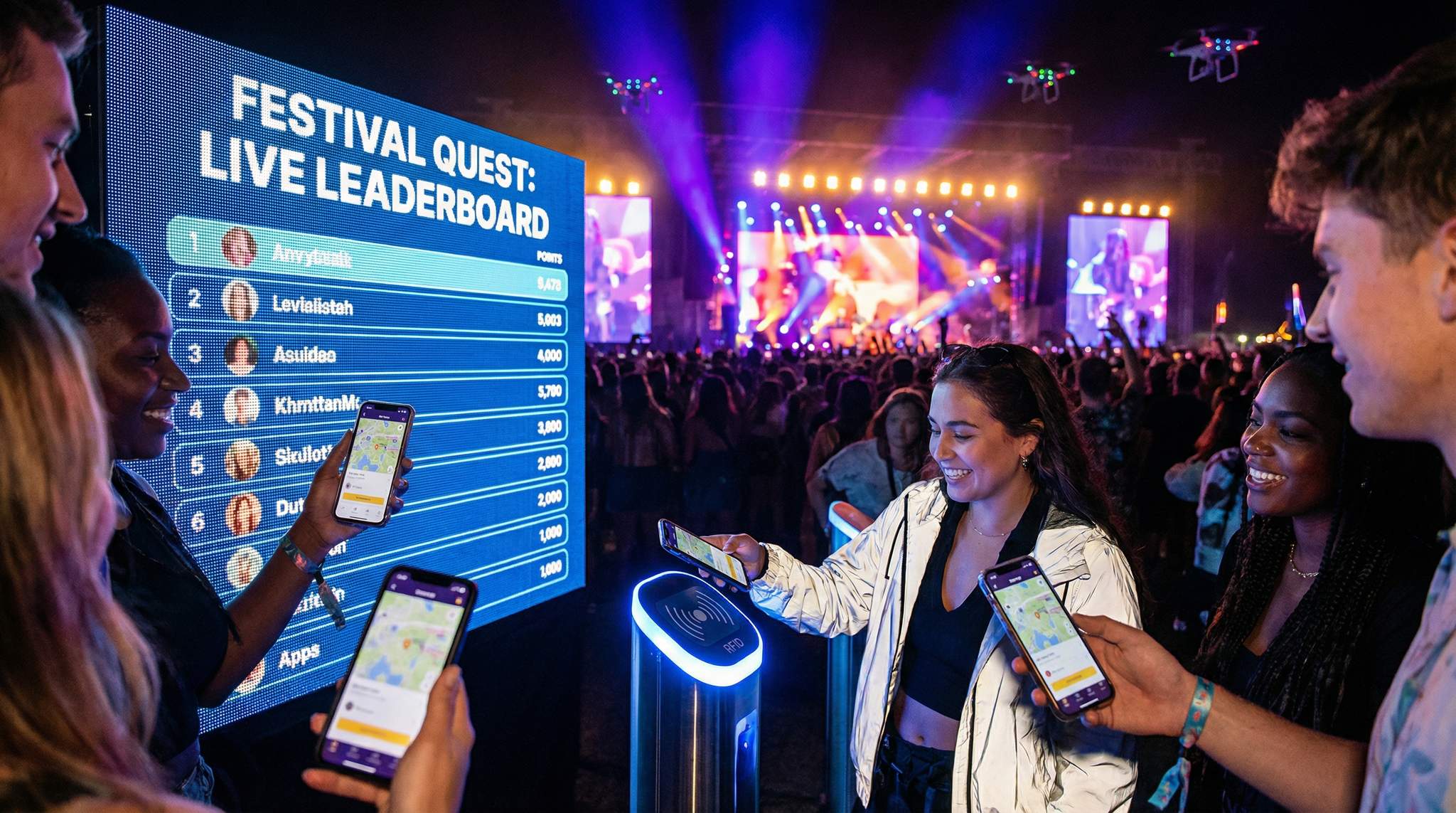
Another powerful on-site gamification approach leverages RFID (Radio Frequency ID) or NFC technology embedded in attendees’ badges or wristbands. These smart credentials already facilitate seamless entry and cashless payments at many events – and they can double as game tokens. One format is the checkpoint challenge, where attendees tap their badge at various stations to record their visit or complete a task. For example, a large convention might deploy RFID readers at key points of interest (certain booths, demo areas, or info kiosks) and challenge attendees to “visit all 10 checkpoints to win a prize.” As participants tap at each location, the system logs their progress (often updating in the event app or a webpage). This works much like a scavenger hunt but can feel more seamless since it’s just a quick tap – no need to scan QR codes or take out your phone camera. Checkpoint challenges are great for drawing traffic to specific areas you want to highlight. A trade show could use it to drive attendees to sponsor booths: e.g., “Tap your badge at all Gold Sponsor booths to unlock a special reward.” In fact, event organizers often integrate such digital passport systems into their apps – attendees get a checklist of places to visit and earn points or stamps automatically via NFC taps, as the app keeps track of their journey. The impact can be dramatic: one health products expo ran a badge-tapping scavenger hunt and saw thousands of extra booth visits as attendees enthusiastically made the rounds to complete the challenge, often submitting quiz responses for points. When designing RFID/NFC games, ensure the check-in process is reliable and fast (test those readers!), and have visible signage or staff encouraging people to tap. It’s also wise to display progress (like “7/10 checkpoints completed” on the app) to motivate folks to finish the set. With the smooth user experience RFID provides, checkpoint challenges are an easy win to boost exploration and exhibitor engagement.
Grow Your Events
Leverage referral marketing, social sharing incentives, and audience insights to sell more tickets.
Networking Games and “Connection Bingo”
Smart badges can also facilitate networking-focused games. One clever idea many conferences use is a form of “Networking Bingo” or a connection challenge. The concept is simple: encourage attendees to meet a number of new people or specific types of people. For instance, you might create a game where attendees get points or a badge for every unique connection they make using their smart badge. This can be done by having a feature in the event app to scan each other’s QR codes or tap NFC badges when two people have a conversation. Some event apps include built-in mini-games for networking; for example, an icebreaker challenge might prompt: “Find someone who traveled from another country” – once you find such a person, you scan each other’s badges to both get credit by scanning each other’s QR code. These kinds of games nudge attendees to mingle beyond their usual circles. Another approach is offering rewards for networking actions: “Meet at least 5 new contacts and get a free drink ticket,” or “If you collect 10 business connections, you’ll be entered into a VIP reception raffle.” By turning networking into a friendly game, you give the less outgoing attendees a structured reason to approach others. One pro tip: emphasize quality over quantity in the rules – for example, you could require that connections be mutual in the app (both people accept the connection) to rack up points. When thoughtfully executed, networking gamification significantly boosts participation in networking activities, proving effective for encouraging participation. Attendees who might otherwise linger alone feel empowered to jump in, and many report that they met people through the game, which is a win for community building. The end result is a more connected, community-like vibe at your event – and participants appreciate that, because making new professional or social connections is often a primary reason they came in the first place.
Gamified Check-Ins for Sessions and Workshops
Beyond expo floors and networking mixers, gamification can spice up how attendees engage with educational sessions and breakouts. A straightforward tactic is to award points or badges for checking into sessions via the event app or by tapping a badge at the session door. This incentivizes people to show up on time and check out more talks. You can take it further by integrating live polling or quizzes during sessions as part of the game. For example, each session could have a couple of quiz questions in the app – attendees earn extra points for answering correctly (and maybe just a smaller point award for answering at all, to encourage participation even if unsure). Some conferences turn Q&A into a game: attendees submit questions through the app and get upvoted by others; the ones whose questions get answered by the speaker receive points or a shout-out. Leaderboards by knowledge can form if you have a trivia competition across sessions, or even a team-based contest where different breakout rooms compete for the highest quiz scores. The key is to use gamification to enhance learning, not detract – the questions or challenges should reinforce the session content or encourage attentive listening. By rewarding people for engaging with sessions (instead of checking email in the back row), you not only make the talks more interactive, but also gather valuable insight on attendee learning if you analyze quiz results. As a case in point, a tech company’s user conference introduced a session-check-in game with a simple twist: every session you attended and checked into increased your chance of winning a premium giveaway at the closing reception. They saw a noticeable uptick in session attendance, especially for early morning slots that are typically sparse. In short, a little gamification in session participation can drive attendees to consume more of the content you worked hard to program – and enjoy doing it.
Linking Games to Cashless Spending
An emerging trend is tying gamification to on-site spending and commerce. With more events going cashless, it’s possible to track purchases by attendee – and thus create challenges around buying behavior. For example, a music festival might set up a game where every purchase at a food stall or merchandise tent earns you points (perhaps 1 point per dollar spent, or flat points per transaction scanned by your wristband). Attendees who hit a certain point threshold by the end of the day could get a bonus reward like a coupon or a free merch item. This essentially rewards attendees for spending more on-site, boosting revenue while making the spender feel appreciated. One real-world approach was seen at a multi-day festival that offered a “loyalty quest”: attendees who made at least one purchase at each of the five main food zones got a special limited-edition pin. This drove avid festival-goers to explore all the dining options (increasing overall F&B sales) and provided a collectible keepsake as an incentive. Another example: conventions might partner with vendors for a “shop & win” game, where each vendor booth purchase gives a code to enter into the app for a chance at a grand prize. Organizers need to be cautious with spending-based gamification to avoid any perception of pay-to-win. The incentives should be positioned as thank-yous for supporting vendors, not as attendees literally buying their way to victory. But done tastefully, cashless gamified rewards can lift spend – some events have seen average attendee spending jump by 20–25% when they introduced bonus incentives for cashless adoption. It’s a win-win: vendors see more business, and attendees have fun trying new products or treats in pursuit of points and prizes. Just be sure to advertise these promotions clearly and make the process seamless at the point of sale (staff should know to remind people, and the system must register the purchase to the game reliably). When integrated well, tying gamification to commerce can turn a routine transaction into part of the play.
Live Leaderboards and Real-Time Feedback
Big Screen Leaderboards and Digital Signage
One of the most exciting elements you can introduce to an on-site game is a live leaderboard that everyone can see. Human beings are naturally competitive and curious – show us a scoreboard and we instantly pay attention. At events, organizers are using digital signage and big AV displays not just for maps and schedules, but to showcase game leaderboards in real time. Imagine a conference lobby screen rotating through “Top 10 Trivia Masters of the Day” or a festival stage LED wall that occasionally flashes the “Scavenger Hunt Leaders – 5 codes found!” updates. These public displays whip up friendly competition and also continually remind attendees that the game is on. Seeing their name on a leaderboard can be a thrill for participants (and a motivator to keep going), while those not playing yet may be intrigued to join when they notice the competition. For team-based games, showing a team leaderboard (e.g., Red Team vs Blue Team points) can create a fun group camaraderie and some spirited rivalry across the crowd. When implementing leaderboards on signage, ensure the data updates smoothly – ideally integrated directly from your game platform or app backend. Also consider the frequency and locations: you might have dedicated screens for the game or just insert slides periodically between speaker sessions or during changeovers on stage. Visibility is key: if the game is a big focus, put the leaderboard near high-traffic areas (registration, main halls) so it’s always in view. However, also be mindful not to embarrass anyone – e.g., it’s best practice not to show last place or negative connotations, only highlight the leaders or milestones achieved (keep it positive). By making the game’s progress highly visible, you stoke the competitive fire and create a shared experience all attendees can rally around and talk about.
In-App Progress Tracking and Notifications
While big screens are great for atmosphere, the event app remains the command center of most gamified experiences. Within your app, it’s important to give players real-time feedback on their personal progress and the overall game status. This means including features like: an in-app leaderboard or ranking display, a dashboard of the user’s own points/badges, and perhaps a progress bar for any ongoing quest (“You’ve completed 3 of 5 challenges!”). Frequent feedback keeps people engaged – it’s the dopamine hit that their actions are being recognized. Push notifications can amplify this: for example, if someone cracks into the Top 10, the app could send a congratulatory notification (“You’re now 7th place out of 250 players!”). Likewise, as the event nears its end, you might push reminders (“Just 1 hour left to complete the scavenger hunt!”) to create urgency. In-app messaging can also highlight daily winners or surprise mini-challenges (“Flash Challenge: earn 50 extra points if you visit the Innovation Lab by 3pm!”). These tactics re-engage users throughout the event and keep the momentum going. It’s also a good idea to enable some social features in the app around the game – for instance, allowing players to share their achievements or invite friends to join the game. Some events have a feed where attendees post photos or updates when they hit milestones, effectively generating buzz. Just be careful to not overwhelm people with notifications – make them meaningful and maybe allow users to opt-out if they only want to check status manually. Overall, a well-designed in-app experience for the game acts like a personal scoreboard and coach, nudging attendees to complete one more mission or check how they stack up. This continuous feedback loop is what sustains engagement from day one until the final moments of the event.
Team Competitions and Collaborative Play
While many gamification elements focus on individual accomplishments, there’s a lot of power in team-based games at events. Humans are social creatures, and forming teams can ignite even more participation as people rally together. There are a few ways to implement team competitions. One approach is to pre-assign teams (perhaps by badge color, ticket type, or at random) and have all attendees contribute to their team’s score through their actions. For example, a large conference might divide attendees into four “houses” Hogwarts-style, and every quiz answer or connection made by any member adds to that house’s total. This creates a fun, underlying narrative for the event – you suddenly have teammates and a shared goal with strangers. Another method is to let attendees form their own small teams (2-5 people) for certain challenges, encouraging colleagues or new acquaintances to partner up. Some events do this for escape room challenges or photo scavenger hunts, where groups work together to solve puzzles. Live leaderboards for teams can then be displayed, fostering camaraderie (“Go Team Blue, we’re in the lead!”) and some playful trash-talk between groups. A great example was a marketing summit that ran a “city-wide marketing quest” where attendees were grouped by region – North vs South vs East vs West – competing in various challenges. It spurred a lot of cross-department mingling as people teamed up with those from their region who they might not normally talk to, all in effort to help their side win. When designing team games, ensure that teams are balanced and that everyone has a roughly equal chance to participate (e.g., if one team has far more members, you might weight scores by team size or have multiple leaderboards by team size category). Also, consider recognizing not just the top team but perhaps shout-outs for things like “Most Spirited Team” or “Best Team Costume” if you allow that element – this keeps it light and inclusive. The beauty of team gamification is that it builds community: attendees feel a sense of belonging and mutual encouragement, which can greatly enhance their overall event experience.
Celebrating Achievements and Winners
A critical aspect of gamified engagement is how you acknowledge and reward the top players or all players when the game comes to a close. After all, people put effort into your challenges – celebrating them leaves a lasting positive impression. There are many ways to do this, and you can mix multiple methods:
- Prize ceremonies: If feasible, announce winners on the main stage or during closing remarks. Hand out prizes in person for a photo op. Even if the prize is modest, the public recognition makes it special. Calling someone up as “Our scavenger hunt champion” or “the top networker of the event” can be very memorable for that attendee (and shows others that these games are worth participating in).
- Digital shout-outs: Use your event’s social media or email follow-up to congratulate winners and participants. You could tweet “Congratulations to Jane D., who solved all 10 puzzles in our conference game!” or include a “Hall of Fame” section in the post-event email/newsletter with top scorers listed. This gives attendees some bragging rights they can share on LinkedIn or with colleagues.
- Prizes and perks: Of course, have your prize rewards ready as promised. These might range from trophies and medals to free tickets to next year’s event, gadgets, gift cards, or sponsor-provided gifts. Ensure the prize aligns with the effort – a grand prize for the overall winner, plus maybe a few runner-up prizes or raffle draws so multiple people get something. Some events also give every participant a small token (like a digital certificate or a discount code) to thank them for playing, which is a nice touch especially if you want to encourage them to return.
- Certificates or badges: In professional events, you might award digital certificates for participation or completion (useful if the game had a learning component, as attendees can show they engaged fully). Less formally, digital badges in the app or community platform can remain on their profile as a memento (“Level 5 Adventurer – Completed 2026 Summit Challenge”).
- Feedback and reflection: Consider asking winners or participants for a quick quote or feedback about the game – you can display these comments (“It was so much fun exploring the venue through the game!”) on screen or in your recap. It underlines the success of the engagement.
By highlighting achievements, you wrap up the gamified experience on a high note. This not only makes the winners happy, but also signals to all attendees that these activities were a meaningful part of the event. It encourages those who might have skipped this time to take part next time. And crucially, it transitions the energy of the game back into the overall event narrative – you show that the event wasn’t just about sessions or music, but about the vibrant participation of the community. In essence, celebrating the gameplay reinforces the message that everyone’s engagement made the event better.
Rewards and Incentives: What’s in It for Players?
Crafting a Points Economy that Guides Behavior
When implementing gamification, one of your design tasks is to set up the “points economy” – essentially, how people earn points or progress and what those points mean. A well-crafted points system will nudge attendees towards the actions you value most. To do this, list out all the interactions or tasks in your game and assign point values reflecting their importance. For example, in a conference game, you might give 5 points for checking into a session, 10 points for asking a question in the app, and 20 points for visiting a sponsor booth. If you’re doing a festival scavenger hunt, maybe each QR code found is 100 points, but finding a secret bonus code is 500. The key is balancing the distribution: straightforward or easy tasks get small rewards; harder or more impactful actions get more. Be transparent (usually) about these values so players know how to strategize. Some organizers even publish a “game guide” listing how to earn points. However, you can also keep a few high-value secret tasks that only reveal if someone stumbles on them (to add a bit of mystery). Another consideration is whether points are finite (the game ends and highest score wins) or redeemable for rewards like a currency. In a redeemable model, you’ll need to decide redemption rates (e.g., 100 points = 1 raffle ticket, or points can be spent in an in-app store for swag). Make sure whatever economy you choose, it can’t be easily gamed – if someone can farm points infinitely by exploiting a loophole (say, repeatedly refreshing a QR code), that’s a problem. Put limits: one check-in per session, one scan per location, etc. Test the system and run the math: what’s the max points someone could reasonably get, and does that align with your expectations? A solid points economy not only motivates engagement, it also keeps the game fair and competitive. It’s essentially the backbone of your event’s mini-universe of play, so spend time to get it right.
Choosing Prizes and Perks that Motivate
Let’s face it – prizes are a huge motivator in getting people to fully engage with a gamified experience. The good news is, the prize doesn’t always have to be expensive; it just has to be desirable to your audience. When selecting rewards, consider what attendees would genuinely value. For many events, experiential prizes work great: VIP upgrades (like better seating or lounge access), meet-and-greets with speakers or artists, backstage tours, or free tickets to future events spark a lot of excitement and don’t always cost you much directly. Physical prizes are popular too – electronics (tablets, headphones), gift cards, travel vouchers, high-end merchandise – you might procure these via sponsors. If your event has merch, a bundle of swag or limited edition items can also be attractive. Cash prizes or scholarships will definitely get interest if it fits the context (e.g., a competition at a collegiate event). Keep in mind the scale of the prize relative to the effort: if you’re asking a lot (like multi-day involvement), the carrot should feel worth it. On the flip side, even small fun rewards can drive behavior for simpler tasks. Things like drink tickets, free snack coupons, or event-branded souvenirs (t-shirts, pins) handed out as instant wins make people smile and participate more. Some events have success with point redemption stores: for example, accumulate points and “buy” something at a prize booth – this way many people can get a reward of their choice (small items for fewer points, bigger for more). Also, consider recognition as a reward: a certificate, a shout-out from the CEO for the top contributor, a “Champion” badge on their profile – these intangible rewards still carry meaning. In choosing rewards, you can even survey past attendees on what they’d like. Ultimately, aligning prizes with your audience’s interests ensures you’re offering true motivation. A well-chosen prize or perk can be the difference between someone deciding “nah, I won’t bother with the game” and “okay, challenge accepted!”
Instant Gratification vs. Grand Prizes
A successful gamification design often balances short-term rewards with long-term prizes. Instant gratification is all about giving players something to celebrate quickly after they accomplish a task. This could be as simple as a congratulatory animation in the app (“You found the hidden key! +50 points!”) or a small tangible prize they can claim immediately (like a sticker every time you visit a new booth, or a piece of candy for answering a quiz). These bite-sized rewards keep people engaged by rewarding effort, not just ultimate victory. They also inject fun throughout the experience – attendees get little dopamine hits each time they do something right. On the other hand, grand prizes create excitement and incentive for the ultimate goal. Knowing that “the top scorer wins a new iPad” or that “completing all tasks enters you into the grand raffle for a $500 travel voucher” gives the competitive folks something to strive for and maintains interest until the end. It’s wise to advertise the big prize clearly so everyone knows what’s at stake. The mix of both instant and grand rewards caters to different player personalities: those who just enjoy playing will appreciate the small perks along the way, and the highly competitive will gun for the big win. For instance, a conference might hand out branded pins or goodies at each booth when you check in (instant reward), but also announce that anyone who collected all pins is eligible for a major prize draw at closing (grand prize). This way even participants who don’t win the grand prize still feel it was worth it because they got small rewards and enjoyment in the process. Striking the right balance is important – too many instant rewards without a big payoff might fizzle out interest eventually, while only having a distant grand prize might not sustain engagement initially. By combining both, you keep the satisfaction flowing and the tension rising, ensuring maximum participation from start to finish.
Sponsor-Powered Rewards and Challenges
Gamification also presents a fantastic opportunity to involve sponsors in a meaningful way. Instead of a sponsor just slapping logos on things, they can become an integral part of the game, benefiting both the attendee experience and the sponsor’s goals. One approach is to have sponsors provide or brand some of the rewards. For example, a tech sponsor might donate a gadget as a grand prize, or a beverage sponsor could offer free drink coupons as instant prizes. This gives sponsors positive exposure (“Thanks to Acme Co., you get a prize!”) at the exact moment attendees are happiest (when they win). Another approach is to create sponsor-themed challenges: e.g., a sponsor could host a special quest or mini-game at their booth. Perhaps a car company sponsor sets up a racing game station where participants compete for points, or a travel sponsor has a trivia wheel related to destinations – integrated into the event’s overall game. When done well, attendees don’t see it as an ad – it’s just another fun activity – but it drives foot traffic to that sponsor. In fact, RFID and app-based games have been used to drive thousands of extra visits to sponsor booths by making them checkpoints or task locations, as attendees enthusiastically made the rounds. Sponsors love this because it increases engagement with their brand in a positive way. A case in point: many festivals and expos now run “passport” contests where each major sponsor has a QR code at their stand; attendees who scan all sponsor codes complete the passport and get a prize. This guarantees each sponsor gets a moment with the attendee. When integrating sponsors, just ensure the game still feels attendee-centric (it should be genuinely fun or rewarding, not a tedious ad chore). Also, limit how many sponsor tasks one has to do so it doesn’t come off as overly commercial. If balanced, sponsor activations become highlights of the gamified journey, not detours. As noted in industry discussions, gamified sponsor experiences can boost sponsor ROI and attendee enjoyment simultaneously, turning first-timers into loyal fans and encouraging them to stay on site to join the fun. It’s a true win-win: attendees get more to do and win, sponsors get more interaction and data, and you as the organizer deepen your partnerships while financing some of the game elements via sponsorship.
Recognition and Community Building
Rewards in gamification aren’t just about points and prizes – recognition itself is a powerful reward that can enhance the attendee experience and build community. Gamified engagement gives you many opportunities to publicly acknowledge participants, which in turn fuels a sense of belonging and accomplishment. We touched on leaderboards and winner announcements earlier; here, let’s emphasize how recognition can be structured to reward different levels of participation, not just the very top achievers. For instance, you might publish a list of all attendees who completed the scavenger hunt, not only the fastest – framing it like a roll of honor (“These 148 attendees completed every challenge — give them a hand!”). If your system allows, you could even give everyone personalized stats at the end (“You placed 45th out of 500 players, great job – you were in the top 10%!”), which makes people feel good about their effort regardless of win/lose. Social recognition is important too: encouraging players to share their achievements on social media (maybe with an event hashtag and a branded photo frame in the app for “I conquered the quest!”) turns them into micro-influencers for your event and gives them a personal promotional moment. Within the event, if someone does something exceptional (like being the very first to finish a quest, or helping others during the game), don’t hesitate to mention those anecdotes on stage or online. It humanizes the whole experience. Also consider ending the event with a highlight reel or recap that includes the gamification: e.g., show a slide like “Collectively, attendees unlocked 3,000 clues, completed 2500 challenges, and walked a combined 500 miles exploring the venue!” — this kind of summary gives everyone a sense that they accomplished something together. It reinforces community by showing that the audience’s active participation was a big part of the event. By recognizing players not just as individuals but as a contributing group, you build a shared pride and increase the likelihood they’ll return next time (maybe to defend their title or recruit friends to join the fun too). In short, thoughtful recognition transforms a set of disparate games into a unifying event narrative about attendee engagement and community spirit.
Real-World Success Stories: Gamification in Action
Festivals: From Coachella to Niche Local Events
Large music festivals have been early adopters of on-site gamification, using tech to add new dimensions to the fan experience. A shining example is Coachella (USA), which in recent years introduced the Coachella Quests – a series of gamified scavenger hunts and challenges set across the festival grounds. In 2024, these quests combined digital and physical clues, and the response was massive: nearly 50,000 quests were completed by attendees over the two weekends (Coachella Quests gamified scavenger hunts). Players who solved puzzles could unlock exclusive perks, like access to a secret lounge or listening parties for unreleased tracks, which created a huge buzz on-site as the hunt kept attendees energised. The festival’s aim was to drive engagement to all the attractions (art installations, sponsor activations, etc.), and indeed gamification proved a great way to get feet on the ground everywhere. On the other side of the world, the i Light Singapore light art festival implemented its “i Quest” QR treasure trail to educate and entertain visitors, rewarding them with instant prizes and a S$1,000 grand prize opportunity for completing the quest, as the scavenger hunt motivated participation. This led to full-venue exploration and an immersive link between the game and the festival’s sustainability theme, helping to educate attendees about sustainability. Even smaller-scale festivals are doing it: food & wine festivals might have tasting passports (sample all brew vendors to win a glass), city arts festivals hide “easter egg” art pieces around town that attendees track via app, etc. The case studies consistently show higher attendee satisfaction and dwell time. For instance, festival-goers often report the games gave them “something extra” to do between shows and made the whole day more engaging. Importantly, festivals have seen gamification boost sponsor traffic and vendor visits since players must interact with those elements in the course of play, leading to a richer overall experience, provided you tailor challenges to match the audience, turning first-timers into loyal fans. From global events like Tomorrowland and SXSW to regional cultural fairs, turning a festival into a partial game zone has proven to be a hit for keeping crowds entertained and energized.
Conferences and Expos: Driving Engagement and Leads
Professional conferences, trade shows, and expos have also reaped big benefits from gamified attendee engagement. A notable example comes from a tech industry conference in the USA, where a major SaaS company set up a leaderboard quiz challenge at their booth. Attendees answered five trivia questions on a tablet about industry trends, got a score and saw their rank on a screen. This sparked friendly competition – many people came back multiple times, day after day, aiming to beat the high score. The outcome was great for the company: not only did they collect hundreds of leads (each participant entered their info), but attendees remembered their booth as “the one with that fun quiz game,” creating a positive brand association for those who completed the challenge. Meanwhile, at a large health products expo, organizers integrated a digital scavenger hunt via the event app. Attendees earned points for visiting specific exhibitor booths and checking in by scanning a QR code on the booth poster. Those who completed the circuit qualified for prize drawings. The result was a surge in booth traffic – some vendors reported hundreds more visits than the previous year, directly attributed to the game, and overall lead collections went up ~25% compared to normal, representing significant gains for exhibitors. Exhibitors were thrilled, and attendees had fun treating the expo like a mission to complete. Even smaller-scale B2B events have had success: for example, a European finance conference gamified its session feedback process. Attendees earned badges (and a chance at a raffle) for providing ratings and comments via the app for each session they attended. This yielded a record feedback volume, giving organizers richer insights while attendees felt heard and engaged. The pattern across these stories is clear – when you turn parts of a conference or trade show into a game, attendees interact more deeply with content and exhibitors. It breaks the ice, drives networking and lead generation, and makes the event more lively. As one event technology adoption report noted, gamification helped push a conference’s event app adoption to over 85% usage, far above average with avg 30+ interactions per user, because people were eager to participate in the challenges. These real-world outcomes underscore that gamification isn’t just gimmicks; it delivers tangible ROI in attendee activity and satisfaction.
Niche and Community Events: Creative Engagement
Gamified engagement isn’t only for massive events – smaller and community-focused events are using it creatively too. Take the example of a regional comic-con style fan convention. Organizers there implemented a weekend-long “Heroes vs. Villains” game narrative. Upon arrival, attendees were sorted (randomly) into two teams – Heroes or Villains – via a unique QR code on their badge. Throughout the con, they could earn points for their side by completing tasks like answering trivia at panel sessions, finding hidden comic logos in the venue, or winning quick mini-games at certain booths. A live scoreboard showed the tug-of-war between Heroes and Villains, and by the closing ceremony, one team triumphed and all its members got a small prize (and bragging rights and a trophy photo). The friendly rivalry had attendees talking and collaborating (“We need more heroes at the cosplay contest, come join us!”). It not only entertained, but also encouraged folks to attend diverse program items they might have otherwise skipped (since each activity offered points). In another instance, a local food festival introduced a “Tasting Treasure Hunt.” Visitors picked up a game card that listed various unique dishes to try from different vendors. Tasting each one earned a stamp; collecting all stamps could be traded in for a commemorative T-shirt. This simple gamification boosted vendor sales (people were buying items just to get the stamp and complete the set) and led attendees to explore the entire festival rather than sticking to one area. Community events have gotten imaginative on low budgets too: a library’s book fair created a scavenger hunt for kids with riddles leading to different book genres, using nothing more than printed clues and stickers as rewards – attendance and time spent at the fair jumped noticeably compared to previous years. These examples show that scale isn’t a barrier: even events with a few hundred attendees can benefit from playful interaction. Often, smaller events see an outsized impact because the games create a bonding experience among attendees who all start to feel like they’re part of a close-knit community challenge. With a bit of creativity, gamification can be tailored to fit any theme – be it a sustainability fair running an eco-challenge, a charity walk with achievements for hitting distance milestones, or an academic symposium with a poster presentation bingo. The possibilities are endless, and the successes across niches reinforce that people of all ages and interests enjoy a good game that adds value to their event journey.
The Bottom Line: Engagement, Satisfaction, and Spend
Across these global case studies, some common threads emerge. First, gamification reliably boosts engagement metrics: higher participation in activities, more content consumption, and longer dwell times. Attendees who might have left early stick around to finish a quest or see how the competition ends. Second, attendee satisfaction scores tend to rise. Post-event surveys often show increased enjoyment and a sense that the event was “more engaging” or “uniquely fun.” People love feeling like an active part of the event rather than just an audience member, and games facilitate that. Third, there’s often a positive impact on on-site spending and ROI. Festivals report increased concession sales when games drive people to all corners of the venue (they buy food when they end up in a new area). Trade shows and sponsor ROI improve with the boost in booth traffic and lead generation – which in turn helps you retain and attract sponsors, impacting the bottom line. One festival that added a cashless payment reward game (spend X amount to get a bonus) saw average attendee spending jump significantly, contributing to a healthy revenue uptick thanks to the bonus incentive strategy. Finally, gamification can produce a wealth of data and insights: you learn which attractions were most visited (via scans), how attendees moved through your event, what content drew interest through quizzes, etc. This data can help you refine layout, scheduling, and content for future editions. Taken together, the real-world evidence makes a compelling case that when done thoughtfully, gamifying the attendee experience is far more than just a novelty – it’s a strategic tool that can delight your audience, build community, and drive tangible returns for your event’s success.
To summarize some of these success stories and their outcomes, the table below highlights a few real and illustrative examples of gamified activations at events of different types and the results they achieved:
| Event & Context | Gamified Activity | Outcome / Impact |
|---|---|---|
| Coachella (USA) – Major music festival | Festival-wide digital scavenger hunts (“Coachella Quests”) with puzzles and AR elements | ~50,000 quest completions; drove exploration of all stages & art areas, unlocked exclusive fan experiences (Coachella Quests gamified scavenger hunts) as the hunt kept attendees energised. Created huge buzz and attendee excitement on-site. |
| i Light Singapore – Light art festival | “i Quest” QR code treasure trail across 19 installations, with instant voucher prizes and grand prize draw | Increased foot traffic to every art installation; hundreds of prizes claimed; reinforced sustainability theme through interactive storytelling, as the scavenger hunt motivated participation and helped to educate attendees about sustainability. Higher attendee engagement and education. |
| Boomtown Fair (UK) – Immersive music festival | Full-fledged interactive storyline and role-play throughout the venue (performers, hidden missions, team puzzles) | Deep attendee immersion – many spent as much time playing the “game” as watching performances, transforming festival-goers into participants and creating a deep emotional investment in the event. Drove strong loyalty and word-of-mouth; festival differentiated by its unique gamified world. |
| Tech Conference (USA) | Quiz challenge at sponsor booth with live leaderboard (5-question industry trivia on tablet) | Large increase in booth engagement; attendees made repeat visits to improve scores for those who completed the challenge. Company collected valuable leads and data (quiz answers) while attendees remembered the booth as a highlight, representing significant gains for exhibitors. |
| Trade Expo (Global health products) | Event app digital passport: attendees earned points for visiting 10 designated exhibitor booths (QR code check-in at each) | Thousands of additional booth interactions generated; some exhibitors saw ~20–35% more leads as attendees enthusiastically made the rounds. Attendees reported enjoying the expo more due to the “hunt,” leading to higher satisfaction scores. |
These examples demonstrate that whether it’s a massive festival or a niche trade show, gamified engagement strategies can yield measurable benefits in participation, satisfaction, and even financial returns. Crucially, they all kept the focus on enhancing the attendee experience while meeting event goals – a balance that is key to successful implementation.
Implementing Gamification in Your Event: Best Practices
Planning the Experience from the Attendee’s View
Implementing a gamified experience requires careful planning and experience design. Put yourself in the shoes of an attendee and map out the entire journey of the game: How will they discover it? How do they learn the rules? What actions do they need to take, and when/where? One best practice is to create a simple storyboard or user flow chart for the game before you build anything. This helps identify any confusing steps or potential bottlenecks. For instance, if you realize that five challenges all funnel people to the same location to claim a prize, you might end up with a queue – so you’d tweak the design to spread things out. It’s also important to timing: decide if your game runs the whole event or has specific hours/rounds. Some conferences introduce a new mini-challenge each day to keep things fresh, whereas a festival might have the game continuously running in the background. Next, coordinate with all event departments – programming, operations, marketing – to embed the game into the event fabric. If a challenge involves a session or a speaker, loop them in so they know to mention it. If it involves a sponsor booth or a specific venue area, ensure those stakeholders are prepared (and maybe have a small sign “Scan here for points!” at their spot). Testing is critical: long before attendees arrive, do a dry run of the entire game with staff or a focus group. This will catch issues like QR codes not scanning well in bright light, trivia questions that are too easy or hard, or a mobile app flow that’s not intuitive. During planning, also prepare for various “what-ifs”: What if Wi-Fi fails? What if far more people play than expected – do we have enough prize stock? What if almost no one plays – do we have a plan to promote it more on-site? By thinking through the attendee experience in detail and planning for contingencies, you set your gamification project up for success. Essentially, treat it like an attraction within your event that deserves its own mini project plan, because the smoother and more engaging the game flow, the more your attendees will love it.
Choosing the Right Technology Platforms
Selecting the right tech platform or tools to power your gamification is a crucial decision. Fortunately, you don’t always have to build from scratch – many event tech providers and apps offer gamification features out of the box. Start by auditing your existing event tech: does your event app have a built-in game or engagement module? For example, some event apps support scavenger hunts, QR code missions, live polling with scoring, and badge scanning games natively. Leveraging an integrated solution can save time and ensure data flows into one system. If your current tools are limited, look at specialized gamification platforms. There are products specifically for event scavenger hunts, interactive expo games, and audience engagement that can often integrate with your registration or app via API or SDK. When evaluating tech, consider: What interactions does it support? (QR scanning, AR, trivia, leaderboards, etc.), Is it usable offline? (very important if Wi-Fi is spotty – some native apps will queue scans and sync later), Customization and branding options, and real-time analytics access (you want to monitor progress during the event). Also check the ease of use for attendees – requiring a separate app download just for the game can be a barrier. If possible, embed the game in your main app or use web-based tools that don’t need installation. Don’t forget the hardware side: if you use RFID/NFC, you’ll need badge readers or tap stations – decide whether those will be handheld units with staff or self-service kiosks, and plan their network connectivity and power. Data security and privacy should be checked too (especially in Europe with GDPR – if the game collects personal data, be clear in consent forms). It might sound like a lot, but many events partner with experienced vendors who have done it before, which can simplify implementation significantly. Take time to read case studies or talk to references for any platform you’re considering – learn how it performed under real event conditions. The right tech choice will ensure the game runs reliably and scales to your crowd, letting you focus on the content and fun rather than troubleshooting software during showtime.
Network Infrastructure and Connectivity
Behind every tech-enabled activation is the often unsung hero: network infrastructure. If your gamification relies on mobile app usage, scanning, or real-time updates, you are inherently depending on internet connectivity at the venue. To avoid turning a fun game into a frustrating experience, it’s essential to bulletproof your event network. Start with assessing the venue’s Wi-Fi coverage and capacity – you’ll need strong, stable Wi-Fi (or cell coverage) especially in the areas where gameplay will happen most (e.g., expo halls, lobbies, stage areas if AR is used there). Work with the venue IT team or bring in your own network vendor to ensure enough access points and bandwidth. If using RFID tap stations, see if they connect via Ethernet, Wi-Fi, or even offline and batch-sync; plan accordingly so no station is out of range. Offline capability is a major plus for gamification tech – for example, some RFID systems will log taps internally even if the network blips, then upload when back online, preventing data loss. Test all QR codes or AR markers under site conditions ahead of time – sometimes glossy posters and spotty signals don’t mix, so you might adjust placement (placing codes where there’s strong signal or less glare). Consider local caching: if your app has content (like AR models or quiz questions), make sure it downloads upfront or caches so that each interaction doesn’t pull heavy data. It’s also wise to have a backup connectivity plan: maybe a few cellular hotspots as a failover, or even paper-based game sheets as a last resort so the game can continue if tech fails. Some events set up a dedicated support network for critical components (for instance, ensuring that leaderboard screens or kiosks are hard-wired via Ethernet to avoid Wi-Fi issues). Basically, don’t skimp on networking – it’s part of your event’s foundation. As many an organizer has learned, tech is only as good as the network it runs on, and investing in robust connectivity and testing can save you from on-site headaches, so be sure to educate attendees for seamless transactions and remember that boosting attendee adoption of event tech requires a solid network. If all this sounds daunting, engage with professional event network providers who can manage Wi-Fi arrays and monitor traffic live during the event. With solid infrastructure, you ensure that when attendees eagerly open their app to play or scan a code for points, it just works – quickly and reliably.
On-Site Promotion and Participant Onboarding
You can design the greatest event game ever, but it won’t matter if attendees don’t know about it or understand how to play. That’s why on-site promotion and onboarding are so important. Begin priming attendees before they arrive: use pre-event emails and social media to announce the gamification program. Explain what kind of fun to expect (“Join our event scavenger hunt for a chance to win big prizes!”) and consider giving a quick “how-to” or an example challenge to pique interest. Encourage people to download the event app early if that’s where the game lives – some events even offered early app download incentives or previews of the game to boost adoption, using incentives to turbocharge pre-event engagement and ensuring downloads before a certain date. At the event, make a splash about the game from the start: have signage at registration (“Download the app and play our Event Game – earn points for exploring!”), include a one-pager in the welcome packet with instructions, and have the emcee or keynote speaker announce it on Day 1. You might run a very simple icebreaker challenge immediately (like “Open your app and answer today’s poll question to earn your first points now”) to get people engaged and familiar with the interface. Staff or volunteers should be briefed to act as game ambassadors – roaming the venue with “Ask me about the game” shirts or stationed at a help desk to assist with any tech issues or questions (“How do I scan this?”). During the event, keep promoting: put reminders on the big screens, send push notifications (“Haven’t started the treasure hunt yet? There’s still time! Here’s a hint for clue #1…”), and celebrate milestones publicly (“We just passed 500 players, awesome!”). The goal is to sustain enthusiasm and ensure newcomers or latecomers can still jump in. Also, emphasize the benefits of playing in your messaging – whether it’s the fun, the potential prizes, or the networking value – so attendees see “what’s in it for me.” Some events even tie gamification into their opening story, e.g., “We invite you all to help us solve a mystery this week – check your app for your first mission!” which makes it feel like a collective adventure. Finally, as the event progresses, update everyone on the game’s progression: announce interim winners or top scores daily to keep it in the conversation. Good promotion and clear onboarding ensure that your expensive tech investment actually gets used. You’d be surprised how many attendees will miss out on an event app’s features simply because they weren’t well informed or encouraged – don’t let your gamification fall into that trap, even if the app engaged dozens of times. With strong communication, you’ll maximize participation and enjoyment.
Support, Monitoring, and Iteration On-Site
Launching the game is not the end of your work – you need to actively support and monitor it during the event. Assign a team or at least a point person to watch over the gamification program in real time. This person/team should keep an eye on the backend dashboard if available: Are all systems up and logging data? Are points being awarded correctly? They should also track participation metrics live. If by midday Day 1 only 5% of attendees have started playing, that’s a sign to ramp up promotion or simplify onboarding (maybe people didn’t find the QR codes, etc.). Conversely if there’s far more engagement than anticipated (a good problem!), be ready to perhaps add more prizes or adjust difficulty so things remain balanced. On-site support includes technical troubleshooting: be prepared to handle issues like “the app crashed” or “my QR scanner isn’t working” by having help desk knowledge or quick fixes (often a device reboot or app reinstall solves many issues). For RFID games, have a plan if a station goes down – maybe a staff can manually scan badges with a mobile reader as backup. It’s wise to have a FAQs sheet and support script for common queries. Also, monitor attendee feedback – this can be via social media, in-app chat, or just listening in person. Sometimes players will point out a flaw (“Hey, clue #3 text is confusing” or “scanner at booth 7 is slow”). Address these in real time: clarify the clue via an app notification if needed, or reset the hardware at booth 7. Being responsive shows attendees the game is well-managed and keeps trust. If mid-event you realize something isn’t working as intended (say, one challenge is too hard and no one can complete it), don’t hesitate to iterate on the fly: you might simplify a riddle or reduce the target requirement so more people can succeed. Many events do a daily huddle to tweak gamification: e.g., adding a bonus round on day 2 to boost excitement, based on day 1’s outcomes. Keep your stakeholders (sponsors, etc.) in the loop if changes involve them. And of course, continue the energy: encourage your team on-site to cheer players on – a volunteer giving high-fives at the finish line of a scavenger hunt or a staff member live-tweeting “Congrats to the team who just solved the puzzle!” adds human warmth to the digital game. By actively monitoring and supporting the gamified activities, you’ll ensure a smooth experience and be able to maximize its impact through timely adjustments. Essentially, treat it with the same care you’d treat a live show – be ready to improvise and assist in real time. This hands-on approach can make the difference between a gamification effort that flops and one that triumphs with rave reviews.
Post-Event Analysis and Learnings
Once the event is over and the prizes are handed out, the gamification journey enters its final phase: analysis and learning. All the data collected during the game can provide rich insights. Start by pulling the key metrics you defined as success criteria – participation rate (what percent of attendees played?), completion rate (how many finished all challenges), number of scans or actions logged, etc. Analyze which challenges were most and least popular. For example, maybe 90% of players did the QR hunt, but only 40% bothered with the photo challenge – why might that be? These insights can help refine future engagement ideas. Also look at timing: did engagement spike on Day 1 and drop off, or vice versa? If you see a lull, perhaps the game needs a mid-event boost next time. If you used the game to drive attendee behavior (like session attendance or booth visits), compare those numbers to previous events without gamification – often you’ll be able to quantify improvements (e.g., “session attendance was 15% higher on average, presumably because of the game incentives”). Collect qualitative feedback too: include questions about the gamified elements in your post-event survey. Ask attendees what they enjoyed, what was confusing, and if it increased their overall satisfaction. You might discover that even those who didn’t play still thought it was a cool idea – or maybe those who didn’t play say it was because they never heard about it (which is a promotion lesson). Share the results internally and with stakeholders: if sponsors were involved, give them a report on how much traffic or engagement their part of the game generated. If you can tie any ROI, like increased spend or lead counts, highlight that in your event debrief – it helps build the business case for doing it again. In fact, popular digital scavenger hunts make the experience more meaningful and fun. Savvy organizers use these metrics to prove the ROI of event technology investments and justify expanding them, relying on data compiled by industry analysts. Also, be honest about what went wrong: did any tech fail at a critical moment? Document it and plan solutions (or choose different tools) for next time. Gamification is still a learning process for many, so continuous improvement is key. Lastly, incorporate the gamification story into your event’s legacy: use the photos, anecdotes, and stats in marketing for the next edition (“Last year attendees completed over 5,000 challenges – join the fun in 2027!”). This not only builds hype but also shows that your event is innovative and attendee-centric. By closing the loop with thorough analysis, you ensure that each iteration of your event’s gamified experience gets smarter, more engaging, and more effective at achieving your goals.