When the lights go out unexpectedly at a festival, the celebration can quickly turn into chaos. Reliable power is the unseen hero of every successful event, keeping stages booming, lights shining, and safety systems running. For festival producers, generators and fuel management are as critical as booking the headline act. This guide offers seasoned advice on choosing the right generators, placing them safely, handling fuel wisely, and maintaining uninterrupted power throughout the festival.
Choosing the Right Generators for Music Festivals
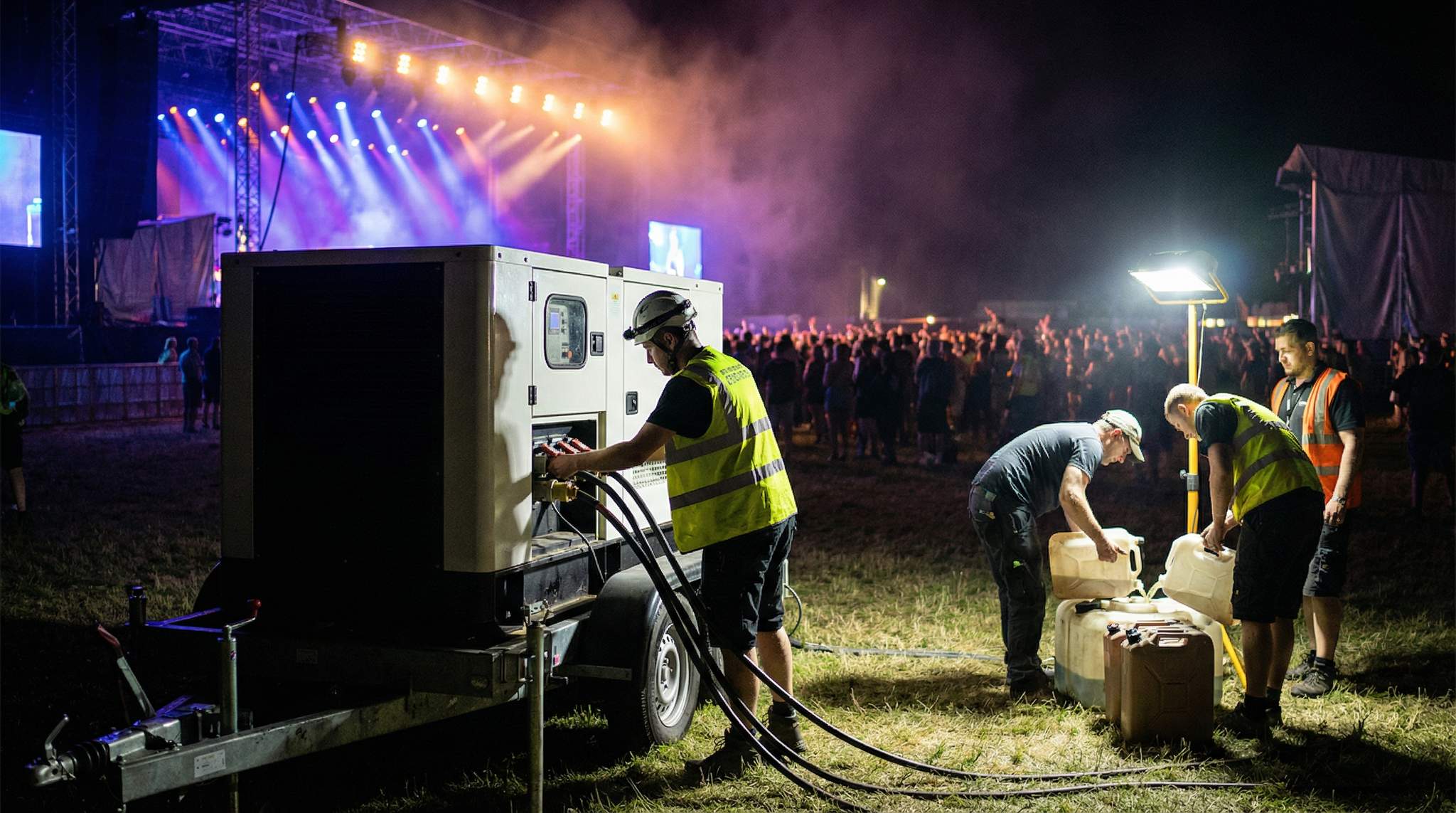
Selecting the appropriate power source is the foundation of effective power management for outdoor festivals. Not all power units are created equal, and the specific demands of live audio, lighting rigs, and vendor villages require specialized equipment. When sourcing generators for music festivals, producers typically rely on heavy-duty, towable diesel units (often referred to as “silenced” or “whisper” generators) designed to run quietly and continuously for days. These specialized festival generators feature robust voltage regulation, which is critical to prevent power spikes from damaging sensitive audio-visual gear.
Beyond the massive primary units powering the main stages, you will also need to consider localized power needs. For example, a dedicated DJ generator—often a smaller, pure sine wave inverter unit—might be deployed for remote VIP areas, pop-up electronic stages, or sponsor activations where running hundreds of feet of heavy cable from the main distro isn’t practical. By matching the specific type of generator to the application, organizers can build a resilient, decentralized power grid that minimizes the risk of a site-wide blackout.
When sourcing a generator for outdoor concert productions—which often feature a more concentrated, single-day schedule compared to a sprawling multi-day festival—promoters must prioritize rapid deployment and high-peak load capacity. A standalone outdoor gig typically relies on a robust, towable twin-pack system (two generators running in parallel) to ensure that if one engine falters, the show continues seamlessly. This setup provides the necessary redundancy for high-draw audio and lighting rigs without the complex, decentralized grid required by larger festival sites.
Boost Revenue With Smart Upsells
Sell merchandise, VIP upgrades, parking passes, and add-ons during checkout and via post-purchase emails. Increase average order value by up to 220%.
Sizing Generators to Your Load
No festival can run without sufficient power, so it’s vital to size generators appropriately for the expected load. Under-sizing a generator risks overloads and blackouts, while over-sizing can waste fuel and budget. Start planning early by calculating the total electrical load of all equipment and facilities at the event. Consider every power draw, including:
- Stages and AV Equipment: Sound systems, amplifiers, mixers, lighting rigs, video screens, and instruments. These can draw significant power, especially during peak performance times.
- Vendor Booths and Catering: Food trucks, refrigeration units, electric cookers, coffee machines, and point-of-sale systems all need power, including any carnival rides or merchandise booths that might be part of the event.
- Site Lighting and Effects: Floodlights for pathways, decorative lighting installations, LED screens, and lasers or special effects machines.
- Facilities and Utilities: Restroom trailers, water pumps, heating or cooling systems, medical tents, and security or communications equipment.
Once all equipment is listed out, estimate each item’s power consumption (in watts or kilovolt-amperes, kVA). It’s wise to consult technical specifications or an electrician to get accurate figures. Add a safety margin on top of the sum – seasoned producers often add 20–30% extra capacity. This buffer accounts for surges (for example, when a sound system kicks in with bass-heavy music) and any last-minute additions on site. Generators also operate most efficiently when they’re loaded at roughly 70–80% of their maximum capacity, so a bit of headroom is beneficial for both performance and fuel efficiency.
Planning a Festival?
Ticket Fairy's festival ticketing platform handles multi-day passes, RFID wristbands, and complex festival operations.
When dealing with extensive catering villages, performing a precise electrical load calculation for food truck generator power requirements is essential to prevent localized grid failures. Food vendors are notorious for underestimating their draw, often arriving with high-wattage fryers, commercial espresso machines, and heavy-duty refrigeration units that demand significantly more amperage than a standard 120V outlet can provide. To manage this, festival producers should mandate that every vendor submit a detailed equipment list with exact wattage and amperage specifications weeks before load-in. By aggregating these figures and applying a diversity factor—recognizing that not every heating element will cycle on simultaneously—you can accurately size the dedicated catering generators, ensuring your food and beverage operations remain fully powered during peak dinner rushes.
For a small boutique festival, the total power demand might only require a single 25 kVA portable generator, but even then ensure it can comfortably handle peak times (like all food vendors operating during the dinner rush plus the stage running at full tilt). In contrast, a large music festival with multiple stages and a huge vendor village could need several large generators (100 kVA and above) or even a synchronized generator farm feeding into a power distribution system. In large-scale events, it’s common to dedicate separate generators to different areas – for example, one generator exclusively for the main stage, another for the food court, and another for production facilities. Dividing loads this way prevents a problem in one zone from tripping the power elsewhere.
Real-world example: At a regional outdoor concert, the organizers initially rented a single 50 kVA diesel generator for all stage and vendor power. As the sun set and stage lights came on, food vendors also fired up their electric grills and freezers, pushing the power usage beyond what that generator could supply. The overloaded generator tripped, causing a brief outage right before the headline act. Luckily, power was restored after a short delay once non-essential equipment was unplugged, but the lesson was clear – precise load calculation and employing a generator with ample capacity (or multiple units) would have prevented this embarrassing interruption. Future editions of that festival opted for a 75 kVA unit and split some vendor power to a secondary generator, ensuring uninterrupted power even at peak load.
Positioning Generators Safely
Where and how generators are placed on the festival site has serious safety and operational implications. A generator, especially a larger diesel unit, is a heavy piece of equipment with hot surfaces, exhaust fumes, and high voltage connections – it must be positioned with care.
Go Cashless With RFID Technology
Enable contactless payments, faster entry, and real-time spending analytics with RFID wristbands and NFC-enabled ticketing for your events.
Keep generators accessible but secured: They should be located in an area that staff and technicians can reach easily for refueling and maintenance, yet restricted from public access. Use sturdy fencing or barricades around generators if festival attendees could potentially wander near. This not only prevents curious guests from tampering with equipment or accidentally getting hurt, but also establishes a clear perimeter for any potential hazards (like fuel or oil spills). Posting warning signs (e.g., “Authorized Personnel Only” or “Danger – High Voltage”) on the fencing adds an extra layer of public safety awareness.
Consider distance and orientation: Position generators at a safe distance from stages, tents, and attendee gathering areas. This spacing has multiple benefits:
– Noise Reduction: Even “silent” or sound-attenuated generators produce noise. Distance (or placing them behind structures) helps minimize the generator hum bleeding into performance audio or the guest experience. For instance, a small community festival placed its generator right behind the stage without sound insulation – during quiet moments in performances, attendees could hear the engine chugging. The next year, they relocated it further away and behind a solid plywood wall, dramatically reducing the noise on the dance floor.
– Fume Management: Aim exhaust vents away from people. Generator engines emit diesel or gasoline exhaust that contains carbon monoxide and unpleasant fumes. They should never be placed in enclosed spaces or too close to crowds. Ideally, situate generators downwind from key attendee areas so that the wind carries exhaust away from the audience, stage crew, and artists.
– Safety Radius: Keep them clear of flammable materials and structures. For example, don’t park a generator directly beside dry grass, fabric decorations, or underneath a stage deck. A few meters of clear space around the unit is advisable to reduce fire risk. Also, ensure the generator sits on firm, level ground – this prevents tipping or fuel spills, and helps maintain proper operation of the equipment.
Need Festival Funding?
Get the capital you need to book headliners, secure venues, and scale your festival production.
Secure cabling and connections: Along with the generator itself, pay attention to how power cables run from it to the stages and facilities. Use cable ramps or cable covers for any wires crossing walkways to prevent trip hazards and damage to the cables. All high-voltage distribution boxes should be elevated from wet ground (in case of rain or mud) and likewise kept away from public reach. Professional festival electricians often establish a “power distro” area where the main generator feeds into breakers and from there to heavy-duty extension cables running to various parts of the site. Keep this distro hub neat, dry, and monitored.
Finally, prepare for weather and environmental factors. If there’s a chance of rain, generators might need a canopy or at least weather-proof housing (while still allowing ventilation). Avoid areas that could flood or collect standing water. If the event is on a night when it could get cold or dew forms, make sure any plastic fuel cans or the generator’s fuel tank are not in a position where water could contaminate the fuel or cause equipment issues.
When mapping out your site infrastructure, remember that generators, power distribution networks, diesel storage areas, and external lighting rigs must all work in concert. Strategically placing your primary power hubs near high-draw zones reduces the length of heavy cable runs, while keeping bulk fuel reserves safely isolated in a dedicated depot. Furthermore, dedicated external lighting—such as towable light towers for parking lots, box offices, and perimeter security—often requires its own localized power rather than drawing from the main stage distro. This decentralized approach ensures that critical safety illumination remains completely independent of performance power grids.
Fuel Storage and Refueling Planning
Having plenty of fuel on hand – and a solid plan to use it – is just as important as choosing the right generator. Many festival power failures occur not from mechanical breakdown, but simply running out of fuel due to poor planning. To keep the music playing and lights shining, implement a robust fuel storage and refueling schedule well in advance.
Calculate fuel requirements: Once the generator size and expected load are known, estimate how much fuel it will consume per hour. Generators typically have published fuel consumption rates (e.g., a 50 kVA diesel generator might burn around 10–15 liters of fuel an hour under moderate to heavy load). Use these figures to project fuel use for the duration of the festival. For example, if an event runs 10 hours a day over a three-day weekend with a generator at near 75% load, that 50 kVA unit could use roughly 100–150 liters per day, totaling 300–450 liters for the whole event. Then add a contingency – seasoned organizers often maintain at least 20% extra fuel above the expected need. This buffer covers unanticipated situations like an extension of running hours, heavier usage than predicted, or a missed fuel delivery.
Fuel storage setup: Store fuel in proper, safe containers and locations. Use approved fuel drums or cans made for gasoline or diesel (usually clearly marked and constructed of durable material). The storage area should be cool, ventilated, and away from ignition sources. Keep fuel stock well away from any open flames (like fire pits or barbecue grills) and also distant from generators or electrical gear to reduce fire risk. Many large festivals use a designated “fuel depot” located off the main activity area – this could be a fenced-off corner of the site where a fuel truck or large fuel bladder is stationed. On a smaller scale, it might be a lockable shed or a covered pallet where extra fuel cans are kept. In all cases, the area must have clear signage (e.g., “Fuel Storage – No Smoking”), and ideally, secondary containment like a spill tray or bunded flooring to catch any leaks from fuel containers.
Scheduling refuels: Plan when and how refueling will happen during the event. Generators often can run for several hours on a full tank (some large units can go 8–12 hours before refueling). Schedule top-ups during low-activity times to minimize impact – for instance, early morning before attendees arrive, or during a band changeover when the stage isn’t active. If the festival runs overnight, schedule a refuel in the middle of the night when crowds are smallest. Always assign trained crew members to monitor fuel levels throughout the event; this can be as simple as checking the generator’s fuel gauge every few hours and logging it. With multiple generators, coordinate so that not all refuel at once (maintain power to critical areas by staggering refills or having one generator take the load while another is being refueled or serviced).
For multi-day events or very large festivals, coordinate fuel deliveries ahead of time. You may need a fuel supplier to come on-site daily or have a fuel truck on standby. Running out of fuel on day 2 because the nearest gas station ran dry or a delivery truck got stuck in traffic is not a valid excuse – plan alternatives. In one instance, a countryside festival nearly went dark because the scheduled diesel delivery truck was delayed by several hours. Fortunately, the production team had preserved enough reserve fuel to last until the truck arrived, avoiding a show-stopping outage. This highlights why having excess fuel on-site and multiple supplier contacts is part of good risk management.
Fuel Safety Protocols
Handling fuel is inherently hazardous – gasoline and diesel are flammable, and spills or misuse can lead to fires or environmental damage. A festival environment, with its hectic pace and many hands, demands strict fuel safety protocols to prevent accidents. The goal is to make sure that fuel handling is treated with the same care as any other high-risk aspect of production.
Limit who handles fuel: Only designated, trained staff members should refuel generators or transport fuel containers. These individuals should be briefed on proper procedure – for example, shutting down smaller generators before refueling (to avoid ignition from a hot engine or electrical spark), or if a generator must be refueled while running (as sometimes happens with large units that can’t be easily turned off without cutting power), using extreme caution and proper equipment to pump fuel without spills. In all cases, absolutely no smoking or open flames is allowed anywhere near fuel storage or during refueling. It may sound obvious, but a surprising number of incidents occur from someone casually smoking a cigarette 10 feet from a fuel area. Vigilance is key.
Personal protective equipment (PPE) and gear: Staff handling fuel should wear appropriate PPE – this can include gloves (to avoid skin contact with fuel and to grip slippery cans), safety glasses (to protect against splash), and even flame-resistant workwear if available. Have a fire extinguisher rated for flammable liquids (Class B in many fire codes) within arm’s reach whenever fuel is being handled. Additionally, keep spill cleanup materials on hand: absorbent pads, sand or cat litter, and a disposal container for soaked materials. If a minor spill happens, it should be contained and cleaned immediately to prevent slip hazards or fire risk. All crew members should know where these safety items are located.
Secure fuel and keys: It’s not just the risk of fire – fuel is a valuable commodity and potentially dangerous in the wrong hands. Keep fuel storage locked or under supervision. For instance, if a fuel truck is on site, its valves and nozzles should be secured when not in use, and the area patrolled by security at night. Likewise, if generators have lockable fuel caps or doors, ensure they are used. There have been cases of vandalism or mischief where someone tampered with a generator or even stole fuel at events, leading to chaos. A simple padlock on a fuel tank cap and barrier fencing can deter these problems.
Emergency procedures: Establish a plan in case something does go wrong. All relevant crew should know how to respond if there’s a fuel spill larger than a few liters, or if a fire breaks out in the generator area. This might include stopping fuel flow, using extinguishers, and calling the fire department if needed. Also inform the local fire marshal or authorities about the festival’s fuel storage plan beforehand if required – many jurisdictions have limits on how much fuel can be stored without special permits (for example, above a certain number of liters on site). Complying with these regulations is part of safety. By treating fuel management with respect and caution, organizers protect not only the festival’s continuity but the people on site and the environment.
Mitigating Occupational Hazards for Power Technicians
Operating a dedicated festival power generator involves more than just plugging in heavy-duty cables; it requires protecting the specialized site crew and stationary engineers who manage these temporary power plants. Festival environments introduce unique occupational risks that must be managed proactively. Technicians frequently face hazards such as extreme noise from running engines, exposure to hazardous materials like diesel and oil, and the physical dangers of navigating dangerous enclosures or tight generator housings.
Additionally, working long shifts outdoors exposes crews to temperature extremes, while the equipment itself presents risks of severe burns from hot exhaust pipes, electric shock from high-voltage distribution panels, and injuries from moving parts like cooling fans and belts. To safeguard your team and ensure seamless power management for outdoor festivals, mandate strict lockout/tagout procedures, provide comprehensive PPE (including hearing protection and insulated gloves), and ensure only certified professionals access the power compound.
Ensuring Uninterrupted Power for Critical Systems
An unexpected power outage in the middle of a festival is more than just an inconvenience – it can be dangerous. Darkness can cause crowd panic or accidents, and loss of sound can escalate into unrest if attendees grow frustrated. It’s the nightmare scenario every festival producer wants to avoid. That’s why ensuring uninterrupted power to critical systems is paramount.
Identify critical vs. non-critical loads: Determine which parts of the festival absolutely cannot lose power without serious consequences. Obvious critical systems include stage sound and lighting (no one wants a headline act suddenly silenced), site lighting at night (for exits, pathways, and security), emergency medical tents and communications (radios, PA systems for safety announcements), and any crowd safety infrastructure like barriers that may be power-operated. Non-critical loads might be things like phone charging stations or decorative lighting – nice to have, but not life-safety critical. By prioritizing, organizers can design the power setup to give critical circuits the most robust protection.
Redundancy and backup plans: For any large festival or high-stakes application, consider having backup generators or at least backup capacity. This could mean an entire second generator on standby, already wired into a transfer switch, ready to kick in if the primary fails. In practice, large stage productions often use two generators in parallel or an A/B system: one handles the load while the other idles in low-power or standby mode, so if one stops, the other immediately bears the load. At minimum, keep a portable generator or two available backstage for emergency use – even if it can’t power the whole show, it could supply enough electricity for emergency lighting or a basic PA to direct the crowd if the main system fails.
For smaller festivals with tighter budgets, a full duplicate generator might not be feasible. Instead, have a contingency plan: know the nearest rental company or supplier who could dispatch a replacement generator on short notice, and ensure that vehicles and towing capability are available to retrieve it if needed. Also, keep spare fuel filters, fuses, or other minor parts that a technician could use to fix a generator on-site if it malfunctions. In one notable incident, a multi-day cultural festival’s main stage generator had a mechanical issue that caused it to shut down during an afternoon set. Because the production team had a backup generator on standby, they managed to switch power over within minutes. The show went on with only a brief pause, and most attendees hardly noticed the glitch. Without that backup unit, the headline performance that night might have been canceled – a potentially devastating blow to the festival’s reputation.
Uninterrupted power supplies (UPS) for electronics: Consider using small UPS units for particularly sensitive equipment. A UPS is a battery backup device. While giant amplifiers would drain a UPS in seconds (making it impractical to power large speakers this way), small UPS units can still protect things like the FOH (front-of-house) audio mixing console, the lighting control board, or the computer servers running ticketing or RFID systems. If the generator flickers or there’s a gap when switching power sources, a UPS can keep those critical control systems alive long enough (even just a few minutes) to either restore power or do an orderly shutdown. This can prevent data loss or damage to electronics, and allow the tech crew to communicate with the audience if needed (“Please stand by, we have a brief technical issue…” rather than being abruptly cut off).
Continuous monitoring: Assign an electrician or power manager to watch the loads in real time. Today’s generator hire companies often provide remote monitoring for fuel levels and load on large units. Even without such technology, assign someone to periodically check that generators are not overloading (there’s usually a gauge or display on the generator), and that all systems are receiving power as expected. This person can potentially catch problems early – perhaps a cable heating up, an unusual sound from a generator engine, or an overloaded circuit – and address them before they escalate to a failure.
Ultimately, uninterrupted festival power comes from intelligent design (right-sized, well-placed equipment), rigorous maintenance (fuel topped up, machines serviced), and backup solutions for when Murphy’s Law strikes. By planning for the worst while expecting the best, festival producers can vastly reduce the odds of a show-stopping power failure.
Advanced Strategies for Outdoor Event Power Management
As festivals scale in size and complexity, basic generator deployment must evolve into comprehensive outdoor event power management. Modern mega-festivals and sprawling greenfield sites increasingly rely on smart power grids and telemetry to monitor energy consumption in real time. By utilizing load-on-demand systems, producers can synchronize multiple smaller generators to automatically power up or down based on the live electrical draw. This approach not only drastically reduces fuel consumption and emissions but also prevents the catastrophic failure of a single massive unit taking down an entire stage.
In recent years, the traditional festival power supply has evolved beyond relying solely on diesel engines. Forward-thinking producers are increasingly integrating hybrid battery systems and temporary grid tie-ins where municipal infrastructure allows. This diversified approach to your event’s energy grid not only lowers the carbon footprint but provides an ultra-reliable, silent backup for sensitive front-of-house electronics.
Furthermore, effective energy oversight for large-scale outdoor events requires meticulous attention to environmental resilience. Distribution networks (distros), cabling, and connections must be engineered to withstand extreme weather conditions, from torrential rain to blistering heat. Veteran organizers map out their power infrastructure using topographical site data to elevate critical junctions above potential flood zones and ensure that heavy cable runs do not intersect with heavy machinery pathways or high-traffic attendee routes. Integrating these advanced logistical frameworks ensures that your site’s energy grid remains invisible, safe, and flawlessly reliable.
Frequently Asked Questions
How do you calculate the right generator size for a festival?
Calculate the total electrical load of all stages, vendors, lighting, and facilities in watts or kVA. Add a safety margin of 20–30% to the total to account for power surges and last-minute additions. Generators operate most efficiently at 70–80% capacity, so sizing with this headroom prevents overloads while maintaining fuel efficiency.
Where should generators be positioned at an outdoor event?
Place generators on firm, level ground away from stages and attendee gathering areas to minimize noise and fume exposure. Ensure exhaust vents point downwind from crowds and maintain a safety radius clear of flammable materials. Secure the area with sturdy fencing to restrict public access while keeping it accessible for technicians.
How much fuel reserve should a festival maintain?
Organizers should maintain at least 20% extra fuel above the expected consumption to cover extended hours or heavier usage. Calculate requirements based on the generator’s hourly burn rate and the event duration. For example, a 50 kVA unit might use 10–15 liters per hour, requiring substantial on-site storage or scheduled deliveries.
What safety protocols are necessary for generator refueling?
Only designated, trained staff wearing appropriate PPE like gloves and safety glasses should handle fuel. Enforce a strict no-smoking policy and keep Class B fire extinguishers and spill cleanup kits nearby. Schedule refueling during low-activity times, such as early mornings, and ensure all fuel storage areas are locked and ventilated.
How can festivals prevent power outages during critical performances?
Implement redundancy by using backup generators on standby or running parallel units where one takes the load if the other fails. Use Uninterrupted Power Supplies (UPS) for sensitive control equipment like audio consoles to bridge power gaps. Continuous monitoring of loads helps technicians identify and fix issues before they cause a blackout.
Why is it important to use cable ramps for generator power lines?
Cable ramps protect high-voltage power lines from damage caused by foot traffic and vehicles while preventing trip hazards for attendees. Securing cabling ensures safe power distribution from the generator to the stage or vendor areas. Distribution boxes should also be elevated off wet ground to prevent electrical faults and ensure public safety.
What are the core principles of power management for outdoor festivals?
Effective power management for outdoor festivals relies on accurate load calculation, strategic equipment placement, and built-in redundancy. Organizers must map out every power draw—from massive main stage lighting rigs to individual vendor booths—and distribute these loads across multiple synchronized generators. Implementing a decentralized grid with backup units and dedicated fuel management ensures that a single point of failure won’t compromise the entire event.
How do generators, power distribution, diesel storage, and external lighting integrate on a festival site?
A safe and efficient festival site physically separates these elements while connecting them logically. Primary generators and power distribution hubs are placed near high-load areas like stages to minimize cable runs. Diesel storage is kept in a secure, isolated, and ventilated depot away from ignition sources and public access. Meanwhile, external lighting for perimeters and parking often utilizes independent, smaller towable light towers with their own built-in power, ensuring that site safety illumination remains unaffected by main stage power fluctuations.
How does telemetry improve power management for outdoor events?
Telemetry allows production teams to monitor real-time electrical loads, fuel levels, and engine performance across the entire festival site remotely. This data-driven approach enables organizers to balance power distribution dynamically, prevent overloads before they trip breakers, and optimize fuel efficiency by identifying underutilized generators.
What is the best type of generator for an outdoor concert?
For a standalone outdoor concert, the best choice is typically a heavy-duty, towable diesel generator with sound attenuation (often called a whisper generator). Concert producers frequently use a twin-pack configuration—two synchronized units—to provide built-in redundancy, ensuring the audio and lighting systems remain powered even if one engine experiences a mechanical fault.
What are the primary occupational hazards for technicians managing a festival power generator?
Site crew and stationary engineers face several distinct hazards when operating heavy-duty power equipment. These include extreme noise, exposure to hazardous materials (like diesel fuel and lubricants), navigating dangerous enclosures, and enduring environmental temperature extremes. Furthermore, technicians must be protected against severe burns from hot engine components, electric shock from high-voltage outputs, and injuries from moving parts within the generator housing.
How does a festival power generator differ from a standard construction generator?
While both provide off-grid electricity, a festival power generator is specifically engineered for live events. These units feature advanced sound attenuation (whisper-quiet operation) to prevent noise bleed into performances, and precise voltage regulation to protect sensitive audio-visual equipment from power spikes. They are also designed for continuous, multi-day operation under fluctuating loads, making them the backbone of reliable power management for outdoor festivals.
What components make up a comprehensive festival power supply?
A robust festival power supply extends beyond just the primary generators. It encompasses the entire temporary energy grid, including synchronized diesel or hybrid generators, heavy-duty cabling, distribution boxes (distros), cable ramps, uninterrupted power supplies (UPS) for sensitive electronics, and dedicated towable light towers. Managing this complete supply chain ensures safe, redundant, and continuous electricity across the event site.
How do you calculate the electrical load requirements for food truck generators at a festival?
To perform an accurate food truck generator power requirement electrical load calculation, organizers must collect a comprehensive list of all vendor equipment, including high-draw items like fryers, espresso machines, and refrigeration units. Convert all listed power draws to watts or kVA, sum the total for the catering zone, and apply a 20–30% safety margin. Because heating and cooling elements cycle on and off, applying a diversity factor helps right-size the dedicated vendor generators without overspending on unnecessary capacity.