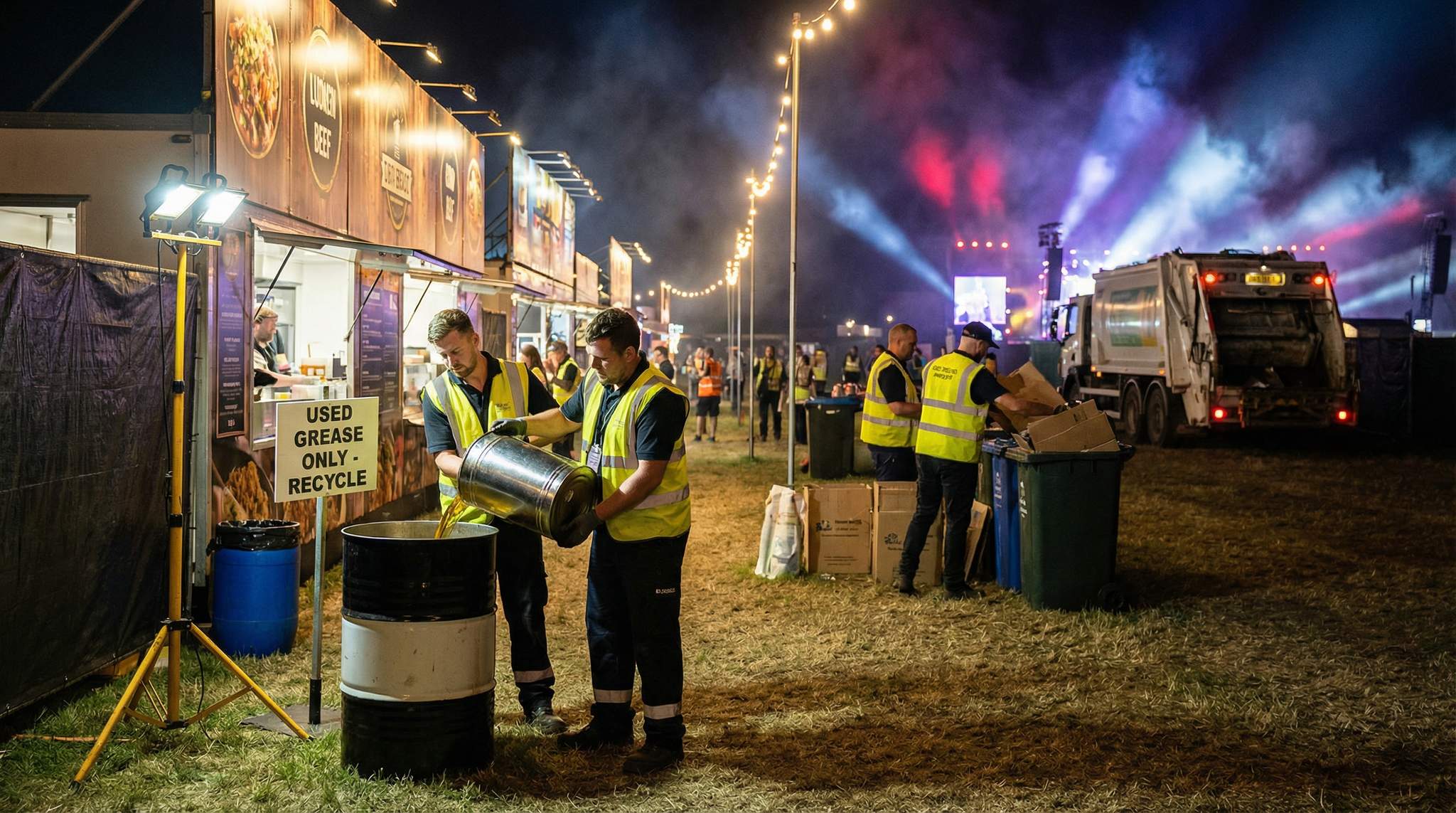
Managing waste from vendors, especially food vendors, is a critical part of festival logistics. A busy food stall can generate mountains of trash – from food scraps and packaging to used cooking oil – all of which must be dealt with swiftly and safely. If vendor waste isn’t handled properly, it will not only create an eyesore but can also lead to environmental hazards, pest infestations, and even safety risks from spills. Effective vendor waste management ensures a cleaner festival site, keeps health inspectors happy, and leaves attendees with a positive impression of the event’s cleanliness and professionalism.
Provide Adequate Trash and Recycling Bins
One of the first steps in vendor waste management is making sure vendors have easy access to waste bins for all their needs. Each vendor station should be equipped with clearly labeled trash bins for general waste and recycling bins for materials like cardboard boxes, bottles, and cans. Food vendors often accumulate cardboard packaging and empty bottles quickly, so providing recycling containers nearby encourages them to sort and dispose of these items properly instead of tossing everything into general trash.
Having plenty of bins – both in vendor back-of-house areas and front-of-house for attendees – helps prevent overflow and litter around vendor booths. If vendors lack convenient bins, they might end up piling garbage behind their stalls, which can spill over or attract pests. Avoid this by placing dedicated garbage and recycling receptacles within a short reach of every vendor and by ensuring they’re large enough (or emptied frequently) to handle the volume. In practice, some festivals even ask vendors to bring their own small back-of-house trash cans and bags to manage waste in their stall, with festival staff collecting and emptying those as needed. Clear signage on what goes into each bin and regular monitoring will further assist vendors in keeping their area tidy while separating recyclables from trash.
Manage Grease and Oil Disposal Safely
Food vendors cooking on-site will inevitably produce used cooking oil and grease that need proper disposal. Never allow vendors to dump grease on the ground or down drains – this is not only illegal and environmentally harmful, but it also creates serious safety hazards. One small festival learned this the hard way: a food vendor with no proper disposal option dumped his fryer oil behind the booth, and by the next morning the area was slick with grease and swarming with insects. It was a nightmare cleanup scenario that clearly illustrated why a proper grease disposal plan is so critical. Instead, implement a plan for grease disposal by providing grease traps, oil drums, or barrels specifically for used cooking oil. Position these containers in an easily accessible yet secure location (for instance, a marked area behind the food court or vendor row) where vendors can periodically empty their fryers into them. Make sure the grease barrels are sturdy, have closable lids, and are placed on a stable surface to prevent tip-overs or leaks.
Data-Driven Event Marketing
Track ticket sales, demographics, marketing ROI, and social reach in real time. Exportable reports give you the insights to make smarter decisions.
Many large festivals supply dedicated grease disposal units on-site and even mandate that vendors strain their oil before pouring it in, ensuring that food bits don’t contaminate the collected oil. For example, the organizers of Rolling Loud (a large hip-hop music festival) provide centralized grease tanks for vendors and instruct them to filter out solids and avoid throwing any trash into those containers – even a small amount of contamination can lead to hefty fines from waste processors or local authorities. On the other hand, some smaller community events require vendors to take their used cooking oil with them and dispose of it off-site; in fact, it’s not unusual for a fair or local festival to include a clause in the vendor contract stating that any oil left behind will result in a fine.
For organizers operating within permanent infrastructure, coordinating cooking oil collection for stadiums and large-scale arenas requires a different approach than temporary greenfield sites. Venue managers must establish high-capacity, centralized grease interceptors and partner with specialized rendering companies for regular pump-outs. Unlike temporary barrels used at weekend pop-ups, stadium-grade oil collection systems are often hard-plumbed into the venue’s back-of-house commercial kitchens, allowing concessionaires to safely dispose of hot fryer oil without transporting it through crowded service corridors. Establishing a dedicated contract for bulk cooking oil recycling not only ensures compliance with municipal fire and environmental codes but can also generate a modest revenue stream, as many rendering facilities pay for high-quality, uncontaminated used oil.
Planning a Festival?
Ticket Fairy's festival ticketing platform handles multi-day passes, RFID wristbands, and complex festival operations.
Whichever approach you choose, communicate it clearly to your vendors in advance so they come prepared with the right equipment (funnels, sealable containers for transporting oil, etc.) and know the rules. When grease is handled correctly, you avoid nasty spills that can cause slips and falls, foul odors, or even fire risks. You also prevent pests (who are drawn to oily food residues) and protect the ground and waterways from pollution. As a bonus, collected cooking oil can often be recycled – for instance, one Australian festival has been collecting used fryer oil and upcycling it into biodiesel to fuel some of its generators and vehicles on-site. Providing an eco-friendly way to dispose of grease gives vendors extra incentive to follow the rules, since their waste becomes part of a sustainability effort rather than just trash.
Plan for Proper Wastewater and Greywater Disposal
Beyond solid trash and cooking oil, comprehensive festival waste management must also address liquid waste. A common logistical hurdle for organizers is determining where is the proper place to dispose of wastewater at an off site food event. Food vendors generate significant amounts of greywater from handwashing stations, dishwashing, and food preparation. Allowing this runoff to spill onto the ground or into storm drains is a major health code violation and environmental hazard. To prevent this, organizers must provide dedicated wastewater collection points, such as IBC totes or specialized greywater holding tanks, strategically placed near the food courts. Vendors should be instructed to transport their liquid waste in sealed buckets to these tanks. For larger multi-vendor setups, hiring a sanitation contractor to pump out these holding tanks daily ensures you remain compliant with local environmental regulations and keeps the site sanitary.
For off-site food events located in remote areas or greenfield sites without municipal sewer hookups, establishing these centralized disposal hubs becomes even more critical. Organizers must map out the site so that heavy vacuum trucks can access the greywater holding tanks without crossing pedestrian pathways or disrupting the festival’s flow.
When dealing with off-site food events—such as pop-up culinary festivals in city parks or remote greenfield sites—the logistics of liquid waste become even more complex. Festival producers must often install temporary above-ground bladder tanks or multi-port plumbing manifolds that allow several food trucks or stalls to connect their sink drainage directly. This prevents the risk of accidental ground discharge. Furthermore, you must ensure that your chosen sanitation partner is licensed to transport and process high-fat, high-oil greywater at an approved municipal treatment facility, as standard portable toilet waste processors may not accept food-grade wastewater.
Schedule Regular Waste Pickups During the Event
Even with ample bins and grease containers in place, waste management at a festival is not “set and forget.” It’s crucial to schedule regular waste pickups and cleaning rounds throughout the event. For multi-day festivals, arrange for waste removal (trash, recyclables, and used oil) at the end of each day or even mid-day if volumes are high. If it’s a single-day event, ensure that staff or contracted haulers periodically empty dumpsters and replace full bin liners during the day. Don’t wait until final teardown to address all the garbage – overflowing trash bins halfway through your festival day are not only unsightly, they can also quickly become a health hazard and create more work later.
Food vendor areas, in particular, can generate a lot of waste in a short time. Think of the lunchtime or dinner rush, when trash cans fill up with food wrappers, plates, and leftovers within just a couple of hours. Assign a cleaning crew to monitor the vendor zone continuously, so garbage bags can be swapped out before they brim over and oil drums can be checked before they reach capacity. Plan ahead with your waste disposal contractor about peak times (like meal hours) and have them on standby for extra pickups if needed. This continuous attention not only keeps the area clean, but also reduces the chance of trash blowing around or oils leaking from overfilled containers. The very sight of staff efficiently carting away waste during the festival reinforces to vendors and attendees alike that cleanliness is a priority for the event. In fact, some organizers have found that vendors take more pride in maintaining their own stand’s cleanliness when they see the event staff actively keeping the grounds tidy.
Need Festival Funding?
Get the capital you need to book headliners, secure venues, and scale your festival production.
Communicate Waste Management Guidelines to Vendors
A well-thought-out waste plan only works if vendors know about it and cooperate. Clear communication with vendors is key. Well before the festival begins, include detailed waste disposal instructions in vendor information packets or contracts. Outline what is expected of them – for instance, that they must use the provided bins for all trash, break down their cardboard boxes for recycling, keep their booth area tidy, and pour all used cooking oil into the designated grease barrels (never onto the ground or into a drain). Emphasize a “leave no trace” policy: vendors should restore their spot to the same clean condition as when they arrived, with no litter or greasy residue left behind.
It also helps to hold a brief on-site orientation or send a reminder communication as the event approaches, highlighting where trash bins, recycling stations, and oil disposal points are located, as well as the timing for waste pickups. Provide vendors with a point of contact (such as a vendor coordinator or on-site sustainability manager) for any waste-related issues – for example, if their trash is piling up faster than expected or if a spill occurs that they need assistance with. When vendors understand that proper waste management is a non-negotiable part of participating in the festival, and when they have the tools and information to do it right, they are far more likely to comply. In fact, having clear guidelines and convenient waste bins actually makes vendors’ own operations smoother, since they won’t be stuck with garbage cluttering their workspace or attracting pests. Good communication and support creates a shared sense of responsibility for keeping the festival clean.
Choosing Compliant Multi-Vendor Waste Segregation Solutions
When scaling up to a larger gathering, handling garbage in-house is no longer viable. Organizers must evaluate how to choose an FSA-compliant waste disposal solution (or one that meets equivalent local health and food safety authority standards) tailored for a weekend fair or massive multi-day festival. The best multi-vendor waste segregation solutions for event sites involve partnering with specialized waste contractors who can provide color-coded, clearly labeled bins for distinct waste streams: general refuse, mixed recyclables, compostable food scraps, and hazardous materials like cooking oil. Working with integrated waste vendors handling grease, food, and recyclables together streamlines your logistics. Instead of coordinating multiple haulers, a single comprehensive partner can manage the entire lifecycle of your event’s refuse, ensuring that food safety standards are met, cross-contamination is minimized, and diversion rates from landfills are maximized.
When vetting potential sanitation partners for a weekend fair, organizers should prioritize companies with proven experience in high-volume, temporary event settings. Request documentation of their local health department and Food Standards Agency (FSA) compliance, ensuring they hold the proper licenses to transport hazardous liquids like used cooking oil and greywater. A reliable contractor will also offer a clear contingency plan for unexpected surges in attendance, guaranteeing that extra bins or emergency pump-out trucks can be dispatched on short notice.
Consolidating your contracts with a single provider also simplifies site operations. When you rely on comprehensive sanitation partners to manage cooking oil, organic compost, and dry recycling simultaneously, you eliminate the logistical headache of coordinating multiple pickup schedules. A unified approach means fewer heavy trucks navigating pedestrian-heavy back-of-house zones, reducing the risk of accidents and minimizing noise disruptions. Furthermore, these all-in-one waste management companies often supply dedicated account managers who understand the unique pacing of live events, allowing them to adjust collection frequencies dynamically during peak meal rushes.
To implement the most effective festival waste management strategies, look for partners that offer transparent reporting and diversion metrics. Top-tier segregation systems don’t just haul trash away; they provide detailed breakdowns of how much organic matter, recyclable material, and hazardous liquid was successfully diverted from landfills. This data is invaluable for proving compliance to local health departments and food standards agencies (FSA). Furthermore, utilizing a unified provider reduces the number of collection vehicles navigating your back-of-house areas, significantly improving site safety and operational efficiency during peak hours.
A robust festival waste management strategy also involves conducting pre-event audits with your chosen sanitation partners. By reviewing their disposal manifests and diversion protocols beforehand, organizers can confidently verify that their multi-vendor waste segregation solutions for event sites are truly FSA-compliant and environmentally sound. This proactive approach protects the festival from liability and ensures that all waste vendors handling grease, food, and recyclables together are operating up to the highest industry standards.
Keeping the Site Clean: Prevent Spills, Pests, and Problems
Effective vendor waste management is not just about aesthetics – it’s about safety and health. Piles of garbage or food scraps can quickly attract flies, wasps, or rodents, creating a nuisance and potential health code violations. Unattended waste also produces bad odors that can drift into public areas and sour the festival atmosphere (nobody wants to enjoy a meal next to the smell of yesterday’s trash). Grease spills or leaking garbage bags can turn parts of your festival grounds into slip-and-fall hazard zones, risking injuries to staff or guests. All these issues can hurt your event’s reputation and even jeopardize future permits if inspectors witness a dirty, hazardous environment.
Fortunately, these problems are largely preventable by enforcing the best practices outlined above. Ensure every trash bin has a lid or cover to deter pests and contain smells, and make sure vendors are tying up their garbage bags properly. If a spill does happen – say a vendor accidentally tips over a fryer oil container – have a response plan ready. Keep a stock of spill cleanup materials on hand (such as absorbent pads, cat litter or sawdust for soaking up oil, heavy-duty garbage bags, and gloves) and train your cleanup crew on how to safely contain and remove grease or food spills promptly. Addressing a mess immediately will minimize the damage and prevent a minor incident from becoming a major problem. In short, keeping vendor areas clean and swiftly dealing with any waste-related mishaps will keep everyone safer and happier. It also leaves a positive impression on local authorities, venue owners, and attendees, which is crucial for the festival’s reputation – and for securing the opportunity to host future events at that site.
Frequently Asked Questions
How should festivals dispose of used cooking oil and grease?
Festivals must provide sturdy grease traps, oil drums, or barrels in secure locations for vendors to empty their fryers. Vendors should strain the oil to remove food solids before pouring it into these containers. Alternatively, organizers can mandate that vendors transport their used oil off-site, enforcing this rule through contract clauses and potential fines.
What types of waste bins are necessary for food vendor stations?
Each vendor station requires clearly labeled trash bins for general waste and specific recycling bins for cardboard boxes, bottles, and cans. Providing separate recycling containers encourages proper sorting and prevents cardboard packaging from filling up general trash. Bins should be placed within short reach of every vendor to prevent garbage from piling up behind stalls.
How often should waste be collected during a festival event?
Waste removal should occur regularly, such as at the end of each day for multi-day festivals or mid-day during high-volume periods. Cleaning crews must monitor vendor zones continuously, especially during lunch or dinner rushes, to swap out full garbage bags before they overflow. Immediate removal prevents health hazards and unsightly litter accumulation.
Why is grease disposal management critical for festival safety?
Proper grease disposal prevents serious safety hazards like slip-and-fall accidents caused by slick, oily surfaces. dumping oil on the ground or down drains attracts pests like insects and rodents and can lead to environmental pollution. Managing grease correctly also avoids foul odors and fire risks, ensuring the event remains safe for attendees and staff.
How can organizers ensure vendors follow waste management guidelines?
Organizers should outline detailed waste disposal instructions in vendor contracts and information packets well in advance. Best practices include holding on-site orientations to show bin locations and providing a specific point of contact for waste issues. Clear communication ensures vendors understand the “leave no trace” policy and use provided infrastructure correctly.
What materials are needed to clean up oil spills at festivals?
Cleanup crews should keep a stock of absorbent materials such as cat litter, sawdust, or specialized absorbent pads to soak up grease spills immediately. Staff must use heavy-duty garbage bags and gloves to safely contain and remove the waste. Prompt cleanup with the right materials prevents the spill from becoming a slip hazard or attracting pests.
Where is the proper place to dispose of wastewater at an off-site food event?
Wastewater and greywater from food preparation or handwashing must never be dumped on the ground or into storm drains. Organizers should provide dedicated, sealed holding tanks or IBC totes near vendor areas. Vendors must transport liquid waste to these receptacles, which are then pumped out by licensed sanitation contractors.
How do organizers choose a compliant waste disposal solution for a weekend fair?
Selecting a compliant waste disposal solution involves hiring integrated waste management contractors capable of handling grease, food scraps, and recyclables simultaneously. Look for partners who provide clear multi-vendor waste segregation systems, such as color-coded bins, and who guarantee compliance with local health and food safety regulations.
What are the best FSA-compliant multi-vendor waste segregation solutions for event sites?
The most effective solutions involve hiring a single, integrated waste management contractor capable of supplying color-coded, clearly labeled bins for all waste streams, including general refuse, compost, recyclables, and hazardous liquids like cooking oil. Top providers ensure strict adherence to food safety and health regulations by minimizing cross-contamination risks, offering transparent landfill diversion reporting, and reducing the number of collection vehicles operating in busy back-of-house areas.
Why should organizers hire a single vendor for all festival waste streams?
Partnering with comprehensive waste vendors handling grease, food, and recyclables together streamlines event logistics by providing a single point of contact. This unified approach reduces the number of collection trucks on-site, lowers overall sanitation costs through bundled services, and ensures consistent compliance reporting across all refuse categories.
What criteria should festival producers use to vet waste management contractors?
Festival producers should evaluate waste management contractors based on their experience with temporary live events, ability to handle multiple waste streams (including grease and greywater), and possession of necessary health department or FSA compliance certifications. Additionally, organizers should look for partners that offer dynamic pickup scheduling, transparent landfill diversion reporting, and emergency response capabilities for unexpected attendance surges.
What infrastructure is needed for wastewater disposal at remote off-site food events?
For remote or off-site food events lacking municipal sewer connections, organizers must deploy temporary infrastructure like above-ground bladder tanks, IBC totes, or multi-port plumbing manifolds. These systems allow food vendors to safely drain their sinks without risking ground contamination. All collected greywater must then be pumped out by licensed sanitation trucks and transported to an approved treatment facility.
How does cooking oil collection for stadiums differ from temporary festival sites?
Cooking oil collection for stadiums typically relies on high-capacity, hard-plumbed grease interceptors connected directly to back-of-house commercial kitchens. Unlike temporary festivals that use portable barrels, large permanent venues partner with specialized rendering companies for scheduled bulk pump-outs, ensuring compliance with strict municipal fire codes and preventing hot oil transport through busy service corridors.