Photo Ethics in User-Generated Festival Content: Simple Rules for Respectful Sharing
Family-friendly festivals thrive on shared memories. In the age of smartphones and social media, attendees love capturing and posting their festival experiences online. User-generated content (UGC) can be a powerful promotional tool and a way to build community – but photo ethics are crucial, especially when children and families are involved. A festival that encourages respectful photo sharing will foster trust and a positive atmosphere for all attendees. This article offers practical guidelines and examples for festival organisers on cultivating an ethical photo-sharing culture at their events.
Why Photo Ethics Matter at Family Festivals
When families attend a festival, they expect a fun and safe environment – both on-site and online. Photo ethics refers to the responsible and respectful sharing of images. At a family-friendly festival, that means protecting children’s privacy and ensuring everyone feels comfortable with how photos are taken and used. Key reasons to focus on photo ethics include:
- Privacy and Safety: Parents and guardians may be uneasy with strangers snapping close-ups of their kids and posting them publicly. Respecting privacy helps avoid potential safety risks and legal issues around child protection or data privacy laws.
- Trust and Community: Showing that your festival takes photo ethics seriously builds trust with attendees. Families are more likely to return (and recommend your event) if they know you prioritise their comfort and consent.
- Reputation Management: A festival’s image can be damaged if an attendee posts an inappropriate photo (e.g. a child in a vulnerable moment) that goes viral for the wrong reasons. Proactive guidelines help prevent negative incidents before they happen.
- Inclusive Atmosphere: Clear rules about respectful photography contribute to an inclusive, family-friendly atmosphere. Everyone can relax and enjoy the event without fear of unwanted exposure on social media.
Real-world Insight: Many large events have learned the hard way that culture is taught, not assumed. For example, after noticing some guests overzealously live-streaming children’s activities, the organisers of a major family festival in Australia introduced a formal Photo Policy in 2019. They emailed guidelines to attendees and posted signs on-site. The result was a noticeable improvement – parents reported feeling more at ease, and the festival’s social media channels saw only positive, consent-friendly photos being shared.
Publish Simple Photo-Sharing Rules
One of the most effective steps a festival organiser can take is to publish simple, clear rules for photo sharing. Make these guidelines highly visible – on your website, in pre-event emails, on the event app, and with signage at the venue. Keep the rules brief and easy to understand so attendees will remember them. For a family-oriented festival, consider rules such as:
Turn Fans Into Your Marketing Team
Ticket Fairy's built-in referral rewards system incentivizes attendees to share your event, delivering 15-25% sales boosts and 30x ROI vs paid ads.
- No close-ups of other people’s kids: Remind everyone that focusing on children who are not their own is off-limits unless they have permission. A candid shot of the crowd or a wide scene is fine, but zooming in on a child’s face without consent crosses the line.
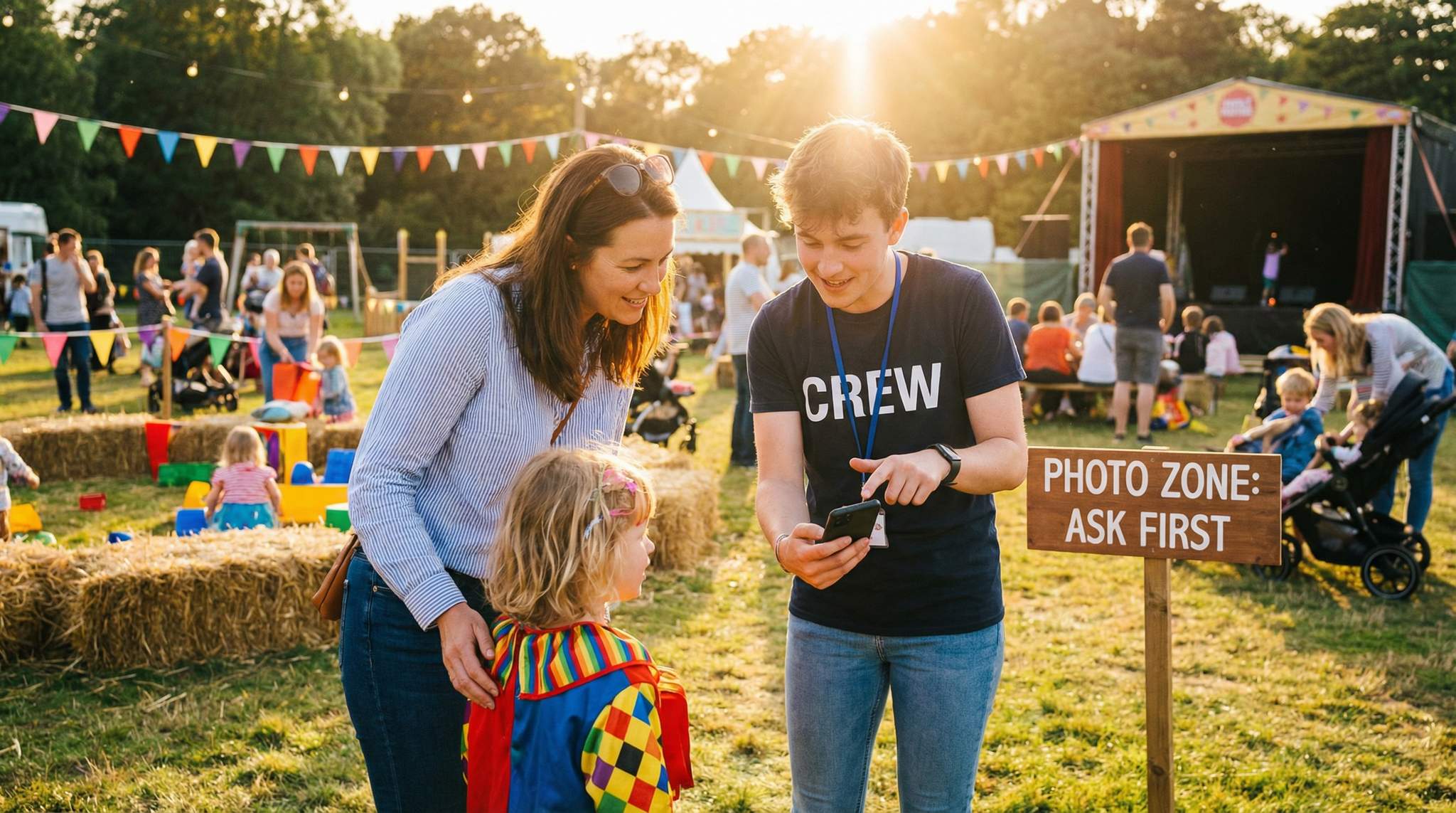
- Ask first before photographing others: Encourage a culture where attendees ask for consent when they want to photograph someone outside their own group. “Ask first, shoot later” is a handy slogan. This applies to adults and kids alike – always get a nod or yes from the person (or the child’s parent/guardian) before snapping a photo of them.
- Share kindly: Emphasise that any photos shared should portray others respectfully. Festival-goers should avoid posting anything that could embarrass or harass someone. For instance, it’s poor etiquette to upload a picture of a child throwing a tantrum or someone in an unflattering moment. Encourage sharing the joyous, positive moments instead.
- Follow posted photo policies: If certain areas have additional rules (e.g. no photography in the children’s play zone or near water activities for safety), ask attendees to honour those. Many family festivals have “photo-free” zones like childcare areas or nursing stations.
By publishing these simple rules, you set the expectations from the outset. Consider including a friendly reminder in the festival programme or guide. For example, “We love seeing your festival photos! Just remember to snap respectfully – no close-ups of other kiddos, and always ask permission. Let’s share the fun kindly!” Such language is approachable and reinforces the guidelines without sounding too strict.
Case Study: Camp Bestival’s Family Photo Guidelines
To make this advice concrete, look at Camp Bestival in the UK, a renowned family-friendly festival. Camp Bestival’s organisers have for years championed a safe environment for kids, and that extends to social media. In their communications, they’ve asked attendees to be mindful when posting photos. They advise parents to photograph mainly their own children and politely discourage images of other families’ kids. Camp Bestival’s team also makes use of roaming staff who will gently intervene if they see a guest excessively photographing children who aren’t their own. The outcome? Attendees widely understand that “if it’s not your kid, you don’t close-up click.” Camp Bestival’s social media feeds end up filled with heart-warming images that celebrate families with everyone’s consent – a great example of simple rules in action.
Planning a Festival?
Ticket Fairy's festival ticketing platform handles multi-day passes, RFID wristbands, and complex festival operations.
Encourage Consent: “Ask First, Share Kindly”
Creating rules is a start, but truly fostering a culture of consent requires reinforcement and positive examples. Festival producers should weave the “ask first, share kindly” ethos into the event’s culture:
- Model the behavior: Lead by example on your official accounts. If your team posts or reposts attendee photos, always seek permission first and say so in the caption (e.g. “? Reposted with permission from @JaneDoe – thank you for letting us share this beautiful family moment!”). When festival organisers demonstrate consent, attendees are more likely to follow suit.
- Train your staff and volunteers: Brief all staff, especially those in family areas, to be aware of photo etiquette. They can act as ambassadors, politely reminding someone if they see questionable photography behavior. For instance, if a volunteer sees a person staging a close-up photoshoot of random kids at the puppet show, the volunteer can step in and say, “Hi, we ask that people only take close-ups of their own children. You’re welcome to snap the performance, but please avoid focusing on others. Thanks!” A friendly nudge can educate without scolding.
- Use gentle reminders during the event: Consider announcements or notices: “Having a great time? Don’t forget to snap responsibly – please ask before including others in your photos. Let’s make sure everyone feels comfortable!” A periodic public address reminder or a push notification via the festival app can reinforce consent culture throughout the day.
- Create a family badge or identifier: Some events use an optional visual cue, like a coloured wristband or a badge for parents who prefer absolutely no photos of their children. This is similar to schools or youth sports, where a coloured lanyard might indicate a child who shouldn’t be photographed. While you can’t enforce that on all social platforms, it helps signal to other attendees to be extra cautious and respectful around those families.
The core message is empathy: “How would you want others to handle photos of your child or your family?” By appealing to attendees’ own sense of protection for their loved ones, you encourage them to extend the same courtesy to others.
Success and Slip-Up Stories
Even well-meaning attendees sometimes forget to ask. There have been instances at festivals (and theme parks, too) where a parent notices a stranger taking a photo of their child’s cute costume or funny dance without permission. This can lead to complaints or uncomfortable confrontations. As an organiser, having your team prepared to handle these situations is key. For example, at a children’s science festival in Singapore, staff received a report of someone live-streaming kids at a play zone. Organisers swiftly approached the individual, explained the no-close-up rule, and asked them to stop the stream. The person complied, apologised, and the situation was diffused – largely because the rule had been clearly advertised, giving staff authority to enforce it.
Contrast that with a positive story: at the Big Feastival in England – a food and music festival popular with families – one attendee wanted to post a photo of a toddler in an adorable costume dancing by the stage. Remembering the festival’s guidelines, they found the child’s parents, showed them the cute photo, and asked permission to share it on Instagram. The parents appreciated being asked and gladly agreed. The resulting post not only delighted viewers but also mentioned, “Shared with permission from the family”. The festival’s organisers spotted this exemplary behavior and highlighted that post on their official page, praising the photographer for respecting consent. By celebrating great examples like this, the organisers reinforced the kind of community they want at their event.
Grow Your Social Following With Every Sale
Require social media follows, shares, or playlist adds to unlock presale access or special pricing. Turn every ticket purchase into audience growth.
Moderate Hashtags and Manage Content
Festival organisers cannot control everything attendees post, but they can manage their official channels and hashtags to some extent. A few strategies to maintain an ethical sharing environment online:
- Official hashtag monitoring: If your festival promotes an official hashtag (e.g., #SunnyvaleFamilyFest2025), assign someone on your social media team to monitor it regularly during and after the event. Look out for any posts that violate your photo guidelines – such as a close-up of a child clearly not taken by their parent, or any photo with disrespectful captions. Most content will likely be fine, but it’s important to catch the few that aren’t.
- Respond or report violations: When you find UGC that breaks the rules, decide on the appropriate action. Often, a polite private message or comment to the poster can resolve it: “Hi! We’re glad you had a great time. We noticed this photo has other children in frame – would you mind ensuring their parents are okay with it? We strive to protect everyone’s privacy. Thanks for understanding.” Many people will remove or edit a post if kindly asked. In cases of more serious violations (e.g. a post that is abusive or truly unsafe), don’t hesitate to report it to the platform and ask for removal. Your first responsibility is to the safety and comfort of your attendees.
- Moderate on your own pages: Likewise, keep an eye on comments and visitor posts on your festival’s official Facebook page, Instagram tags, TikTok duets, etc. Delete or hide inappropriate images or comments that might pop up. For example, if someone attempts to share a photo on your Facebook event page that breaks your rules, take it down and send them a note explaining why. This shows others that you enforce your standards.
- Dedicated content moderators: For larger festivals, it might be worth having a small moderation team or using a moderation tool during the event. They can swiftly filter user-submitted images or videos on your event app or website. Some festivals even have a “social media command center” during big events – part of their job is content moderation to catch problems in real time.
- Hashtag guidelines in advance: When you advertise the official hashtag, include a gentle nudge about content. E.g., “Use #SunnyvaleFamilyFest2025 to share your pics! (Remember our photo etiquette: ask consent & no close-ups of other people’s kids.)” This reminds everyone that the hashtag is a space for kind, respectful sharing.
By actively moderating, festival organisers can catch issues early and maintain a positive online narrative of the event. It’s much better to have zero controversial photos associated with your festival’s name than to have one problematic post overshadow all the good stories.
Need Festival Funding?
Get the capital you need to book headliners, secure venues, and scale your festival production.
Provide Consent-Friendly Caption Examples
A clever way to teach your community about consent is by example. Many people simply haven’t thought about photo ethics before – so show them what it looks like. Provide sample captions or template posts that model how to share content considerately. You can do this in a blog post, a social media guide, or even on signage at the festival’s photo booth or info desk. Here are a few examples of consent-friendly captions:
- “We asked Jonah’s mum if we could share this photo, and she said yes – just look at his face painting! ? #FunFairFestival”
- “Shared with permission: These best friends had a blast at the carnival today. ? #FamilyFunDay”
- “A beautiful moment between a father and daughter at the concert ? (Posted with the family’s okay.) #SummerFestMemories”
- “Thanks to the Smith family for letting us share this adorable picture from Kids Zone. ? #FestivalFamily”
In each of these examples, the caption explicitly or implicitly indicates that permission was obtained and everyone’s happy about the sharing. It sets a tone that this is the normal, polite way to post photos from the festival. If you run a contest (say, “Share your best festival photo to win tickets for next year!”), make consent part of the criteria for winning. State that entries must have permission from anyone prominently featured in the photo. This not only protects your festival legally, it instills the habit in your attendees.
Celebrating the Good Actors
Publicly celebrating attendees who do UGC right can powerfully reinforce positive behavior. You might do a shout-out on social media or even an appreciation in your post-event newsletter: “Huge thanks to our festival community for sharing so many joyful moments! Shout-out to @CameraDad123, who not only took fantastic photos but also made sure to ask everyone before posting – we appreciate you for helping create a respectful culture!” This kind of recognition makes people feel seen and motivates others to follow the lead.
Some festivals have even given awards for the “Best Family Photo” or “Kindest Capturer” highlighting pictures that embody the spirit of the event and were shared considerately. For instance, at a community festival in New Zealand, the organisers noticed one attendee was carefully obtaining consent and even emailing photos to families who didn’t use social media so they could still enjoy them. The festival brought that person on stage at closing to commend them for exemplifying the event’s values. It turned into a touching moment that underscored how much the community cared about each other.
By celebrating great examples, you send a clear message: in this festival family, we look out for one another. The more you reinforce this message, the more it becomes part of your festival’s identity.
Teaching a Respectful Sharing Culture
Ultimately, nurturing photo ethics at your festival is about teaching and reinforcing a culture, not simply enforcing rules. It’s similar to other aspects of event culture (like anti-harassment policies or sustainability efforts) – people won’t know the expectations unless you tell them and show them consistently.
- Onboard your community: If your festival has loyal attendees year after year, start each cycle by onboarding them to your values. Pre-event marketing can include stories or videos about “how we share memories at [Your Festival] – with respect and consent.” Newcomers will see that and understand this is a caring community, not a free-for-all.
- Global and cultural sensitivity: Be aware that norms differ internationally. Some cultures are very open about photography in public, while others are more guarded – especially with children. Since many festivals attract visitors from around the world, it’s wise to err on the side of caution and clarity. Even if legally you’re in a country where anyone can photograph in public, set a higher ethical standard at your private event. Make it part of the festival’s culture that consent comes first, regardless of background.
- Learn from others: Many family-centric events globally have implemented successful photo ethics policies. Disney Parks, for example, allow photography but have strict rules against inappropriate photography and will intervene if a guest is taking intrusive photos of children not in their party. While a music festival isn’t the same as a theme park, the principle of proactive courtesy is transferable. Another example: the Toronto Kids Fest includes a reminder in their ticket terms that any personal photos should respect other attendees’ privacy – a small but meaningful step.
- Adjust and communicate: After each festival, review how your photo guidelines worked. Did you still get complaints about unauthorized kid photos? If so, maybe your rules need to be more prominent or specific. On the other hand, if things went well and you got compliments on your respectful environment, share that success! Let your community know: “We heard from many parents who felt comfortable this year thanks to everyone’s thoughtful photo sharing. Let’s keep it up!” This positive reinforcement will encourage the behavior to stick.
Conclusion
In the vibrant swirl of a festival, it’s often the candid snapshots and spontaneous videos that capture the magic best. By encouraging those moments to be shared ethically and empathetically, festival organisers ensure that everyone can relish the spotlight safely. The guiding principle is simple: treat others’ images as you’d want yours or your child’s to be treated. No festival wants a delightful family outing to turn into a privacy headache on Monday morning.
When organisers publish clear rules, promote an ask-first mentality, moderate content actively, and highlight shining examples of respectful sharing, they actively teach their community a culture of care. Over time, these values become second nature within the festival scene. Seasoned producers know that a great festival isn’t just about the music, food, or attractions – it’s also about the community experience and shared values.
In the end, photo ethics for user-generated content at festivals boils down to respect. Share memories, share them kindly, and make sure the digital echoes of your festival bring smiles to everyone’s faces. With thoughtful leadership, the next generation of festival-goers will carry forward a tradition of consent and kindness, ensuring family-friendly events remain welcoming and joyous for all.
Frequently Asked Questions
What does photo ethics mean for family festivals?
Photo ethics refers to the responsible and respectful sharing of images, specifically focusing on protecting children’s privacy and ensuring attendee comfort. At family-friendly festivals, this entails avoiding close-ups of strangers’ children without permission and fostering an environment where consent is prioritized before photos are taken or posted online.
Why are photo ethics important at events?
Prioritizing photo ethics protects children’s safety, avoids legal issues regarding data privacy, and builds trust with parents who expect a secure environment. Clear guidelines prevent negative viral incidents involving vulnerable moments and create an inclusive atmosphere where families feel safe from unwanted social media exposure.
What are simple photo sharing rules for festivals?
Effective festival photo rules include prohibiting close-ups of other people’s children, requiring consent before photographing strangers, and respecting designated “photo-free” zones like childcare areas. Organizers should encourage attendees to “ask first, shoot later” and only share positive, respectful moments that do not embarrass or harass others.
How can festival organizers encourage consent for photos?
Organizers can foster a culture of consent by modeling behavior on official social channels, explicitly stating when photos are reposted with permission. Additionally, training staff to politely intervene when they see intrusive photography and using signage or announcements to remind guests to “ask first” reinforces respectful sharing.
How should festivals handle inappropriate user-generated content?
Festival teams should monitor official hashtags and privately message users who post non-consensual photos, asking them to remove or edit the content to protect privacy. For serious safety violations or abusive posts, organizers must report the content to the social media platform immediately and delete inappropriate comments on their own pages.
What is the role of staff in festival photo ethics?
Staff and volunteers act as ambassadors for photo ethics by politely intervening if they witness intrusive photography, such as strangers taking close-ups of children. They can gently remind attendees of the “ask first” policy and explain that the rules exist to protect family privacy and ensure a safe environment.
How do I manage festival hashtags for safety?
Managing festival hashtags involves assigning a social media team to monitor the feed for policy violations, such as unauthorized photos of children. Organizers should also include etiquette reminders when promoting the hashtag, encouraging users to share kindly and respect privacy boundaries within the online community.
What are examples of respectful festival photo captions?
Respectful captions explicitly mention that permission was obtained, such as “Shared with permission from the family” or “Mom said yes to this photo.” Providing these templates helps attendees understand how to credit subjects properly and reinforces the norm of seeking consent before posting images of others.