Power Supply and Electrical Distribution Planning
Ensuring the Lights Never Go Out at a Festival
Power is the unseen hero of any successful festival. From the booming sound systems on the main stage to the food vendors’ grills and the lights guiding attendees at night, a festival runs on electricity. If the power fails, even the best-planned event can grind to a halt. This is why careful power supply and electrical distribution planning is fundamental for festivals of any size.
Assessing Power Needs for Every Aspect of the Festival
The first step in power planning is to assess the total power demand across the entire event. Organizers should break down requirements by each major component:
- Stages and Audio/Visual Equipment: Large sound systems, lighting rigs, video walls, and special effects on stages consume significant power. A big stage with a professional concert setup can draw tens or hundreds of kilowatts on its own. For example, a main stage at a music festival with extensive lighting and a large PA system might easily require 250–400 kW or more. Each additional stage (from secondary music stages to smaller performance tents) adds its own demand.
- Vendors and Food Stalls: Food vendors often need power for cooking equipment (ovens, fryers, refrigerators) and point-of-sale systems. A single food truck or stall might need anywhere from 2 kW (for simple setups) to 10 kW or more (for full kitchens). Multiply that by dozens of vendors and the power needs quickly add up. It’s important to survey vendors in advance about their electrical requirements so nothing is overlooked.
- Site Lighting and Effects: Festivals that run after dark need extensive lighting for walkways, stages, tents, signage, parking areas, and safety. Even a modest arrangement of floodlights, string lights, and LED fixtures around the site can draw a substantial load. A large festival may deploy portable light towers and hundreds of fixtures throughout the grounds. Plan for both the creative lighting (to set ambiance) and functional lighting (for safety and navigation).
- Utilities and Operations: Don’t forget the power needed for operational hubs like production offices, security and ticketing checkpoints, medical tents, and refrigeration for supplies. These “behind-the-scenes” needs are critical. For instance, a production office might need to run computers, radios, and chargers, which is a lighter load compared to stages but still essential. Additionally, if the festival has camping areas or special attractions (like amusement rides or art installations), include their power draws in the assessment.
Developing a comprehensive festival power supply strategy early in the planning phase also dictates your overall site layout. When organizers map out their infrastructure, positioning heavy-draw attractions near primary distribution hubs minimizes voltage drop and reduces the need for excessively long, expensive cable runs.
Go Cashless With RFID Technology
Enable contactless payments, faster entry, and real-time spending analytics with RFID wristbands and NFC-enabled ticketing for your events.
When adding up power needs, always include a margin (often 20–30% extra) above the calculated requirements. This buffer accounts for any unexpected equipment, power spikes when many devices start up at once, or last-minute additions. Seasoned festival producers know that it’s better to overestimate than to find out mid-event that you don’t have enough juice to keep everything running. As a rule of thumb, if the initial estimate for total power is, say, 500 kW, planners might arrange for 600 kW of capacity to be safe.
Grid Power vs. Generators: Choosing Your Energy Source
Once the power requirements are understood, the next question is where that electricity will come from. Festival organizers generally have two main sources to consider: tapping into the local electric grid or using temporary generators (or a combination of both).
Planning a Festival?
Ticket Fairy's festival ticketing platform handles multi-day passes, RFID wristbands, and complex festival operations.
- Using Grid Power: If the venue is in or near a built-up area, it might be possible to connect to the local electrical grid or to existing onsite power infrastructure. Grid power can provide steady electricity without the need to refuel generators, and it can be cost-effective if the infrastructure is already in place. However, drawing hundreds of kilowatts from the grid often requires coordination with utility companies, permits, and sometimes installing temporary transformers or additional connections. There is also a limit to what the local grid can supply without upgrades. Reliability is another factor – while grid power is typically stable, a wider power outage (due to storms or grid failures) could still bring your event down if you have no backup. For instance, even a world-famous film festival experienced a total blackout on its final day due to an external grid substation failure, underscoring that relying solely on grid power involves some risk.
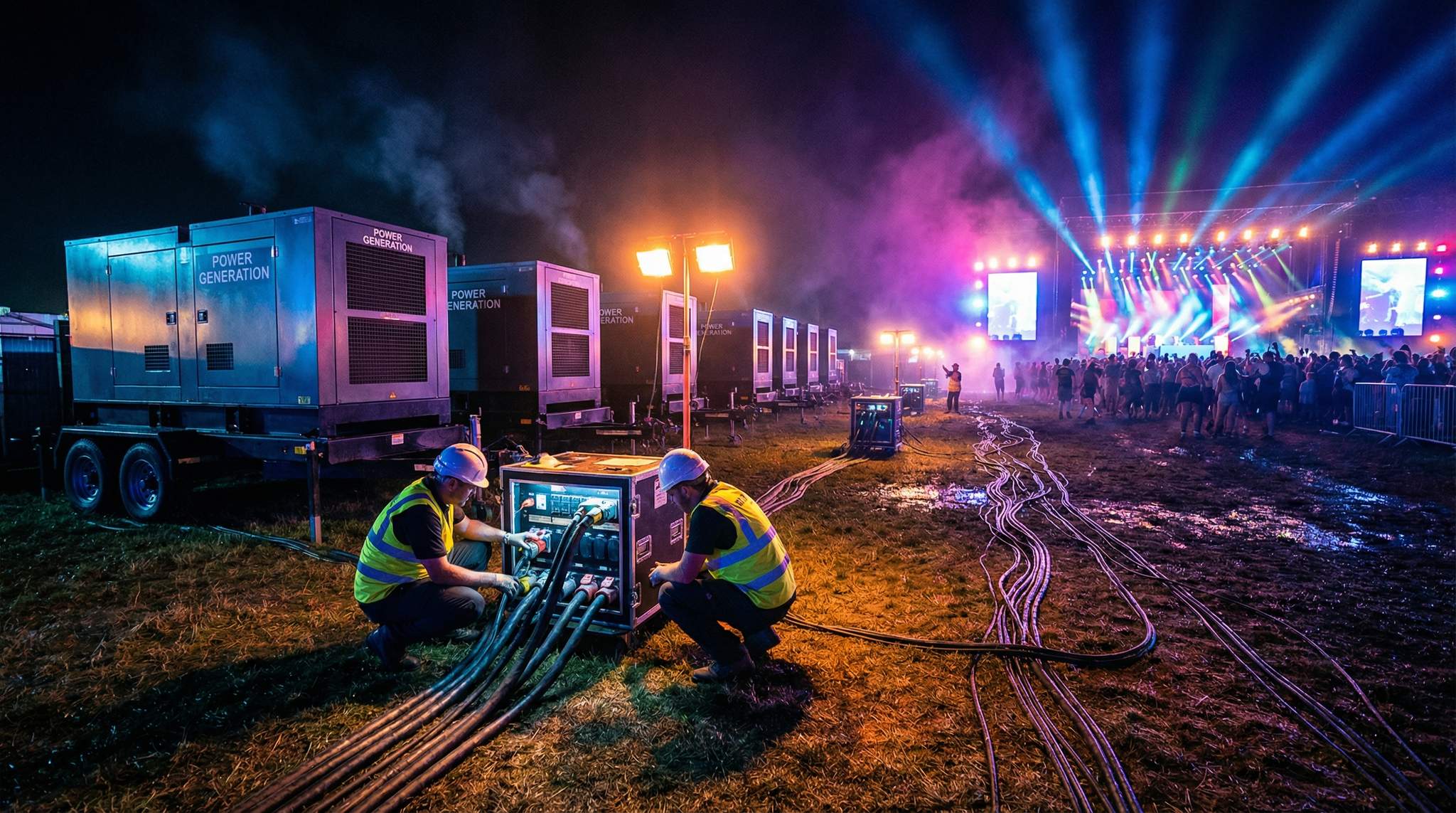
- Deploying Generators: Most outdoor festivals, especially in remote locations, rely heavily on portable generators. Diesel generators are the workhorses of festival power due to their high output and reliability. They come in various sizes – smaller towable units (perhaps 20–100 kW) for individual zones, and massive trailer-mounted units (500 kW or more) for main stages or large sections of the site. Generators give organizers control over their power supply independent of local infrastructure, which is crucial for rural sites like farms or open fields. The downsides include fuel management (diesel needs to be stored and regularly refilled), potential noise, and emissions. Many festival producers mitigate noise by using “super-silent” or sound-attenuated generators placed strategically far from stages and attendee areas. Emissions can be addressed by using biofuels (like biodiesel or hydrotreated vegetable oil) instead of regular diesel – an increasingly popular choice to reduce carbon footprint.
- Hybrid Approaches: Some festivals use a mix of grid power and generators. For example, a festival might run basic needs and daylight operations on grid power, but have generators for the stages and night-time use when the load is higher. Alternatively, the grid could supply most needs while a generator stands by as a backup in case of a grid failure. In recent years, there’s also movement toward sustainable power solutions like battery banks, solar panels, or hybrid generator systems that combine renewable energy with fuel-powered generators. While these green solutions can supplement the power supply (and are great for things like small stages or ambient lighting), they still often work alongside traditional generators to meet the full demand.
When sourcing generators for music festivals, organizers must look beyond basic construction-grade units. The demands of live audio and complex lighting rigs require specialized music festival generators that offer precise voltage regulation and frequency stability. For large-scale operations, partnering with vendors who specialize in industrial power supply events ensures you receive twin-pack synchronous generators—units that run in parallel to guarantee uninterrupted electricity supply during festivals even if one engine fails. Effective power management for outdoor festivals also dictates that these primary power plants are positioned to minimize cable runs while remaining accessible for heavy fuel trucks.
When designing a system for temporary power for a music festival, organizers must account for the transient nature of the event site. Unlike permanent venue infrastructure, a temporary grid requires rapid deployment and teardown. This means selecting modular distribution panels and plug-and-play cabling systems that can be quickly routed across greenfield sites without causing ground damage. Effective short-term power solutions also involve coordinating with staging companies to ensure that portable generator farms are positioned safely away from high-traffic attendee zones while remaining close enough to minimize voltage drop over long cable runs.
When scaling down from a multi-day mega-event to a single-day show, selecting the right generator for an outdoor concert requires a highly targeted approach. Promoters must balance intense peak-load demands—such as sudden lighting cues and heavy bass transients—with the strict noise ordinances often enforced in municipal parks or urban amphitheaters. In these single-stage scenarios, deploying a high-capacity, sound-attenuated towable power plant, paired with an automatic failover backup, provides rock-solid reliability without the sprawling logistical footprint of a multi-megawatt festival compound.
When making the choice, consider scale and location. A small urban street festival might get by with tapping into city power lines for a few booths and a small stage. In contrast, a 3-day music festival in the countryside with 50,000 attendees will likely deploy multiple large generators, potentially supplying several megawatts of power (equivalent to the consumption of a small town). Always conduct a site survey: understand what existing electrical infrastructure is available and its capacity, and determine how easily generators and fuel can be brought in and positioned.
Collect Any Attendee Data at Checkout
Add custom registration fields to your checkout — dietary needs, t-shirt sizes, company names, and more. Conditional logic and per-ticket-type fields.
Securing a reliable outdoor power supply for festivals in remote or “greenfield” sites often requires a phased deployment. Site managers typically bring in smaller, towable generators during the build week for construction crews and production offices, before transitioning to the multi-megawatt primary plants needed for the live event days.
Beyond massive multi-day concerts, coordinating the electricity supply for outdoor events like food and wine festivals, corporate retreats, or seasonal holiday markets requires a highly adaptable approach. While these gatherings might not feature massive main-stage audio rigs, they often involve dozens of decentralized power draws—such as individual vendor stalls, ambient site lighting, and experiential marketing activations. For these scenarios, event producers frequently deploy a network of smaller, ultra-quiet inverter generators or high-capacity battery power stations. This decentralized strategy ensures a reliable energy flow across sprawling footprints without the noise pollution or heavy cabling infrastructure associated with traditional mega-watt power plants.
Need Festival Funding?
Get the capital you need to book headliners, secure venues, and scale your festival production.
Designing the Electrical Distribution System
Having sources of power (whether grid or generators) is only half the battle – the electricity then needs to be distributed safely and efficiently across the festival site to every location that needs it. Designing a distribution system is like creating the festival’s circulatory system, with power cables as the arteries.
1. Power Distribution Planning: Start by creating a power distribution map of the site. Mark where each generator or power feed will be located, and how cables will run from those points to stages, vendor areas, and facilities. The goal is to minimize extremely long cable runs (which can lead to voltage drop or tripping hazards) and to allocate power sources close to heavy loads. For example, if two stages are at opposite ends of a field, it often makes sense to dedicate separate generators to each rather than stringing cables hundreds of meters. Likewise, cluster vendor booths into zones that can be served by a nearby distribution box.
2. Load Distribution and Phasing: Large generators typically provide multi-phase power (such as three-phase electricity), which is useful for heavy equipment and for balancing loads. An experienced event electrician will balance the load across phases so that no single phase is overloaded. If one phase of a generator is powering all the food stalls and another is mostly idle, that’s inefficient and could lead to power trips. Instead, distribute the big consumers (like stage lighting, audio equipment, cooking appliances) across different phases or generators. Also, consider splitting critical loads: for instance, on a big stage, often the audio equipment is run on a separate power feed from the lighting equipment. This practice not only prevents a lighting surge from accidentally shutting down the sound, but it also avoids electrical noise interference on the audio lines.
3. Cabling and Equipment: Use heavy-duty outdoor-rated cables that can handle the current required. All cables and connectors must be rated for more amperage than they will actually carry, providing a safety margin. For distribution, portable electric panels or “distros” are used – these are essentially breaker panels that take in high-capacity power (like a 400 A feed) and split it into multiple circuits (like 20 A or 30 A outlets) for various needs. Long cable runs should be kept clear of high-traffic areas, or cables should be covered with cable ramps or buried safely, to eliminate tripping hazards and protect the cables from vehicles and foot traffic. It’s also wise to elevate connections and joints off the ground when possible to avoid water ingress in case of rain (rain is a reality at many outdoor festivals).
When selecting a festival power cable, organizers must prioritize durability and compliance. Industry-standard HO7RN-F rubber flexible cables are typically required for outdoor event environments due to their resistance to mechanical stress, oil, and extreme weather. For high-amperage main feeds from generators to primary distribution boards, heavy-duty cam-lock connectors and multi-core lines are standard. Additionally, every cable run crossing pedestrian or vehicle paths must be secured within heavy-duty cable protectors (often called yellow jackets) to maintain ADA compliance and prevent catastrophic power loss from severed lines.
4. Professional Installation and Safety: Always have a qualified electrical team design and install the distribution system. This often means hiring a professional power supplier or electrical engineers who specialize in events. They will ensure connections are correct, phase balancing is done, and all equipment is grounded (earthed) properly. Safety devices like GFCI (Ground Fault Circuit Interrupter) outlets or RCDs are used in appropriate locations (especially anywhere near water or damp conditions, like outdoor bars or restroom areas) to protect people from electric shock. All wiring should comply with local electrical codes and standards for temporary installations. A robust system also includes proper grounding rods for generators and distribution points to prevent any dangerous fault conditions.
5. Overload Protection and Monitoring: Each distribution panel and generator setup should have appropriate fuses or circuit breakers. This prevents dangerous overloads and isolates problems if a particular cable or device short-circuits. During the event, staff should monitor the electrical load on major circuits. Today it’s common to have load monitoring equipment or at least manual spot-checks with clamp meters to see that no generator or circuit is consistently above, say, 80% of its rated capacity. By monitoring in real time, the crew can redistribute loads or fire up additional generators if they see usage going higher than expected.
Advanced Power Management Strategies for Outdoor Events
As productions scale, basic distribution is no longer sufficient. Modern event power supply relies on smart telemetry and active load tracking. Organizers producing large-scale outdoor shows must implement comprehensive power management protocols to monitor fuel consumption, phase balance, and emissions in real time. Utilizing smart distribution boxes equipped with remote monitoring allows site managers to track the exact draw of every vendor and stage. When contracting vendors for industrial power supply at events, stipulate the inclusion of these digital monitoring tools. This data-driven approach not only prevents mid-show tripped breakers but also provides a highly accurate blueprint for optimizing generator sizes and reducing fuel costs in subsequent years.
Ensuring Redundancy and Reliability
Even with great planning, equipment can fail or unexpected situations can arise. That’s why the best festival power plans include redundancy and backup solutions to keep the show going if something goes wrong.
- Backup Generators: For critical areas like the main stage, it’s common to have a backup generator on standby. In some cases, two generators can be run in parallel sharing the load, so if one fails the other automatically takes over without a loss of power. At the very least, a second generator can be positioned nearby, pre-fueled and tested, ready to be switched on at a moment’s notice. The time it takes to swap power can be the difference between a brief hiccup versus a cancelled performance.
- UPS (Uninterruptible Power Supply): Certain equipment cannot tolerate even a brief loss of power – for example, digital audio mixing consoles, servers running ticketing or RFID systems, or emergency lights. For these, UPS units (battery backup systems) are essential. A UPS can bridge the gap of a few seconds or minutes during which a generator is being started or a circuit is being moved. They ensure that critical systems stay online long enough for backup power to kick in.
- Fuel Management: Running out of fuel is a preventable cause of power failure. Crew should calculate fuel burn rates for each generator and ensure a schedule for refueling (typically during low-activity times like early morning). Large festivals often have fuel trucks on site to top up generators daily. It’s wise to have more fuel on hand than you expect to use – and secure the fuel storage safely away from ignition sources and attendee access. In one festival scenario, a generator supplying a stage went down simply because it ran out of diesel; a 15-minute outage during a peak moment could have been avoided with better fuel monitoring.
- Spare Equipment: Have spare cables, distribution boxes, and even extra light fixtures or amplifiers for critical areas. If a cable gets damaged or a distro panel fails, a replacement should be ready to swap in. Quick response is vital – which means having roaming electricians or power techs during the event, equipped with tools and protective gear, who can troubleshoot issues immediately.
- Testing and Rehearsals: A reliable plan isn’t complete until everything is tested. Before gates open, do a full power-on test of the site. This may involve turning on all generators, powering all systems and perhaps even simulating the full festival schedule for a short period. This shakedown can reveal if any circuit is overloaded (a breaker might trip) or if any part of the site isn’t receiving stable power. It’s better to blow a fuse during a test on Thursday than in the middle of the headline act on Saturday night. Some veteran crews also run
load banktests on generators before the festival – using dummy loads to ensure each generator can handle its expected capacity and to “exercise” the generators. - Weather and Contingencies: Weather can affect power reliability. Rain or mud can threaten generators and cables, extreme heat can cause generators to overheat, and high winds might knock down overhead cable runs or cause debris that damages equipment. Plan for these by weatherproofing equipment (tents or enclosures for generators and distros), securing cables firmly, and even having contingency plans like relocating generators if certain areas flood. Reliable power planning means thinking through these worst-case scenarios and having solutions ready.
The Fundamental Importance of Reliable Power
Power supply might not be the most glamorous part of festival planning, but it is absolutely fundamental. A well-designed power system keeps the music playing, the food cooking, and the lights shining. It directly impacts safety (emergency systems and lighting), revenue (vendors can’t sell food or merch without power), and attendee experience (nobody enjoys a silent stage or dark, unsafe pathways).
History has shown that festivals which neglect proper power planning often learn hard lessons. From small local events to large international festivals, there are cases where stages went dark or entire events were cut short due to power failures. On the flip side, organizers who invest time and resources into robust power and electrical distribution find that their events run smoother and avoid many crises. Reliable power is essentially the backbone of the festival – much like water supply or security, it’s something attendees might not notice when it’s working, but will definitely notice if it fails.
It’s worth noting that budgeting for adequate power is also crucial. The cost of generators, fuel, and electrical professionals should be built into the festival budget – cutting corners here can lead to expensive failures later. In summary, planning festival power is about calculating needs, choosing the right source, building a solid distribution network, and adding backups for resilience. By approaching these tasks with diligence and drawing on expert help, the next generation of festival producers can keep their events running without a hitch, no matter what challenges arise.
Frequently Asked Questions
How much power does a main festival stage typically require?
A main stage with professional concert setups, extensive lighting, and large PA systems often requires between 250 and 400 kW or more. Planners must assess total demand by including audio/visual equipment, video walls, and special effects, while adding a safety margin of 20–30% to account for unexpected power spikes.
How do organizers calculate total power demand for a festival?
Organizers assess requirements for every component, including stages, food vendors (typically 2–10 kW each), site lighting, and operational hubs. After summing these figures, they add a 20–30% buffer to account for startup spikes and unexpected additions. This total determines the necessary capacity for grid connections or portable generators.
Is it better to use grid power or generators for outdoor festivals?
Most outdoor festivals rely on portable diesel generators for reliability and independence, especially in remote locations. While grid power is cost-effective if infrastructure exists, it carries risks of wider external outages. Many events use a hybrid approach or keep generators as backup to ensure the show continues if the local grid fails.
How should power be safely distributed across a festival site?
Safe distribution involves creating a site map to minimize long cable runs and using heavy-duty, outdoor-rated cables protected by ramps. Professional electricians must balance loads across phases to prevent tripping and install safety devices like GFCI outlets and grounding rods. All wiring should comply with local temporary installation codes.
Why is load balancing important for festival electrical systems?
Load balancing distributes power usage evenly across multiple phases of a generator to prevent overloading a single line. Efficient balancing ensures stability for heavy consumers like stage lighting and cooking appliances. It often involves separating critical loads, such as running audio and lighting on different feeds to avoid interference or cascading failures.
What role do UPS units play in festival power planning?
Uninterruptible Power Supply (UPS) units provide essential battery backup for critical equipment that cannot tolerate power loss, such as digital audio consoles and ticketing servers. They bridge the gap during a power failure, keeping systems online for the few minutes it takes for backup generators to start up and take over the load.
What type of generators are best for music festivals?
The best generators for music festivals are specialized, sound-attenuated, twin-pack synchronous units. Unlike standard construction equipment, these power plants provide the precise voltage regulation essential for sensitive audio-visual gear. Partnering with providers experienced in industrial power supply events ensures the hardware can handle the dynamic loads of live performances while maintaining a stable electricity supply during festivals.
What are the best practices for power management for outdoor festivals?
Effective power management for outdoor festivals involves comprehensive load calculation, strategic generator placement, and phase balancing. Organizers must map out the site to minimize cable runs, utilize heavy-duty distribution panels, and implement real-time load monitoring to prevent overloads and ensure a safe, uninterrupted energy flow across the event grounds.
What should organizers look for when hiring an event power supply contractor?
When sourcing an event power supply partner, organizers should prioritize contractors with specific experience in live entertainment rather than general construction. Look for vendors who provide comprehensive power management services, including load calculation, smart distribution telemetry, phase balancing, and twin-pack synchronous generators to ensure uninterrupted operation.
What type of festival power cable is required for outdoor events?
Outdoor events require heavy-duty, weather-resistant cabling, most commonly HO7RN-F rubber flexible cables. These are designed to withstand mechanical stress, moisture, and temperature fluctuations. For main generator feeds, organizers rely on high-amperage multi-core cables with cam-lock connectors, ensuring all runs are safely housed in heavy-duty cable ramps when crossing traffic areas.
How do organizers secure an outdoor power supply for festivals in remote locations?
Securing an outdoor power supply for festivals in remote or greenfield sites requires deploying portable, high-capacity diesel or hybrid generators. Organizers must conduct thorough site surveys to determine optimal generator placement, plan for heavy fuel truck access, and implement a phased rollout starting with smaller units for the build week before bringing in the primary multi-megawatt plants for the event itself.
What size generator is needed for an outdoor concert?
Sizing a generator for an outdoor concert depends entirely on the scale of the audio-visual production. A modest community show might only require a 20 kW to 50 kW unit to run a basic PA system and static stage lighting. Conversely, a major outdoor concert featuring national touring acts, large LED video walls, and complex moving light rigs will typically demand twin-pack synchronous generators providing 200 kW to 500 kW or more. Promoters should always work with specialized event power contractors to calculate exact peak loads and ensure adequate redundancy.
What are the key considerations when setting up temporary power for a music festival?
Setting up temporary power for a music festival requires careful planning around site topography, rapid deployment, and safe cable routing. Organizers must utilize modular distribution equipment, weather-resistant cabling, and portable generators to build a reliable, short-term electrical grid. Key considerations include minimizing voltage drop across large greenfield sites, ensuring ADA-compliant cable management, and balancing loads effectively to handle the dynamic energy demands of live performances.
What are the primary challenges when coordinating the electricity supply for outdoor events?
Coordinating the electricity supply for outdoor events requires balancing decentralized power needs—like vendor stalls, ambient lighting, and sponsor activations—across large, often uneven terrain. Organizers must mitigate voltage drop over long cable runs, ensure all temporary distribution panels are weather-resistant, and deploy quiet, low-emission generators or battery banks to maintain a pleasant atmosphere for attendees without compromising on power reliability.