Robots Invade Festivals: Hype vs. Reality in 2026
A Glimpse of Festival Automation in 2026
In 2026, festivals are experimenting with robots and automation in everything from pouring drinks to patrolling the skies. The idea of robot bartenders mixing cocktails and drones monitoring crowds sounds like science fiction, but it’s increasingly a reality on festival grounds. Driven by both necessity and innovation, event organizers are testing whether these high-tech helpers can genuinely improve operations or if they’re more of a flashy marketing gimmick. Early trials show a mix of outcomes – some tech tools boosted efficiency when thoughtfully implemented to enhance operations, while others have been more trouble than they’re worth. This article examines real-world deployments to separate beneficial innovations from the hype.
Drivers: Labor Shortages and Tech Breakthroughs
Several trends are powering this robotic rise. Labor shortages in the events industry (from post-pandemic staffing gaps to rising wage costs) have pushed organizers to seek automated alternatives. When hiring a full crew at 2019 levels isn’t feasible, forward-thinking festival producers turn to technology to do more with leaner teams. At the same time, tech has advanced rapidly – robots are becoming more capable and affordable, and AI software is making automation smarter. For example, self-service kiosks and cashless systems are already common, letting fans “do it themselves” for entry and purchases. Now physical robots are emerging to fill roles once handled exclusively by staff. The promise is attractive: machines that don’t get tired, can operate 24/7, and handle repetitive tasks with precision. Stadiums and theme parks have led the way in adopting such automation, and festivals are following suit by deploying tools like autonomous cleaning machines and aerial surveillance drones.
Balancing Innovation with Attendee Expectations
While the tech is exciting, seasoned producers know festivals are fundamentally about human experience. Fans cherish the personal, communal vibe – something a cold machine could undermine if used carelessly. Successful events find a balance: using automation for back-end efficiency, while keeping the human touch front-and-center. For instance, a drone might quietly watch over the perimeter, but security staff are still on the ground interacting positively with attendees. Veteran organizers caution against adopting tech for tech’s sake. The goal is to solve problems (like long lines or trash buildup), not just to show off gadgets. As one industry analysis put it, focusing innovation on practical improvements that deliver real value is key to avoiding the hype trap. In the following sections, we’ll dive into specific robot applications – from bar service to security – evaluating their real-world impact and offering guidance on implementation.
Robotic Bartenders and Automated Drink Service
From Novelty to Necessity at the Bar
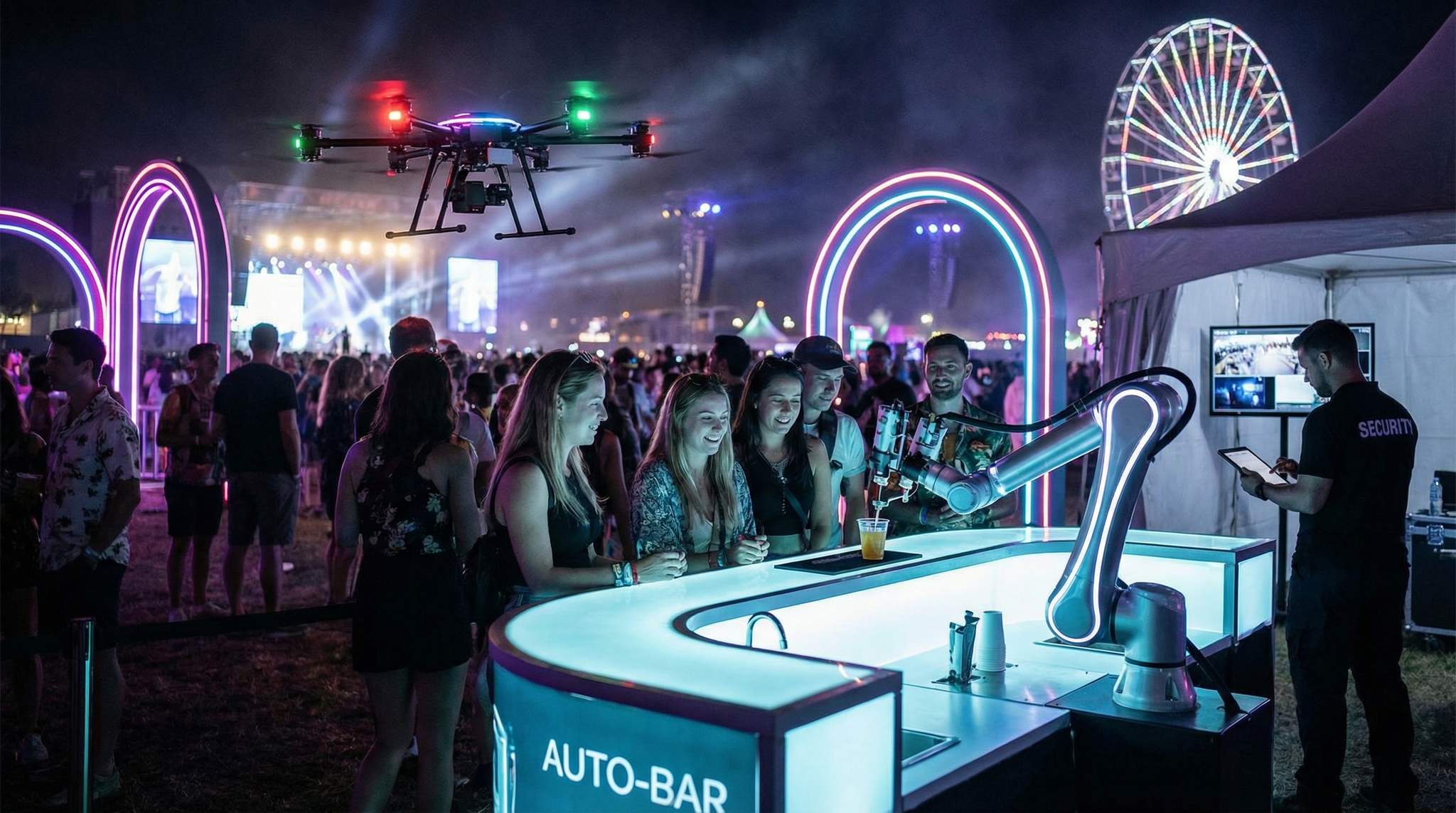
One of the trendiest uses of robots at festivals has been behind the bar. Robotic bartenders – essentially automated drink-making machines – have popped up at events as eye-catching novelties. Attendees initially flock to these futuristic bars, eager to watch a robot arm shake a cocktail or a machine dispense a perfect beer. For example, at the South Beach Wine & Food Festival in the US, an AI-driven robotic bartender named “Cecilia” served drinks and bantered with guests, complete with voice recognition and cheeky one-liners. The cool factor is undeniable: a robot bar can generate buzz on social media and draw curious crowds.
Data-Driven Event Marketing
Track ticket sales, demographics, marketing ROI, and social reach in real time. Exportable reports give you the insights to make smarter decisions.
However, festival organizers are looking at robot bartenders for practical reasons too. During peak hours, beer tents and cocktail booths can hardly keep up with demand – and finding enough experienced bartenders can be tough. In theory, a robot bartender doesn’t require breaks, won’t call in sick, and can serve consistently measured drinks all day. This makes automation appealing as a solution to bartender shortages. Some large venues and events have already installed automated drink dispensers (like the “Rotender” machines in Los Angeles) that pour draft beverages at the push of a button. These systems have landed in stadiums, arenas, and even on cruise ships, handling high volume drink service without the need for as many staff. Festival producers are now piloting similar tech, hoping that robots can keep the beer flowing and lines moving when human resources are stretched thin.
Speed and Throughput: Do Robots Serve Faster?
A critical question is whether robot bartenders can actually serve drinks faster than humans, especially under festival pressure. Real-world data suggests that the difference isn’t as dramatic as one might think. Trials show an average robotic bar unit can sustain roughly 60–90 drinks per hour, which is comparable to a skilled human bartender’s output. In one analysis, a robotic cocktail station averaged about 14.2 drinks in a 15-minute peak period versus 15.6 drinks by an experienced human bar team – essentially a tie in production speed. The consistency of robots is a plus (each pour is perfectly measured), but raw speed isn’t a guaranteed win.
Planning a Festival?
Ticket Fairy's festival ticketing platform handles multi-day passes, RFID wristbands, and complex festival operations.
Why aren’t they vastly faster? One reason is bottlenecks in the service process. Even if the robot can mix a drink in 30 seconds, orders often come via touchscreens or apps. If a chunk of attendees don’t navigate the app smoothly (low battery, poor signal, or just confusion), the robot sits idle waiting for input. By contrast, human bartenders can take verbal orders rapidly and multitask (e.g. chat with one guest while pouring for another). Another factor is that robots often handle only one drink at a time in sequence, whereas a seasoned human bartender might start pouring multiple drinks in parallel during a rush. In lower-demand times, robots have an edge – they don’t get tired and maintain a steady pace, sometimes outperforming humans by ~12% during slow periods. But in peak rushes, the best human teams can match or even slightly exceed robot throughput by hustling hard. As a result, robots alone don’t eliminate bar lines – at least not with current technology.
Reliability and Downtime
Speed aside, festivals must consider reliability. What happens if the robot breaks down mid-event? This is a very real concern. Machines can fail – a syrup pump might clog or a sensor can misalign – and when that happens, service grinds to a halt. Field reports indicate common glitches like a jammed ingredient tube or calibration error will completely stop a robot bartender until a technician intervenes to resolve the error. The average repair time for these minor failures is around 6 minutes, but if an issue is complex, the outage could be much longer. During a headliner set when thousands of thirsty fans hit the bar, a 10-minute outage at a robotic bar is a disaster (and unlike a human, a robot can’t “improvise” a quick workaround). In contrast, human staff can often adapt on the fly – if one tap stops working, they can grab another keg or shift to serving bottled drinks, keeping the line moving.
This means festival organizers need contingency plans for robot-run bars. Many have learned to always have a human bartender or technician nearby to handle problems or take over service if needed. For instance, one automated cocktail unit called FestiBrew malfunctioned during a peak rush at a European festival, leaving guests unhappy until staff quickly jumped in to pour beers manually. The lesson is clear: robots at the bar are not yet “set and forget.” They require on-site support and backup, just like any other piece of equipment. Some events address this by using hybrid models – a self-serve beer wall for simple pours (which patrons operate themselves), overseen by one attendant who can troubleshoot and also pull pints the old-fashioned way if technology fails. Real-world pilots have found this can significantly reduce staff needs (one supervisor replacing 4-5 bartenders) while maintaining throughput, as long as human backup is on hand.
Cost, Complexity, and Cocktail Quality
Another consideration is cost and complexity. High-end robotic bar units (with articulate arms that mix cocktails) can cost tens of thousands of dollars. For a festival, that might mean renting the equipment or partnering with a sponsor or tech provider to share the expense. Setup can be non-trivial: these systems need reliable power (often 220V for industrial machines), stable internet or network connections if they use cloud software or app orders, and time for calibration before the event. Adding a robot isn’t as simple as “plug and play” – it often requires hours of prep and sometimes vendor technicians on-site. And unlike a human hire, a machine can’t be easily scaled up last-minute. You can’t “rush in another robot” if ticket sales surge, because each unit has a fixed location and throughput capacity. This scalability asymmetry means producers must carefully forecast demand and deploy the right number of units well in advance.
Go Cashless With RFID Technology
Enable contactless payments, faster entry, and real-time spending analytics with RFID wristbands and NFC-enabled ticketing for your events.
Quality and menu flexibility are additional sticking points. Festival bars don’t just pour beer – many serve craft cocktails, local specialities, or make on-the-fly substitutions when an ingredient runs out. Most robot bartenders have a limited repertoire. They rely on pre-programmed recipes and a set lineup of ingredients loaded into the machine. If a guest asks for a special cocktail that’s not programmed, or a slight variation (“light on the syrup” or an extra lime), the robot can’t accommodate unless an operator manually intervenes. Even garnishes like mint sprigs or elaborate mixology techniques are often beyond what current automated bars handle autonomously without human aid. One industry executive noted that their automated unit wasn’t aiming to replace a creative mixologist; it’s built for speed and consistency, not craft flair. For events known for creative drinks, this could be a limitation – many festivals pride themselves on signature cocktails or the ability for bartenders to surprise and delight guests. With a machine, the drink will be exactly the same every time, for better or worse.
Fan Reactions: Cool Factor vs. Frustration
How do attendees feel about robot bartenders? Initially, many are excited. A survey of festival-goers who tried an automated bar found they rated the “wow” factor high for novelty, but overall satisfaction was lower than with human service. Patrons appreciated quick, cashless transactions and consistent quality, but they missed the personal interaction. In post-purchase surveys, robots scored only around 2.9 out of 5 in overall experience, whereas human-staffed bars averaged 4.4/5. The lack of banter, recommendations, and that human energy can make a robot bar feel clinical. One festival fan put it this way: “It was cool to try once, but I enjoy chatting with the bartender – the robot was efficient but a bit soulless.” On the flip side, some attendees love the high-tech vibe and even find it entertaining to watch a robot work. It becomes an attraction in itself.
Need Festival Funding?
Get the capital you need to book headliners, secure venues, and scale your festival production.
That novelty can translate to marketing value. Festivals positioning themselves as innovative or futuristic might gain brand points by showcasing robotics. Social media posts of “the festival with the robot bartenders” can generate buzz. But if the execution is poor – long waits due to a slow robot or technical hiccups – public perception can sour quickly. Crowds have little patience for a gimmick that slows them down. This is why many producers stress that any automated bar must at least match the speed and service level of a traditional bar, or it risks irritating fans. The best approach has been to deploy robot bartenders in a controlled way: for example, as a dedicated experience in the VIP lounge or at a sponsor’s activation booth, rather than replacing every bar on site. That way, interested guests can seek it out, enjoy the novelty, and those who prefer a human touch still have plenty of traditional options. In short, robotic bartenders can enhance the festival experience when used smartly, but they are not a wholesale replacement for humans. They work best as a complement – easing peak bottlenecks and adding a dash of sci-fi fun – rather than a core service everyone must use.
Table: Human vs. Robot Bar Service Comparison
| Factor | Human-Run Bar | Robotic Bar System |
|---|---|---|
| Peak throughput | ~60-70 drinks/hour per bartender team | ~60 drinks/hour per robot unit |
| Consistency | Varies by bartender; minor variances | Precise pours every time; uniform quality |
| Downtime & recovery | Resilient – staff can cover each other or adjust on the fly | Stops entirely if a fault occurs until fixed (avg ~6 min repair) |
| Order flexibility | Can handle custom requests and substitutions | Limited to programmed recipes & ingredients on hand |
| Guest interaction | Personal touch; staff can engage and upsell | Novelty factor; minimal interaction and no personalisation |
Autonomous Cleaning Robots: Keeping Festival Grounds Tidy
Tackling Trash with Automation
If there’s one thing every festival struggles with, it’s trash and cleaning. By the end of a festival day (or weekend), the grounds are typically littered with cups, cans, food wrappers, and more – an unfortunate byproduct of thousands of people having a good time. Cleaning crews usually work overnight to restore order, racing against the clock to have the venue clean by the next morning. In recent years, some festival organizers have looked to autonomous cleaning robots to help with this monumental task. The vision is appealing: self-driving machines that can roam the venue picking up garbage or sweeping up debris, supplementing (or even replacing) large cleanup crews.
Early forays into cleaning automation at events have included things like robotic floor scrubbers, vacuum units, and even experimental litter-picking robots. For example, large indoor venues have used autonomous floor scrubbers (imagine a Roomba on an industrial scale) to polish concrete floors after crowds leave. At outdoor festivals, prototype all-terrain robots have been tested to patrol fields at night and collect trash, much like a mini robotic garbage truck. Some of these look like little carts or coolers on wheels, using sensors and cameras to identify litter. The theoretical benefit is huge – a single robot could cover a zone repeatedly, doing the work of several laborers and freeing human staff for more delicate tasks like sorting recyclables. Especially for multi-day camping festivals where trash accumulation is constant, robots could continuously tidy up communal areas and bathrooms, improving hygiene and appearance even before the event ends.
After-Hours Cleaning: Robots vs. Human Crews
The most practical use of cleaning robots is during after-hours, when attendees have left or are asleep. Overnight, autonomous units can operate without risking bumping into attendees. Festivals like Glastonbury or Bonnaroo often have armies of overnight cleaners; a few well-deployed robots could reduce that headcount and give the human crew a head-start by morning. Robots don’t mind working 3 AM shifts in the cold and dark. For instance, some event organizers have noted that a cleaning robot can methodically patrol the grounds and collect trash into onboard bins, meaning when the human team arrives at sunrise, there are fewer piles to deal with by morning. Additionally, robots can handle repetitive tasks like floor scrubbing in restrooms or emptying dozens of trash bins fitted with IoT sensors (which alert when full). The result can be a cleaner venue and a smoother reset each day, with potentially lower labor costs.
However, there are limitations. Outdoor festival sites are very different from the smooth floors of a shopping mall (where cleaning bots have seen success). Fields, grass, mud, uneven terrain, and random obstacles make autonomous navigation tricky. Many cleaning robots struggle on rough or changing terrain – a small wheeled robot that works great on asphalt might get stuck in a muddy field or snagged on cables and tents. Festival environments can also be harsh on equipment: dust, spilled drinks, and even vandals (a robot roaming around might be too tempting for some pranksters in the campgrounds). This is why most trials keep cleaning bots confined to controlled areas: for example, an indoor artist hospitality lounge or the concrete concourse of an arena within a festival, rather than the open field. Overnight timing is also crucial; one wouldn’t run a floor scrubber through a crowd in daylight, but after the stage lights go out, it’s safer to let it loose.
In terms of performance, current robots can’t yet match the intuition and adaptability of human cleaners for all tasks. Humans can quickly distinguish trash from someone’s belongings or know to be gentle with a lost phone mixed in the litter; a robot might just scoop everything. Therefore, the approach has been augmentation: using robots to handle the bulk (like vacuuming general debris or hauling trash bins) while humans handle finer details and anything the machines miss. Festivals that have piloted these systems report moderate success – machines do make the morning cleanup faster – but also note that you need a staff member to oversee each unit (in case it gets stuck or finishes its route needing redeployment). In effect, one person might manage a fleet of 3-4 cleaning robots, doing the work of a larger cleaning crew but not entirely “hands-off.” Still, even a reduction of a dozen overnight workers can be significant for the budget and for reallocating staff to other important areas.
Innovations in Waste Management Tech
Beyond autonomous roaming robots, festival organizers are adopting other automated systems for waste management that, while not as flashy, can drive big efficiency gains. Smart waste bins, for example, are being used at some events: these are trash or recycling bins equipped with compactors and sensors that signal when they’re almost full. Instead of staff constantly walking the grounds checking every bin, the system directs cleaners only to those that need service, which can dramatically cut redundant labor costs. Some festivals have also explored semi-automated “trash collection trains,” where a small drone or ground robot leads volunteers in a coordinated sweep, using GPS to ensure no area is missed. And in terms of sorting waste, innovative conveyor systems with AI vision (akin to what recycling facilities use) could one day be deployed on-site to automatically separate recyclables from trash – though that’s still an emerging concept for temporary events.
One particularly creative experiment was conducted by Cornell University researchers: they released adorable trash barrel robots in a public plaza to see how people reacted. These robots, mounted on hoverboard bases, roamed around asking people for garbage. The result? People were surprisingly receptive – many treated the robots like “playful pets,” feeding them trash and even helping them when they got knocked over. This suggests that well-designed trash robots could not only clean, but also engage attendees to participate in keeping the grounds clean (turning it into a bit of interactive fun). At festivals, one could imagine friendly trash bots cruising through the crowd after a show, prompting people to hand over their empty cups. Such approaches might boost recycling and reduce litter through positive engagement, rather than just automated brute force. While these concepts are still experimental, they point to a future where festival sustainability efforts get a high-tech assist.
It’s also worth noting the environmental angle here. Festivals are under pressure to improve waste diversion and overall sustainability metrics. Many events now strive for “zero-waste” operations – typically defined as 90%+ of waste being diverted from landfills. To hit these ambitious targets, every efficiency counts. Robots and smart waste systems could play a part by making collection and sorting more thorough and less labor-intensive. A festival can tout its use of innovative green tech (like solar-powered cleaning robots or automated recycling sorters) as proof of moving beyond old wasteful practices. In an industry where fans and sponsors increasingly demand eco-consciousness, leveraging automation to handle trash is a logical next step – provided the machines themselves are energy-efficient. (One analysis pointed out that some robot vacuums and bar machines draw significant power during operation, so organizers must factor in the energy footprint of new tech as well.)
Obstacles and Practical Lessons
The experiments so far have yielded some important lessons for cleaning automation. First, terrain and environment are critical: if your festival is on a beach, in a forest, or a muddy field, today’s robots might not cope well. It may be better to use them in VIP areas, parking lots, or other smoother zones. Second, there’s the matter of trust and safety. Attendees might be wary of a machine moving around near them – what if it bumps into someone or, in a worst case, malfunctions and causes injury? One incident at a tech fair in China saw a robot malfunction and lunge into a spectator area, causing brief panic before it was shut off. That underscores why festival organizers must vet robots carefully, do thorough safety tests, and possibly keep them fenced off or only run when attendees aren’t present. In practice, festivals often schedule autonomous cleaners for late night and then cordon off small sections at a time (so a robot can work without people entering its immediate area). High-visibility vests, warning lights, or even a chaperone accompanying the robot can also help signal to any stragglers that a machine is operating.
Another challenge is durability and maintenance. Festival settings (outdoors especially) can be rough: devices might need all-weather protection, rugged wheels, and filters for dust. If a robot breaks down mid-event, do you have spare parts or a technician on-site? Some events learned this the hard way when an autonomous vacuum had its sensors clogged by fine dust on day 1 and became “blind.” The fix was to clean the sensors twice a day thereafter – an easy step once identified, but something human cleaners don’t require. Budgeting for at least one technician or technically savvy crew member to manage the care and feeding of your robots is highly recommended.
In summary, autonomous cleaning robots show real promise in cutting cleanup times and labor costs, but they must be chosen and used strategically. They shine in controlled conditions and off-peak hours. For 2026, a few pioneering festivals have reported positive outcomes using robots to handle late-night trash sweeps and bathroom cleanings, reporting cleaner grounds each morning and reduced strain on their staff. Yet, these same producers will quickly add that robots are helpers, not magic solutions – you still need a solid human cleanup crew and a plan B. Over time, as the technology improves (smarter navigation, better all-terrain models), we can expect to see more festivals integrating cleaning bots to keep their venues spotless and green.
Security and Surveillance: Drones on Patrol
Drones as Eyes in the Sky
Security is a top priority at large festivals, and drones have emerged as a valuable tool for keeping events safe. In 2026, many festivals have begun deploying camera-equipped drones to watch over crowds, monitor perimeters, and respond quickly to incidents. Unlike fixed CCTV cameras or ground patrols, drones provide a bird’s-eye view and can cover huge areas swiftly. One or two security drones aloft can do the surveillance work that might otherwise require dozens of personnel on foot. They can hover over dense crowd areas to spot signs of trouble (like a fight, a medical emergency, or an unsafe bottleneck forming) and relay real-time video to the control center. Festival security teams have used drones to monitor parking lots for car break-ins, to scan fence lines for gatecrashers, and even to spot fires or hazards in real time. For example, a drone at a UK music festival helped officials detect an unauthorized bonfire in the camping area at night, allowing staff to intervene before it grew.
The advantages of drones in a festival setting are clear. They can reach any point of the site within seconds, which is incredibly useful for urgent situations. If an incident is reported (say a lost child or a medical collapse), directing a drone camera there can give security a visual while response teams are en route. Thermal imaging on drones has been used to find people in dark corners or monitor crowd density at night, identifying hotspots where the audience is too tightly packed (a valuable safety insight to prevent crushing). Some events have drones with loudspeakers that can broadcast messages to a specific area if needed (for crowd control or emergency announcements). All this can enhance situational awareness and shrink response times, contributing to safer, better-managed events and providing continuous surveillance for music festivals.
It’s not just music festivals – large sporting events and theme parks have also embraced security drones, and festivals are adapting those practices. For instance, the organizers of a major 80,000-person festival in Europe partnered with a drone services company for continuous overhead surveillance during the event. The drones provided day and night video feeds, and according to the security director, it was like having an “eye in the sky” that could coordinate ground teams much more efficiently. By 2026, this approach is becoming more common, especially at multi-stage festivals spread over wide areas (where keeping tabs on everything from one central CCTV room is difficult). Drones integrate into the security operation as another set of patrol units – just flying ones.
Benefits: Quick, Proactive Security Coverage
The real-world benefits of security drones have been demonstrated at events like Tomorrowland in Belgium and Paaspop in the Netherlands. At Tomorrowland 2024, for example, drones operated by police continuously monitored the festival’s massive grounds (which hosted 400,000 attendees over two weekends). The drones helped enforce a temporary no-fly zone and gave security forces instantaneous overviews of any situation. Over the festival’s duration, more than 1,000 drone flights were logged, mostly by authorized security drones. This allowed security staff to spot and react to issues that would be hard to see from ground level – such as detecting when certain exits were getting overcrowded or identifying individuals breaching fences in remote parts of the site. Response teams could be dispatched faster and more precisely thanks to drone surveillance.
Another benefit is deterrence. Just as a visible CCTV camera can dissuade misbehavior, a drone visibly hovering overhead can make would-be troublemakers think twice. Organizers have noted that when attendees see drones, they often assume they’re being watched (which, indeed, they are), leading to better behavior in some cases. Drones equipped with spotlights have also been used to illuminate dark parking areas or campsite sections, discouraging fights or vandalism simply by making it clear that the area isn’t unwatched. At large camping festivals, a drone doing a late-night sweep with a thermal camera can quickly locate any campfires (which are often banned for safety) or clusters of people where something might be amiss, enabling intervention before a situation escalates.
Perhaps one of the most life-saving uses of drones has been in medical emergencies. If a report comes in of a person down in the crowd, finding the exact location among thousands of people can be like searching for a needle in a haystack. Drones can zoom over and find the spot within seconds by tracing distress signals or guiding medics visually. Some festivals have even explored drones delivery of medical supplies – for example, dropping an AED (defibrillator) to a remote corner of the festival site where a person is having a cardiac arrest, at speeds much faster than medics could run through a thick crowd. While this is still an emerging practice, it showcases how drones could directly improve emergency outcomes at events, making them more than just cameras in the sky.
Controlling the Airspace: No-Fly Zones and Rogue Drones
However, the rise of drones also introduces new headaches: unauthorized drones piloted by attendees or outsiders. In the era of cheap hobbyist drones, it’s not uncommon for a fan to think it’s a great idea to fly their own drone over the festival to get cool footage – not realizing how dangerous or illegal that can be. Rogue drones pose collision risks (especially if there are official drones and helicopters in the air), they can drop into crowds, and they raise serious security concerns (smuggling contraband or worse). Festivals in 2026 have had to get proactive about this. Most large events now establish official no-fly zones over their sites and work with aviation authorities to legally enforce them with aviation authorities. For instance, Tomorrowland’s organizers set up a geo-fenced airspace and required any drone operator (like police or media) to get special authorization to fly. Despite that, violations happen: at Tomorrowland 2024, police detected numerous unauthorized drone flights just outside the allowed perimeter and even detected numerous unauthorized drone flights during the event. Some were flying dangerously high (one was caught at 1,642 feet altitude!) or far beyond visual line of sight, breaking multiple rules regarding altitude.
To combat this, festivals are employing drone detection and counter-drone technologies. Specialized radio-frequency scanners and radar systems can pinpoint when an unapproved drone is in the vicinity. For example, Paaspop Festival in 2025 used a system that tracked Remote ID signals to identify pilots and identified two rogue drone flights, logging their pilots’ positions for authorities. Other events have tested jammer devices (that can force a drone to land) or even old-school methods like net guns and trained birds of prey to intercept drones, although those are less common. The bottom line is that drone management is now a part of festival security strategy. Organizers often coordinate with local law enforcement or anti-drone experts to secure the airspace. They also communicate clearly to attendees that personal drones are banned and can result in ejection or fines. Signage at entrances and PSAs on social media make the policy clear: your cool drone video isn’t worth a security incident.
Festival teams that have integrated drones into their security plan recommend developing standard operating procedures for drone security, much like any other security asset deployment strategy. This includes having trained operators (sometimes hiring licensed drone pilots or using police units), setting flight paths or designated surveillance schedules, and establishing no-fly rules for showtimes if drones might distract from performances (some artists request no overhead drones during their set). Importantly, privacy considerations must be handled; some attendees may feel uneasy with drones filming them. Best practice is to be transparent: announce that security drones will be in use for safety purposes, and ensure the footage is handled securely (not publicly broadcast beyond the need-to-know security team). Many festivals note that after initial curiosity, most fans accept drones as just another part of the high-security environment, much like cameras or guards – especially when it’s explained that the goal is to keep everyone safe and catch trouble early.
[Internal Perspective: Learn how top festivals enforce no-fly zones and utilize anti-drone tactics in our guide on countering unauthorized drones at events and how to utilize anti-drone tactics effectively.]
Ground Robots and Other Security Gadgets
While drones rule the sky, what about robots on the ground for security? This is less common, but a few interesting trials have happened. Some events have tested autonomous security robots – think of a rolling robot like a big kiosk that can patrol and use cameras or even sensors to detect weapons. Companies like Knightscope produce egg-shaped security robots that have been used in malls and parking lots; a few tech-forward venues have considered these as “additional patrols” during events. In practice, their usefulness at a festival is limited. They move slowly and can’t navigate dense crowds or grass very well, so they might only be feasible in open concourses or entrance areas. They also lack the authority of a human guard – an unruly guest might not think twice about tipping over a robot that tells them to stop (an issue that’s been reported in some public trials). As a result, we haven’t seen widespread adoption of rolling security bots at music festivals yet. They remain more of a curiosity, deployed at most as a stationary sentry or info-point that can call for human help if needed.
One ground-based technology that has been useful is robotic camera towers. These aren’t robots in the sci-fi sense, but telescoping portable units with 360° cameras (sometimes with AI analytics) that can be moved around the site. They provide a high viewpoint like a drone but can stay up all day in one spot without flying. Some festivals use these to cover blind spots where installing a fixed tower isn’t feasible. They can track motion and alert security to potential intrusions or loitering in back-of-house areas, for example. It’s a simpler form of automation, but effective for extended monitoring.
Finally, festivals are exploring other automated safety tools: AI-powered video analytics that watch CCTV feeds for anomalies (like a crowd surge pattern that suggests distress), and even wearable devices for staff that can trigger alerts if a security team member falls or is attacked. These aren’t “robots” per se, but they show how automation and intelligent systems are being woven into festival safety operations. The key is always to enhance human capability, not to replace it outright. Security robots and drones provide new vantage points and greater coverage, but human judgment and decision-making remain irreplaceable when it comes to keeping a festival secure and enjoyable.
Beyond the Gimmick: What Actually Works?
Where Robots Shine in Festival Operations
Looking across the different use cases – bars, cleaning, security and more – it’s clear that some automated solutions are proving their worth. The sweet spot for festival robotics tends to be repetitive, labor-intensive tasks where consistency is crucial. These are areas where machines have an advantage or can dramatically extend human capacity:
- Ticketing and entry processing: Automated scanning gates and kiosks (while not robots with arms and legs) have been a huge win, cutting entry wait times by letting one attendant oversee multiple fast lanes simultaneously. This concept of automation handling the high-volume transactions can be extended to other areas on site.
- Cashless self-serve systems: From RFID wristband self-pour beer walls to self-checkout merch stands, these reduce staffing needs and often speed up service. Fans appreciate shorter lines and the novelty of pouring their own beverage, and festivals see more sales when wait times drop. In fact, events piloting self-serve beer taps saw wait times plummet and labor reduced by up to 70% at those stations (labor reduced by up to 70% at those stations).
- Overnight cleanup: Autonomous vacuum sweepers and floor scrubbers have reliably handled post-event cleaning in indoor areas. Festivals reported saving dozens of labor hours by deploying robotic scrubbers in expo halls and stadium concourses overnight, waking up to cleaner grounds with minimal human effort. The robots can repetitively scrub or vacuum large floor areas much more efficiently than a few people with mops.
- Security surveillance: Drones have arguably delivered some of the highest value, preventing incidents and enabling swift response. The safety improvements from detecting overcrowding or intercepting trespassers early are hard to quantify but invaluable. Organizers often cite drone surveillance as a tech investment that clearly paid off by avoiding costly accidents or breaches. It’s become a must-have at certain large festivals, rather than a gimmick.
- Data and monitoring: Even when not visible to attendees, many festivals are using AI and automation in the background (like AI schedule optimizers or crowd movement analytics). These quietly make the event run smoother. While not “robots” roaming the site, such automation can reduce errors and stress for producers – a genuine help that fans feel through a more seamless experience (shorter delays, better crowd flow, etc.). In the end, a lot of the tech that “actually works” is often the kind that attendees don’t even notice, because it’s integrated so well.
Gimmicks and Unfulfilled Promises
On the other side of the coin, there have been plenty of festival tech ideas that garnered headlines but didn’t prove very practical. Robot bartenders can fall into this category if implemented without foresight. The concept looks amazing in press photos, but if it serves drinks slower than a human or keeps breaking down, fans lose patience quickly. Many events that tried flashy cocktail robots found them neat for a VIP demo, yet not ready for prime time across the whole festival. In some cases, the robot bars ended up with longer lines than the human bars because of novelty-seekers plus slower cycle times – exactly the opposite of the intended effect. That’s a sure sign of a gimmick overtaking utility.
Another example is delivery drones dropping beverages or merch to crowds – a fun idea that generated buzz a few years back (one South African festival even trialed beer delivery via drone parachutes). In reality, safety and logistical issues make this impractical: drones carrying objects over people can be dangerous, and coordinating orders is chaotic in a festival setting. The novelty wore off and the idea hasn’t been widely adopted beyond staged publicity stunts. It turns out handing a beer over a counter is still much simpler and safer than air-dropping it onto dancing attendees!
Similarly, some festivals rolled out social or entertainment robots that didn’t quite land. One event had a roaming “AI concierge” robot intended to answer attendee questions – but it struggled with the noise and slang, resulting in more confusion than help. Many attendees just used the festival app or asked a human volunteer instead. The lesson: an automated solution that isn’t robust in the real environment (loud, busy festival grounds) will be seen as a toy or marketing prop, not a true service improvement. Attendees are quick to label something a gimmick if it fails to meet their needs or complicates their experience.
Festivals have also learned that tech for tech’s sake can backfire. It’s tempting to implement the latest gadget just to appear cutting-edge, but if it doesn’t align with the festival’s brand or audience, it may flop. For instance, a boutique folk music festival that prides itself on an unplugged, rustic atmosphere probably won’t benefit from peppering the grounds with shiny robots – in fact, that could alienate their core attendees who come for a down-to-earth vibe. What works at an EDM mega-festival (where the crowd loves high-tech spectacle) might not at a community jazz weekend. Knowing your audience’s expectations is crucial when deciding which innovations to introduce. A gimmick in one context might be great in another, but “gimmicky” generally implies the tech is superficial and not solving a real problem.
The Human Touch vs. High Tech
Perhaps the biggest overarching theme is that festivals shouldn’t lose sight of the human element. Many veteran event producers emphasize that technology should enhance the human experience rather than replace it. For every task you automate, think about how you’ll re-deploy human staff to maintain that festival soul. If robots handle 80% of transactions and cleaning, maybe your remaining crew can spend more time interacting positively with guests, creating memorable moments that machines can’t. This balance is what separates innovative festivals that feel alive from those that risk feeling like sterile tech demos.
In practical terms, this could mean using automation to take over back-end or boring tasks, freeing staff to do the fun, engaging jobs. An example: instead of five bartenders frantically pouring drinks non-stop (with no time to smile or chat), you have one supervisor at a self-serve bar who now can converse with attendees, help them use the system, and maybe teach them about the craft beers on tap. The technology removed the manual drudgery but left room for personal interaction. Experienced festival organizers know that fans ultimately remember the vibe – the friendliness of staff, the shared moments with other people – more than the tech. So, the best implementations of robotics and automation are those that augments human warmth and hospitality by handling the heavy lifting behind the scenes.
There’s also a generational consideration. Younger audiences (Gen Z and beyond) tend to be more comfortable with automation and may even expect a level of digital convenience, but they also crave authenticity. They’ll appreciate an efficient, cashless, tech-enabled event, yet they also value brands that feel genuine and community-driven. Striking the right mix of high-tech and human-touch can actually become a selling point. For example, marketing might highlight that your festival has cutting-edge AI and robots to improve service, but also assure that it remains a personable, welcoming experience. In 2026, some of the most lauded festivals are those that manage to be innovative without losing their soul – embracing new tools while preserving the sense of human connection and community (without losing their soul or community feel).
Does High-Tech Sell More Tickets?
From a business perspective, do these robot and automation initiatives help the bottom line in terms of ticket sales or sponsorships? They can. A segment of festival-goers (especially tech enthusiasts) might be drawn to an event known for cool innovations. For instance, a festival that partners with a robotics company to showcase new tech could attract media attention and attendees curious to “experience the future.” Sponsors, especially in the tech and beverage industries, often love these collaborations – a beer brand might sponsor a robot bartender activation, gaining a cutting-edge association for their brand. This can unlock new funding or marketing support that traditional festivals wouldn’t get.
On the flip side, if tech experiments lead to operational failures (long lines, safety scares), that can hurt the festival’s reputation and trust with attendees. People might not return if they felt like guinea pigs for a half-baked idea that made their experience worse. So, producers must weigh the PR benefits of being seen as innovative against the risk of a gadget flopping in practice. The festivals that get it right report positive feedback, with attendees commenting on how modern and well-organized things felt – even if they can’t see all the tech, they notice the results (short waits, clean grounds, visible security presence overhead, etc.). Those that misfire might not directly see a ticket sales slump (since that often depends on lineup and marketing), but they could see lower attendee satisfaction scores, which indirectly affect loyalty and word-of-mouth.
In essence, tech can be a differentiator in a crowded festival market if done meaningfully. But no robot will rescue a festival that isn’t delivering on core factors like lineup, location, and atmosphere. Smart festival directors treat these innovations as one part of a holistic improvement strategy – and always keep a Plan B (usually human-driven) ready to go in case the cutting-edge solution turns out to be just a shiny toy.
Table: Real Benefits vs. Practical Issues of Festival Robotics
| Automation Type | Real Benefits | Practical Issues |
|---|---|---|
| Robot Bartenders | Eases bartender shortages; consistent pours keep drink quality high; tech novelty can draw interest and press | Expensive hardware and setup; not faster than skilled humans for complex orders; prone to technical glitches that halt service |
| Cleaning Robots | Work overnight when staff rest; handle repetitive floor cleaning or trash collecting; improve next-day site cleanliness | Navigating festival terrain is challenging; can get stuck or require human oversight; significant upfront cost and maintenance |
| Security Drones | Wide-area surveillance with minimal staff; rapid incident response and real-time crowd oversight; strong deterrent effect | Strict regulations and permit needs; risk of drone malfunctions or crashes; potential privacy concerns among attendees; requires trained operators |
| Info & Service Bots | 24/7 availability for basic info tasks (e.g. answering FAQs); can entertain attendees with high-tech appeal | Often struggle with noise and complex queries; limited usefulness beyond novelty; can never replace the empathy of on-site staff for customer service |
Implementing Robotics at Your Festival
Start Small: Pilot Testing in Low-Stakes Environments
For festival organizers intrigued by these technologies, the consensus advice is clear – crawl before you run. It’s tempting to roll out a fleet of robots after seeing a flashy demo, but real-world events are unpredictable. A prudent approach is to start with a small pilot. This could be at a minor event you run (if you have a smaller festival or even a single-day show to use as a testing ground), or a limited deployment at your main festival. For instance, rather than equipping every bar with a robot bartender, test one unit at a less critical bar (say, at the VIP area or a secondary stage) and gather data on how it performs. Similarly, perhaps trial a cleaning robot just in the vendor area rather than the entire venue. Monitor everything: how many drinks did the robot serve, how many errors occurred, how did attendees respond, and what did your staff observe as pain points? By starting small, you can identify unforeseen challenges (and there will always be some) without risking a major failure across your whole event.
It’s also wise to test technology in environments similar to your festival conditions ahead of time. If possible, do a demo run on-site during setup or at another venue with comparable terrain and connectivity. Some festivals partner with local events or venues to pilot tech during off-season. Remember that what works in a controlled trade show demo might falter in the mud, noise, and chaos of a live festival. Stress-test the equipment: run the robot longer than you think it will need to run during the festival, simulate worst-case scenarios (like power or Wi-Fi loss), and see how it holds up. Invite a few staff members or volunteers to interact with it as attendees would, to catch usability issues. This iterative testing approach can save a lot of embarrassment later. As one organizer who tried a chatbot info kiosk noted, “We did a trial at a local fair first – and thank goodness, because we discovered the software struggled with slang questions. We retrained it before the big festival and it performed much better.” The takeaway: treat new tech rollouts as you would a rehearsal for a performance – never debut cold in front of your full audience.
Matching Tech to Genuine Needs
Before going wild with automation, festivals should identify their genuine pain points and goals. It sounds simple, but it’s easy to be enamored by a cool gadget and then search for a problem for it to solve (that’s a recipe for gimmicks). Instead, start by listing the biggest operational challenges or guest experience issues your festival faces. Long entry lines? Overwhelmed bartenders? Litter everywhere? Security blind spots in the crowd? Once you have the problems defined, research which technologies (if any) directly address them. For example, if lengthy bar queues are a top complaint, maybe a self-serve beer tap system or a faster POS and payment automation would yield more benefit than a full robot bartender. If campsite waste is an issue, perhaps contracted extra cleanup crew or incentivizing fan clean-up (with a deposit system) might achieve more than investing in a one-off trash robot.
In other words, maintain a solutions-first mindset: pick the tool that best fixes the problem, not the fanciest tool out there. Sometimes the solution might not even be a robot or AI at all, but better training or re-allocation of staff (low-tech!). That said, when a technology does align with a need, then it’s time to explore it seriously. Look at case studies from similar events – did another festival successfully implement the tech? What were the results? Industry reports and conferences can be helpful here, as well as reaching out directly to peers. Festival organizers often share insights via associations or forums, so you may find someone who already tried that shiny new robot and can give you the candid pros and cons.
Another key aspect is audience fit. Consider how your particular attendee demographic will react. A family-oriented festival might welcome security robots that make parents feel safer, whereas an underground rave crowd might view them as unwelcome surveillance. An eco-conscious festival might prioritize sustainability tech (solar generators, etc.) over attendee-facing gimmicks. Aligning the tech with your festival’s brand and audience values ensures it enhances rather than clashes with the experience. When tech aligns with a real need and your audience’s interests, it stops being a gimmick and becomes a beloved feature. For instance, a tech/music festival that implemented an AI art installation with robots fits perfectly and was a hit, whereas if the same were plopped into a heritage folk festival, it might have bombed. Know thy audience, and choose accordingly.
Partnering with Tech Providers and Startups
Few festival organizers are robotics experts or have the budget to develop custom automation in-house. That’s why partnerships are crucial. In 2026, many festivals are teaming up with startups to pilot new solutions on-site. This can be a win-win: the festival gets early access to cutting-edge tech (often at a reduced cost or even free as a proof-of-concept), and the tech provider gets a high-profile real-world showcase for their product. For example, a festival might partner with a robotics startup to provide a few cleaning robots as a trial – the event gains extra cleaning power, and the startup gets valuable data and publicity. Some festivals have essentially become innovation labs for testing festival technology by hosting these experiments. Attendees sometimes even enjoy being part of a “first” and giving feedback on new tech.
When partnering up, it’s important to clarify expectations and responsibilities. Ensure the vendor provides technical support (ideally on-site technicians during the event). Have clear agreements on who covers costs if equipment is damaged, and what the backup plan is if things go awry. It helps to involve your insurance provider too – sometimes special coverage or clauses are needed for experimental tech. Also, discuss data sharing: if their system is collecting video or usage stats, will you have access to that data too? It could be valuable for your own analysis. From the other side, share your festival expertise with the tech partners – they often benefit from understanding the event context better. Many engineers don’t know what 12+ hours in mud and rave conditions can do to a machine unless you tell them!
Established companies (like major cashless payment or security firms) might also offer pilot programs for new features with loyal clients. If you’re already working with a ticketing platform or an entry system, ask them about new automation features – maybe they have beta programs for facial recognition entry or AI-driven fraud detection that you could leverage. Big vendors often seek case studies to prove their new tech in the field. By being an early adopter, you might negotiate a discount or added support. Just be sure the core, mission-critical systems remain stable; don’t beta-test something that could bring down your entire gate unless you’re extremely confident. Use partnerships to augment, not jeopardize, your essential operations.
[Pro Tip: Transform your event into a hotbed of innovation by partnering with startups for on-site solutions and learning how to integrate new tech seamlessly.]
Training Your Team and Setting Expectations
Introducing robots or any automation means your human team’s roles will shift – and they need to be prepared and on board. Training is absolutely essential. Don’t assume because something is “automated” that staff can ignore it. On the contrary, staff should be trained both to operate the technology and to step in when it fails or needs help. Using the earlier example of a self-serve beer station: your crew should know how to recalibrate the taps, refill ingredients, reset the system if it freezes, and politely guide attendees in using it. If you bring in a cleaning robot, your cleaning crew needs to know its route, how to start/stop it, and how to safely interact with it. Ideally, involve the staff early in the process – maybe even during the pilot tests – so they gain familiarity and confidence. This also helps reduce any fear or resentment (“the robots are taking our jobs”). Emphasize that the goal is to elevate staff roles instead of eliminating them. Show how automation will handle mundane tasks, allowing staff to focus on more skilled or creative aspects of their job (like customer service, problem-solving, or supervisory duties). When team members see a robot as a tool that makes their work easier or the event better, they’ll support its success rather than secretly hope it fails.
It’s also wise to assign specific team members as point people for each tech. For example, designate a “robot wrangler” stagehand or an AV tech who is in charge of the drones. This person would receive deeper training (perhaps directly from the vendor) and be the go-to for troubleshooting. During the festival, they keep a close eye on performance and can respond fast if something goes wrong. It might be tempting to just let the vendor handle their robot on-site, but always have a staffer shadowing them – you want internal knowledge transfer, because vendors might not catch every nuance of your event’s dynamics.
Furthermore, set realistic expectations with your team and stakeholders about what the tech will and won’t do. Automation often has a learning curve and can even slow things down initially as everyone adapts. Let’s say you implement a new automated credential scanning at artist check-in; it might be glitchy on day one, and your team should be prepared to switch back to manual check-in if needed without feeling like they failed. Prepare contingency workflows: “If the robot bartender goes down, here’s how we quickly revert to a human-only bar for the interim.” Practicing these switches in advance (even just a verbal tabletop exercise) can make the response much smoother under pressure. The crew should know that it’s okay if the tech doesn’t work perfectly – there’s a backup plan and their judgment is still vital. That mindset keeps morale high and service consistent even if there’s a hiccup with the new toys.
Finally, don’t forget to brief any volunteers or temporary staff who might encounter the technology. If volunteers are managing waste bins that have sensors, they should know what that indicator light means. If street team members are asked questions about the security drones overhead, they should have a basic friendly explanation ready (“Those are our security drones – they’re just helping keep everyone safe!”). Uniform communication ensures the whole festival staff, permanent or temporary, is aligned and the attendees get clear information.
Budgeting and ROI Analysis
Investing in robots and advanced tech can be costly, so it’s important to treat these decisions with the same rigor as any big budget item. Build a detailed budget for any automation project, including not just the upfront cost or rental fee of the equipment, but also hidden costs like power infrastructure (do you need extra generators or battery stations?), connectivity (maybe you need a dedicated Wi-Fi network or mobile data for the devices), training time (paying staff to learn it), and support (tech staff or vendor fees on-site). Sometimes the sticker price of a robot is just the beginning – factor in maintenance, insurance (you may need extra coverage for a drone or robot in case it injures someone or damages property), and potential replacement costs if it gets destroyed by accident or unruly behavior. On the flip side, consider potential savings and revenue: fewer staff hours needed (calculate the wage savings if, say, you can operate with 10 fewer temp staff each day), or faster throughput (more drink sales in same time). If a robot bartender increases drink output during peak times, that could directly boost revenue – can you estimate how many more drinks per hour and translate that to dollars? These figures help evaluate if the investment makes financial sense.
Sometimes the ROI is not purely monetary but experiential – e.g., improved attendee satisfaction or social media buzz. Those are valid returns too, though harder to quantify. You might use proxy metrics like, “Our post-festival survey scores for ‘beverage wait time’ improved by 15% after implementing self-serve taps,” or “Our sustainability sponsor increased their funding since we demonstrated cutting-edge waste reduction efforts.” When pitching the budget internally (or to investors/sponsors), combine the hard numbers with these softer benefits to paint a full picture of value.
One good approach is to do a cost-benefit table before and after automation. For instance, list the cost of traditional approach (say 50 cleaning staff for 8 hours = X dollars) vs automated (5 robots + 10 staff + tech support = Y dollars). Include intangible benefits like “robots can clean in areas humans can’t easily (roof, high fixtures)” or conversely intangible downsides like “risk of negative press if robot fails publicly.” By laying it out, you might find the robot plan only makes sense if you achieve certain efficiencies – which then becomes your performance target. If those efficiencies don’t materialize (e.g., you still needed almost the same number of staff), then you know the ROI fell short. This disciplined analysis guards against getting carried away with hype. It might turn out that renting one $50,000 robot bartender for the weekend is not remotely worth it compared to hiring a few more bartenders and upgrading your bar POS system. On the other hand, a $5,000 investment in drone security might save $10,000 in fencing and additional guards you’d otherwise need – every case will differ.
Also explore alternative financing: can a sponsor cover the cost in exchange for branding (“This Robot Bar presented by XYZ Corp”)? Or can you share costs with another event (if you own the robot, maybe rent it to other promoters when you’re not using it)? There are creative ways to justify an expense if it brings marketing or multi-use opportunities. Some festivals have even gotten government innovation grants for technology or sustainability grants to adopt green tech. Check if such funding is available in your region for things like energy-efficient robots or advanced safety measures – it could offset your expenses considerably.
In summary, treat automation investments like business investments: do your homework on costs, have metrics in mind to gauge success, and ensure you’re not diverting funds from more critical areas without a clear payoff. While robots can reduce certain costs, they introduce new ones, so the financial equation must be carefully weighed. If done right, you’ll either find the ROI is there – which gives you confidence to scale up the tech use – or you’ll conclude it’s not worth it and pivot away before sinking too much money.
Challenges, Risks, and Lessons Learned
Preparing for the Unexpected
No matter how well you plan, introducing robotics and automation to live events will produce surprises. It’s crucial to have robust contingency plans and a flexible mindset. Essentially, hope for the best, plan for the worst. What if the main stage power fails and your high-tech systems go down? (One festival experienced a generator outage that not only killed the sound, but also the Wi-Fi that an app-based bar system relied on – causing chaos at concessions until backup power was restored.) Always ask, “What if this fails?” for each technology and have an old-school alternative. For ticketing, keep a few handheld scanners or even paper lists as emergency backup. For bars, have manual cash/payment options ready if the cashless system or robot stops. For drones, ensure security staff know they might have to cover ground visually if the drone feed cuts out.
A practical tip is to conduct a drill or simulation with your team for major tech components. For example, simulate the robot bartender breaking down at peak hour – what steps do staff take? Who’s responsible for swapping it out or switching to manual service? Simulate losing the drone surveillance – do you perhaps position a couple of staff with binoculars on a high platform as a rough substitute? It might sound silly, but having these response plans written and rehearsed can save precious minutes and maintain order in a real scenario. Many festivals already do emergency drills for things like evacuations; consider adding tech failure scenarios to your training so that the crew doesn’t panic or waste time figuring out what to do on the spot. This also reassures stakeholders (and insurers) that you’re not over-reliant on unproven systems.
Communication is part of preparation too. If something fails in view of the public – say the robot dog that was supposed to entertain kids starts acting erratically – have a plan for messaging. It could be as simple as emcees making a light-hearted announcement (“Looks like our friendly robot is a little tired – we’ll give it a rest now, folks!”) or having social media team prepared with a statement if needed. Being transparent yet calm can turn a potentially negative incident into just a minor footnote for attendees. The worst outcome is if a tech failure also causes a communication failure, leading to confusion or misinformation. For instance, if entry gates malfunction and create long lines, immediately deploy extra staff to manage the crowd and explain the situation while you fix it – otherwise frustration grows and rumors spread. Preparedness in both operations and PR keeps a hiccup from snowballing into a disaster.
Tech for Tech’s Sake: Avoiding the Trap
We’ve touched on this, but it bears repeating as a lesson: always question the “why” before implementing a new technology. It’s easy to get caught up in the excitement of being the first festival to have a walking robot mascot or an AI-driven setlist predictor. But if these don’t tangibly enhance the event or align with your goals, they can be distractions at best and costly mistakes at worst. One festival director admitted after a tech flop, “We got it because it seemed cool and everyone was talking about it, but in hindsight we didn’t have a clear use-case.” Don’t let pressure or FOMO (fear of missing out) drive your tech decisions. Just because 2026’s trend lists are full of buzzwords (AI! VR! Robots! Metaverse!) doesn’t mean your festival needs all of them. It’s better to do one innovation well that truly benefits your event than five half-baked gimmicks that complicate things.
A good practice is to perform a risk-reward analysis for any significant new tech. List potential upsides (with realistic probabilities) and the potential downsides or failure modes. If the upsides mostly read “it will look cool” and downsides include “could disrupt service”, that’s a red flag. There should be concrete operational or experiential gains to justify the added complexity. Also consider the timing: implementing major new systems in the same year you’re already, say, moving to a new venue or increasing capacity might be too much change at once. Stagger innovations so you have bandwidth to manage them. Some festivals take an every-other-year approach – one year focus on improving fundamentals and minor tweaks, the next year try one big new tech feature, then back to consolidation. This way, if something goes wrong, it’s isolated and easier to recover from without jeopardizing the whole event.
Listening to attendee feedback is a powerful tool to keep you honest about what is or isn’t a gimmick. If post-event surveys and social media are raving about how amazing the new self-serve lockers or AR navigation app was, great – that’s tech adding value. If nobody mentions the expensive robot DJ you had roaming the grounds (or worse, they ridicule it as annoying), that’s strong evidence it wasn’t worth it. Be willing to drop an idea that isn’t resonating, no matter how much you personally liked it. Ultimately, the festival is for the attendees; success is measured in their enjoyment and safety. The coolest technology in the world is a failure in festival terms if it doesn’t serve those ends.
Managing Public Perception and Staff Morale
When introducing automation, festival organizers need to manage public perception carefully. Transparency and messaging can prevent misunderstandings. For example, if you’re using facial-recognition for entry or drones for surveillance, be upfront about it. Let attendees know before they arrive via email or FAQ: explain what tech is in use and, importantly, why – e.g., “For your security, we will have drone cameras patrolling the site. We’re doing this to respond faster to any safety issues. Your privacy is important and the footage is monitored only by our authorized security team.” This kind of communication frames the narrative so people understand the benefit. If you skip this and just surprise attendees on-site with tech that might feel invasive, you risk backlash. Even something as benign as a roving photo robot should be signposted (“smile, our robot photographer might snap you for the aftermovie!”) so folks aren’t caught off guard.
There’s also a community aspect. Festivals often have loyal fan bases who care about the event’s ethos. If your festival has built a reputation as being very community-driven, some fans might bristle at the idea of robots because they fear it means a move toward corporatization or losing the personal feel. Address these concerns head-on. For instance, on your website or socials, you might do a behind-the-scenes piece about how the new tech works and how it helps the human staff to create a better experience. Show that the heart of the festival – its people and culture – remains the same. Many will appreciate that you’re being progressive but still values-driven.
Staff morale is the internal side of that coin. Some crew members could worry that automation threatens their jobs or that it devalues their skills. Inclusive planning and reassurance are key. Involve the team in tech adoption decisions when possible – ask department heads where they think automation could assist, and which parts of their workflow are better left manual. This inclusion makes it something being done with them, not to them. When introducing, say, an AI scheduling tool for crew shifts, emphasize that it’s there to reduce grunt work and scheduling conflicts, not to cut anyone’s role. If any roles truly will be reduced (e.g., fewer trash pickers needed because of a cleaning machine), try to reassign those people to other positions or upskill them to oversee the new tech. The narrative should be that your team is upgrading alongside the tech. Some festivals even gave fun titles like “Robot Operations Lead” to a crew member who previously was a janitorial supervisor – a symbolic gesture that shows career growth rather than replacement.
One unexpected positive reported by festivals that embraced tech: many younger staff and volunteers found it exciting and motivating to work with new tools. It gave them a sense that the event was forward-thinking and that they were gaining cutting-edge experience. So if handled well, introducing robots can actually boost morale by breaking monotony and giving staff new toys to master. Make sure to celebrate successes – when the team and the tech collaborate to pull off something great (like record-fast entry times or an incident smoothly handled by drone coordination), acknowledge both the humans and the machines in debriefs and thank-yous. In the end, it’s all driven by people, and recognizing their adaptability and effort will keep them onside for the next innovation you attempt.
Future Outlook: 2026 and Beyond
As we retire the discussion of robots at festivals in 2026, it’s worth looking ahead. The pace of tech development suggests that what is a novelty today could be standard in a few years. Will every festival in 2030 have robot baristas and security drones? Possibly not every, but certainly more events will adopt these as costs come down and reliability goes up. We’re likely to see incremental improvements: next-gen robot bartenders addressing current flaws (faster mixing, better UI for orders, self-cleaning functions), cleaning robots with improved all-terrain mobility, drones with longer battery life and more autonomous AI (reducing the need for a skilled pilot for each unit). A glimpse of the future can be seen in places like theme parks and “smart cities” where automation is routine. Festivals may eventually tap into municipal fleets of cleaning robots or city-wide drone traffic management if those become public infrastructure.
One area to watch is AI integration across systems. Imagine an AI platform that monitors all inputs – CCTV, drones, ticket scans, social media feeds – and gives organizers predictive alerts (“Zone 4 getting crowded, dispatch cleaning bot after the set to avoid trash pileup, and send water to gate 2 where heat is rising”). This kind of central brain could orchestrate various robotic helpers and human teams together. Early versions of such command centers are already being trialed at large events and sports games. They aren’t flashy to fans, but they make the operation smarter and more proactive. It’s likely festivals will increasingly operate on data-driven decision-making minute-by-minute, with automation executing the routine adjustments (like temperature-controlled misting fans kicking on, or dynamic LED signage directing crowds – all automatically).
However, some things will remain impractical or unwanted. It’s safe to predict that festival-goers will always value human performers and interactions – a robot band might be a fun gimmick one year, but it won’t replace the magic of live artists. The communal aspect of festivals is something no algorithm can recreate. So the utopian/dystopian image of a fully automated festival (from gate to stage) is not where organizers aim to go. Instead, the future likely holds a hybrid approach: more and more automation of behind-the-scenes labor and logistics, coupled with very intentional human-centered experiences at the forefront. As tech handles tickets, toilets, and trash, the organizers can actually focus more on creative programming, interactive art, and personal touches that make the event unique.
Producers stepping into the late 2020s should remain pragmatic. New tech will always come with hype cycles. Many will promise to be game-changers for events. By applying the lessons we’ve outlined – thorough testing, focusing on real needs, balancing human and machine efforts – festival organizers can cut through the noise and harness innovations that truly elevate their events. The core mission doesn’t change: deliver a safe, memorable, seamless experience for attendees. Robots, drones, and AI are just new instruments to play the same symphony. Use them wisely, and your festival can hit notes of efficiency and delight that were impossible in years past. Use them poorly, and it’ll be off-key gimmicks that the audience tunes out. The choice, and the responsibility, lies with the producers to steer this high-tech evolution in service of the festival spirit.