Why Setting Clear Goals Matters
Before the first stage is built or a single ticket is sold, a successful festival begins with a clear purpose. Setting specific goals and objectives from the outset is crucial for guiding every decision along the way. It’s easy for planning to go off track when faced with countless choices – from booking artists to budgeting – but clearly defined objectives act as a compass. They ensure that each decision, big or small, aligns with the festival’s core mission. Moreover, without clear goals, it’s impossible to measure success or learn from the experience, as you won’t have a concrete benchmark to evaluate what worked and what didn’t.
Start with the Big Picture
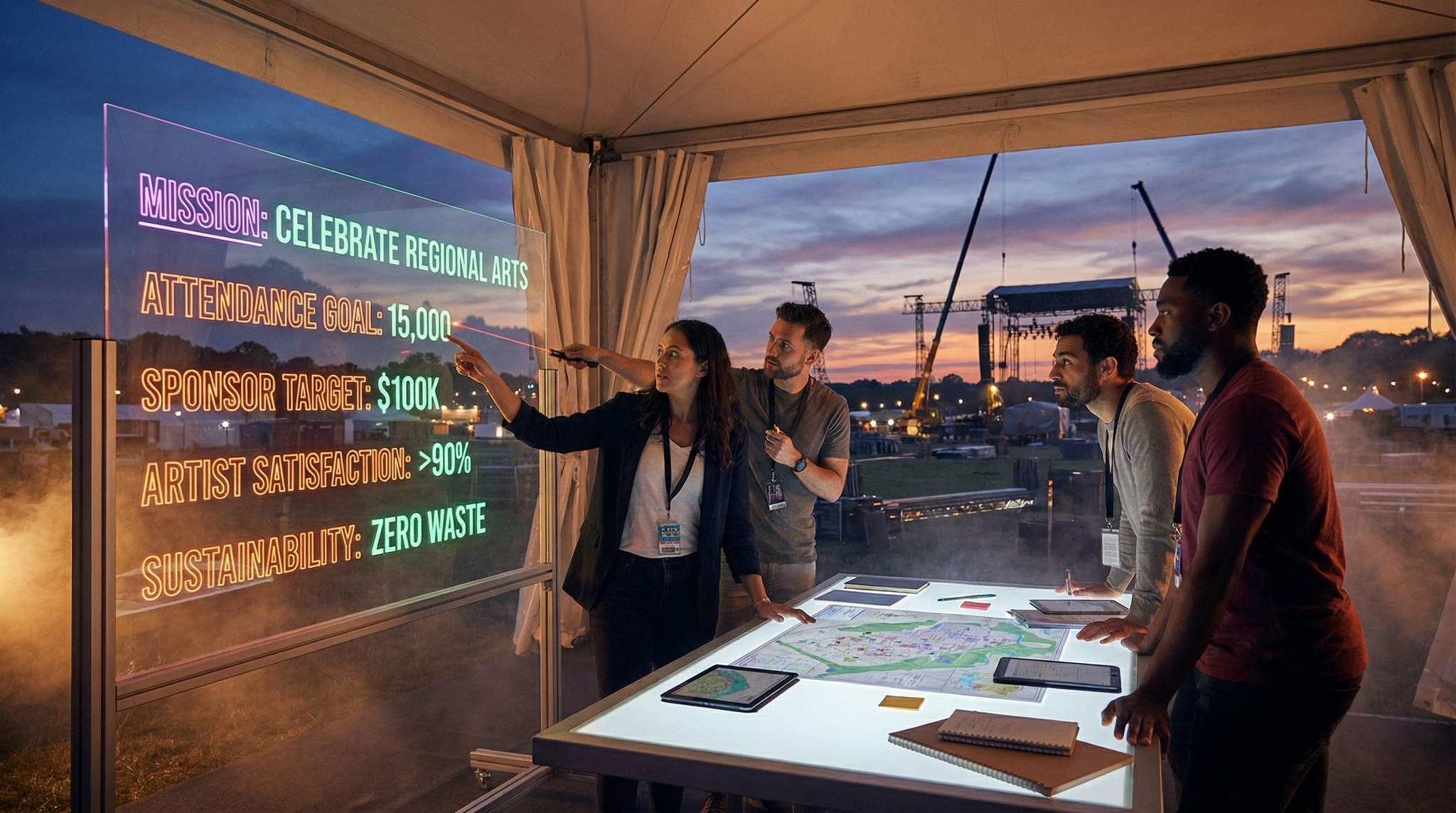
Every great festival should start by answering a fundamental question: Why does this event exist? Understanding the festival’s underlying mission or vision will inform all of your goals. For example, are you creating a music festival to showcase independent artists in your region? Or perhaps a food festival aimed at boosting local tourism? Defining this big-picture purpose will help you set objectives that make sense. Once you know your “why,” you can outline what success looks like – whether it’s a certain number of attendees, a financial target, or a specific impact on the community or industry.
Actionable Tip: Write down a one-sentence mission statement for your festival. This can be as simple as “To celebrate and promote regional jazz talent while providing an exceptional weekend experience for our community.” This mission will serve as a touchstone for all goal-setting and planning decisions.
Establishing these foundational festival goals also aligns your internal team and external stakeholders. Whether you are pitching to municipal councils for permits or presenting to potential angel investors, having a documented set of objectives proves that your event is a professionally managed enterprise rather than a casual undertaking.
Data-Driven Event Marketing
Track ticket sales, demographics, marketing ROI, and social reach in real time. Exportable reports give you the insights to make smarter decisions.
Make Goals Specific and Measurable
Vague goals like “make an amazing festival” sound inspiring but aren’t helpful when it comes to planning. Instead, focus on specific, measurable objectives. One popular approach is to use the SMART criteria – ensuring each goal is Specific, Measurable, Achievable, Relevant, and Time-bound. In practice, this means putting concrete numbers or clear outcomes to your ambitions. For instance, rather than saying “attract a big crowd,” set a goal like “attract 5,000 attendees on the festival’s first day.” Instead of “get sponsors,” aim for “secure five local business sponsors contributing a total of $50,000.” Concrete targets give your team clear direction and make it possible to gauge progress.
Consider these examples of specific festival goals:
– Attendance: Draw 10,000 attendees over two days, with at least 20% coming from out of town (if your aim is to increase regional or national reach).
– Financial: Achieve $100,000 in ticket revenue and secure at least $30,000 in sponsorships to cover costs and reach a 10% profit margin.
– Audience Experience: Earn a 90% positive feedback score in post-festival surveys, and achieve a Net Promoter Score (NPS) above 50, indicating attendees are likely to recommend the event.
– Artist/Vendor Satisfaction: Have 95% of artists and vendors express interest in returning next year – a sign that those behind the scenes felt it was a well-run, worthwhile event for them.
– Community Impact: Donate $5,000 to local charities from profits or have a goal to drive a 15% increase in business for local hotels and restaurants during the festival weekend.
Planning a Festival?
Ticket Fairy's festival ticketing platform handles multi-day passes, RFID wristbands, and complex festival operations.
Each of these objectives is tied to a number or clear result. Measurable goals like these let you track progress during planning and pivot if needed. For example, if ticket sales are lagging behind your target midway to the event date, you know to intensify marketing or adjust your strategy. If sponsor funds fall short, you might scale back expenses or seek new partnerships. Measurability keeps you honest about how your plans are unfolding.
Different Types of Goals for Festivals
Festivals are complex, so your goals should cover multiple areas of success. Here are several categories of objectives to consider:
- Attendance and Reach: How many people do you want to attend? Are you targeting a specific demographic or geographic area? (e.g., Attract 3,000 attendees with 25% families with children.)
- Financial Goals: What is the financial aim? This could be breaking even, achieving a profit margin, or raising a certain amount for charity. (e.g., Keep expenses at or below $200,000 and generate $250,000 in revenue for a 20% surplus.)
- Experience and Satisfaction: What experience do you want attendees to have? Consider goals for attendee satisfaction, repeat attendance, or community buzz. (e.g., Achieve an average attendee satisfaction rating of 4.5 out of 5.)
- Program Quality and Content: If your festival centers on content (music, film, food, etc.), set goals for curating high-quality offerings. (e.g., Feature 50 indie films with at least 5 award-winning premieres, or Book 10 headline musicians including at least 3 Grammy winners.)
- Operational Excellence: Aim for smooth logistics. Objectives could include “average queue times less than 10 minutes at entry and food stalls,” or “no major safety incidents and a fully compliant safety audit.”
- Brand and Marketing: Consider goals related to your festival’s brand recognition and media presence. (e.g., Gain 10,000 new social media followers through the festival campaign or Secure coverage in 3 national media outlets.)
- Community and Sustainability: Many festivals today also set objectives around community impact or sustainability. (e.g., Recruit 100 local volunteers, source 60% of food from local vendors, or recycle at least 80% of festival waste.)
- Ticketing Goals and Objectives: A robust ticketing strategy requires its own set of targets beyond baseline revenue. Set specific milestones for early-bird sell-outs, VIP upgrade conversions, and demographic reach. This phase is also the time to evaluate event management and ticketing partners—ensuring your chosen platform provides the right tools for your specific niche, whether you are running a boutique food festival or a massive multi-day music event.
When developing your communications strategy, you must also decide on your core narrative. Media partners and sponsors will often want to know from which aspect you plan to pitch or write about the festival. Your predefined targets should dictate whether you highlight the cultural significance, the economic boost to the local area, or the groundbreaking lineup. Defining this angle early ensures your press releases and promotional materials remain consistent with your overarching vision.
Not every festival will prioritize all these categories, but brainstorm which ones align with your event’s mission. A community food festival might focus on local economic impact and attendee enjoyment, whereas a large music festival might emphasize ticket sales, sponsor revenue, and social media impressions. Tailor your goals to what truly matters for your festival’s success.
Smart Promo Codes & Presale Access
Create percentage or flat-rate discount codes with usage limits, date ranges, and ticket type restrictions. Plus unlock codes for private presales.
Tailor Goals to Festival Size and Scope
The scale of your event plays a huge role in goal-setting. A small boutique festival with a few hundred attendees will have very different targets than a mega-festival drawing hundreds of thousands. Be realistic and relevant: aiming for 50,000 attendees isn’t sensible for a first-year event in a small town, and a modest profit goal may not satisfy investors of a major festival.
For smaller or first-time festivals, objectives might center on building a foundation and community engagement. For example, a local indie film festival’s primary goal might be to showcase 30 local filmmakers and draw 1,000 attendees, building buzz for the local film scene rather than turning an immediate profit. Secondary goals could be to break even financially and gather feedback to improve the event next year. These aims acknowledge that the first year is about proving the concept and creating goodwill.
Need Festival Funding?
Get the capital you need to book headliners, secure venues, and scale your festival production.
In contrast, a large established festival likely has growth and profitability high on the agenda. Take an international music festival that has run for a decade – its goals might include increasing attendance by 15% over last year (say from 50,000 to 57,500), expanding VIP ticket sales by 20%, or attracting attendees from 10+ different countries to bolster its global reputation. A big festival can also afford to set ambitious targets for media coverage, sponsor engagement, and maybe expansion into new programming areas, because it has more resources and data from past years to guide projections.
Audience demographics also influence goals. If your festival caters to families, you might set objectives around children’s activities attendance or family satisfaction levels. If it’s a niche music genre festival, a goal might be to draw a certain number of aficionados of that genre, or to have a high approval from that community’s influencers. Aligning goals with your target audience ensures the festival will be designed to meet their expectations, which in turn drives success.
Remember that goals must be relevant to your context – it’s about what success means for you and your stakeholders. A festival can be wildly successful by one measure (say, critical acclaim or community impact) even if it’s modest in another (like total revenue), as long as that was the intention from the start.
Learning from Successes and Failures
Seasoned festival producers often have tales of both triumph and misstep that underline the importance of clear goals. One notable success story is Glastonbury Festival in the UK – from its early days, it had a strong vision not just of music, but of community values and charitable giving. Those guiding goals have shaped everything from Glastonbury’s lineup (mixing big names with emergent talent and activist speakers) to its operations (investing heavily in attendee services and sustainability initiatives). As a result, Glastonbury’s success isn’t measured just by ticket sales (which sell out in minutes each year), but also by millions of pounds donated to charities and a globally recognized reputation for a unique festival ethos. This long-term consistency in goals has helped it grow and maintain quality over decades.
On the other hand, the infamous Fyre Festival fiasco (2017) is a cautionary tale of what happens when objectives are either unclear or wildly unrealistic. The organizers promised a luxury, transformative festival experience in the Bahamas without clearly defining feasible logistical and financial goals to support those promises. The result was an overhyped event that failed spectacularly – stranded attendees, incomplete infrastructure, and a public relations disaster. While there were many failures in that case, a key lesson is that having realistic, well-planned goals and a strategy to achieve them is non-negotiable. Grand visions must be backed up by concrete objectives and meticulous planning, or they remain only visions.
Most festivals fall somewhere between these extremes. The takeaway is that successful events, big or small, define what they are striving for from the beginning. When a festival fails or underperforms, post-mortem analyses often reveal that goals were fuzzy, conflicting, or not effectively communicated to the team. Perhaps one organizer was focused on maximizing ticket revenue while another prioritized artistic prestige – without alignment, the festival can pull in different directions.
Using Goals as Your Planning Compass
Once you’ve set your festival goals, use them as a compass throughout the planning process. Share the objectives with your entire team and stakeholders so everyone is on the same page about what “success” means. This clarity prevents the common pitfall of “mission creep,” where a festival starts adding more and more features or ideas that don’t serve the core objectives. For instance, if your primary goal is to cultivate a niche jazz audience, you might decide against adding a trendy EDM stage at the last minute, even if someone suggests it could sell more tickets – such a move could dilute your brand and alienate your target attendees.
Here are some practical ways goals will guide your decisions:
– Budgeting and Resource Allocation: Allocate funds in proportion to your priorities. If one of your top goals is delivering a top-notch attendee experience, you might justify increased spending on extra restrooms, comfortable lounges, or interactive installations, even if it means a slimmer profit margin. Conversely, if profitability is the main goal, you’ll carefully scrutinize every expense against its potential return.
– Marketing and Ticket Sales: Your marketing strategy should reflect your objectives. If hitting a certain attendance number is crucial, invest in an early and aggressive marketing campaign targeting the right audience. Set milestones (e.g., 50% of tickets sold by three months out) and monitor progress. Clear goals help you decide when to ramp up promotions or offer early bird discounts to stay on track.
– Lineup and Programming Choices: Let goals influence your programming. If one goal is to showcase diversity in music, ensure your lineup spans multiple genres or includes underrepresented artists. If your goal is high ticket sales, securing a couple of big-name headliners might be a priority. Every booking decision can be weighed against the question: Does this act or activity help fulfill our festival’s objectives?
– Venue and Logistics: The choice of venue and infrastructure should align with your targets. A goal of 5,000 attendees means choosing a location that can safely and comfortably handle that crowd, with room for amenities. Objectives around sustainability would push you to pick a venue with recycling facilities or to budget for eco-friendly toilets and power sources.
– Team Focus and Morale: When everyone knows the end goal, it empowers team members to make micro-decisions daily that support the festival’s success. It also helps morale – hitting interim targets (like a sell-out of early bird tickets or securing that key sponsor) can be celebrated, reinforcing a sense of progress and purpose.
Throughout the organizational phase, regularly revisit your goals. Create a simple checklist or dashboard to track key metrics (tickets sold, funds raised, marketing reach, etc.) against your targets. If something is behind, your team can brainstorm solutions early, rather than being surprised later. Using goals as a compass doesn’t mean plans won’t change – festivals often need to adapt – but it ensures that when you do adjust course, you’re still navigating toward the same ultimate objectives.
Measuring Success and Celebrating (or Learning from) Results
After the festival concludes and the stages go quiet, your goals become the yardstick to evaluate how you did. Gather the data for each of your key objectives:
– Tally up ticket sales and attendance figures and see how they compare to your targets.
– Review financial statements to calculate whether you hit your revenue and profit goals.
– Dig into attendee feedback through surveys, social media, and reviews to measure satisfaction and identify highlights or pain points.
– Check in with artists, vendors, and sponsors – did they feel the festival met their expectations and needs? This can often indicate if your operational and content goals hit the mark.
– Look at any metrics for community impact or media reach that you set out to achieve (for example, local economic data or press mentions).
When determining how to measure success and impact in festival programming, look beyond just crowd size at the main stage. Evaluate attendee engagement metrics, session attendance, and qualitative feedback on the lineup’s diversity and relevance. For instance, if your location is Canada, you might measure cultural impact by tracking the percentage of indigenous or local Canadian artists featured, which is often crucial for securing regional arts grants. This post-event review phase is also the ideal time to evaluate the event management company or ticketing partner you used. For example, if you run a culinary event, you might review how well your provider functioned as a food festival guide, assessing whether their platform seamlessly handled timed-entry tasting sessions or VIP add-ons compared to legacy systems like TicketWeb.
It’s rare to hit every goal 100%, especially for new festivals, but this post-event analysis is gold for learning. Maybe you reached your attendance goal but missed the mark on attendee satisfaction – why was that? Perhaps lines were too long or a particular aspect of programming didn’t resonate. Or you stayed within budget but struggled with not having enough volunteers, indicating a need to set a volunteer recruitment goal next time. By comparing outcomes against initial objectives, you can pinpoint what worked (to repeat it) and what didn’t (to improve or rethink it).
For the goals you did achieve, celebrate those successes with your team. Achieving a goal is not only a morale boost but also validation that your planning strategies were effective. For the goals you fell short on, treat it as a learning opportunity rather than a failure. The most experienced festival producers iterate and refine their approach year over year. Use the insights gained to set even more realistic or ambitious goals for the next edition of the event.
Finally, communicate the results to stakeholders in the context of the original goals. Sponsors, partners, and team members will appreciate seeing a clear narrative: “We set out to do X, and we achieved Y.” If you surpassed targets, it’s a great way to build credibility and excitement for future festivals. If some targets weren’t met, being transparent about it shows professionalism and a commitment to growth – you can even outline how you plan to address those areas moving forward.
Passing the Torch: Wisdom for the Next Generation
Setting clear festival goals and objectives is a practice that separates haphazard events from professional productions. It’s advice that bears repeating for newcomers and a reminder even for veterans: a festival without clear goals is like a ship without a destination. By defining what you want to achieve right from the start, you empower every subsequent step – from choosing the venue to booking talent to marketing tickets – to serve that vision.
Experienced festival organizers know that this foundational work pays off. It creates coherence in planning, helps rally your team around a shared vision, and ultimately increases the likelihood of delivering an unforgettable event on your own terms of success. For the next wave of festival producers, taking this wisdom to heart early will save countless headaches and set you on a path to creating festivals that not only thrill audiences but also fulfill the purpose you set out to achieve.
In the end, clarity in goals leads to clarity in execution. As you embark on planning your festival, take the time to articulate those specific, measurable objectives. They will be your North Star in the exciting, chaotic journey of festival production – guiding you to celebratory high-fives when the lights go down, and a festival story that you’ll be proud to tell for years to come.
Frequently Asked Questions
Why is setting clear goals important for festival planning?
Setting specific goals acts as a compass guiding every decision, from artist booking to budgeting, ensuring alignment with the festival’s core mission. Clear objectives also provide concrete benchmarks to evaluate success, allowing organizers to measure what worked and learn from the experience to improve future events.
How can festival organizers make their objectives specific and measurable?
Organizers should use the SMART criteria to attach concrete numbers and clear outcomes to ambitions. Instead of vague aims like “attract a crowd,” set targets such as “attract 5,000 attendees” or “secure $50,000 in sponsorship.” Measurable goals enable teams to track progress and pivot strategies if targets like ticket sales lag.
What are the different types of goals a festival should consider?
Festivals should consider objectives across multiple categories including attendance reach, financial targets like profit margins, and attendee satisfaction scores. Other key areas involve program quality, operational excellence regarding queue times and safety, brand recognition through media coverage, and community impact or sustainability initiatives like waste recycling.
How do goals differ between small boutique festivals and large established events?
Small or first-time festivals often focus on building a foundation, community engagement, and breaking even financially. In contrast, large established festivals prioritize growth, such as increasing attendance by 15%, expanding VIP sales, or boosting profitability. Goals must be realistic and relevant to the event’s specific scale and resources.
How do defined goals influence festival budgeting and resource allocation?
Clear goals dictate where funds are prioritized. If the primary objective is a top-notch attendee experience, budgets may favor amenities like lounges over profit margins. Conversely, if profitability is the main goal, expenses are scrutinized against potential returns. This ensures financial decisions directly support the festival’s defined success metrics.
What metrics are used to measure festival success after the event?
Post-festival evaluation involves comparing actual results against initial targets. Key metrics include total ticket sales and revenue figures, attendee satisfaction from surveys and Net Promoter Scores (NPS), and feedback from artists and vendors. Organizers should also review community impact data and media reach to identify areas for future improvement.
What are common ticketing goals and objectives for a festival?
Common ticketing goals and objectives go beyond simply selling out. They include hitting specific milestones for presale conversions, achieving a target ratio of VIP to general admission passes, and reaching new demographic markets. Organizers should also set objectives for evaluating their ticketing platform’s performance, ensuring the provider offers the right data insights, marketing tools, and reliable infrastructure to maximize revenue.
How do organizers measure success and impact in festival programming?
To measure the success and impact of festival programming, organizers should analyze stage or session attendance, audience engagement levels, and post-event survey feedback regarding the lineup. Additionally, tracking demographic representation—such as the inclusion of local or regional talent—can demonstrate cultural impact and help secure future funding or sponsorships.
How do festival goals influence PR and media narratives?
Clear festival goals help organizers determine the primary angle for their media campaigns. When journalists or sponsors ask which aspect you plan to highlight about the event, your predefined objectives—whether they focus on cultural significance, sustainability, or local economic impact—will dictate the narrative you share with the press.