Festivals captivate our senses with music, art, and community – but behind the scenes they can also generate enormous environmental strain. A single weekend can leave a field littered with trash, send thousands of disposable cups and food containers to landfills, and burn through diesel fuel for power. In an era of climate awareness, this impact is impossible to ignore. Festival organizers worldwide are under rising pressure from attendees, communities, and regulators to dramatically improve sustainability and waste management at their events.
Key Stat: Over 80% of festival-goers now expect events to actively tackle their environmental impact, and nearly 70% say a festival’s sustainability practices influence their ticket purchases – according to a 2023 industry survey on festival sustainability.
Responding to this call, many festivals – from small boutique gatherings to mega-events – have begun reinventing their operations with the planet in mind. Iconic events are banning single-use plastics, running stages on renewable energy, and embracing “leave no trace” ethics once reserved for wilderness trips. These changes aren’t just about appeasing fans; they reduce cleanup costs, avoid fines, and can even attract sponsors who value green credentials. Sustainability has moved from a “nice-to-have” to a core component of successful festival production.
This authoritative guide explores how to integrate sustainability and effective waste management into every facet of a festival. It offers proven strategies for planning greener festivals, minimizing waste, conserving resources like energy and water, and engaging everyone – staff, artists, vendors, and attendees – in the mission. Whether you’re organizing a 1,000-person local fair or a 100,000-strong international music festival, the principles remain the same: plan intentionally, innovate where you can, and collaborate widely. The sections below break down the key domains of sustainable festival production, with insights on what works, common pitfalls to avoid, and examples from events that have paved the way.
Data-Driven Event Marketing
Track ticket sales, demographics, marketing ROI, and social reach in real time. Exportable reports give you the insights to make smarter decisions.
Table of Contents
- Integrating Sustainability into Festival Planning
- Energy Efficiency and Carbon Reduction
- Minimizing Single-Use Plastics
- Sustainable Sourcing and Materials
- Water Conservation and Greywater Management
- Festival Waste Management and Recycling Programs
- Eco-Friendly Sanitation and Waste Technology
- Post-Festival Cleanup and Site Restoration
- Sustainability Certifications and Reporting
- Green Team Volunteers and Attendee Engagement
- Sustainable Backstage and Artist Hospitality
Integrating Sustainability into Festival Planning
Sustainability starts at the planning table. Festival organizers should set clear environmental goals from day one – whether it’s achieving a certain waste diversion rate, reducing diesel fuel use by a percentage, or eliminating specific pollutants. Early commitment ensures that every department (production, vendors, transportation, etc.) aligns with these goals. For example, if you aim to go plastic-free, procurement must source compostable or reusable alternatives, and marketing must educate ticket-holders on new policies. Building a sustainability plan also means engaging local authorities and the venue early on: many jurisdictions require detailed environmental and waste management plans as part of event permits.
Implementing core sustainable festival practices from the outset does more than just protect the environment; it fundamentally streamlines your production lifecycle. When promoters and venue operators prioritize green logistics—such as mapping out efficient power grids or mandating eco-friendly vendor guidelines—they often discover significant reductions in operational overhead and waste hauling fees.
Planning a Festival?
Ticket Fairy's festival ticketing platform handles multi-day passes, RFID wristbands, and complex festival operations.
Transitioning a traditional event into a true eco-festival requires more than just adding recycling bins; it demands holistic, eco-friendly festival solutions that touch every department. From deploying solar-powered light towers to utilizing digital ticketing platforms that eliminate paper waste, these integrated green strategies help promoters reduce their environmental footprint while often lowering long-term operational costs.
When evaluating music festival sustainability, producers must recognize that the environmental hurdles faced by large-scale outdoor concerts often mirror those of massive indoor exhibitions. Developing scalable solutions to sustainability challenges in music festivals and trade shows—such as standardizing modular, reusable booth builds or implementing centralized, zero-waste catering hubs—allows organizers to cross-pollinate best practices across different event formats, ultimately driving down costs and standardizing green operations industry-wide.
Warning: Treating sustainability as an afterthought is a recipe for headaches. Last-minute fixes (like scrambling for recycling bins during show week) rarely work and often cost more. Integrate green practices into your festival’s DNA from the beginning to avoid public relations issues, regulatory fines, and operational crises on-site.
One useful approach is to designate a Sustainability Coordinator on the festival team. This person (or committee) drives the eco-plan forward, ensuring commitments don’t slip through the cracks as the event frenzy ramps up. They can coordinate with vendors on requirements (e.g. all food stalls must use compostable serveware), liaise with waste contractors, and track progress on sustainability targets. It’s also wise to involve external experts or consult resources from organizations like A Greener Festival early in the process – they can provide benchmarks and advice tailored to events.
Go Cashless With RFID Technology
Enable contactless payments, faster entry, and real-time spending analytics with RFID wristbands and NFC-enabled ticketing for your events.
Planning should include a realistic timeline for sustainability initiatives. Major changes (such as installing solar panels or implementing a site-wide reusable cup system) might need a year or more of lead time, while smaller tweaks (like switching to recycled-content wristbands) can be done closer to showtime. Below is a general timeline for integrating key sustainability actions into festival planning:
| Timeline (Months Out) | Key Sustainability Actions |
|---|---|
| 12–18 months (Initial Planning) | Define sustainability vision and specific goals (e.g. “50% waste diversion”). Secure leadership buy-in and budget for green initiatives. Research local environmental regulations and permit requirements. |
| 6–12 months (Preparations) | Hire or assign a Sustainability Coordinator. Outline programs for recycling, energy, water, etc. Start contacting vendors and suppliers about sustainability expectations (such as no single-use plastics, plant-based menu options). Plan comprehensive waste management and recycling programs with waste contractors. If pursuing certifications (like ISO 20121 or a Greener Festival Award), begin documentation and data collection. |
| 3–6 months (Operational Planning) | Confirm infrastructure: order enough recycling/compost bins, arrange renewable energy sources or biodiesel generators, book composting toilets if using. Train core staff on sustainability protocols. Roll out attendee communication (announce green initiatives and what attendees should bring or avoid). Recruit and train volunteer Green Team members. |
| 1–2 months (Final Prep) | Perform walkthroughs focusing on eco-logistics: placement of bins, setup of water refill stations, power hookups for solar or energy-saving equipment. Ensure vendors have delivered on promises (e.g. no plastic straws or Styrofoam). Prepare signage about sustainability (e.g. “Free Water Refill Station” signs). |
| Festival days (During Event) | Monitor and adjust in real time: track bin usage and schedule extra pickups if needed, have Green Team volunteers help attendees sort trash correctly, use a sustainability checklist each day (fuel use, waste levels, etc.) to stay on target. Use stage announcements or apps to thank attendees for keeping the site clean. |
| Post-event (After) | Conduct a thorough cleanup and “leave no trace” sweep of the venue. Measure results: calculate total waste vs. recycled, fuel consumption, water used, etc. Hold a debrief with the team to identify successes and areas for improvement. Share a public sustainability report to build transparency and accountability. |
Pro Tip: Partner with local environmental groups or waste management companies during planning. They often offer free advice or resources – some may even provide on-site staff or services (like e-waste collection or compost processing) in exchange for visibility at your event. These partnerships can save costs and lend expertise to your sustainability efforts.
A cornerstone of this early preparation is drafting a comprehensive festival waste management plan. Local councils and permitting bodies—whether you’re dealing with US county regulators or UK municipal authorities like those overseeing festival waste management in Staffordshire or Somerset—increasingly require these documents before granting licenses. A robust plan outlines your projected waste streams, bin infrastructure, hauler contracts, and strategies for handling specialized refuse, ensuring you remain compliant and avoid hefty post-event fines.
It helps to learn from festivals that have already made sustainability a priority. Many events publish sustainability reports or case studies highlighting what worked for them. Here are a few examples of festivals and their notable green initiatives:
| Festival (Location) | Sustainability Highlight |
|---|---|
| Glastonbury (UK) | Banned the sale of single-use plastic water bottles in 2019, eliminating an estimated 1 million bottles per festival by providing free water refill stations. |
| Outside Lands (USA) | Diverts ~89% of festival waste from landfill through intensive recycling and composting programs – one of the highest waste diversion rates in the industry as of 2024. |
| Shambala (UK) | Went 100% meat-and-fish free in on-site catering, drastically reducing the event’s food-related carbon footprint and water usage (while sparking conversation about sustainable diets among attendees). |
| DGTL (Netherlands) | Pioneering a “circular festival” model: implemented reusable cups and plates, composted all food waste, and even turned collected urine into fertilizer for local farms. |
| Burning Man (USA) | Enforces a strict “Leave No Trace” ethos. Every attendee must pack out all their own trash, resulting in a nearly spotless desert playa after 70,000 people vacate the site. |
By weaving sustainability into the fabric of planning, festivals create a strong foundation that makes all the on-site initiatives possible. With a solid plan in place, producers can dive into specific domains – from energy and water to waste and community engagement – and implement the strategies in action.
Energy Efficiency and Carbon Reduction
Music festivals are electrically hungry – powering sound systems, lighting rigs, video walls, campgrounds, and stages often means diesel generators chugging away around the clock. Traditionally, events relied on diesel gensets because they are portable and proven, but burning diesel emits large amounts of CO? and particulate pollution, contributing to climate change and poor air quality on-site. A sustainable approach to festival energy focuses on reducing energy demand and switching to cleaner power sources wherever possible.
One of the first steps is an energy audit during planning. By analyzing the wattage needs of stages, vendors, and site infrastructure, producers can right-size their power supply and avoid the common mistake of dramatically oversizing generators (which leads to wasted fuel and money). For instance, instead of three 500 kW generators running at half-load, a festival might manage with two properly loaded units – saving fuel and rental costs. Upgrading to energy-efficient equipment also makes a big difference: LED stage lighting and modern sound systems can deliver the same show with a fraction of the power draw of older gear.
Pro Tip: Coordinate stage schedules and site operations to optimize power use. Stagger technical rehearsals and sound checks so that not all stages demand peak power at once. This load management can reduce the total generator capacity required. Also implement “power down” policies after hours – for example, ensure vendors and production switch off non-essential lighting and equipment overnight when attendees have left the grounds.
The next step is transitioning to renewable and low-carbon energy sources. Many festivals are exploring solar, wind, and battery systems to offset a portion of their power needs. For instance, on-site solar arrays can charge battery units during the day, which then run quiet and emission-free to power stages after dark. Even if renewables can’t yet supply all energy, they significantly cut generator run times. Where grid power is available, tapping into the electrical grid (especially if using a renewable energy supplier) is ideal – some urban festivals have eliminated generators entirely by using grid electricity. For off-grid sites, using sustainable biofuels like HVO (Hydrotreated Vegetable Oil) in diesel generators can slash net carbon emissions by 80% or more compared to fossil diesel. Major events such as Glastonbury have trialed hybrid systems and biofuels successfully, proving that big festivals can turn down the diesel.
Warning: When implementing new energy technologies or fuels, always have a contingency plan. If you’re trying out a solar-powered stage or an innovative battery system, arrange for a backup generator or grid tie-in that can take over if needed. Unexpected cloud cover, equipment glitches, or extreme power demand spikes can still occur – a reliable fallback ensures the show goes on even if green tech falters.
Key Stat: Audience travel often accounts for the largest share of a festival’s carbon footprint – ranging from roughly 30% up to 80% of total emissions for destination events (depending on location and audience), according to data from Event Industry News. This means efforts to encourage car-pooling, shuttle buses, and train travel for attendees (and to source supplies locally) can rival or even exceed the impact of on-site improvements in cutting overall emissions.
To manage emissions comprehensively, many producers now calculate a carbon footprint for their festival. This includes emissions from generators and on-site vehicles, as well as attendee travel and even merchandise production. By doing so, you can identify the biggest carbon hotspots and target them. In addition to cutting emissions at the source, some festivals invest in carbon offsets to balance out the remainder – for example, funding tree planting or renewable energy projects equivalent to the CO? their event emits. While offsets are not a license to pollute, when paired with genuine reductions they can help an event achieve carbon-neutral status.
Crucially, communicate your energy initiatives to attendees and staff. If you’ve installed solar panels or brought in a biofuel generator, let people know with signage or stage announcements. It not only educates the public but also holds the festival team accountable. Some events even provide live “energy dashboards” showing how much solar power is being generated or diesel saved – which can boost engagement and pride among attendees.
In summary, a combination of demand reduction, smarter power management, and cleaner energy sources forms the core of sustainable festival energy strategy. For deeper insights and case studies on this topic, exploring renewable energy and carbon reduction strategies at festivals provides practical examples of what’s working in the field.
Need Festival Funding?
Get the capital you need to book headliners, secure venues, and scale your festival production.
Minimizing Single-Use Plastics
Single-use plastics – think beverage bottles, cups, straws, food containers, and even glitter – are a notorious contributor to festival waste. Walking the grounds after a show, one often sees a sea of discarded cups and empty water bottles underfoot. Not only do these items fill dumpsters (or worse, litter the venue and nearby nature), they can take hundreds of years to decompose if landfilled. Reducing single-use plastic is therefore one of the most visible and impactful steps toward a greener festival.
The strongest approach is an outright ban on single-use plastics for both vendors and attendees. In practice, this means vendors cannot sell drinks in plastic bottles or serve food with disposable plastic plates and cutlery, and attendees are asked to bring reusable water bottles instead of relying on disposables. Many leading festivals have gone this route – as of 2024, about 70% of festivals assessed by industry reports have completely eliminated single-use plastics on site, a massive jump from just a few years prior. This rapid shift has been driven by fan expectations and successful pilot programs proving that events can go plastic-free without hurting the attendee experience.
Key Stat: When Glastonbury Festival banned single-use plastic water bottles in 2019, it prevented an estimated 1 million bottles from being consumed that year. Dozens of other festivals now report eliminating hundreds of thousands of plastic cups and straws annually by switching to reusables and compostable alternatives.
Completely banning plastics requires providing convenient alternatives. One popular solution is a reusable cup program: attendees pay a small deposit for a sturdy cup (often branded as a souvenir) for beer and drinks, which they can refill throughout the event. They return it at the end to get their deposit back or keep it as merch. This dramatically cuts down the mountains of disposable pint cups. Festivals in France, the UK, and elsewhere have successfully implemented deposit-refund cup systems that virtually eliminated plastic cup litter. For food service, vendors can switch to compostable or biodegradable plates, bowls, and cutlery made from materials like paper, bamboo, or plant-based plastics. Some events have even handed out free pocket-sized metal straws or sporks to attendees to discourage single-use items.
Pro Tip: Make sustainable choices the easiest choices. Install plenty of water refill stations (with clear signage on-site and in your festival app) so refilling a bottle is more convenient than buying a new one. Encourage attendees to bring a reusable bottle by offering free water or a small discount on drinks to those who do. You can also partner with a sponsor to give out reusable cups or bottles at the entrance – turning an eco-friendly move into a positive branding opportunity.
Enforcing a plastic-free policy does require vigilance. Communicate clearly to attendees what is and isn’t allowed (“Leave your single-use plastics at home” should be part of the pre-festival info). Work closely with vendors: update vendor contracts to specify approved packaging materials and conduct spot-checks during the event to ensure compliance (nothing undermines a plastic ban like a food stall handing out plastic cutlery on day one). Provide vendors with a list of suppliers for compostable containers and other alternatives to make the switch easier.
Warning: Simply swapping petroleum-based plastic for “compostable” plastic isn’t a silver bullet. Compostable foodware only breaks down under specific conditions in industrial composting facilities – not if it’s littered on the ground or thrown in regular trash. If your festival uses compostable cups or plates, be sure to collect them in dedicated bins and actually send them to a compost facility. Otherwise, they’ll persist in landfills much like regular plastic, and the intended benefit is lost.
The payoff for reducing single-use plastics is significant. You’ll see a cleaner venue, lower waste hauling costs (since recyclable and compostable waste is often cheaper to process than landfill garbage), and strong approval from attendees. People increasingly notice and appreciate a cup-free or bottle-free environment – it becomes part of your event’s identity. Beyond the environmental impact, it can even be a selling point in marketing and sponsorships. For more ideas on cutting out plastics without sacrificing practicality, check out our guide on replacing single-use plastics with eco-friendly alternatives at festivals.
Sustainable Sourcing and Materials
Every physical item at a festival – from the stages and tents down to staff t-shirts and signage – comes from somewhere and will go somewhere after the show. Sustainable sourcing means choosing materials and products that have a lower environmental footprint and planning for reuse so that nothing goes to waste. This concept touches construction, decorations, merchandise, food procurement, and more.
Start with the big elements: staging, structures, and décor. Festivals are increasingly using reclaimed or renewable materials for their builds. Instead of buying all new lumber and plastic for set pieces, an event might construct art installations from reclaimed wood or recycled metal. Not only does this repurpose existing materials (reducing demand for new raw materials), it often adds a unique upcycled aesthetic to the event. Likewise, when building anything new, opting for certified sustainable materials – like FSC-certified timber or steel with recycled content – ensures a lighter environmental touch. Many events design modular stages and signage that can be disassembled and stored for reuse year after year rather than trashed. Investing in durable, reusable infrastructure might cost more upfront but pays off over multiple editions by eliminating tons of one-time-use materials.
Merchandise and printed materials are another key area. Merch like t-shirts, hoodies, and giveaways should be sourced responsibly – think organic cotton or bamboo fabric instead of conventional cotton (which uses lots of water and pesticides), and water-based inks instead of harsh chemical dyes. An increasing number of festivals now offer merch made from recycled fibers (such as beanies or hoodies spun from recycled plastic bottles). Beyond the products themselves, consider their longevity: offer timeless designs that aren’t event-dated so unsold stock can be used next year, or partner with charities to donate excess merch rather than sending it to landfill. For credentials and tickets, more events are adopting digital ticketing and RFID wristbands to cut down on paper and plastic use. If physical tickets or passes are needed, choose options like recycled-content paper or plant-based plastic for wristbands instead of the standard single-use plastics.
Food and beverage sourcing also falls under sustainability. What vendors serve has a massive environmental impact. Festivals are increasingly prioritizing local, seasonal, and plant-based food options. Sourcing food locally (within the region) means fewer transport emissions and supports local farmers – attendees get fresher meals and your event’s carbon footprint shrinks. Emphasizing vegetarian and vegan menu options can dramatically cut the carbon and water footprint of festival catering. (Industrial meat production, for instance, generates far more emissions and waste than growing plant-based foods.) Some festivals have even gone fully meat-free; in 2024, about 20% of events assessed offered only vegetarian or vegan menus (up from just 8% in 2023), reflecting a fast-growing shift toward lower-impact diets. Even for events that still serve meat, encouraging vendors to source from sustainable farms or include smaller meat portions in dishes can make a difference. And whether it’s food, beer, or merchandise, sourcing from local and independent producers not only reduces environmental impact but also ties your event into the community in a positive way.
Special effects and experiential activations also require careful eco-conscious sourcing. If your production includes immersive elements like a festival snow truck or a compressed air foam cannon, standard chemical fluids can severely damage local flora and complicate site remediation. Forward-thinking technical directors now specify 100% biodegradable, plant-based soap formulas for these machines. This ensures that high-impact visual effects don’t leave behind a toxic residue, keeping your event compliant with environmental permits while still delivering a memorable fan experience.
Curating a dedicated market with sustainable vendors is another excellent way to enforce eco-friendly sourcing while enhancing the attendee experience. Whether you are producing a massive music event or a niche environmental film festival, requiring your marketplace partners to adhere to strict zero-waste, fair-trade, or upcycled material guidelines ensures your procurement ethos extends to everything sold on-site.
Pro Tip: Audit the supply chain of your festival essentials. Little changes add up: use only FSC-certified or recycled paper for any printed programs or flyers (better yet, go digital where possible), choose biodegradable cleaning products for your crew instead of chemical cleaners, and source stage effects or art installation materials from repurposed or rental sources. Every contract is an opportunity to pick a greener option or support a like-minded supplier. Include sustainability specifications in vendor agreements (e.g. “signage must be printed on recyclable material” or “no single-use foam decor”) to set expectations clearly from the start.
One often overlooked aspect of sourcing is planning for end-of-life. It’s great to use sustainable or reusable materials, but you must ensure they actually get reused or recycled. For instance, if you invest in high-quality, non-dated signage, have a storage plan so it can return next year. If you build elaborate props for a stage, consider donating them to local theaters or art studios after the event, rather than tossing them. Some festivals partner with upcycling organizations to collect unusual leftover items (like hundreds of abandoned tents or old banners) and transform them into new products – turning would-be waste into unique merchandise or community goods. This not only diverts waste but creates positive stories to share with your audience and sponsors.
Warning: Be wary of “greenwashed” products. Words like “eco-friendly” or “biodegradable” on supplies can be misleading – always verify with credible certifications. For example, look for FSC certification on lumber, Fair Trade or organic labels on foods and merch, or suppliers who are B Corp certified for overall sustainability. And remember, an item’s sustainability isn’t just about what it’s made of, but how it’s used. A recyclable banner that gets tossed in a dumpster is no better than a non-recyclable one. Plan not just for responsible sourcing, but also for the responsible disposal or reuse of each material item at your festival.
By scrutinizing procurement with an eco-conscious eye, festivals can drastically reduce their upstream impact and set an example for responsible consumption. It’s a continuous learning process – each year new products and materials become available that might improve on what you did before. Keep an open dialogue with suppliers and other event organizers about what works and what doesn’t. For specific tips on everything from staging to vendor supplies, see our guide on sustainable sourcing of festival materials and supplies for an in-depth exploration of eco-friendly procurement.
Water Conservation and Greywater Management
Water is a precious resource on festival sites, especially those in remote or arid locations. Large events can easily use tens of thousands of gallons of water per day for drinking, cooking, cleaning, and showers. Sustainable water management at festivals focuses on reducing water waste, supplying water efficiently, and handling wastewater responsibly so that nearby land and waterways aren’t contaminated.
One striking fact is that festival attendees tend to use far less water on-site than they would at home – out of necessity. A typical person might use 100–150 liters of water per day in normal life (from showers, taps, toilets, etc.), but at a camping festival, usage often drops to a fraction of that. Attendees accept that long, hot showers or continuous flows of tap water aren’t available. The goal for organizers is to meet basic needs safely while encouraging conservation at every step.
Start by ensuring ample drinking water availability without resorting to plastic bottles. This means setting up free water refill stations (taps or fountains connected to big water tanks or the mains) throughout the venue and campgrounds. Clearly mark these stations and announce their locations – if people can easily fill their reusable bottles, they won’t hoard disposable bottles. Ensure these stations are designed to minimize waste (e.g. push-button or auto-shutoff taps so water isn’t left running). Many festivals also employ water trucks to roam the campgrounds and refill attendee containers in situ, reducing queues and discouraging any wastage.
For showers and sinks, using water-efficient hardware is key. If you provide shower facilities, opt for low-flow showerheads that reduce water use per minute. Some festivals set up timed shower systems (for example, push-button showers that run for maybe 30 seconds to a minute per press) to prevent long, wasteful soaping sessions. Even simple signage like “Take short showers – others are waiting!” helps reinforce a conservation mindset. In restrooms and sinks, spring-loaded faucets or foot pump sinks (common in eco-festivals) ensure that taps aren’t accidentally left running. It’s also worth educating your attendees: remind them before the event via email or the festival guide that water will be limited and to prepare accordingly (for instance, many seasoned campers bring biodegradable wet wipes as a supplement so they don’t rely solely on showers).
On the operational side, greywater (the soapy runoff from sinks, showers, and dish-washing stations) must be managed carefully. Never allow greywater to just accumulate on the ground – it can attract pests, create mud pits, and pollute local soil and groundwater with chemicals. Set up dedicated greywater collection points wherever there are sinks or communal washing areas. Often this involves simple plumbing to route greywater into large holding tanks or bladder bags. After the festival, this collected greywater can be pumped out and transported to a proper wastewater treatment facility by a contractor. Some innovative festivals even treat greywater on-site: for example, using mobile filtration units or constructed wetlands (lined with plants and gravel) to naturally filter and purify the water so it can be safely released or used for non-potable purposes like dust control.
Beyond standard greywater, comprehensive liquid waste management for festivals must account for vendor cooking oils, chemical toilet effluent, and hazardous liquid spills. Organizers should contract specialized liquid waste haulers who can safely pump, transport, and dispose of these materials in accordance with environmental regulations, preventing catastrophic ground contamination that could jeopardize future venue use.
Pro Tip: Assign a team to actively monitor water usage and infrastructure during the event. Something as simple as a leaky faucet or a loose valve on a water tank can waste hundreds of liters over a weekend. By having staff or volunteers regularly patrol the site to check taps, showers, and tanks, you can catch leaks or overflow issues early and fix them. Also, consider shutting off non-essential water lines during off-peak hours (e.g. turn off the spigots in the campgrounds during the stage performances) to prevent accidental wastage when not in use.
Warning: Underestimating water needs can quickly become a safety issue. Running out of drinking water in the middle of a hot afternoon, for example, could lead to dehydration and medical emergencies for attendees. Always err on the side of having more potable water capacity than you think you’ll need. If using tankers, schedule extra deliveries; if on a well or local supply, have backup sources or bottled water reserve for emergencies. Water is one commodity you never want to run dry.
Beyond drinking and washing water, consider other water uses. Many festivals need water for dust suppression (spraying dirt roads) or for cleaning equipment. Whenever possible, use non-potable or reclaimed water for these tasks. For example, some events reclaim the greywater for use in spraying roads, thereby giving it a second life and reducing the draw on fresh water supplies. Coordinate with local authorities on this – in some cases city or county water trucks can supply reclaimed water for your event’s needs.
Finally, any water-saving effort should be communicated. Let attendees know about the water limitations and the measures you’re taking – festival-goers are generally very receptive to conservation messaging when it’s explained as part of the event’s ethos. Encourage attendees to do their part (e.g. “Please turn off the tap while brushing your teeth”) and thank them when they do. When everyone understands that water on site is finite, they are more likely to use it wisely.
In summary, efficient water management at festivals comes down to supplying enough for health and hygiene, avoiding waste at every turn, and dealing with wastewater in a way that doesn’t harm the environment. For additional techniques and technologies – from rainwater harvesting to greywater treatment systems – see our dedicated guide on water conservation and greywater management at festivals.
Festival Waste Management and Recycling Programs
Trash is an unfortunate byproduct of any large gathering, but how it’s handled separates a sustainable festival from a careless one. A robust waste management and recycling program keeps the grounds cleaner during the event, maximizes how much material gets diverted from landfills, and can significantly cut disposal costs. The keys to success are providing adequate facilities (bins and collection points), educating attendees and staff on proper sorting, and partnering with waste haulers who can process the recyclables and compostables you collect.
Mastering waste management at festivals requires treating refuse as a logistical flow rather than an afterthought. By mapping out the entire lifecycle of materials entering your site, production teams can identify potential bottlenecks before the gates even open. Effective waste management at festivals relies heavily on this proactive material tracking, ensuring that hauling schedules align perfectly with peak consumption times.
Scaling up festival recycling operations requires more than just placing blue bins around the venue. Promoters must establish a clear chain of custody for recyclable materials, coordinating with local material recovery facilities (MRFs) to ensure that collected aluminum, plastics, and cardboard actually meet commercial processing standards. Contamination is the biggest threat to any large-scale event recycling initiative; therefore, deploying dedicated sorting teams at back-of-house transfer stations can salvage compromised loads and protect your diversion metrics.
Every festival should start by estimating the amount and types of waste it will generate. As a rule of thumb, multi-day camping festivals produce more waste per person (because attendees accumulate trash at campsites) than single-day city festivals. Here’s a rough illustration of waste volumes by event size:
| Event Scale | Typical Total Waste Generated |
|---|---|
| Small festival (5,000 people, 1–2 days) | 10–15 tons of waste |
| Medium festival (10,000–20,000 people, 3 days) | 30–80 tons of waste |
| Large festival (50,000+ people, 4+ days) | 100–300+ tons of waste |
These figures can vary widely based on attendee behavior and on-site policies (a strictly plastic-free, pack-it-in/pack-it-out style festival will generate far less waste than one where attendees expect to buy and toss everything on site). Still, it underscores that even a mid-sized event deals with tens of tons of material that must be handled properly.
Implementing advanced eco-friendly festival solutions for refuse—such as AI-assisted sorting bins or on-site organic composters—can drastically elevate your diversion rates. When evaluating waste management at festivals, producers must look beyond basic hauling and consider how every piece of material can be repurposed, recycled, or safely degraded.
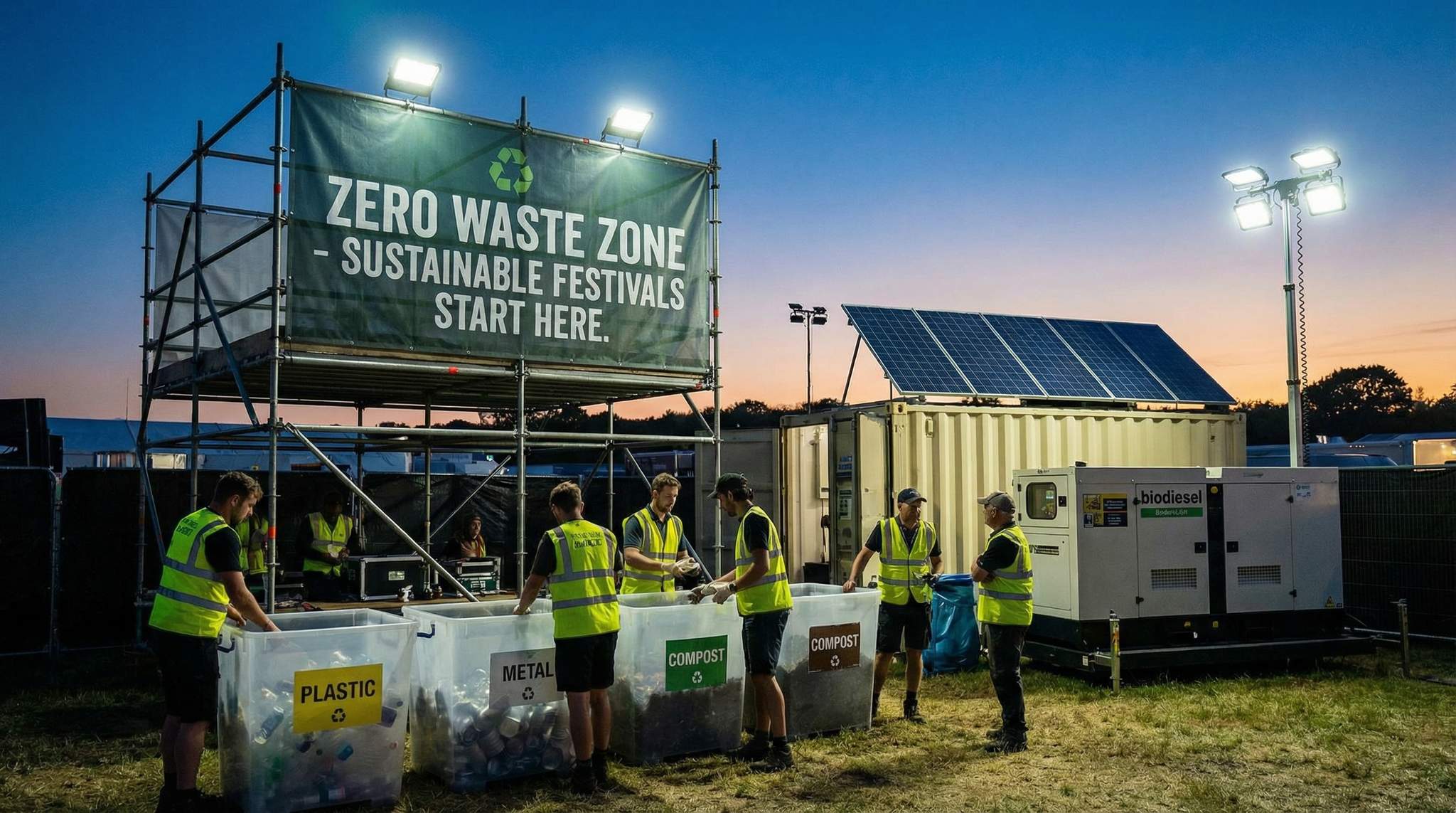
A successful program begins with the right infrastructure. Strategically place waste sorting stations throughout the venue and campgrounds – typically, each station should have at least three bins: Recycling, Compost (organic waste), and Landfill (general trash). Using universal colors and clear signage (e.g. blue for recycling, green for compost, black for trash) helps attendees quickly discern where to put their waste. It’s crucial that these stations are abundant and conveniently located: near food courts, at camping areas, along main pedestrian paths, and by exits. If bins overflow or aren’t nearby, even well-intentioned people will give up and litter or contaminate the system.
Equally important is educating attendees on what goes where. Use every channel: pre-festival emails (“We’re a sorting festival – pack accordingly!”), site maps indicating bin locations, posters at each station with pictures of common items and the correct bin for each, and announcements from stages or MCs reminding folks to sort their waste. Many festivals print simple recycling guides on the back of maps or put them in the festival app. The more specific you are (e.g. “Pizza boxes go in Compost, beverage cups go in Recycling if empty”), the less contamination you’ll have to deal with later.
Pro Tip: Empower an on-site “Green Team” dedicated to waste management. These can be volunteers or paid staff who monitor the sorting stations, help attendees put items in the right bin, and even do occasional pickups of litter. Festivals that deploy Green Team members at busy trash stations (especially during and right after meal times) find dramatically cleaner outcomes – a friendly volunteer helping someone compost their food scraps correctly can prevent an entire bag of recyclables from being spoiled by contamination. Bonus: attendees often appreciate and remember these interactions, which can improve overall festival satisfaction.
Behind the scenes, coordinate closely with your waste hauling and recycling partners. Communicate well in advance about the streams you’ll have (e.g. plastic/aluminum recycling, compostable foodware, etc.) and ensure the local facilities can actually process them. It’s frustrating to meticulously sort compostables and then learn there’s no industrial compost facility in range – in such a case, focus on recyclables and minimizing leftovers instead. Schedule dumpster swaps and pickups smartly: multi-day events often need overnight waste removal so that bins can be emptied before the next day. Negotiate for waste audit data too – many haulers can tell you how much was collected in each stream, which is valuable for measuring your success (e.g. “We diverted 60% of waste from landfill this year”).
Executing efficient festival waste removal during live show days requires precise logistical timing. Promoters should schedule compactor pickups and bulk hauling during off-peak hours—such as early mornings or during mainstage headliner sets—to minimize disruption to the attendee experience. Partnering with a specialized event refuse contractor ensures that transfer stations are cleared rapidly, preventing overflow that can lead to health hazards, pest issues, and site contamination.
Festivals can also reduce waste by intercepting it at the source. Encourage vendors to minimize packaging (do you need individually wrapped cutlery sets, or can napkins be unwrapped in a tray?). Require them to use serviceware that matches your sorting system – there’s nothing worse than having a compost bin full of plastic-lined cups that should’ve been recyclable. Some events provide approved compostable or recyclable vendor packaging as part of the vendor fee, ensuring uniform materials. Additionally, establish policies for attendees that prevent common waste issues: for example, many camping festivals discourage or ban single-use plastic water bottles and Styrofoam coolers, knowing these often get abandoned at campsites.
Despite best efforts, litter will happen, especially during concerts when people drop cups on the ground. Plan for cleanup crews during and after the event. During show days, schedule roaming crews in the early morning to do a sweep of high-traffic areas (nobody likes to dance amid yesterday’s trash). Immediately after the event, deploy a large cleanup operation – the faster you collect stray waste, the easier it is to sort and the less chance it blows away or causes damage. Post-event cleanup should include a meticulous “MOOP sweep” (Matter Out Of Place) of the venue and any parking/camping areas, with teams walking grid patterns to pick up even small items like cigarette butts. This is labor-intensive, but it’s essential for leaving the site in good condition (and keeping landlords and communities happy so you can return next year).
Key Stat: An estimated 250,000 tents are abandoned at UK music festivals each year, constituting thousands of tons of plastic waste in landfills, a figure highlighted by the Association of Independent Festivals. This kind of waste is avoidable – campaigns urging attendees to “take your tent home” and donation programs for leftover camping gear have started to dent the numbers in recent years, proving that a cultural shift combined with convenient donation options can tackle even large-scale waste problems.
Ultimately, reducing festival waste is about both infrastructure and culture. You need the bins and logistics, but you also need buy-in from everyone on site. The more you make waste reduction a part of the festival’s identity – something attendees participate in rather than view as an inconvenience – the better your results will be. Celebrate your wins (announce how many tons you recycled or composted), and be honest about where you can use help next time. Year over year, you can strive to improve your diversion rate (some events now exceed 90% waste diversion through hardcore programs). If you’re looking to level up your waste game, our article on festival waste management and recycling programs offers advanced tips and case studies from events that achieved very high diversion rates.
Eco-Friendly Sanitation and Waste Technology
Providing clean, functional sanitation is a basic requirement for any festival – but it’s also an area ripe for sustainable innovation. Traditional festival toilets (the infamous plastic portable loos or “porta-potties”) and showers can be huge water-wasters and a source of unpleasant pollution if not managed well. Eco-friendly sanitation focuses on minimizing water use, safely treating human waste on-site when possible, and using new technologies to turn waste into a resource rather than a hazard.
A major trend in green festivals is the adoption of composting toilets or other low-water toilet systems. Composting toilets are dry or nearly water-free units that collect human waste along with carbon-rich material (like sawdust) and allow it to decompose into compost over time. Many festivals have brought in modern composting toilet units – which, when maintained properly, are odor-free and surprisingly pleasant compared to traditional porta-potties. Not only do they save tens of thousands of liters of water (since they don’t flush), they also eliminate the need to haul away toxic sewage. Instead, the waste is contained and starts to break down into a fertilizer. (Typically, the festival partners with a company that finishes composting off-site and uses the resulting compost for non-food agriculture or land reclamation projects). Attendees often respond positively to compost toilets as long as they are kept clean and well-stocked (a bit of educational signage about how to use them doesn’t hurt either).
Even standard chemical porta-potties can be managed more sustainably. Using biodegradable, non-toxic waste treatment fluids (instead of the typical blue chemical cocktails) means the waste can be processed with less environmental harm. Ensuring regular servicing and keeping them clean extends their usability – a clean toilet is less likely to be misused and trashed. Some festivals have also trialed water-saving vacuum flush toilets in central “comfort stations” that flush with minimal water into holding tanks – a step halfway between porta-potties and full plumbing that can improve user experience without massive water waste.
When it comes to innovative waste tech, festivals are exploring options like on-site biodigesters. These are essentially large mechanical stomachs that take organic waste – including food scraps and even sewage – and break it down anaerobically, producing biogas (which can generate energy) and nutrient-rich fertilizer. For example, a biodigester could theoretically take all the festival’s food waste and even toilet waste and convert it into methane for generators and a liquid fertilizer byproduct. While still an emerging idea for short events (most biodigesters work best with a steady year-round input), it’s a glimpse of a future where festivals might power themselves from their own discards.
Another promising area is urine diversion and recycling. Urine is generally sterile and packed with nitrogen and phosphorus – key nutrients for agriculture. Festivals have trialed special urinals that collect urine separately, avoid mixing it with other wastewater. Projects in Europe (e.g. at DGTL in Amsterdam) have successfully turned festival-goers’ urine into fertilizer used on local fields to grow crops. It’s a concept that gets great press and closes a circle – what comes out at the festival eventually goes into making food or biofuel that could be used at the next event.
Regardless of the technology, a core principle of sustainable sanitation is plan for maintenance. If you provide composting toilets, you need trained staff or volunteers to monitor them (stir contents, add cover material, direct people politely). If you deploy fancy new tech, have technicians on-site and a backup plan in case of failure. The worst outcome is a sanitation breakdown that causes health risks or forces a switch back to less sustainable emergency measures. So, scale your experiments to what you can confidently manage.
Finally, don’t overlook hand hygiene in a sustainable way. Instead of pure water-based handwashing (which uses a lot of water and creates greywater to manage), consider alcohol-based hand sanitizer at stations – it’s effective and saves water. If using sinks, foot-pump or timed faucets conserve water as mentioned earlier. Provide biodegradable soap so any greywater impact is minimized.
Festival-goers quickly appreciate well-thought-out sanitation. Clean, non-smelly toilets and readily available hand-cleaning options actually make people more receptive to other green initiatives, because it shows the organizers care about both the environment and attendee comfort. Many attendees will gladly use a composting loo if it’s pleasant and they know it’s eco-friendly, instead of viewing it as a sacrifice.
In essence, greener sanitation is about using appropriate technology to reduce water and chemical use, turning waste into a resource where possible, and maintaining high standards of cleanliness. The field is evolving – what was fringe at festivals a decade ago (like compost toilets) is becoming common at major events. To explore specific technologies and approaches (from urine diversion systems to cutting-edge waste treatment), see our article on eco-friendly festival toilets and waste technology for a closer look at sanitation innovations.
Post-Festival Cleanup and Site Restoration
Long after the final encore, there’s one vital phase of festival sustainability left: returning the site to its original (or better) condition. A successful post-festival cleanup and site restoration program is not only environmentally responsible – in many cases it’s required by landowners and permits. “Leave no trace” isn’t just a mantra for wilderness campers; festivals of all sizes are embracing it to ensure goodwill with host communities and minimal ecological damage.
Planning for cleanup should start well before the festival begins. Organizers often arrange contracts with cleanup crews or volunteer networks (like local sports teams or scout groups) who will come in right after the event to help pick up litter. It’s prudent to budget significant time and money for this operation, proportional to the size of the event. A major multi-day festival might spend several days to a week on intensive cleanup, whereas a one-day event in a stadium can often be cleaned overnight.
Immediately after attendees leave, waste teams should spring into action. The first step is typically a gross cleanup: picking up and bagging all visible trash across the stages, audience areas, and campgrounds. Heavy machinery like street sweepers, skid loaders, or tractors with trash rakes can assist for large open fields (some festivals use modified farm equipment to gather loose trash and tents from campgrounds). Simultaneously, crews can start dismantling and sorting infrastructure – for example, collecting all signage and decor that will be stored for reuse, and separating anything broken that must be recycled or trashed.
The final phase of site restoration hinges on rapid, large-scale festival waste removal. Once the gross cleanup is complete, production teams must coordinate a fleet of roll-off dumpsters and specialized hauling trucks to clear the accumulated refuse from the venue. Establishing a centralized back-of-house loading zone for these removal vehicles prevents heavy truck traffic from damaging delicate grounds or interfering with stage teardown crews.
One of the toughest challenges is dealing with abandoned camping gear. Despite messaging, some percentage of campers inevitably leave tents, chairs, and other gear behind. Rather than sending these straight to landfill, festivals can coordinate with charities to salvage what’s usable. In the UK, for instance, organizations like Charity Tent collect left-behind tents, sleeping bags, and boots for refugees or homeless shelters. Some festivals set up donation stations during pack-out where campers can drop unwanted items in a designated spot (making it easier to sort and donate), instead of just walking away from them in the field. Promotion of these initiatives beforehand (“Don’t want to take your tent home? Leave it at the Yellow Donation Tent on your way out!”) can significantly reduce random abandonment.
After the bulk waste is removed, a fine-toothed comb approach is needed. Micro-trash like cigarette butts, bottle caps, glitter, and confetti can be extremely harmful to wildlife and ugly for landowners. It’s not uncommon for crews to literally crawl on hands and knees or use magnet sweepers and specialized vacuums to collect these tiny bits. Some festivals enlist volunteers for a day of “MOOP sweeping” (as Burning Man calls it) where grids are walked and every little foreign object is picked up. This is laborious but it’s the difference between a superficially clean site and one that is truly returned to its natural state. Again, incentives (like offering free future tickets or a small stipend to volunteer sweepers) can help get this done thoroughly.
Site restoration may also involve remediation work if the event caused any damage. Common issues include trampled grass turning to mud, landscaping that needs replanting, or soil compaction in high-traffic areas. Many outdoor festivals travel with a landscaping kit: grass seed or sod to lay down on worn patches, soil aerators to loosen compacted dirt, and sometimes even irrigation to water newly planted areas if rain isn’t expected. The goal is to leave the venue as good as or better than you found it. Documenting conditions before and after is a good practice – not only to check your own performance, but to have proof for landowners that you met your obligations.
One shining example of post-festival commitment is Burning Man: after the event, teams spend weeks combing the desert and the organizers produce a detailed “MOOP Map” rating how well each area was cleaned. While not every festival can match that level of dedication, it’s a reminder that with planning and effort, even a huge temporary city can virtually vanish without a trace.
Finally, once cleanup is done, it’s valuable to reflect and report. Many festivals now produce a short environmental or sustainability report that includes cleanup results – e.g. how many tons of waste were recycled vs. landfilled, how many volunteer hours went into cleanup, and any notable successes (“98% of tents were taken home this year!”) or areas for improvement. Sharing these results with attendees and the public not only builds credibility, but also closes the feedback loop – people see that their efforts (like using the bins correctly or taking their tent home) made a quantifiable difference.
In summary, a true leave-no-trace event doesn’t end when the music stops. A comprehensive post-festival cleanup and restoration plan ensures that the festival’s environmental footprint is minimal and that the site remains welcome for future celebrations. For more on implementing a leave-no-trace policy and effective cleanup operations, read our guide on post-festival cleanup and site restoration practices which is full of practical tips from seasoned production teams.
Sustainability Certifications and Reporting
As festivals implement all these green initiatives, many are choosing to formalize their commitment through sustainability certifications and reporting. Earning a reputable certification or publishing an annual sustainability report can validate your efforts, identify areas to improve, and demonstrate transparency to fans, sponsors, and regulators.
One widely recognized standard is ISO 20121 – a certification specifically for sustainable event management. ISO 20121 provides a framework that helps events incorporate sustainability at every level, from planning to procurement to post-event review. Achieving ISO 20121 certification involves an independent audit of your event’s processes and impacts. It’s a rigorous process, but festivals that have done it say it helped create internal systems for continuous improvement. For instance, to get certified you must establish sustainability objectives, engage stakeholders, measure performance, and implement a continuous improvement cycle. Events like the London 2012 Olympics set the bar by becoming ISO 20121 certified, and since then a number of major festivals and sporting events have followed suit. Even if a festival doesn’t pursue the certificate, the standard’s guidelines can serve as a useful checklist for best practices.
When evaluating frameworks, organizers often look to the most common ISO standards applicable to live events. While ISO 20121 is the premier event-specific certification, integrating principles from ISO 14001 (Environmental Management Systems) can also provide a rigorous, globally recognized structure for minimizing your festival’s ecological footprint.
Another route is seeking recognition from industry initiatives such as the A Greener Festival (AGF) Awards. AGF is an organization that has been assessing and rating festivals on sustainability for over a decade. They offer awards in categories like “Outstanding” or “Improver” based on an extensive on-site audit covering waste, energy, water, transport, and more. Participating in such a program gives you a detailed third-party report on how you’re doing and where to improve, and if you score well, you earn a badge of honor that can help with marketing and credibility. European events in particular have embraced AGF – for example, Boom Festival in Portugal and Shambala in the UK have repeatedly earned top marks, showcasing innovations that others then emulate.
Beyond certifications, reporting your sustainability metrics annually is a powerful tool. This usually takes the form of a public Sustainability Report or an infographic released after the event. In it, you’d include data like total waste generated and percent recycled, total water used, total fuel or energy consumed (and percent from renewables), carbon footprint calculations, number of bikes or bus riders in attendance (to gauge transport impact), donations made to environmental causes, and so on. You can also highlight stories – “vendors donated 1,000 lbs of food to a local shelter” or “power from diesel was reduced by 30% this year.” Reporting not only holds you accountable to your goals, but also earns trust: attendees and partners see you’re serious enough to measure and share results, not just make green claims.
When communicating these results, honesty is key. It’s okay to report that you fell short of a target – maybe you aimed for 80% waste diversion but hit 65%. Explain why (e.g. contamination in recycling or unexpected attendee behavior) and what you’ll do differently next time. This transparency tends to be appreciated and lends credibility far more than only touting successes and hiding shortcomings.
Pro Tip: Align your festival’s sustainability goals with broader global initiatives. For example, you can map your efforts to the United Nations Sustainable Development Goals (SDGs) – such as SDG 7 (Affordable and Clean Energy) or SDG 12 (Responsible Consumption and Production). Mentioning in your report that “Our waste reduction efforts contribute to SDG 12” places your event in a larger context. It can also attract sponsors who are keen to show their support for these global goals.
Finally, use certification and reporting as learning tools internally. The process of gathering data for a report or undergoing an audit often uncovers inefficiencies or previously unnoticed issues. Maybe you discover that a particular vendor is generating an outsized portion of waste, or that a lack of staff training led to generators running unnecessarily. These insights are gold for planning improvements.
In some regions, formal sustainability reporting by festivals is becoming expected. Cities or permit authorities might ask for an environmental impact summary post-event. Getting ahead of the curve by doing it proactively can strengthen your festival’s reputation and relationship with officials. Plus, sponsors increasingly prefer to back events with proven sustainability credentials – a certification or well-crafted report can be the differentiator that lands a sponsorship deal.
For tips on navigating the certification process and examples of effective festival sustainability reports, our article on festival sustainability certifications and reporting provides guidance on validating and communicating your green efforts.
Green Team Volunteers and Attendee Engagement
The best sustainability plan on paper means little if the people on-site don’t participate. This is where Green Team volunteers and attendee engagement become critical. By actively involving the festival community – both staff and fans – in your eco-initiatives, you create a culture that makes green practices second nature during the event.
Green Teams usually refer to dedicated volunteers or staff focused on environmental efforts. They are the friendly faces helping attendees put the right item in the right bin, the patrols picking up litter in the campgrounds, or the crew handing out free ashtrays to smokers. Recruiting a passionate Green Team can amplify your sustainability impact exponentially. Volunteers with a personal drive for the environment will often go above and beyond – whether it’s teaching a confused festival-goer about compostable packaging or happily spending an extra hour to ensure the grounds are spotless. Many festivals offer Green Team volunteers perks like free or discounted tickets, unique team T-shirts, or special camping areas, in exchange for a certain number of work hours on eco-tasks.
To maximize their effectiveness, train your Green Team well. Before the festival, provide a briefing (in person or via video) about your recycling system, any unusual waste items to watch for, how to approach attendees positively, and safety guidelines (e.g. wearing gloves, not picking up broken glass by hand). During the event, keep them motivated – celebrate successes like “we collected 500 kg of recycling today!” and ensure they get enough breaks to also enjoy the festival they’re helping.
Attendee engagement begins with communication, but it can go further into interaction and rewards. In addition to the signage and announcements mentioned earlier, think of creative campaigns to engage festival-goers in sustainability challenges. For example, some festivals run a “camping contest” where the cleanest campsite or the camp that best decorates with recycled materials wins a prize (like VIP upgrades or merch). This turns environmental responsibility into a friendly competition and badge of honor. Similarly, deposit-refund systems engage attendees by giving a financial incentive to do the right thing (return that cup and get $2 back). You can build on that – perhaps a bonus reward for the person who returns the most cups, etc.
Another engagement strategy is to integrate sustainability into the festival programming. Consider hosting a workshop or talk at a side stage on an environmental topic, or having an art installation made of reclaimed materials that also educates on an issue (like an exhibit of a sea turtle made from recycled plastic bottles). Some festivals invite local environmental NGOs to have a presence on-site, offering fun activities (like upcycling crafts, or a pedal-powered phone charging station) which subtly educate while entertaining. When attendees start interacting with these elements, it reinforces the overall green message of the event.
Artist involvement can be influential too. If you have artists who are passionate about the environment, collaborate with them to give a shout-out from the stage about a green initiative (“Don’t forget to refill your water bottles, let’s save a million plastic cups this weekend!”) or to participate in a short meet-and-greet at the eco-info booth. Fans listen to their idols, and a single comment from a headliner about not trashing the venue or using the recycling bins can have a big impact on crowd behavior.
Pro Tip: Leverage social media and festival apps for engagement. During the event, push notifications or tweets can remind attendees about sustainability in a fun way (“First one to tweet a selfie of you recycling gets a merch voucher!” or “Show a filled trash bag at the info tent and get a free sticker”). Post-event, publicly thank the community for their efforts (“Big thanks – 85% of you carpooled or took the shuttle! Let’s do even better next year”). This not only encourages those who participated, but also builds anticipation that being green is part of the festival experience.
One challenge is dealing with unengaged attendees – there will always be some who are there purely to party and couldn’t care less about sorting their trash. Rather than scold, it’s better to make doing the right thing as easy as possible (convenient bins, volunteers to assist) and to focus on positive peer pressure. Often, the majority’s behavior can influence the stragglers; if people see everyone around them picking up after themselves, social norming kicks in and they’ll be less likely to litter. Over a few years, festivals often observe a culture change where new attendees learn “Oh, at this festival we all clean up after ourselves – that’s just how it’s done here.” That is the ultimate goal: engagement to a point where sustainability isn’t a forced rule, but a natural part of the event’s culture.
When attendees leave the festival feeling not only that they had a great time, but that they were part of something positive for the planet, you’ve really achieved something special. These engaged fans will carry that story (and perhaps new habits) home with them, amplifying the impact beyond the festival gates.
Sustainable Backstage and Artist Hospitality
While much of a festival’s environmental focus is front-of-house (what the audience sees and does), it’s equally important to green the behind-the-scenes operations. Artist hospitality, crew catering, and backstage amenities can generate significant waste and emissions if not managed thoughtfully. By extending sustainability to the artist and crew areas, festivals both reduce their overall footprint and set an example that eco-consciousness is part of the event’s core values – not just a PR angle for attendees.
Start with the artist riders and dressing rooms. Historically, it’s common for artists to arrive to trailers stocked with copious amounts of single-use plastic: bottled water, sodas, snacks in disposable packaging, unused towels, etc. An easy win is to coordinate with artists (via their tour managers) ahead of time to implement greener hospitality choices. Many artists are receptive to this – some even request it. For instance, instead of 50 individual water bottles on ice, provide each performer with a reusable water bottle (perhaps festival-branded) and have water coolers or jugs available. Stock dressing rooms with beverages in cans (which are easily recyclable) or glass (in jurisdictions where glass is reused or recycled), rather than plastic. If you lay out catering, use real dishware and cutlery in the artist lounge whenever possible – or at least compostable serving materials – instead of disposable serveware.
Artists’ catering and hospitality can also embrace sustainability by focusing on local and organic foods. Many artists these days appreciate farm-to-table style catering. Opt for menus that are heavy on plant-based delicious options – not only is it environmentally friendly, but it also caters to the increasing number of vegetarian or health-conscious performers. You might highlight to artists that the beef on the menu is grass-fed from a nearby farm, or the vegetables are sourced from local organic growers – these details get noticed and often appreciated. And just like attendees, artists don’t need an overload of excess food. It’s better to replenish a buffet as needed than to lay out huge spreads that end up wasted. Plan portion sizes based on actual artist count (plus reasonable buffer) and have a plan to donate untouched excess artist food to a local shelter at the end of each day.
Backstage waste management should mirror the front-of-house. Ensure recycling and compost bins are just as accessible in production offices, dressing room areas, and catering zones as they are on the festival grounds. Often, crew and artists will follow the lead if bins are clearly labeled – they’re generally happy to recycle if given the chance. Assign part of your Green Team or janitorial crew to service backstage areas with the same rigor as the public areas.
One novel idea some festivals have adopted is including the touring crew in sustainability efforts. For example, providing bus drivers with info on where they can plug in to shore power instead of idling their diesel tour buses all day (some festivals set up shore power drops at the tour bus parking so drivers can turn off engines – saving fuel and emissions). Another idea is offering artists carbon offsets for their travel to the festival – a festival might say “We’ve purchased carbon offsets for all our artists’ flights this year” or give them the option to opt-in via a small deduction or contribution (some artists might even volunteer to cover it themselves if asked). These gestures show that sustainability isn’t just for fans, but something everyone involved is participating in.
Don’t underestimate influencing artists either. If you lead by example backstage, artists and their teams might take note and carry those ideas onto the next tour or festival. There have been cases of artists adjusting their own tour riders after playing a particularly green festival and seeing that it worked just fine. As a producer, you can gently encourage this by sharing what you’re doing: “We’ve gone plastic-free backstage this year as part of our sustainability program – let us know if you need a reusable bottle or anything to help with that.” Most artists will be completely fine with it, and you might be surprised – some will be outright enthusiastic and ask questions or want to contribute ideas.
One more element: swag and gifts for artists. Festivals often provide welcome packages or artist gift bags. Ensure these are sustainably minded too. Use eco-friendly merchandise (like a t-shirt made from organic cotton, or a tote bag made from recycled material) and include useful, reusable items (reusable mugs, locally made products) rather than cheap plastic trinkets that will end up in the bin. Artists have seen it all, and many will be more impressed with a thoughtful, locale-specific, sustainable gift (like a donation made in their name to a local environmental charity, accompanied by a thank-you note, or a basket of local organic treats) than another branded plastic gadget.
In essence, making the back-of-house operations sustainable ensures that your festival’s green ethos is truly holistic. It prevents a scenario where, say, front-of-house is clean and green but backstage is generating mountains of waste. Instead, everyone – from headliners to stagehands – is part of the solution. As a bonus, it sends a powerful message that sustainability at your event is authentic. When artists and crew experience firsthand that you walk the talk, they become ambassadors for your festival’s values, often giving praise publicly or on social media, which can further boost your reputation.
For more detailed practices on greening the behind-the-scenes aspects (from touring logistics to eco-friendly hospitality riders), refer to our piece on sustainable backstage hospitality practices for festival artists. It offers a closer look at how festivals can reduce the environmental impact of the production itself, not just the attendee experience.
Essential Reading
- Renewable Energy & Carbon Reduction at Festivals: In-depth look at powering events with solar, wind, and other low-carbon solutions, plus examples of festivals cutting their carbon footprints.
- Leave No Trace – Post-Festival Cleanup & Site Restoration: Strategies for restoring festival grounds, managing post-event waste, and making sure no footprint is left behind.
- Festival Sustainability Certifications & Reporting: Guide to programs like ISO 20121 and AGF Awards, and tips for measuring and communicating your festival’s sustainability performance.
- Reducing Single-Use Plastics – Eco-Friendly Alternatives: Practical tips for eliminating plastics in everything from drinkware to merchandise, and what to use instead.
- Sustainable Sourcing & Materials for Eco-Friendly Festivals: Advice on procuring greener supplies – from biodegradable wristbands to solar lighting – and building sustainability into your supply chain.
- Water Conservation & Greywater Management at Festivals: Exploration of water-saving technologies and how to handle wastewater (showers, sinks, runoff) without harming the environment.
- Festival Waste Management & Recycling Programs: Case studies on festivals that achieved high recycling rates, and a play-by-play on setting up an effective waste-sorting operation.
- Green Team Volunteers & Attendee Engagement: More ideas on mobilizing volunteers, incentivizing attendees, and creating a culture of sustainability on-site.
- Greening Festival Artist Hospitality: A closer look at how production teams are making backstage hospitality eco-friendly, from plastic-free green rooms to sustainable artist gifts.
- Eco-Friendly Festival Toilets & Waste Tech: Covers the latest in sanitation innovation – compost toilets, urine-to-fertilizer projects, biodigesters – and how festivals are reimagining waste as a resource.
How can small festivals be sustainable on a tight budget?
Many sustainability measures actually save money for small festivals. For example, encouraging attendees to bring their own water bottles and providing refill stations greatly reduces spending on bottled water. Using volunteer Green Teams for recycling and cleanup can cut labor costs. Small events can also partner with local farms or suppliers to get deals on local food (reducing transport costs) and use simple solutions like renting decor and equipment instead of buying disposable items. Even without a big budget, focus on low-cost wins like eliminating single-use disposables, promoting car-pooling, and borrowing or reusing infrastructure – these steps go a long way. As the festival grows, reinvest some of the savings from these measures back into more sustainability improvements.
What’s the most effective way to reduce waste at a festival?
The most effective strategy is to tackle waste before it’s created: prevent and reduce. Ban or strictly limit the biggest sources of trash (for instance, single-use plastic bottles and serveware). Provide reusable or compostable alternatives and make sure attendees have easy access to them (like plenty of water refill stations and a reusable cup system). At the same time, set up a strong recycling and composting program for the waste that is generated, with clearly labeled bins and volunteers helping people sort. When festivals implement these measures – removing the worst waste items and actively managing the rest – they can divert a huge percentage of trash from landfills. In short: stop waste at the source and have a plan for handling whatever remains.
How do we get attendees to follow our sustainability rules (like sorting waste or not littering)?
The key is making it easy, clear, and rewarding for attendees to participate. Make it easy by providing lots of well-marked opportunities – for example, numerous waste stations so they’re always nearby, free pocket ashtrays for smokers, and water refills so they aren’t forced into buying bottles. Make it clear by communicating your rules and goals loudly and often (through emails, signage, stage announcements) and showing visible staff or volunteers doing the right thing. And make it rewarding by using things like deposit-refund systems (they get money back for returning cups), public praise (thanking the crowd for keeping the grounds clean), or even fun competitions (prizes for the cleanest campsite). Most people want to do the right thing – the easier and more positive you make it, the more they’ll join in.
Are sustainable practices realistic for very large festivals with huge crowds?
Yes, in fact many of the world’s largest festivals are proving it’s possible. Large events have the advantage of scale – they can invest in infrastructure like on-site water treatment or hire big teams of volunteers to manage waste. It does require significant planning: mega-festivals often start sustainability efforts 12–18 months in advance, coordinate with city utilities and large contractors, and have full-time staff dedicated to green programs. Examples like Glastonbury (UK) or Bonnaroo (USA) show that even 50,000+ attendee events can ban plastic bottles, run stages on biofuel, and achieve high recycling rates. It comes down to commitment from the top and integrating sustainability into the core logistics for those big shows. And because large festivals draw media attention, their successful initiatives can influence countless other events and attendees beyond their own grounds.
What happens to all the trash and recycling after the festival?
After the festival, the waste usually goes through a sorting process (if it wasn’t fully sorted on-site). The recyclables collected are sent to recycling facilities where materials like aluminum, plastic, and paper are processed into new products. Compostable waste (food scraps, biodegradable plates, etc.) is transported to an industrial composting facility to decompose into soil amendments. Landfill trash is taken to the local landfill as a last resort. Many festivals coordinate closely with local waste management companies to get reports on how much was recycled vs. landfilled. Some also partner with charities to redistribute usable items – for instance, untouched food might go to food banks, and left-behind tents or clothing to shelters or scouts. The goal is always to minimize how much ends up in the landfill pile once all is said and done.
Which sustainability certifications are relevant for festivals?
In the events world, ISO 20121 is the prominent international standard – it’s a certification for sustainable event management systems and is recognized globally. Besides ISO, the A Greener Festival Award is tailored specifically to festivals and provides an audit and rating (from “Improver” up to “Outstanding”) based on environmental performance. There are also regional programs: for example, in North America some events pursue the Council for Responsible Sport certification (more common in sports events but adaptable) or local green business certifications. Additionally, some festivals align with the UN’s Sustainable Development Goals and use those as a reporting framework, though that’s not a certification per se. Choosing a certification often depends on what your goals are – ISO 20121 is about building a management system, AGF is about meeting specific benchmarks, and others offer recognition in different areas. Many festivals start with an AGF Award or similar as a practical first step.
What should be included in a standard festival waste management plan?
A professional festival waste management plan must detail your projected waste volume, the ratio and placement of sorting bins (landfill, recycling, compost), and your schedule for mid-event hauling. It should also outline your contracts with local waste management facilities, specific protocols for liquid waste management, and your strategy for post-event site restoration. Permitting authorities use this document to verify that your music festival or outdoor event has the infrastructure to handle the expected capacity without burdening local municipal services.
What are the most impactful sustainable festival practices for first-time organizers?
For new promoters, the most effective sustainable festival practices involve tackling high-volume waste streams and energy inefficiencies first. Start by eliminating single-use plastics in vendor contracts, implementing a site-wide reusable cup program, and right-sizing your diesel generators to prevent fuel waste. Establishing these foundational green operations early sets a strong precedent for future editions and immediately reduces your post-event cleanup liabilities.
What are the most cost-effective eco-friendly festival solutions for independent promoters?
For independent organizers transitioning their events into eco-festivals, the most cost-effective solutions often involve policy changes rather than expensive technology. Mandating that all food vendors use certified compostable serveware, eliminating single-use plastic bottles in favor of water refill stations, and implementing digital ticketing are high-impact, low-cost starting points. Additionally, partnering with local environmental organizations for volunteer green teams can significantly improve waste management at festivals without inflating the payroll.
How do organizers measure the success of festival recycling initiatives?
Producers track the efficacy of festival recycling by calculating the waste diversion rate—the percentage of total event refuse diverted from landfills to material recovery or composting facilities. To get accurate data, organizers mandate that their waste hauling partners provide post-event weight tickets for every dumpster. Comparing the tonnage of recovered recyclables against total generated trash allows production teams to benchmark their environmental impact, refine future vendor guidelines, and transparently report sustainability metrics to stakeholders and permitting authorities.
What are the most effective solutions to sustainability challenges in music festivals and trade shows?
The most effective strategies for overcoming environmental hurdles at large-scale events revolve around standardizing procurement and waste diversion protocols. For both outdoor music events and massive indoor exhibitions, organizers should mandate reusable or certified compostable materials in all vendor contracts, deploy centralized sorting stations staffed by trained green teams, and utilize digital ticketing to eliminate paper waste. By treating eco-friendly logistics as a core operational requirement rather than an optional add-on, producers can drastically reduce their footprint while streamlining production across any format.
How do organizers handle large-scale festival waste removal during an event?
Managing festival waste removal effectively requires a combination of strategic scheduling and specialized equipment. Organizers typically deploy back-of-house compactors to maximize dumpster capacity and schedule hauling trucks to swap out full containers during low-traffic hours, such as early mornings. Coordinating closely with a commercial refuse contractor ensures that trash is continuously transported off-site to appropriate recycling, composting, or landfill facilities without disrupting the event’s operations or creating health hazards.