Technology Planning & Strategy
Modern events are embracing sustainability as a core pillar rather than a nice-to-have. Environmental impact is now a top concern for festivals, conferences, and concerts worldwide. In 2026, going green isn’t just about goodwill – it’s increasingly a mandate from audiences, regulators, and the industry itself. Major festivals can consume as much energy as a small town and generate hundreds of tonnes of waste, contributing significantly to global emissions. Facing this reality, event organizers are turning to cutting-edge technologies to shrink their footprint without sacrificing the attendee experience. In fact, studies show today’s attendees appreciate events that reduce their environmental impact, boosting perceived value among eco-conscious fans. From solar-powered stages and energy-efficient AV to smart waste systems and biodegradable RFID badges, sustainable tech innovations are reshaping how events are planned and executed.
This comprehensive guide explores the green technologies and strategies leading the charge in 2026. With real-world examples and case studies from events around the globe, each section provides practical insights into implementing these solutions at any scale – whether you’re organizing a 500-person conference or a 100,000-person festival. You’ll learn how to leverage renewable energy, efficient production tech, smarter waste management, and more, all while maintaining (or even enhancing) the attendee experience. We’ll also address challenges like costs and reliability, and show how aligning with global sustainability goals can improve operations and win attendee goodwill. It’s time to cut through the greenwashing and see what really works for sustainable events in 2026.
The Imperative for Greener Events in 2026
Mounting Pressure to Reduce Event Footprints
Environmental responsibility is no longer optional for event professionals – it’s a pressing imperative by 2026. Live events have left a heavy footprint in the past: an average large music festival can emit around 500 tons of CO2 (about the weight of three houses) and produce thousands of tons of trash. Such staggering numbers have put concerts and festivals under the microscope of regulators, media, and fans. In response, the global events industry is rallying behind initiatives like the Net Zero Carbon Events Pledge, with over 500 organisations signing on to hit net-zero emissions by 2050. Governments, too, are introducing sustainability mandates – from bans on single-use plastics at venues to stringent recycling requirements. The message is clear: events must dramatically cut carbon and waste in line with worldwide climate goals. Many festivals now publicly commit to benchmarks such as eliminating disposable plastics or achieving 90% waste diversion rates by 2026. This top-down and bottom-up pressure is driving rapid adoption of new technologies that make greener events possible.
Data-Driven Event Marketing
Track ticket sales, demographics, marketing ROI, and social reach in real time. Exportable reports give you the insights to make smarter decisions.
Attendee Expectations and Brand Reputation
It’s not just regulators – attendees themselves are pushing events to go green. Surveys and anecdotal evidence indicate that Gen Z and Millennial audiences prefer events with visible sustainability efforts. Fans notice everything from whether a festival has recycling bins and water refill stations to whether the power generators spew diesel fumes. Events that ignore environmental concerns risk backlash or reputational damage, while those that lead on sustainability often enjoy a marketing boost. Prominent festivals proudly advertise eco-initiatives (like “zero waste” or “climate neutral”) to differentiate themselves in a crowded market. Organizers are finding that concrete green measures can actually enhance the attendee experience: cleaner grounds, healthy food options, abundant hydration stations, and innovative eco-friendly activations all contribute to happier, more loyal guests. For example, Lightning in a Bottle and Shambala Festival’s eco-driven approaches have cultivated loyal followings who see their ticket as supporting a positive movement. In 2026, demonstrating sustainability isn’t just ethical – it’s becoming essential to an event’s brand identity and customer satisfaction.
Technology as a Catalyst for Sustainable Change
Thankfully, technology has evolved into a powerful ally for sustainable events. Many eco-friendly practices that once seemed too difficult at scale – like powering a stage with solar panels or eliminating plastic tickets – are now feasible thanks to innovative tech solutions. Renewable energy systems, smart power management, and efficient batteries are slashing fuel use at festivals that once ran entirely on diesel. Advanced LED lighting and AV equipment deliver the same dazzling shows with a fraction of the energy consumption. IoT sensors and data analytics let organizers monitor waste, water, and power in real time to optimise usage. Even attendee-facing tech like mobile apps and RFID wristbands help reduce physical waste by replacing paper maps, tickets, and cash. Industry-wide, there’s a shift from ad-hoc green initiatives to integrated sustainable design from the ground up. Experienced producers note that focusing on fundamentals – power, water, waste – yields the biggest gains. (As one report quipped, no amount of flashy tech will save an event that forgets basics like water stations and clean toilets.) The sections below explore how event professionals are deploying technology to meet sustainability goals without losing sight of attendee needs. From energy to waste to transport, we’ll highlight real innovations that are making greener events not only possible, but profitable and practical.
Sustainable Power: Renewable Energy for Events
Solar-Powered Stages and Festival Grids
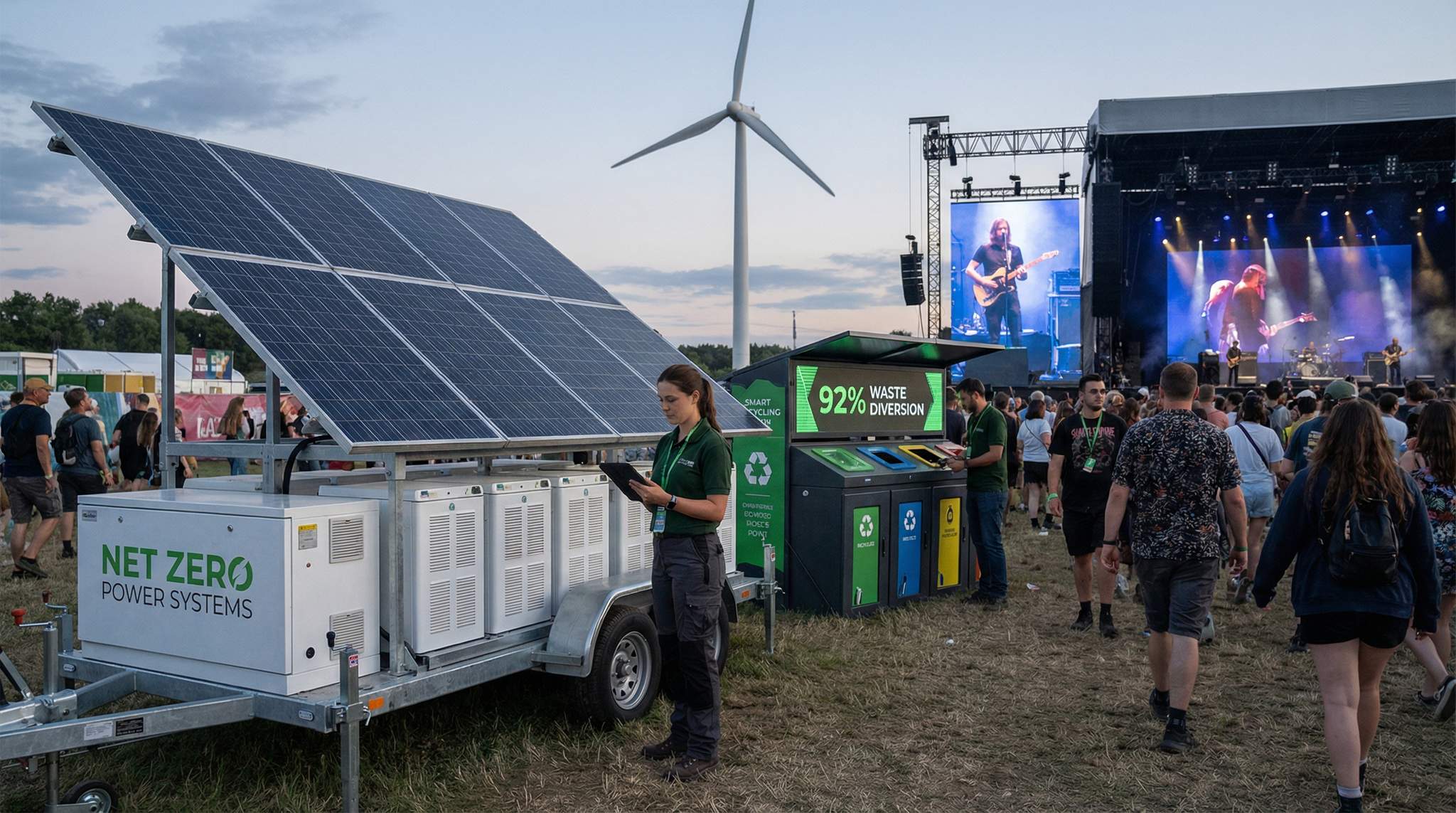
One of the most game-changing developments in event tech is the mainstreaming of solar power for event energy. In 2026, festivals large and small are installing solar panels on stage rooftops, parking structures, and even art installations to generate clean electricity on-site. These aren’t token panels for show – they meaningfully offset fuel use. A multi-day festival typically burns through tens of thousands of litres of diesel running generators, but solar rigs can now shoulder a significant portion of that load. For instance, some events use solar shade canopies (structures that both provide shade and host photovoltaic panels) to double up function. At California’s Lightning in a Bottle, solar arrays have powered entire smaller stages during daytime, cutting generator hours. In the UK, Glastonbury festival has permanent solar panels at Worthy Farm feeding energy into the grid year-round, effectively crediting itself renewable energy. The key is integration: hybrid solar-diesel systems store solar energy in battery banks by day and release it at night, reducing generator runtime. Real-world tests show solar can reliably supply 20–30% of a festival’s electricity needs, even in off-grid locations with sufficient panels and storage. And at urban venues with grid access, solar installations on the facility can offset a huge chunk of power drawn from fossil fuels. The bottom line: sunlight is increasingly running the show – literally – at green-minded events.
Wind Turbines and Alternative Energy Sources
Beyond solar, events are tapping other renewable energy sources to go green. Compact wind turbines are emerging as a viable option, especially for festivals in open areas with consistent wind. In 2026 you might spot portable wind turbines atop towers or even stage structures, quietly generating power from the breeze. While a single small turbine can’t run a main stage alone, they serve as “boosters” that collectively slash diesel generator use when paired with solar. For example, a remote desert festival might deploy a dozen micro wind turbines around the perimeter – each contributing a kilowatt or two – which together keep lights on and fridges cold overnight without burning fuel. Aside from wind, some events are experimenting with biodiesel and renewable biofuels to replace traditional diesel in generators. Biodiesel (often sourced from used cooking oil) can cut net CO2 emissions by more than 50% versus regular diesel. On-site battery energy storage is another crucial piece: lithium battery banks or even new hydrogen fuel cells are used to store renewable power and provide a buffer so that clean energy can meet peak loads. Major music tours, like Coldplay’s 2025–26 tour, have even trialed hydrogen generators and kinetic dancefloor pads (which generate electricity from dancing) to supplement power. While technologies like hydrogen are still in pilot stages, they hint at a future where diesel may not be needed at all. In the meantime, combining solar, wind, and cleaner fuels in a smart mix is allowing 2026 events to significantly reduce their carbon footprint without risking a power outage.
Planning and Reliability of Green Power Systems
Running an event on renewable energy requires careful planning to be successful. Seasoned production teams stress the importance of sizing and redundancy. Solar and wind are intermittent by nature – cloudy weather or a still day can drop output – so robust battery storage and backup generators remain essential parts of the system. The strategy is to maximize renewables while using backups as little as possible. For example, a festival might calculate the minimum overnight power needed for safety lighting and sound checks, and ensure batteries (charged from daytime solar) can cover that. Generators then become truly last-resort, or run only during peak demand when all stages and vendors are at full tilt. Smart power management software helps optimize this: these systems can automatically switch circuits between solar, battery, and generator power based on real-time capacity, ensuring no renewable energy goes to waste. Logistics are another factor – bringing in solar towers or wind units means additional equipment and sometimes specialised crew, which must be budgeted and scheduled. However, many events find sponsors or grants to support renewable initiatives, easing the cost burden. By 2026 renewable energy vendors have also matured; numerous companies now offer mobile solar generator rentals, trailer-mounted battery packs, and technical support geared specifically for events. This growing ecosystem makes it far more practical to implement green power, even if you’re not an energy expert. With realistic planning and the right partners, events are proving they can deliver reliable power for an epic experience, while drastically cutting emissions.
| Aspect | Traditional Approach | Green Tech Solution | Environmental Benefit |
|---|---|---|---|
| Power Generation | 100% diesel generators powering stages | Solar panels + battery storage (hybrid system) | Reduces diesel fuel use by 20–50%, cutting CO2 and air pollution |
| Lighting & Visuals | Halogen fixtures, old projectors, fireworks shows | LED stage lighting, laser projectors, drone light shows | Up to 70% energy savings; zero-emission drone shows replace fireworks |
| Attendee Credentials | Plastic RFID cards or PVC wristbands | Biodegradable or recycled-material RFID wristbands | Eliminates single-use plastics; wristbands break down or get recycled instead of landfill |
| Waste Management | Basic trash cans, manual sorting post-event | Smart bins + on-site recycling/composting systems | Diverts 80–90% of waste from landfills by improving sorting and recycling rates |
| Concessions & F&B | Single-use plastic cups, utensils, bottles | Reusable cup programs, edible or compostable tableware | Dramatically cuts plastic waste (e.g. millions of bottles avoided) |
Energy Efficiency in AV and Production
LED Lighting and Low-Power Visual Effects
Switching to energy-efficient audiovisual tech is one of the quickest wins for greener events. Traditional stage lighting (think incandescent PAR cans or discharge lamps) and older video walls are power hogs. In contrast, modern LED stage lighting can deliver the same luminosity with 70–90% less power. By 2026, most major events have fully transitioned to LED moving lights, pars, and LED video panels for visuals. Not only do LEDs draw a fraction of the electricity, they also emit far less heat – reducing cooling needs in indoor venues and making stages safer to work on. Festivals report that upgrading to LED lighting significantly shrinks the size (and fuel consumption) of the generators they need. In one case, a mid-sized festival cut its overnight generator requirements in half after replacing all stage lights with LEDs, since power draw dropped so much. Laser projectors and newer high-efficiency projection systems are also helping reduce the energy for video mapping and big-screen content. These units can achieve brightness that once required xenon lamps by using solid-state lasers that sip power by comparison. The audience doesn’t notice anything except perhaps even brighter visuals, since these technologies often improve output quality. For example, Coachella’s stages now boast crystal-clear LED walls that are larger and more vibrant than a decade ago, yet require far fewer generators to run. In short, by embracing the latest in lighting and visual effects tech, events are cutting electricity use dramatically while enhancing the show production.
High-Efficiency Audio and Equipment
Audio systems and other production gear have likewise become more energy-efficient without sacrificing performance. Modern Class-D audio amplifiers (now common in festival sound rigs) are over 90% efficient in converting power to sound, compared to older amp designs that wasted a lot of electricity as heat. This means huge concert PA systems can be louder with lower wattage draw, helping conserve power on-site. Speaker technology has also improved – many large-format loudspeakers and subwoofers are built with lightweight materials and more efficient drivers that produce big sound with less input power. Additionally, smart power distribution units are used backstage to shut off or “sleep” equipment when not actively in use (for example, turning off amp racks on a stage that’s idle for a few hours in the afternoon). Outside of sound, consider rigging and motors: new chain hoists and lighting trusses often use regenerative drives that can feed energy back into the system when lowering loads. Even camera and broadcast setups at live events have gotten greener – many use LED lighting for camera visibility and battery-operated wireless units to reduce the need for fuel-guzzling broadcast trucks. These incremental efficiencies across dozens of devices add up. A venue that swaps old analog amplifiers and lighting for state-of-the-art gear might cut its total show power demand by one-third or more. The key takeaway is that efficiency doesn’t mean weaker performance. In fact, the audience enjoys the same or better sound and spectacle, while the production quietly uses far less energy behind the scenes.
Innovative Low-Emission Show Techniques
Beyond making existing equipment efficient, some events are reimagining certain show elements to be more eco-friendly. A prime example is the rise of drone light shows as an alternative to traditional fireworks. Fireworks have long been a crowd favorite for festivals and New Year’s celebrations, but they come with environmental downsides – smoke, chemical residues, not to mention distressing wildlife. In 2026, several cities and events (from Sydney to Las Vegas) have begun replacing fireworks with coordinated drone swarms that create dazzling aerial patterns with LED lights. The result can be just as jaw-dropping, minus the pollution and safety hazards. Another area of innovation is in special effects: for instance, using biodegradable confetti or water-based hazers (fog machines) instead of oil-based fluids. Some touring artists now incorporate kinetic energy or pedal power as part of the show – e.g. having stationary bikes that fans can pedal to power certain installations, combining an interactive element with a sustainability message. Furthermore, creative uses of video and AR can sometimes substitute for physical set pieces, reducing material waste. At a recent tech conference, rather than fabricating a massive physical backdrop (that would later be trashed), organizers used a 360° LED screen to project dynamic visuals creating the illusion of elaborate sets. These approaches show that technology can open up entirely new ways to wow an audience sustainably. By thinking outside the box and leveraging digital or electric alternatives, events are proving they can reduce environmental impact while still delivering unforgettable moments on stage.
Ready to Sell Tickets?
Create professional event pages with built-in payment processing, marketing tools, and real-time analytics.
Sustainable Materials and Attendee Credentials
Biodegradable RFID Badges and Wearables
The rise of RFID and NFC technology for ticketing has made entry and payments seamless – but it traditionally came with plastic in the form of cards or wristbands. In 2026, event organizers are tackling that issue head-on with eco-friendly badges and wristbands. New RFID wristbands are being manufactured from biodegradable or recycled materials instead of virgin plastic. For example, some festivals offer wristbands made from bamboo fiber, organic cotton, or plant-based PLA plastic that will break down in compost after the event. Major wristband suppliers now have “green” product lines – everything from wristbands woven from recycled PET bottles to RFID cards made of sustainably sourced wood. The RFID chip itself still contains metal and silicon, but companies are innovating there too: some designs allow the chip to be easily removed so the band can be composted or recycled separately. Biodegradable card badges (for conferences or VIP passes) have also emerged, using materials like Teslin or starch-based laminates that degrade much faster than PVC. Importantly, these eco-friendly credentials don’t compromise on function: they scan at gates and enable cashless payments just like traditional ones. Organizers often collect wristbands at the end of an event for proper recycling, sometimes incentivizing attendees (e.g. “return your RFID badge for a merch discount”). By switching tens of thousands of passes from plastic to compostable, a large event can avoid a huge amount of persisting plastic waste. It’s a visible, tangible step toward sustainability that attendees notice literally on their wrist, sending a message that every detail matters.
Eco-Friendly Stage Design and Structures
Temporary event structures – stages, tents, set pieces, signage – traditionally generate a lot of waste. Think of all the plastic scrim, PVC banners, foamcore signs used once and tossed. Now, the industry is shifting to sustainable materials and reuse strategies for event design. Staging and scenic companies are offering rental stages made of modular aluminum and sustainable wood that can be reassembled for years, replacing one-off constructions. Some festivals have built beautiful stage facades from reclaimed timber or even mycelium-based materials (grown from fungi) that are lightweight, durable, and compostable. When it comes to branding and decor, there’s a move away from vinyl and plastic. Many events now print necessary signage on recyclable materials like cardboard or use digital screens instead of disposable banners for things like schedules and sponsor logos. Biodegradable paints and inks are also used for art installations to avoid releasing toxins when pieces eventually break down. An illustrative case: a major Australian festival commissioned all its art installations in 2025 to be made from either recycled metal, sustainably harvested bamboo, or solar-powered LED neon – the result was not only eco-friendly, but gave the festival a distinct handmade aesthetic that fans loved. Additionally, the practice of reusing scenic elements across multiple events or years is growing. Touring festivals might design a generic stage set that travels with them all season, or sister events share decor so items get a longer life. By designing with the full lifecycle in mind, events are cutting down on the tons of material waste that used to head to dumpsters at tear-down.
Going Paperless and Reducing Single-Use Items
Another straightforward way technology is greening events: the elimination of paper and disposable items through digitization. In 2026 it’s increasingly common that everything is digital, from tickets to schedules to surveys. Mobile event apps and QR codes have largely replaced printed programs, maps and flyers at conferences and festivals. Attendees can get all the info on their phones or on digital signage around the venue. This has massively cut paper consumption – a large conference that used to print 10,000 program booklets might now print zero, saving several trees’ worth of paper and tons of print ink. Digital ticketing and RFID entry mean no more postage of paper tickets or plastic laminate badges ahead of events. Even things like on-site waiver forms or feedback cards have gone paperless with tablets or app check-ins. Beyond paper, events are tackling other single-use disposables: plastic water bottles, cutlery, straws, and so on. The tech angle here is the deployment of water refill stations (often with IoT sensors tracking usage) in place of selling bottled water. At many 2026 festivals, you’ll see dozens of digital water stations that not only dispense free filtered water, but also display counts like “# of bottles saved from landfill today.” Likewise, modern point-of-sale systems and cashless payment tech have done away with plastic drink tokens or paper vouchers – everything is integrated on an attendee’s wristband or app for a frictionless, waste-free transaction. By making operations digital and encouraging reusables, events prevent literally millions of single-use items from entering the waste stream. For instance, after Glastonbury UK banned single-use plastic bottles, its on-site recycling centre saw plastic waste volumes plummet (in 2019 they collected four times more aluminum cans than plastic) (source). This kind of success is a powerful proof that going paperless and plastic-free, enabled by tech, can hugely shrink an event’s environmental footprint.
Smart Waste Management and Sanitation
IoT-Enabled Waste Bins and Recycling Systems
Managing waste during an event is challenging – trash bins overflow, recyclables get contaminated, and it’s hard to know what’s happening across a large site in real time. Smart waste management systems are changing that. Events in 2026 are deploying IoT-enabled trash and recycling bins that can monitor fill levels, sort contents, and guide attendees on proper disposal. For example, “smart bins” equipped with sensors send alerts to cleanup crews when they’re nearly full, optimizing collection routes so staff aren’t just circling blindly. This prevents the overflowing-bin scenario (which leads to litter and attracts pests) and reduces unnecessary trips by waste trucks, saving fuel. Some smart bins even have internal compactors powered by solar panels – common at large outdoor festivals – which compress waste so each bin can hold 5–8x more material, further reducing collection frequency. On the recycling front, high-tech sorting stations are popping up at venues. These stations use machine vision AI to identify bottles, cans, and compostables on a conveyor as attendees deposit them, automatically separating materials. A few pioneering events in Europe have tested robot arms that pluck out recyclables from mixed waste in real time (a miniature version of what municipal recycling plants use). While still early, these systems promise much cleaner recycling streams – meaning a higher percentage of waste actually gets recycled rather than rejected due to contamination. Even simpler tech helps: LED signage on bins with dynamic instructions (“Landfill vs Recycle vs Compost” with pictures) has been shown to improve attendee sorting behavior. With real-time data from connected bins and smarter sorting, events can achieve far higher waste diversion rates – many are now hitting that 85–90% diversion goal through a combination of tech and good planning.
Composting, Waste-to-Energy and Innovative Toilets
Dealing with solid waste is only half the battle – events also must handle organic waste and sewage sustainably. Here too, new solutions are at work. On-site composting systems are becoming more common at festivals, allowing food scraps and compostable plates to be processed right at the venue. Some large events set up industrial composting units (essentially large digesters) behind the scenes that turn tons of food waste into fertile compost over the course of the event. This not only reduces trash hauling but creates a usable product; for instance, several festivals bag and donate the resulting compost to local farms or use it to replant the venue grounds after the event. Even more high-tech: a few venues are piloting waste-to-energy systems that can take organic waste (or even trash) and convert it to energy on-site via processes like anaerobic digestion. For example, a small music festival in California used a portable anaerobic digester to convert food waste into biogas, which then helped fuel generators – closing the loop on its food waste stream.
One often-overlooked area is sanitation technology – but it’s critical for both sustainability and attendee experience. Traditional chemical porta-loos are not eco-friendly, and hauling out sewage is carbon-intensive. In response, promoters are introducing composting toilets and vacuum flush systems at events. Composting toilets use sawdust or other carbon material to naturally break down human waste into compost, with no chemicals and minimal water. They’ve been deployed successfully at events like Burning Man and Shambala, greatly cutting the water usage and eliminating the need for sewage trucks in some cases. Another approach is vacuum flush toilets (like on airplanes or high-end venues) which can reduce water per flush by 90% and send waste to a central processor that might use anaerobic digestion to convert sanitation waste into a resource. Some European festivals even implemented urine diversion systems – collecting nutrient-rich urine separately to be processed into agricultural fertilizer – a concept known as “pee cycling.” These solutions might sound experimental, but they are proving effective and surprisingly well-accepted when done right. Attendees appreciate clean, odor-free facilities and the novelty of eco-toilets, especially when events communicate the positive impact (e.g. “your visit to the loo is helping fertilize local fields!”). By treating waste as a resource and investing in innovations from composters to modern toilets, events can solve long-standing sanitation issues in a sustainable way, keeping both the planet and the people happy.
Grow Your Events
Leverage referral marketing, social sharing incentives, and audience insights to sell more tickets.
Data-Driven Waste Tracking and Reduction
Just as data analytics have transformed marketing and ticket sales, they’re now being applied to sustainability, including waste management. Many organizers are using data dashboards to track waste in real time during their events. Staff might log each trash pickup or each dumpster haul via a mobile app, feeding into a central system that tallies total waste collected, recycled, and composted. This live tracking enables quick adjustments – if one area of the venue is generating unusual waste volumes, organizers can respond with more bins or education. Post-event, the data is gold for planning improvements. By analyzing which vendors produced the most compost vs landfill waste, or which campgrounds left the most litter, events can pinpoint trouble spots and work with those stakeholders on solutions (like requiring certain vendors to switch to compostable packaging). Some festivals now publish sustainability reports with detailed metrics – for example, revealing that “92% of waste was diverted from landfill” or “120,000 liters of water were dispensed at refill stations, avoiding 240,000 plastic bottles.” Having hard numbers lends credibility to green claims and helps avoid accusations of greenwashing. It also allows events to set concrete targets for the next year. Technology not only gathers this data but also helps achieve the targets: tools like AI can even predict waste generation based on attendance and F&B sales, helping to optimize bin placement and pickup schedules in advance. All told, a data-driven approach to waste turns what used to be an overwhelming, dirty job into a measurable, optimizable operation. It’s the marriage of sustainability and smart operations – and it’s key to continuously driving waste footprints closer to zero.
Greener Event Transportation & Logistics
Sustainable Audience Travel and Ticketing Incentives
One of the biggest contributors to an event’s carbon footprint often lies outside the venue: audience travel. Thousands of people driving or flying to attend can dwarf on-site emissions. Event organizers in 2026 are addressing this through tech-enabled incentives and partnerships to make audience transport greener. Many festivals now use ticketing systems that offer discounts or perks for low-carbon travel – for example, attendees who carpool or take the train can get redeemable vouchers or special camping spots. Mobile apps and online platforms help coordinate these efforts, allowing fans to find carpool buddies or purchase shuttle passes easily. Coachella’s rideshare program, for instance, has long offered a chance to win VIP tickets if you arrive in a car with 4+ people; more events are adopting similar tactics and tracking participation via apps or RFID scanning in parking lots. Some urban festivals integrate directly with city transit cards or ride-hailing apps, providing promo codes or free transit days for ticket holders. Technology also comes into play with remote participation, which, while not replacing live attendance, can supplement it. High-quality live streams and VR experiences enable distant fans to join in without traveling – and organizers can monetize these virtual tickets, reaching a wider audience with a smaller carbon hit. Finally, events are communicating carbon impact to attendees more transparently, sometimes via the ticket purchase process (e.g., “Choosing to take the train will reduce your carbon footprint by X kg CO2”). By leveraging apps, data, and incentives, event producers are nudging audiences toward greener travel choices, aiming to shrink that often-overlooked slice of the footprint pie.
Greener Artist and Crew Transportation
It’s not just attendees – the artists, speakers, and crew traveling to events are another target for sustainability improvements. Artist touring, especially for festivals, has begun to coordinate in greener ways. In 2026 we see the rise of “green touring alliances,” where festivals in a region collaborate on scheduling so that artists can route efficiently rather than criss-crossing continents. By aligning dates and sharing logistical info, a group of festivals can enable, say, a band to play three European festivals in one trip instead of flying back and forth for each. Some artist contracts now include clauses encouraging lower-carbon transport (e.g. using tour buses or rail instead of short flights, where feasible) and artists increasingly are on board, as they face pressure to minimize the environmental impact of their tours. Promoters and production companies are also investing in fleet upgrades: shifting from diesel trucks to hybrid or electric vehicles for moving gear locally, and using biofuel for generators and tour buses. For instance, a major concert promoter recently bought electric vans to shuttle crew and equipment around the city during festival week, slashing fuel use and emissions for those short trips. Bulk shipping of gear is another strategy – instead of each event ordering its own equipment separately (leading to many partial truckloads), alliances of events are bulk-hiring stages, lights, etc., so one full truck can serve multiple stops. This kind of resource sharing is facilitated by logistics software that matches schedules and needs across events. The Green Touring Alliances initiative launched in Europe has shown that coordination can cut both carbon and costs, with multiple festivals reporting savings by co-chartering trains for attendees and sharing freight containers. As these practices spread and logistics tech expands to support multi-event planning, the travel emissions associated with putting on shows can be significantly reduced.
On-Site Logistics and EV Fleets
Within the venue or festival grounds, logistics and transportation are also getting a green overhaul. Many large events now operate their own fleet of electric vehicles (EVs) on-site – think electric golf carts, e-bikes, or even electric ATVs for staff and security. These replace the gasoline gators and diesel trucks that used to zoom around for everything from artist transport to ice deliveries. Charging stations (often solar-powered) are set up backstage to keep the fleet running. The result is quieter, emission-free operations that improve local air quality and reduce fuel handling on site. Drones are another emerging tool: instead of having crew drive around to survey the site, drones can be used for site inspection, spotting any issues (like crowding or trash build-up) from above without consuming fuel. Even for deliveries and heavy lifting, there are greener options – biofuel-powered forklifts, for example, or using hydrogen fuel cell generators to power remote equipment like stage lifts. Another aspect of sustainable on-site logistics is optimisation through software. Advanced scheduling systems can coordinate supplier deliveries to minimize trips, and track vehicle movements to avoid redundant runs. For example, if two vendors need restocking, the system can schedule one EV cart to handle both in one loop. Some festivals use GIS mapping and real-time tracking of assets (tents, toilets, food stands) to streamline the build and break phases, ensuring that trucks take the shortest paths and spend the least time idling. While attendees may not see these behind-the-scenes tweaks, they can feel the effects – less noise, cleaner air, and a generally smoother operation. Plus, every litre of fuel saved on-site is a direct emissions reduction. In combination with greener audience travel and touring, improvements in on-site logistics bring events closer to the goal of an end-to-end sustainable production.
Smooth Entry With Mobile Check-In
Scan tickets and manage entry with our mobile check-in app. Supports photo ID verification, real-time capacity tracking, and multi-gate coordination.
Data, Analytics and Certifications for Sustainability
Tracking Carbon Footprint and Energy Use
To manage something as complex as an event’s environmental impact, you need to measure it. That’s why 2026 events are increasingly adopting carbon tracking and energy management tools. Specialized software and consulting services can calculate an event’s carbon footprint in detail – including energy use, accommodations, waste, and travel – often following protocols like the ISO 20121 sustainable events standard. Before the event, organizers input data or estimates (e.g. generator fuel consumption, number of flights, kg of beef served) and the tools project the carbon emissions. This helps in setting reduction strategies (maybe switching menu options to lower-carbon foods or adding renewable energy capacity). During the event, real-time energy monitoring systems are used at venues to track exactly how much power is being drawn and from what source. Smart meters and IoT sensors on generators, for instance, can show fuel burn and efficiency at any given moment. If one generator is running at low load (wasting fuel), operators can consolidate loads to run generators at optimal efficiency – a practice enabled by data visibility. On the grid side, venues with building management systems optimize HVAC and lighting to trim energy use during off-peak hours. All this data gets compiled into actionable insights. Some festivals now have a “sustainability command center” akin to a operations center, where staff watch dashboards of energy, water, and waste metrics. If targets are slipping, they can react – for example, deploying volunteer “eco ambassadors” to remind attendees about recycling when diversion rates are dropping. After the event, the collected data feeds into comprehensive sustainability reports and certifications. The analysis might reveal that Stage 2 consumed 25% more power than Stage 1, prompting a closer look at why (perhaps older equipment or poor scheduling). By rigorously tracking and analyzing these metrics, events can iterate and improve year over year, much as they do with financials or attendance figures. Data turns sustainability from guesswork into a science, enabling continuous improvement.
Certifications and Standards as Guideposts
In the push for greener operations, many events are aligning with established sustainability standards and certifications. Frameworks like ISO 20121 (Event Sustainability Management) provide a structured approach for organizers to incorporate sustainability into planning and operations. Achieving ISO 20121 certification signals that an event has robust processes to manage its environmental (and social) impacts – it’s something the 2012 London Olympics famously did, and now festivals and conferences are following suit. These standards don’t dictate specific technologies, but tech helps meet many of their requirements (like monitoring resource consumption, engaging stakeholders, and transparently reporting outcomes). Another popular benchmark is the A Greener Festival Award, which evaluates festivals on a range of eco-criteria from energy to waste to community involvement. Festivals in 2026 vie for levels like “Commended” or “Outstanding” from A Greener Festival, leveraging tech solutions to hit the marks – for example, they might need to demonstrate at least 50% power from renewables, or a certain high percentage of waste recycled, to earn the recognition. On the venue side, green building certifications (LEED, BREEAM, etc.) are being sought by new or renovated arenas and convention centers, which often involves installing high-efficiency lighting, smart climate control, and renewable energy – again showcasing technology’s role in meeting criteria. The benefit of adhering to these standards isn’t just a plaque on the wall; it provides events with a roadmap of best practices and lends credibility to their sustainability claims (fending off any skepticism of greenwashing). Additionally, aligning with global initiatives like the Net Zero Carbon Events pledge means events commit to reporting and reducing emissions in line with international climate goals. Technology and data are indispensable in this context: you can’t claim you’re on a path to net-zero without solid metrics and the tech-driven strategies to get there. Certifications and pledges essentially formalize the commitment and keep events accountable, while the innovative tech and strategies we’ve discussed throughout this article are the tools that help fulfill those commitments.
Transparency, Communication, and Engagement
A noteworthy trend in 2026 is how events communicate their sustainability efforts, using technology to engage attendees in the mission. It’s no longer done quietly in the background – organizers are making sustainability a visible part of the event experience. One approach is real-time dashboards or signage at the event showcasing environmental metrics (“X tons of CO2 avoided”, “Y kWh of solar energy generated today”, “Z% of waste recycled so far”). These live displays, often fed by the data systems we discussed, can spark conversations and encourage the crowd to participate (e.g., seeing the recycling rate tick up might motivate folks to find the right bin). Social media and event apps are also used to push green messages during the show: attendees might get push notifications like “It’s a sunny afternoon – our solar panels are cranking! Remember to refill your bottle at a water station and stay hydrated sustainably.” Gamification elements sometimes come into play; for example, a festival app might award points or badges to users for completing eco-challenges (like “visit all 5 sustainability info booths” or “bring a cup to the bar instead of using disposables”) which can then be redeemed for merch or perks. These interactive tactics are enabled by tech but rooted in human psychology – they make sustainable behaviour fun and rewarding. Importantly, transparency is key to trust. Events are increasingly honest about their impacts and progress, sharing post-event data with attendees and stakeholders in wrap-up reports or blog posts. If targets were missed, they say so and explain plans for improvement. This openness, supported by accurate data tracking, builds credibility. Attendees are generally forgiving when they see genuine effort and accountability. In fact, events that bring their community along on the sustainability journey often find that fans become advocates – proudly promoting the festival as one that cares. In a competitive entertainment landscape, that kind of loyal, values-driven fanbase is worth its weight in gold. By using technology not just to reduce impacts but to openly communicate them, events strengthen their reputation and inspire broader change, far beyond the gates of the venue.
Scaling Sustainability: From Conferences to Festivals
Tailoring Green Tech to Event Size and Type
Sustainable event technology isn’t one-size-fits-all – what works for a 80,000-person festival may not be practical or necessary for a 500-person corporate conference, and vice versa. Experienced planners in 2026 understand they must tailor solutions to the event’s scale and context. For example, a multi-day outdoor festival might invest heavily in on-site infrastructure like solar farms, battery containers, and composting toilets, because it’s essentially building a temporary city. A one-day indoor business conference, on the other hand, might focus on the existing venue’s sustainability features (efficient HVAC, LED lighting) and measures like going paperless and offering public transit options for attendees. The good news is that many green tech solutions scale down well. Even a small event can use digital ticketing to eliminate paper, or set up simple recycling stations with clear signage to achieve high diversion. Cloud-based energy management systems can be as useful in a convention center (to monitor breakout room electricity use and avoid waste) as they are on a festival ground. For huge festivals, redundancy and capacity are key – you might need dozens of smart water stations and a robust network of sensors to cover a large site, whereas a smaller event can manage with just a few. Cost is also a factor: big events often have more budget to deploy experimental tech like AI-driven waste sorting, whereas smaller events might opt for low-tech but effective solutions (like manually sorting recyclables with volunteer help, or renting a small solar generator to power a side stage). The strategy is to pick the low-hanging fruit first for any given event. A local music show at a small venue might prioritize using the venue’s LED lights and encouraging fans to take the bus, rather than worry about importing solar panels. Meanwhile, a giant festival hits those basics and then layers on more ambitious projects. By calibrating the approach to the event’s size and resources, organizers ensure the sustainability measures are both impactful and feasible.
Venue vs. Outdoor Settings: Opportunities and Limits
The physical setting of an event – a fixed venue versus an open field – strongly influences which green technologies can be leveraged. Indoor arenas and convention centers often have the advantage of permanent infrastructure. They can undergo one-time upgrades like installing a solar rooftop, high-efficiency water fixtures, or waste sorting facilities, which then benefit every event hosted there. For instance, many large venues have added bottle refill stations throughout the concourses and LED lighting rigs, slashing waste and energy use for all future concerts or games there. Venue operators in 2026 are sharing best practices for such upgrades; from LED lighting retrofits to on-site water filtration, these practical improvements cut carbon and cost simultaneously. Event organizers renting a venue should definitely inquire about and utilise these features – it might be as simple as asking the venue to turn on its energy management system optimizations during the event, or ensuring the cleaning staff follow the venue’s recycling protocol. On the flip side, outdoor festivals and events must create a mini-city from scratch, which is challenging but offers a blank slate to implement green tech. Outdoor events can choose greener generators, lay out efficient power distribution, bring in sustainable vendors, etc., but they also face constraints like weather and temporary setup. For example, heavy rain can hamper solar output or flood compost toilets, so contingency planning is vital. Additionally, in remote greenfield sites, organizers might not have access to municipal recycling or power grids, so they need to bring everything – this is where partnerships with sustainability providers (for mobile solar, waste processing, etc.) are crucial. Outdoor events have more freedom to experiment (nobody is telling them they can’t dig a small wind turbine into the field), but they also carry more responsibility to leave the site as they found it. Increasingly, festivals on greenfield sites adopt a “leave no trace” ethic supported by tech: using GPS mapping during teardown to ensure every structure and bit of litter is removed, and documenting the site condition before and after with drone imagery. In summary, venues offer built-in sustainability opportunities that should be maximized, while open-air events allow for creative bespoke solutions – both environments can achieve great results, but the tactics will differ.
Collaboration and Knowledge Sharing Across Events
One of the most encouraging developments in event sustainability is the spirit of collaboration rather than competition. Organizers are realizing that by sharing knowledge – and sometimes resources – they can accelerate progress for everyone. Industry groups and online forums allow event professionals to swap experiences about what tech or vendor worked (or failed). It’s not uncommon now for the production team of Festival A to call up Festival B after an event and ask, “How did those solar lights work out for you? Would you use them again?” This kind of knowledge sharing helps avoid reinventing the wheel and spreads innovation faster. Formal alliances are also forming: we touched on green touring alliances for routing artists, and there are similar coalitions for sustainability. In the UK, for example, a consortium of independent festivals banded together to bulk order sustainable cups and wristbands, securing a cheaper price and eliminating tons of single-use items collectively. In another case, festivals in the same region coordinated to share certain infrastructure – one festival bought a set of composting toilets and then rented them out to others on adjacent weekends, ensuring the units stayed in use and the costs were recouped. Technology facilitates a lot of this cooperation. Shared online dashboards or templates allow events to benchmark their sustainability metrics against peers anonymously, motivating each other to improve (nobody wants to be the outlier with the lowest recycling rate!). There are even hackathons and innovation challenges where events and tech startups co-develop new solutions, like a contest to design a better solar-powered phone charging station or a more biodegradable glitter for festival-goers. The collaborative ethos means sustainable innovations don’t remain proprietary for long – if something works, word spreads quickly through industry conferences, blogs, and networks. Ultimately, events recognize that climate change is a collective problem, and working together – whether via alliances, sharing best practices, or jointly lobbying for greener suppliers – can create results no single event could achieve alone. This collaborative momentum is propelling the entire live events sector toward greener pastures.
Implementation Challenges and Success Strategies
Balancing Upfront Costs with Long-Term ROI
While sustainable tech offers savings and goodwill, there’s no denying that many solutions require upfront investment. A common challenge event organizers face is budget constraints – eco-friendly options sometimes come with higher initial price tags. For example, renting a solar-battery generator might cost more than a diesel genset, or compostable foodware might be pricier than cheap plastic plates. The key is to evaluate total cost of ownership and ROI over time. Often, the long-term savings outweigh the initial premium: LED lights last many years and slash energy bills; solar power saves on diesel fuel costs year after year; recycling can reduce landfill fees. Some organizers justify green investments by treating them as capital improvements that pay off across multiple events. Others seek sponsors and grants earmarked for sustainability to subsidize these costs (cities or tourism boards increasingly offer grants for events that implement carbon-cutting measures). It’s also crucial to account for hidden and indirect costs – what one guide calls the hidden costs of event technology beyond vendor quotes. For instance, a cheap generator might look good in a quote but end up guzzling more fuel (higher operating cost) and causing noise complaints (reputation cost), whereas the greener option saves money on fuel and avoids potential fines or permitting issues down the road. Savvy producers build a sustainability line item into their budgets from the start, rather than treating green measures as add-ons, ensuring that funds are allocated to these priorities. They also track quantifiable returns: if a $50,000 investment in reusable cup infrastructure results in $10,000 savings per event on disposables and waste removal, that’s a clear 5-event payback period. Additionally, intangible ROI cannot be ignored – improved brand value, meeting sponsor expectations (many corporate sponsors now demand events adhere to ESG goals), and avoiding risk of being called out for wastefulness. By making the financial case and perhaps starting with a few high-impact investments, organizers can overcome cost barriers. When done right, sustainability isn’t just good for the planet, it makes business sense through efficiencies and brand loyalty.
Technical and Operational Challenges
Introducing new technologies in a live event environment isn’t without hiccups. Technical failures or misjudgments can be high-stakes when the show must go on. One challenge is reliability: will that fancy new power management system or grid of solar panels hold up under real-world conditions? If a cloud covers the sun and battery reserves run low, you’d better have a contingency plan or the stage could go dark – an unacceptable outcome. That’s why redundant systems and backups remain crucial. Many events adopt a hybrid approach: use solar/wind but keep a couple of efficient diesel generators on standby; use composting toilets but have a few traditional units as backup in case of overload. Testing and phased rollouts also help manage technical risk – for instance, a festival might pilot an AI waste sorter on a small subset of waste before deploying site-wide. Another challenge is integration: sometimes different technologies need to work together. Integrating ticketing apps with transit systems, or syncing a sustainability data dashboard with dozens of sensor types, can require custom development and troubleshooting. Having the right technical expertise either on staff or on call is key. During the event, there’s the operational aspect of training crew and volunteers on the new tech: a high-tech waste station is only effective if staff know how to maintain it and guests use it correctly. This means investing time in training and clear communication (simple signage, staff briefings, maybe even demo videos beforehand). There’s also the human factor – occasionally, resistance to change can be an obstacle. Long-time crew might be skeptical of “newfangled” methods, or vendors might push back on requirements like using only compostable serveware. Strong leadership and education is required to get everyone on board with why the changes matter and how to execute them. It’s wise to anticipate some teething problems and have support on standby (e.g., bringing the solar provider’s technician on-site). The events that succeed are those that treat sustainable tech deployment with the same seriousness as any mission-critical production element: thorough planning, backups in place, trained personnel, and a mindset of adaptability. With those, most challenges can be overcome without impacting the attendee experience.
Getting Stakeholder Buy-In and Participation
Even the best green strategy will falter if key stakeholders aren’t committed. One of the less tangible but vital tasks for an event organizer is building buy-in from all parties – staff, vendors, sponsors, venues, and attendees – to actively support sustainability goals. This often starts at the top: festival directors or event CEOs need to champion the cause so that sustainability isn’t seen as a side project but as core to the event’s values. Clear policies and expectations should be set early for vendors and contractors (e.g., “all food vendors must use compostable packaging” or “sound and lighting suppliers must use energy-efficient equipment where possible”). It helps to frame these requirements positively – many vendors are happy to comply if they understand the reasoning and see that the event is truly committed (and not just giving lip service). For sponsors, aligning with sustainability can be a selling point: sponsors increasingly have their own CSR targets, so an event’s green credentials can attract brands that want to be associated with eco-friendly experiences. Indeed, some events have brought on sustainability partners – companies that provide funding or in-kind support for green initiatives in exchange for recognition (for example, a solar company sponsoring the solar charging stations, or a recycling company sponsoring a “Green Zone”). When it comes to attendees, making them part of the mission is key. This means communicating do’s and don’ts (like what they can bring, how to dispose of waste) in advance and on site, and also empowering them to contribute. Volunteer green teams at festivals roam campsites educating and helping attendees recycle properly; at conferences, organizers might encourage attendees to offset their travel emissions via an app during registration. Some festivals build sustainability into the culture with pledges attendees sign (such as agreeing to take their tents home, not leave them). It’s remarkable how much fans will cooperate when they feel a sense of collective responsibility – many modern festival-goers consider themselves stewards of the environment during the event. Lastly, celebrate the wins: thanking attendees, staff, and partners for helping achieve milestones (like announcing “we diverted 90% of waste – thank you!” at the closing of the show) reinforces positive behavior and buy-in for next time. Achieving a truly green event is a team effort, and the role of technology is not only to provide solutions, but also to provide the data and platforms that help galvanize that team around a common goal.
| Sustainable Tech Investment | Upfront Cost | Operational Savings / Benefits | ROI Considerations |
|---|---|---|---|
| Solar + Battery Power System | High (panels & battery purchase or rental) | Saves fuel costs each event; reduces generator runtime | ROI in ~3–5 years if used regularly; grants or sponsorships can offset initial cost |
| LED Lighting Upgrade | Medium (new fixtures or retrofits) | 70%+ less energy use; lower cooling needs; bulbs last longer | Quick payback (1–2 years) from energy savings, especially at venues with frequent events |
| Biodegradable RFID Wristbands | Low/Medium (slightly higher unit cost than plastic) | Eliminates plastic waste; improves brand image | Minimal direct financial return, but provides reputational gains and appeals to eco-conscious sponsors & attendees |
| Smart Waste & Recycling Systems | Medium (sensor bins, sorting tech rental) | Less trash hauling, lower landfill fees; cleaner venue | Moderate ROI: saves on labour for clean-up and disposal fees; helps meet regulatory requirements |
| Reusable Cups & Water Stations | Medium (purchase durable cups, install refill units) | Reduces single-use cup and bottle costs; revenue from cup deposits; avoids plastic waste | Payback in 1–3 events if deposit/return system is used; major waste reduction and goodwill benefits |