Teens at Festivals: Independence Meets Safety
Family-friendly festivals thrive when every age group is having fun – and that includes teenagers. Teens are at a unique stage: they crave independence, yet still need guidance and safe boundaries. The challenge for festival organizers is to respect teens’ autonomy while keeping them safe and engaged. Around the world, successful family festivals have found creative ways to give teens space of their own, from dedicated hangout zones to teen-driven activities. These “teen zones” can transform a festival experience – not only preventing teenage boredom or mischief, but actively turning young attendees into enthusiastic festival fans.
One thing is clear: when teens feel trusted and respected, they’re more likely to immerse themselves in the event (and less likely to rebel against the rules). Even famously youth-oriented events have recognized this. For example, the Vans Warped Tour in the US – known for drawing crowds of high-schoolers – offered a “Reverse Daycare” tent where parents could relax (free of charge) while their teens enjoyed the punk-rock madness, a unique feature highlighted in the Star Tribune’s report on the tour. This meant teens could roam freely without feeling helicoptered, yet parents were nearby if needed. The lesson? Empowering teens with some autonomy and having a support system in place makes the festival experience better for everyone.
Designing an Engaging Teen Hangout Zone
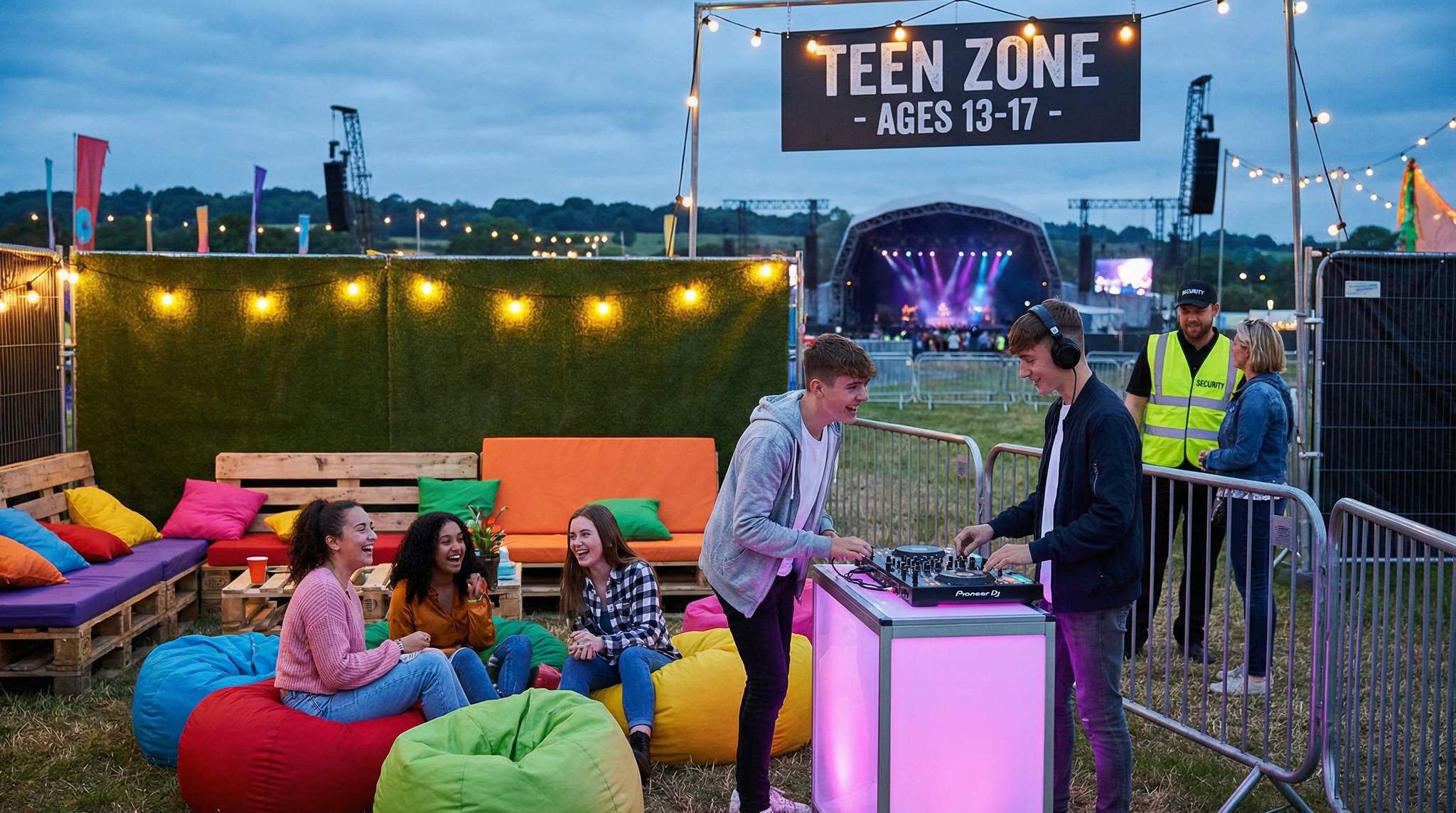
A well-designed teen zone can be a magnet for young festival-goers. It’s not about separating teens completely from the festival, but giving them a dedicated space to chill and socialize on their own terms under light supervision. Many festivals set up supervised hangout areas filled with age-appropriate games, music, and workshops to keep teens entertained:
- Games & Activities: Think about interactive entertainment that appeals to teenagers’ sense of fun and adventure. This could include everything from gaming stations (console or VR games) and sports like basketball or skate ramps, to more laid-back options like ping-pong, foosball, or board games. At Lagos’s Kydz Teen Fest, for example, the “Teen Power Zone” features VR games and even a teen entrepreneurship market, as detailed on the Kydz Teen Fest website – mixing fun with creativity and learning.
- Music & Dance: Music is at the heart of any festival, and teens love to express themselves through it. Consider a small stage or DJ booth in the teen area where young aspiring DJs or local teen bands can perform. Having a youth DJ spinning popular tracks gives teens a mini dance floor of their own. Australia’s Splendour in the Grass festival took this approach in its family section: the “Little Splendour” area includes a Big Kids Zone with sports, henna, and games, described in Amnplify’s review of the Little Splendour zone and even a silent disco. In 2018, a 15-year-old DJ (DJ Sol) performed to give his peers a show by someone their own age, a moment captured in Amnplify’s coverage of the festival.
- Creative Workshops: Festivals can also offer workshops tailored to teen interests. Think along the lines of street art sessions, beginner-friendly music production or DJ classes, dance workshops, photography outings, or crafts with a modern twist. These give teens a chance to learn new skills and express themselves. In the UK, Latitude Festival hides an “Inbetweener’s Area” in the woods for ages ~12 and up, where older kids and teens can try activities like zip-lining and outdoors workshops away from the little kids, a tip found in SheerLuxe’s guide to family festivals. By giving teens exciting challenges and creative outlets, you keep them busy in the best way.
Design the teen zone to feel welcoming but not babyish. Decor and naming matter – avoid calling it the “kids’ zone” if it’s meant for adolescents. Make it visually appealing, maybe street-art murals or a lounge vibe with comfy seating where they can simply hang out and chat. Provide charging stations for phones (teens will thank you!), and consider a social media photo booth or backdrop so they can snap festival memories to share. The goal is a space where teens want to be – not because they’re corralled there, but because it’s cool, relevant, and theirs.
Grow Your Social Following With Every Sale
Require social media follows, shares, or playlist adds to unlock presale access or special pricing. Turn every ticket purchase into audience growth.
Of course, safety isn’t an afterthought here: adult supervision should be present, but in a low-key way (more on staff tone later). The area should be clearly defined so younger kids don’t wander in and so that festival security can monitor entrances if needed. With these elements in place, a teen zone becomes a win-win: teens get freedom and fun, parents get peace of mind, and the festival as a whole gains a happier family crowd.
Clear Boundaries: Curfews, Pick-Up Points & Policies
Giving teens freedom at a festival doesn’t mean a free-for-all. Clear rules and boundaries ensure safety without ruining the fun. A key strategy is to publish explicit policies in advance – letting both teens and their parents know what to expect. This includes curfews for minors, designated meet-up or pick-up points, and any age-related restrictions on site.
Planning a Festival?
Ticket Fairy's festival ticketing platform handles multi-day passes, RFID wristbands, and complex festival operations.
Set Curfews and Time Limits: Many family-oriented festivals set a “curfew” after which underage attendees must be with an adult or in certain areas. For example, at the UK’s Camp Bestival – one of the most beloved family-friendly festivals – the official rules state that teen ticket holders (aged 13–17) are not allowed in the main arena unaccompanied after 10 pm. After that hour, teens can only stay out in the festival if a parent or guardian is with them. This kind of policy ensures that late-night shows or dance tents (where crowds can get rowdier) aren’t filled with unsupervised minors. Festival producers should decide an appropriate time based on the event’s schedule and vibe, and make it very clear on the website, tickets, and onsite signage. When everyone knows the rule, it actually empowers teens to enjoy the day fully and then meet up with family by the agreed time, rather than being abruptly chased out with no warning.
Designate Safe Pickup Zones: Equally important is having a plan for drop-offs and pickups. If parents are comfortable letting their teens explore solo during the festival day, they’ll need a reliable way to find each other when it’s time to go home. Festivals can designate a well-lit, secure pickup point (or several) at the edge of the grounds. Communicate this spot clearly: in the festival map, on the app, and through signage that says “Family Pickup Zone” or “Teen Pickup Area”. Staff these areas with a few friendly volunteers or security in the late evening, so teens aren’t left waiting alone and parents can easily drive in and out. By publishing pickup details (exact location, operating hours, traffic instructions) ahead of time, you take a huge weight off parents’ minds.
For instance, All Together Now festival in Ireland directs all pickups to a specific gate and has staff guide cars to a designated taxi and parent pickup lot. By organizing this, they prevent chaotic wandering or teens looking for their rides in the dark. Even for camping festivals, it’s wise to establish a meeting point for families each night. And for day festivals, a curbside pickup plan with clear directions and maybe a waiting lounge area can be a big logistical improvement in the family experience.
Age Restrictions and ID Policies: Another boundary to clarify is the age policy of your event. Some festivals require under-16s to be accompanied by an adult at all times, or limit certain age groups. Make sure these rules are stated upfront. The Latitude Festival (UK) is very explicit: no under-16s can attend without an adult, and children under 10 must be with an adult at all times, according to SheerLuxe’s parenting advice for festivals. They even issue special wristbands for 10–12 year-olds whose parents allow them to roam the grounds unaccompanied (with the understanding that any child under 13 found alone without that wristband will be escorted to the welfare team), a safety measure outlined in SheerLuxe’s festival safety guide. This approach shows that you can give pre-teens or younger teens a bit of freedom, as long as you have a system to identify who is allowed to do so. In your festival planning, consider having different colored wristbands for minors, or a registration system for families (Splendour in the Grass, for example, requires parents to register all children under 12 online before the event). These measures help your security team and lost-child units do their job more effectively.
Go Cashless With RFID Technology
Enable contactless payments, faster entry, and real-time spending analytics with RFID wristbands and NFC-enabled ticketing for your events.
Bottom line: Set reasonable boundaries – and broadcast them loudly before and during the festival. Teens might grumble about a curfew or rules, but if it’s communicated in a fair, consistent way, they will be more likely to accept it. In fact, many teens appreciate knowing the limits, because it gives them a clear structure for their fun. And parents, of course, will feel much more at ease bringing their teenagers when they see the festival has thoughtful policies in place.
Training Staff for a Supportive Atmosphere
The people running your festival – staff, volunteers, security – play a huge role in how welcome teenagers feel. It’s critical to train your festival staff in a supportive, non-policing tone when dealing with teens. Supervisors in a teen zone aren’t there to bark orders or hover like strict chaperones; they’re there to be approachable guides and protectors.
Need Festival Funding?
Get the capital you need to book headliners, secure venues, and scale your festival production.
Start by selecting the right team for the teen area. Look for youth workers, young adults, or just staff who are naturally good at relating to teens. Brief them to avoid coming across as law enforcement unless absolutely necessary. The aim is to create an atmosphere of mutual respect. Instead of “Hey, you, get down from there!” it’s “Hey, how’s it going? Careful up there, don’t want you to get hurt – need any help?” The difference in tone is huge. A non-policing approach means staff enforce rules by explaining why they exist and treating the teen attendees more like younger peers than like delinquents.
Real-world example: The organizers of TeenFest events or youth-oriented festivals often train their volunteers to act like mentors. They’ll station “Teen Hosts” in the zone – staff who facilitate games, chat with the kids, and can defuse any small issues with a friendly word. If a few 14-year-olds are getting rowdy, a supportive staffer can join in on the fun briefly or redirect their energy (“Let’s save that for the dance-off later, guys”) rather than immediately scolding. This approach keeps the vibe positive while still maintaining order.
It’s also valuable to educate staff on teen psychology and diversity. Teenagers can be sensitive to feeling patronized. A festival volunteer who listens to their opinions, uses inclusive language, and maybe even knows a bit about the bands or games teens are into will build trust faster. On the flip side, if security guards treat all teens with suspicion (searching them without cause, or constantly monitoring as if they’re troublemakers), the teens will notice and may either withdraw or push back. Train security at entry points to be polite when checking IDs or bags of minors – firm on prohibited items, but never antagonizing. A great tip is to have some security or welfare staff in plainclothes inside the teen zone, blending in more as helpers than authority figures.
Furthermore, ensure your team knows the protocols for emergencies or problems involving teens. If a teenager does break a rule (say, caught drinking alcohol underage, which unfortunately can happen even at family events), how your staff handle it is crucial. The best practice is a calm, solution-oriented response: escort them to a private area, involve a senior staffer or medical team if needed, possibly contact their parents or guardian on site – but avoid publicly shaming or rough handling unless there’s an immediate safety threat. A supportive tone even in discipline shows other teens that the festival is fair and cares about them.
In short, invest time in briefing and training your crew on positive youth engagement. A festival in Singapore once incorporated professional youth counselors as part of the event staff to help manage young attendees – a sign of how seriously some events take the well-being of teens. When festival personnel act as guides and allies, teens feel safer and more respected, which means they’re likely to respond in kind with good behavior and cooperation.
Teen-Led Programming: Give Youth a Voice
If you really want teens to be invested, involve them in the show! Teen-led programming moments are a powerful way to show young attendees that they are a valued part of the festival community. This could mean featuring teenage performers, inviting teens to help curate a portion of the line-up, or creating interactive sessions that are actually led by teens themselves.
Many forward-thinking festivals provide platforms for young talent. For example, the Austin City Limits festival in the US has a “Kiddie Limits” stage where even child and teen performers (like students from School of Rock programs) get to showcase their skills, as reported by KVUE on the Kiddie Limits stage. Seeing peers on stage is hugely inspiring for teen audiences. Similarly, at Splendour in the Grass (Australia), as mentioned, a 15-year-old DJ was part of the official entertainment in the family area, noted in Amnplify’s review of the event – drawing in hordes of dancing teens and kids. And outside the music realm, family festivals sometimes hold teen talent shows or film contests, letting youths submit entries and then presenting the finalists during the event.
Another approach is to involve teens behind the scenes in planning and creativity. In Singapore, the annual Baybeats music festival runs “Budding” programs that mentor young people (often older teens and college-age) to become part of the festival as performers, photographers or writers, as detailed in Bandwagon’s guide to the Budding programmes. After training and mentorship, these youth contributors actually run some content – from writing festival blogs to performing a set on stage. A festival producer could emulate this on a smaller scale: for instance, have a Youth Advisory Board that meets a few times before the event to suggest ideas for the teen zone or pick which workshop topics sound cool to them. You might invite a group of local high school students to curate a one-hour playlist for the teen lounge, or let them host a “teens-only open mic” session.
The key is authenticity. Teens can tell when something was designed for them but without their input – it might miss the mark. By contrast, when teens are co-creators, the programming will likely hit the right notes. One example: Camp Bestival once introduced a “Teen Media Crew” where a handful of teenagers were given cameras and backstage access to interview artists and post live festival updates from a teen perspective. They effectively became part of the production team for the weekend, and the content they created was pure gold for engaging younger audiences.
Even simpler, you could schedule meet-ups or Q&A sessions where teen attendees get to interact with artists closer to their age or influencers they relate to (like young YouTubers or TikTok creators who align with the festival’s values). These are the kinds of moments that can make a teen’s festival experience unforgettable.
By offering leadership opportunities and spotlight to teens, you send a powerful message: this festival isn’t just something your parents brought you to – it’s your festival too. When teens feel that sense of ownership, they are far more likely to respect the event, follow its rules, and come back year after year (eventually as paying adult customers!). It’s an investment in the future as much as a benefit in the present.
Respect Teens and Reap the Rewards
At the heart of all these strategies is a simple principle: Teens stay engaged when they are respected. Respect can be shown in many ways – giving them a dedicated space, listening to their feedback, enforcing rules fairly, and trusting them with responsibility. When festivals treat teenagers as legitimate participants rather than problems to manage, teens rise to the occasion.
On the flip side, ignoring teens’ needs or talking down to them can backfire. If a festival provides nothing for 13–17 year-olds except long lectures on “don’t do this, don’t do that,” boredom and rule-breaking are almost guaranteed. We’ve all seen scenarios where restless teens at an event slip away to cause mischief or bury themselves in their phones the whole time – a loss for them and a headache for organizers. Avoid that by building an environment of mutual respect. As one parent noted about her family’s experience, a safe festival setup allowed her older kids to explore happily on their own: “I was more than happy for [the teens]to go off and see the acts that didn’t interest the younger ones”, a sentiment shared in ChelseaMamma’s review of Camp Bestival. That confidence comes from the festival’s reputation of safety and respect for all ages.
Respect also means setting boundaries and enforcing them consistently. Teens might complain about rules, but if every minor is treated the same and the policies are sensible, they’ll adapt. In fact, many will appreciate that the festival takes safety seriously. For instance, those clear curfews and wristband systems at events like Camp Bestival and Latitude have gained praise from families – the teens know exactly what freedom they have, and parents know the festival staff will back them up if someone breaks the agreement. It builds trust on all sides.
Finally, remember that today’s teen at your festival could be tomorrow’s star organizer or artist. Plenty of seasoned festival producers started out as music-crazy teenagers in the crowd. If you show them a great experience now, you’re not only creating a wonderful memory – you’re also planting the seed for the next generation of festival lovers (and promoters!). Treating teens with respect and providing for them is not just an act of goodwill; it’s cultivating your event’s future community.
In summary: Crafting teen zones with the right balance of autonomy and oversight is an art, but it’s one that pays off immensely. Family-friendly festivals around the world have proven that when teens are engaged and respected, the entire festival atmosphere improves. You’ll see teens dancing with their friends instead of sulking, parents relaxing instead of worrying, and a vibe where everyone – from toddlers to teenagers to grandparents – feels included and happy. That’s the magic of a truly all-ages festival.
Frequently Asked Questions
What are teen zones at family festivals?
Teen zones are dedicated spaces designed for adolescents to socialize and relax away from younger children and parents. These areas feature age-appropriate entertainment like VR games, sports, DJ booths, and creative workshops. They provide teens with autonomy while maintaining light, supportive supervision to ensure safety and engagement.
How can festivals keep teenagers entertained?
Festivals entertain teenagers by creating supervised hangout areas filled with interactive activities like gaming stations, skate ramps, and sports. Offering creative workshops in street art or music production, along with teen-led stages for aspiring DJs and bands, keeps young attendees engaged and prevents boredom during the event.
What safety rules should festivals set for teens?
Effective festival safety rules for teens include strict curfews for unaccompanied minors in main arenas, often set around 10 pm. Organizers should implement age-specific wristband systems to identify minors easily and designate secure, well-lit pick-up points with clear signage to ensure safe departures for families.
How should festival staff interact with teenage attendees?
Festival staff should adopt a supportive, non-policing tone when interacting with teenagers to build trust and respect. Training volunteers to act as mentors or teen hosts rather than strict guards helps defuse issues calmly. Staff should explain rules clearly and use inclusive language to create a welcoming atmosphere.
How do festival pick-up zones work for families?
Festival pick-up zones are designated, well-lit areas staffed by security or volunteers where parents can safely collect their teens. Organizers must communicate the exact location, operating hours, and traffic instructions in advance via maps and apps to prevent chaotic wandering and ensure a smooth exit strategy.
How can festivals involve teens in programming?
Festivals involve teens by offering leadership opportunities such as teen media crews, youth advisory boards, or performance slots on dedicated stages. Allowing young people to curate playlists, host open mic sessions, or mentor under professional staff gives them a sense of ownership and deepens their connection to the event.
What is a reverse daycare at music festivals?
A reverse daycare is a designated tent where parents can relax while their teenagers explore the festival independently. Popularized by events like the Vans Warped Tour, this free service allows teens to experience autonomy without feeling helicoptered, while ensuring parents remain nearby and accessible if needed.
Why are teen zones important for family festivals?
Teen zones prevent boredom and mischief by giving adolescents a space to socialize on their own terms. When teens feel respected and trusted with autonomy, they are less likely to rebel against rules. This creates a safer environment for all attendees and cultivates a loyal future audience.