Introduction: The Rise of AI Performers on Festival Stages
The New Frontier of Festival Lineups
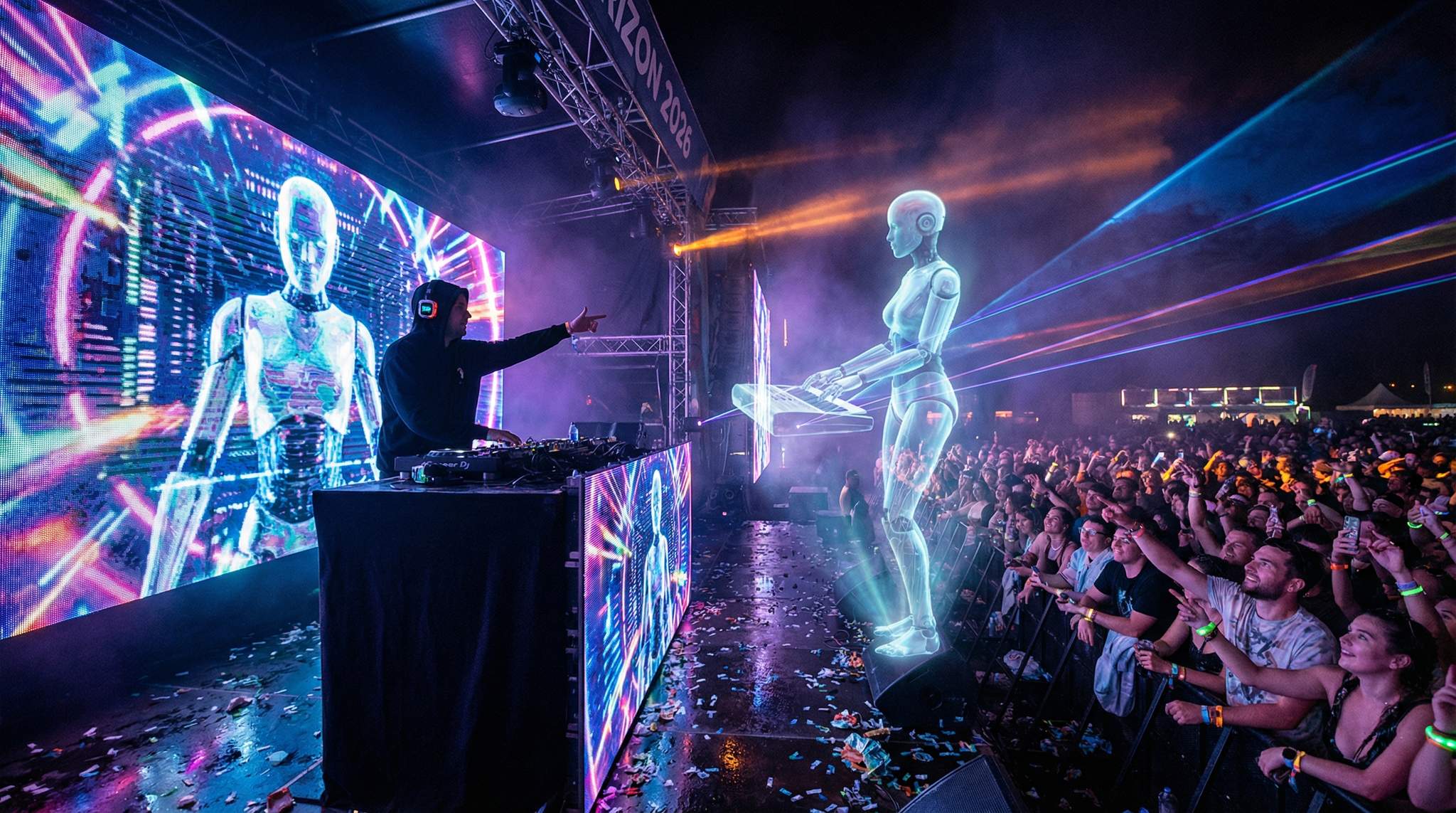
In 2026, music festival lineups are venturing into sci-fi territory. A new breed of AI-generated performers – from virtual DJs to digital pop stars – is hitting festival stages. Producers and fans alike are asking: can these algorithm-driven acts truly electrify a crowd, or are they destined to be short-lived novelties? This debate echoes other high-tech experiments in the event world. Veteran festival organizers point out that technology must enrich the fan experience to deliver real value. No amount of AI or holograms will rescue a show that lacks soul, and tech gimmicks often flop if they don’t enhance core fan needs. The challenge is to determine when an AI act is a genuine innovation versus a flashy distraction.
From Holograms to AI: A Decade of Digital Experiments
The concept of “virtual artists” isn’t entirely new. A watershed moment came back in 2012, when Coachella stunned attendees with a holographic Tupac Shakur appearing on stage. That jaw-dropping cameo sparked industry curiosity about digital performances, marking a milestone with Tupac’s resurrection at Coachella despite complex logistics and uncertain costs. In the years since, we’ve seen more trials – from hologram tours of late legends to Vocaloid pop star Hatsune Miku’s festival appearances. Fast forward to 2024, and Miku was billed at Coachella, signaling that top festivals are willing to experiment with non-human acts. However, results have been mixed. At one Miku show, fans expecting a 3D hologram instead got a flat LED video – a letdown that led to outraged fans demanding refunds after the underwhelming virtual set. Clearly, digital acts can captivate, but only if executed to audience expectations. Now in 2026, advances in artificial intelligence are enabling even more sophisticated “live” performances, raising the stakes for festival producers.
Clones, Virtual Idols, and Algorithmic DJs
Today’s cutting-edge festivals feature everything from AI-driven DJs to purely virtual pop idols. In the Netherlands, techno artist Reinier Zonneveld made headlines by performing back-to-back with an AI clone of himself. His custom AI, trained on over 2,000 hours of his music and 1,000 recorded shows, improvised techno music live onstage in real time at a festival in the Netherlands, a feat that adds a new dimension to performance according to Zonneveld. Meanwhile, pop culture is embracing digital personas like never before – virtual singers and avatar bands draw millions of fans online, and events are taking note. Even mainstream festivals have flirted with this trend: Coachella’s booking of Hatsune Miku (a completely virtual vocalist) and collaborations like holographic K-pop idols show the potential crossover appeal. Still, festival organizers are treading carefully. They’ve watched some high-tech acts wow crowds with futuristic flair, while others fell flat as gimmicks. In the sections below, we’ll dive into real examples of AI acts at festivals, the concrete pros and cons, and how to integrate these high-tech showstoppers in a way that complements live talent and preserves the festival’s authentic vibe.
Real-World Examples of AI Acts at Festivals
Pioneering AI-Driven Performances
Several forward-thinking artists and festivals have already tested AI-powered performances. One landmark example is Reinier Zonneveld’s R^2 Festival in 2024, where the techno DJ played a marathon 10-hour set back-to-back with an AI version of his “musical brain.” According to Zonneveld, the AI model (trained entirely on his own catalogue) could dynamically respond to his live input, co-creating new music on the fly at a festival in the Netherlands, which adds a unique layer to the show. This world-first human-AI duet intrigued the electronic music community – it showcased AI’s creative potential rather than replacing the artist. Zonneveld’s experiment was well-received by his techno audience, generating buzz and encouraging him to expand the concept at a larger scale in 2025.
Turn Fans Into Your Marketing Team
Ticket Fairy's built-in referral rewards system incentivizes attendees to share your event, delivering 15-25% sales boosts and 30x ROI vs paid ads.
Elsewhere, festivals have hosted showcases explicitly blending AI and music. At Italy’s Kappa FuturFestival, the Reply AI Music Contest invited algorithmic music creators to perform live at the festival, where the Reply AI Music Contest hosts presented handcrafted audio visuals. And at digital arts events like MUTEK Montréal and Sónar +D, attendees have witnessed experimental acts where machine-learning algorithms generate live soundscapes and visuals. These niche performances, often presented as art pieces, demonstrate that AI can hold its own as a performer in avant-garde contexts, even if they’re far from the mainstream pop festival stage.
Looking ahead, promoters are actively seeking fresh AI DJ examples for 2025 and 2026 to anchor experimental stages. We are seeing a surge in AI-generated music examples where algorithms don’t just mix tracks, but dynamically produce stems based on crowd reactions. Building on the success of earlier algorithmic showcases, the landscape for an AI music contest in 2026 has expanded. These competitions now often partner directly with festival brands, allowing the winning developer-artist hybrid to secure a live booking, effectively crowdsourcing the next generation of digital headliners.
Planning a Festival?
Ticket Fairy's festival ticketing platform handles multi-day passes, RFID wristbands, and complex festival operations.
Virtual Pop Stars and Holographic Idols
On the pop side, virtual idols have made inroads at major festivals – sometimes triumphantly, other times shakily. Hatsune Miku, the virtual Japanese singer with a massive global following, has appeared at festivals and concerts around the world. When properly executed as a 3D hologram projection, Miku’s shows have thrilled her devoted fans, proving that a digital avatar can headline a live music event. However, her 2024 North American tour revealed the risks of under-delivery. Fans were promised a holographic Miku, but initial shows used a standard LED screen; the backlash was swift, with petitions demanding refunds and transparency about the show’s format, as outraged fans demanded refunds and insisted they deserved full refunds. The lesson for producers is stark: if you book a virtual icon, invest in the full experience or face fan wrath.
Beyond Miku, we’ve seen other hologram headliners spark debate. The legendary ABBA tested the waters not at a festival but in their own high-tech concert residency “ABBA Voyage.” There, ultra-realistic digital avatars of the band perform hits nightly to a 3,000-capacity arena, backed by a live band. The result has been a critical and commercial triumph – the show earned over £100 million in 2024 alone, with sold-out bookings extended into 2026, proving it was never about the tech but the craft. ABBA’s success demonstrated that audiences will embrace virtual performances when the production value is sky-high and the artist’s legacy is beloved. However, that production reportedly cost over $100 million to create, a scale far beyond typical festival budgets. Other attempted hologram tours (from Whitney Houston to Roy Orbison) have met mixed receptions, suggesting that not every digital resurrection strikes the right chord; often the artist on stage alone wasn’t sustaining fan enthusiasm and producers must go beyond novelty to stay engaged.
AI Collaborations with Live Artists
Some of the most promising uses of AI on stage combine algorithms with human performers in hybrid shows. Zonneveld’s AI DJ partnership is one example, but even mainstream artists are experimenting. Electronic pioneer Jean-Michel Jarre’s 2024 “Bienvenue au Stade” concert featured an AI-driven stage director that helped generate synchronized visuals and lighting, effectively becoming part of the creative team leveraging generative AI for visuals known for their complexity. Pop star Björk has used AI software to conduct choirs and generate music during her live performances, blurring the line between programmed and organic. And in a nod to audience interaction, Massive Attack once incorporated real-time AI visuals based on crowd data, literally making the audience part of the show’s artwork, creating unique experiences when used creatively. These cases indicate that AI doesn’t have to steal the spotlight outright – it can collaborate behind the scenes or on stage to enhance a human performance. For festival producers, such collaborations might be an easier sell to skeptical fans: the presence of familiar live artists ensures authenticity, while the AI adds a novel twist.
To summarize the landscape, here’s a snapshot of notable AI/virtual acts and how audiences responded:
Data-Driven Event Marketing
Track ticket sales, demographics, marketing ROI, and social reach in real time. Exportable reports give you the insights to make smarter decisions.
| Festival (Year) | AI/Virtual Act | Reception & Outcome |
|---|---|---|
| R^2 Festival (2024, Netherlands) | Reinier Zonneveld B2B with AI clone – A techno DJ set co-created live by an AI model trained on the artist’s own music. | Positive buzz among electronic music fans. Seen as a groundbreaking creative experiment; repeated on a larger scale in 2025 with added visual elements (e.g. a holographic avatar for the AI). |
| Coachella (2024, USA) | Hatsune Miku virtual performance – The famous Vocaloid pop star “appeared” via digital projection on an LED screen (marketed as a hologram act). | Mixed reaction. Dedicated Miku fans were excited to see their idol, but many attendees were disappointed by the lack of true 3D hologram. Some demanded refunds, citing the presentation as not meeting expectations. |
| MUTEK Montréal (various, Canada) | AI audiovisual art shows – Experimental sets where AI algorithms generate music and visuals in real time as the core of the performance. | Niche but well-received. Tech-savvy and art-focused audiences appreciate the ingenuity. However, these remain niche attractions; casual festival-goers often find them abstract. |
| ABBA Voyage (concert residency) | ABBA’s digital avatars – Ultra-realistic avatars of ABBA’s members (de-aged to their 1970s prime) perform nightly with a live backing band in a custom-built arena. | Huge success (commercially and critically) in a controlled setting. Fans embrace the virtual show due to its high production quality and emotional resonance. Demonstrates that virtual acts can succeed at scale – but required a massive budget and decades-loved artists. |
These examples illustrate that audience acceptance of AI or virtual acts depends heavily on execution, context, and expectations. When the technology delivers a unique experience (and especially if paired with beloved human artists), reception leans positive. If the implementation feels cheap or gimmicky, fans can turn on it quickly. With those lessons in mind, let’s examine why a festival might consider booking an AI-driven act – and the potential advantages of doing so.
Potential Benefits of AI-Driven Acts
Novelty That Drives Buzz and Attendance
In a crowded festival marketplace, being the first or only event to offer something can be a major draw. AI acts bring a novelty factor that sparks curiosity. Media outlets love covering “the festival with a robot DJ” or a holographic guest star, which can lead to free publicity. Tech-savvy attendees may be enticed to buy a ticket just to witness a futuristic spectacle firsthand. For example, the marketing around Zonneveld’s AI collaboration portrayed it as a world-first experience – attracting not just techno fans but also industry watchers eager to see history made. One-of-a-kind experiences are increasingly key to festival differentiation, as organizers find that unique lineups deliver value, and a well-executed AI performance can give your event a distinct identity. This novelty can also appeal to sponsors; a festival showcasing cutting-edge AI might secure partnerships with tech companies interested in being associated with innovation. The caveat is that novelty alone wears off – to truly benefit, the AI act must still deliver a great show. But as an initial hook, the futuristic appeal of an AI performer can boost word-of-mouth and put a festival on the map.
Need Festival Funding?
Get the capital you need to book headliners, secure venues, and scale your festival production.
Creative Possibilities Beyond Human Limits
AI performers can do things humans simply can’t. This opens up new creative frontiers for festival shows. A virtual or AI-driven artist isn’t constrained by biology – it won’t lose its voice, get tired, or require breaks. Theoretically, an AI DJ could play a continuous 24-hour set, or multiple AI clones could appear on different stages simultaneously, giving promoters scheduling flexibility impossible with human talent. AI algorithms can also produce music in real-time that reacts to inputs no human could process so quickly. For instance, an AI could modify its set list on the fly based on live data – ramping up the tempo as crowd energy rises or even composing a new melody inspired by the weather or time of day. Some experimental festivals have toyed with these ideas: imagine music generated live from crowd noise levels or social media trends – an adaptive soundtrack tailored to the moment, keeping things fresh and responsive. Additionally, virtual performers can be visually spectacular. They might appear as shape-shifting characters or integrate with augmented reality effects for the audience. The band Hatsune Miku’s appeal, for example, partly comes from her anime persona doing impossible dance moves and costume changes in seconds. With AI generative visuals and projection mapping, you could have an avatar on stage morph into different forms or environments that would be impossible for a human act, projecting visuals onto 3D surfaces. When done right, these elements create jaw-dropping, immersive spectacles that give attendees a genuinely fresh experience. In short, AI acts offer a playground of creative innovation – the chance to deliver festival moments that people have never seen or heard before.
Furthermore, the rapid advancement of AI singing capabilities in 2026 means virtual vocalists can now synthesize realistic, emotionally resonant vocals on the fly, rather than relying on pre-recorded banks. This allows for true real-time improvisation. Visually, generative models can instantly render dynamic, party-focused AI images and reactive crowd visuals on massive LED screens, matching the exact mood and tempo of the audience. For a festival producer, this means the audiovisual production can be entirely bespoke to that specific night, creating a truly unrepeatable experience.
Practical and Financial Advantages
Beyond the flash, there are some practical benefits that make AI acts attractive in certain scenarios. Logistics and scheduling can be easier: a virtual artist doesn’t need flights, hotels, visas, or soundchecks in the traditional sense. This can simplify planning, especially for global festivals where flying in talent is costly or where artists cancel last-minute. An AI act, once developed, is always “available” and won’t get stuck at the airport or call in sick. This reliability can be a form of insurance for festival lineups. We may even see AI versions of artists used as emergency fill-ins – for example, if a headliner has to pull out days before the event, a festival might deploy an “AI DJ set” in that slot to avoid a total hole in the schedule (though the ethics of that would be debated). Cost is another consideration. Hiring top headliners has become extremely expensive – fees climbing into the millions – and smaller festivals struggle to compete. An AI act has a very different cost structure. There’s an upfront investment in development and production, but if it’s used multiple times the cost per show can become economical. For instance, after paying to create a convincing hologram performance, the marginal cost of “replaying” that act at multiple events is low compared to paying a superstar each time. According to industry discussions on lineup strategy, some promoters see digital acts as a way to future-proof their lineups amid headliner shortages, addressing pressing issues where top talent is scarce – they can create unique attractions in-house instead of chasing the same pool of aging rock and pop stars. Moreover, AI acts don’t demand catering, ground transport, or lavish riders; the savings on hospitality and logistics for a large touring crew are significant. Of course, these financial upsides only materialize if the AI act actually draws a crowd. But in certain niche festivals or branded events, a well-marketed AI performance might not only save costs but even become a new revenue stream (imagine selling virtual meet-and-greets or NFTs of an AI artist’s “autograph”). When used smartly, AI acts can be a tool to control costs and scheduling headaches, allowing producers to allocate budget and effort to other areas of the festival.
Risks and Drawbacks to Consider
Authenticity and Emotional Connection Concerns
For all their novelty, AI acts face a fundamental challenge: can they truly connect with a human audience? Live music is an emotional, communal experience – fans cherish the energy of a favorite singer’s voice or the charisma of a DJ feeding off the crowd. A digital performer, no matter how slick, inherently lacks human spontaneity and presence. There’s no frontman sweating under the lights, no improvisational banter, no possibility of that unique human moment that makes live shows magical (like when a singer unplugs and does an acoustic encore by surprise, or an artist addresses the crowd’s hometown with a heartfelt remark). Some attendees might find an AI act “cool,” yet emotionally hollow. Audience feedback on hologram concerts has often noted a sense of disconnect – the visuals can look impressive, but “it’s not really them” is a common refrain; the artist on stage alone wasn’t sustaining fan enthusiasm and the show must go beyond novelty to stay engaged. This uncanny valley can leave parts of the crowd unmoved or even uneasy. In worst cases, fans could feel alienated or insulted that they’re watching a pre-programmed creation rather than real artists. When Coachella experimented with a virtual idol, social media reactions ranged from fascination to mockery, with some viewers saying they felt like they were “watching a video game cutscene at a live music festival.” For core music lovers, there’s almost a philosophical aversion: the value of live music is that it’s human. Lady Gaga, when asked about AI, quipped that “being a human being isn’t going to go out of style anytime soon,” underscoring the irreplaceable appeal of human artistry. Festival producers must heed this – leaning too far into artificial performances can risk your event’s authenticity and vibe, especially if your audience prides itself on organic, live musicianship. The onus is on the festival to show that an AI act is enhancing the artistic experience, not cheapening it.
This industry-wide identity crisis extends beyond the festival grounds. Entertainment executives frequently debate how AI could impact the future of mainstream talent discovery platforms—such as televised competitions like America’s Got Talent—where the line between human skill and algorithmic assistance is becoming increasingly blurred. If a producer can generate a flawless pop star or a perfect piece of music (or zene, as our European co-promoters might say) entirely in a studio, the live event must offer something deeper. Festival organizers must ensure their stages remain a place for genuine connection, rather than just a playback mechanism for studio-perfected code.
Technical Glitches and Production Pitfalls
Introducing sophisticated tech on stage brings very real production risks. A traditional band might blow an amp or a singer might miss a note, but those hiccups are usually minor. In contrast, an AI-driven performance relies on complex systems that can fail spectacularly. Imagine if the servers running your AI act overheat or the software crashes mid-set – the music could stop abruptly or the on-screen avatar might freeze, leading to an awkward silence in front of thousands of expectant fans. There are also environmental factors: outdoor festivals have to contend with weather, and things like bright sunlight can diminish holographic effects or rain could threaten electronics. Even something as simple as a power fluctuation or loss of internet connectivity could derail an AI performance. We saw a small-scale example of tech not meeting expectations with the Hatsune Miku screen issue – in that case it wasn’t a malfunction but a design choice, yet it still felt like a failure to the audience. A true malfunction could be even more damaging, turning an intended showstopper into a laughingstock. Festival history is full of tales of tech going wrong – from sound systems cutting out to lighting rigs failing – and the more complex the setup, the higher the chance of a glitch. As event tech experts recount, even advanced ticketing and network systems have crashed under pressure, so a bleeding-edge AI system on stage is certainly not foolproof. Another consideration is redundancy: providing failsafes for an AI act can be complicated. If a singer loses their voice, they can often still perform or adapt; if an AI loses its GPU, it’s game over unless you have a full backup system at the ready. Putting together these backup systems and extra rehearsals drives up production complexity and cost. All told, the technical burden of an AI act is significantly higher than a conventional performance. It requires top-notch engineering support, extensive testing, and contingency plans (more on those later). Without those, a festival risks a very public flop. Murphy’s Law is merciless – if the robot is going to embarrass you, it’ll likely do so at the worst possible moment unless you’ve prepared for every scenario.
Fan Backlash and Brand Risks
Festivals thrive on their reputation and community goodwill. There’s a potential PR downside if an AI act is perceived the wrong way by your audience or the music industry at large. One risk is the “gimmick” label – if attendees feel a performance was just a marketing stunt with no substance, they could be vocal about it online. Modern festival-goers are quick to share their unfiltered opinions on forums and social media. A stunt that doesn’t land might lead to sarcastic memes or negative press coverage. For instance, after the underwhelming Miku screen show, the internet buzzed with articles and posts criticizing the organizers for “catching Miku in a TV screen” and not delivering the true hologram experience, leaving fans feeling disappointed and angry and reviewing the Coachella Hatsune Miku hologram performance. That’s not the kind of post-festival press any organizer wants.
There’s also a broader cultural debate about AI in music – and festivals could get caught in the crossfire. Many artists and fans worry that AI-generated music might undercut human creativity or even take jobs from musicians. If your festival is seen as endorsing replacing artists with machines, you might alienate parts of your community. Consider the optics: a festival that once prided itself on supporting local bands, now giving a prime slot to a computer program. Some might find it exciting, but others could see it as a betrayal of artistic values or a cynical cost-cutting move. Musicians’ unions and industry groups are already pushing back on AI “impersonators.” In early 2026, for example, music platform Bandcamp implemented a ban on AI tracks that replicate artists’ styles or voices without permission, stating that any use of AI tools to impersonate is prohibited – an indication of how contentious this issue is becoming in the music world. If word gets out that a festival plans to use, say, an AI clone to mimic a famous singer’s voice, it could trigger ethical outrage or even legal threats from artists’ camps. In one notable case, the label of singer Jorja Smith moved to claim royalties and objected when an AI-generated track imitated her vocal style without consent, noting it is bigger than one artist or one song. A festival certainly wouldn’t want to be on the receiving end of that kind of letter.
Finally, there’s the community aspect. Festivals, especially long-running ones, build a loyal following who often feel a sense of ownership and emotional attachment to the event’s identity. A sudden pivot into AI acts might clash with your brand if not aligned with your theme. For example, a roots folk festival that tried to plop a digital avatar into a lineup of acoustic singer-songwriters would likely face confusion or resistance. On the other hand, an EDM festival or an art-and-technology fest could fold in an AI act more naturally. The key is to weigh how an AI performance aligns with the promise your festival makes to attendees. If fans perceive it as out of touch with what they love about the event, it could dampen loyalty. In summary, the decision to feature an AI act shouldn’t be taken lightly – it has to be managed with careful PR framing and audience sensitivity to avoid backfiring.
Technical and Production Requirements
Stage Infrastructure and Visuals
Implementing an AI or virtual performer on a festival stage demands a higher level of production infrastructure than a typical act. At a minimum, you’ll likely need high-resolution LED screens or a specialized projection system to visualize the performer. If it’s a virtual singer or avatar DJ, the “face” of the act is essentially digital content that must be vividly delivered to a large audience. Many festivals opt for massive LED walls due to their brightness and reliability – for instance, the hologram effects at Coachella (like the famous Tupac apparition) were achieved by projecting onto a nearly invisible screen on stage, similar to the Tupac hologram at Coachella with powerful projectors. For a truly 3D-looking hologram, a Pepper’s Ghost rig or 3D volumetric display might be used, which can involve reflective glass panels and carefully angled projectors. These setups require precise stage measurements, controlled lighting conditions, and often a lot of calibration. Daylight can wash out a projection, so such acts may need to be scheduled after dark or under a tent. In some cases, festivals might erect custom structures or domes to house an immersive AI-driven show, especially if AR or 360° visuals are part of it.
The content itself is another consideration – you’ll need to create or acquire the digital visuals (the avatar, background animations, etc.) well in advance. For example, ABBA’s team worked with visual effects artists (from Industrial Light & Magic) for months to develop their avatars’ realistic look and movements. Festivals may not have that luxury, but at the very least, you’ll want skilled motion graphic designers or game developers to craft the on-screen persona and any interactive graphics. Projection mapping might come into play if you plan to project AI-generated visuals onto stage sets or decor, in which case you’d need 3D models of the surfaces and content tailored to them so lights still dance aptly with the music. It’s a lot, but the payoff is a wow-factor spectacle. As one guide on immersive event visuals notes, leveraging advanced LED walls and projection mapping techniques is key to making digital performances compelling, specifically mastering LED walls and projection mapping. All these visual elements also mean additional equipment on site – from media servers to drive the content, to backup screens (in case one panel goes dead), to extra lighting to complement the screen content. Logistically, budget extra load-in time for setting up these systems and soundcheck (or rather “screencheck”) time to test that the visuals are aligning correctly and visible from all audience angles. In short, treat an AI act almost like a hybrid of a live show and a multimedia installation – you’re effectively building a temporary digital theater on your stage, and that requires robust planning in staging, power, and visuals.
Computing Power and Software
At the heart of any AI-driven act is the software – the algorithms generating or performing the music and visuals. Unlike a standard performance where the artists bring their instruments, here your festival is responsible for bringing the “brain” of the act. That means you’ll need to secure high-performance computing resources on-site. Many AI models, especially those for generating music or graphics in real time, require powerful GPUs (graphics processing units) or specialized hardware (like AI accelerators). You might be running a custom program, for example, that takes the live audio input from a human musician and feeds it into an AI model which spits out accompanying beats or visuals. To avoid latency (lags), this is usually done on local machines rather than relying on cloud computing. Practically, festival producers should allocate a dedicated computer rig for the AI act, ideally with redundant machines. If one fails, the other can take over. These would run the AI models and any supporting software (digital audio workstation sessions, VJ software for visuals, etc.).
It’s crucial to collaborate with whoever is providing the AI system – be it the artist (in Zonneveld’s case, he developed it himself with a team) or a tech company – to understand the requirements. Ask about processing needs, data inputs, and any external dependencies. Some AI acts might require an internet connection, for instance if they draw data from an API or use cloud-based services. Aim to minimize online dependence, since festival internet can be unreliable. If connectivity is needed, consider investing in a dedicated bonded internet line or satellite link for that stage, or better yet, have the data pre-fetched and run everything locally. Also, ensure clean power supply and backup power (UPS) for these computing rigs – the last thing you want is a generator hiccup rebooting your AI brain mid-song. Cooling is another often overlooked factor; powerful computers can overheat, especially if your stage is outdoors on a hot day, so keep them sheltered from heat and give them ventilation or AC as needed.
Software testing and rehearsal are non-negotiable. Unlike a human artist who can adapt on the fly, an AI system will do exactly what it is programmed (or trained) to do – which could include unexpected behavior in a live environment. Schedule time to run the AI through a full performance cycle on site (or in a similar environment) to catch any glitches. For example, if an AI DJ is supposed to transition between tracks autonomously, simulate the exact show conditions (same audio system, same input feeds, etc.) and see if levels and transitions are smooth or if anything odd happens. Often, you’ll discover needs like “we must manually trigger this section” or “the AI needs a 2-second buffer here,” which you can address with a human operator standing by. Having a skilled technician or the AI’s developer present during the show is highly recommended, essentially as a “virtual instrument tech.” They can monitor the system’s status (CPU/GPU load, memory usage) in real time and intervene if something goes awry, much like an engineer would fix a guitar amp that suddenly started smoking on stage. In summary, the technical backbone of an AI act is as important as the talent – invest in the right hardware, fail-safes, and expertise to run it, or the whole performance could grind to a halt.
Specialized Crew and Rehearsals
Producing an AI-driven show isn’t a plug-and-play routine – it demands a team with niche expertise and plenty of rehearsal to get it right. First, consider your crew composition. In addition to the usual festival stagehands, audio engineers, and lighting operators, you’ll need specialists: software engineers or AI technicians who understand the model being used, content designers (for visuals or any interactive components), and potentially a show programmer who acts as a “conductor” for the AI elements. If you’re working with a company providing an AI act (for example, a hologram production company), they will likely supply some technical staff – incorporate them into your crew planning and make sure they have access to all necessary systems (and comms). Language barriers or different working styles can be an issue if you’re bringing in a tech team that doesn’t normally do festivals, so assign a production liaison to keep everyone coordinated. Moreover, your security team should be looped in if the AI act involves any unusual equipment or high-value gear (like powerful computers) on site; that gear might need overnight protection or special placement.
Soundcheck and rehearsal for an AI act can be more complex than for a normal band. It’s not just “line check the mics and go.” You’ll want to do a full run-through of the performance in the venue if possible. This means scheduling enough stage time without audience to simulate the show. During this, check every element: Does the AI’s audio output interface correctly with the festival PA? Are levels consistent? If the AI responds to a human musician (say, an AI drummer accompanying a live guitarist), practice that interplay so both sides sync up. Verify that any visual cues or graphics align with the right moments in the music. If crowd interaction is part of the act (e.g. the AI changes music based on crowd noise or prompts the crowd to do something), you might even bring in a small test audience (or have crew stand in) to see how it plays out. Importantly, run failure scenarios during rehearsal: intentionally cut the internet, or drop the audio feed, or simulate a computer freeze, to see how quickly the team can recover and what backup kicks in. This kind of “pre-mortem” drill is common in critical live events (broadcasts, etc.) but should be a staple for AI performances too.
Another tip is to have a parallel backup performance ready, even if it’s plan C. For instance, have a pre-recorded DJ mix or concert video that can be played on the screens and over the PA if the AI show has to be aborted. It won’t be ideal, but it’s better than dead air. The crew should know exactly who calls that shot and how to execute the switch if needed. Communication is key: ensure the AI tech team is on the same radio channel as the stage manager and audio lead, so if something starts to go wrong, they can all react in sync. The more everyone practices together, the more these responses become second nature. Producers who have integrated new tech into festivals often talk about the value of cross-training your team to handle new tech, whether it’s understanding how robots at 2026 festivals offer real-world benefits or leveraging drones to survey perimeters for safety – lighting people understanding some of the video system, etc., so that there aren’t single points of failure in personnel. While that might be overkill for one act, having at least two people who know how the AI system works (the primary operator and a backup) is wise. Ultimately, an AI act should be treated with the same seriousness as bringing an entirely new stage to your festival – it’s a project within a project, and skimping on the human element (skilled crew and ample rehearsal) is a recipe for trouble. As long as you staff up properly and give the team time to iron out kinks, you’ll greatly increase the odds of a smooth show that wows the crowd.
To recap some key production factors, here’s a comparison of traditional live acts versus AI-driven acts from a planning perspective:
| Factor | Live Human Performance | AI-Driven Performance |
|---|---|---|
| Booking & Availability | Schedule depends on artist availability; can face cancellations due to illness, travel issues, etc. | AI is available on-demand once developed; no travel or physical constraints, so scheduling is very flexible (barring technical downtime). |
| Cost Structure | Talent fee (often high for big names), plus travel, accommodation, hospitality, and crew costs for the artist. | Upfront development cost for AI model/software and content creation; equipment rental/purchase (LED screens, servers). Lower ongoing travel and hospitality costs, especially if reused across events. |
| Stage Presence & Interaction | Charismatic human presence, spontaneous crowd interaction, emotional performance that can adapt in real-time to crowd feedback. | Lacks genuine human presence; any interaction is pre-programmed or algorithmic. Can simulate responses (e.g. visual animations reacting to cheers) but may feel less emotionally resonant. |
| Consistency vs. Variability | Performance quality can vary by night; live spontaneity can create unique memorable moments (or mistakes). | Highly consistent execution (the AI will perform as programmed); can introduce algorithmic variety but less true spontaneity. No risk of “off nights,” but also little chance of magical unplanned moments. |
| Technical Complexity | Requires standard concert tech (sound system, lighting). Fewer points of failure – mainly audio gear and instruments. | Requires complex integration of computing, software, and audiovisual systems. Multiple potential failure points (software bugs, hardware glitches, display issues) requiring advanced technical support and backups. |
| Fan Perception | Seen as authentic; fans value seeing the real artist. Any mistakes or variations often endear the artist to the audience. | Some fans view as novelty or even “fake.” Must overcome skepticism. Needs high production quality to impress; any technical hiccup might be judged more harshly as it can break the illusion. |
As the table suggests, AI acts shift a lot of burden to the production side – essentially trading some challenges of human performers (scheduling, variable performance) for challenges in technology and planning. Next, we’ll delve into the equally critical arena of legality and ethics, as deploying an AI act isn’t just a technical feat but a legal tightrope walk in 2026.
Licensing, Legal, and Ethical Considerations
Intellectual Property and Copyright
One of the thorniest issues with AI-generated music or performances is intellectual property rights. Festivals must ensure that an AI act isn’t inadvertently infringing on someone’s copyright. How could that happen? Imagine an AI DJ trained on thousands of tracks – if it “creates” a new song that in reality lifts a melody from a famous track, you might have a problem. Copyright law globally is still catching up to AI, but the safe assumption is that if recognizable pieces of others’ work are used, you need clearance. This applies whether the AI is sampling audio, generating lyrics, or visual avatars. For instance, if an AI act “sings” an existing song, the festival needs to have performance rights for that composition just as if a cover band were playing it. That part is straightforward (setlist reporting to PROs, etc.). The trickier area is AI-composed music: who is the author, and do they have rights? As of 2026, many jurisdictions (like the US and EU) are grappling with whether AI-generated works can be copyrighted and by whom. For now, as a festival organizer, it’s prudent to get written assurances from whoever provides the AI content that it either is original or properly licensed. If a tech company is supplying an algorithm that produces music, have them warrant in the contract that the output won’t knowingly infringe copyrights – and possibly indemnify the festival if it does. There have already been high-profile incidents, like an AI-created track that mimicked Drake and The Weeknd went viral, only to be pulled down amidst legal questions of impersonation and unauthorized use of likeness. You don’t want your event entangled in a similar controversy where a label claims your AI performance was effectively an unlicensed derivative of their artist’s work.
Visual IP is also a factor. If your AI act uses a visual avatar, ensure that the design is original or licensed. Don’t grab a random anime character or Marvel superhero likeness for your hologram without proper rights, obviously. Even using a deceased artist’s image or voice for an AI performance triggers rights of publicity and likeness laws – typically you’d need permission from the artist’s estate (and possibly pay a licensing fee) to lawfully resurrect them on stage. Tupac’s hologram at Coachella, for example, was done in collaboration with his estate and with licensed footage. If a festival tried to do a surprise “AI Michael Jackson” without the estate’s approval, the legal blowback would be swift and severe. In general, any time an AI act is imitating or recreating a specific artist, living or dead, you must get consent. This goes beyond legal technicalities; it veers into ethical respect. Many artists have made clear they consider unauthorized AI copies as theft of their voice or style. Just recently, a UK label demanded royalties and a halt to an AI track that used a vocalist’s simulated voice, framing it as an infringement of the artist’s rights, noting it is bigger than one artist or one song.
Finally, consider the music industry contracts and royalties. If the AI act uses any pre-recorded elements (samples, stems, etc.), those need to be cleared just like any other performance. Performance royalties for AI-generated songs might still be collected by PROs (performing rights organizations) if any portion is registered under a writer/composer. It’s a murky area, but as a festival, you should stick to existing protocols: submit setlists if required, pay mechanicals if you distribute any recordings later, etc. It might be tempting to think “it’s AI, so it’s royalty-free” – that’s not a safe assumption. The conservative approach is to treat AI outputs as you would a band’s set: ensure all underlying rights are sorted. Engaging an IP lawyer who’s versed in emerging AI issues is wise when contracting an AI act. They can help draft the right clauses to protect you, addressing who owns the output of the AI performance (for example, if it generates a new song live, can the festival record and use it? Or does the AI company/artist retain ownership?). Sorting these questions in contracts with performers or tech providers up front will save headaches down the line. In summary, don’t let the futuristic coolness of an AI act blind you to plain old music law – the same traps (sampling, covers, likeness) still exist, just in new forms.
Performer Rights and Consent
One ethical cornerstone when dealing with AI performers is respecting artists’ rights and intent. If your AI act in any way involves cloning or emulating a real artist’s performance, voice, or image, you must have their consent. The simplest scenario is something like Reinier Zonneveld’s – he cloned himself. The only consent needed was his own, and he was fully on board. In contrast, consider a hypothetical where a festival wants an “AI Tribute” to a famous band. Even if done out of admiration, using an AI to replicate their likeness or sound without permission crosses ethical lines and likely legal ones. Some artists have explicitly stated they do not want holograms or AI representations after their death. Others have embraced it. For example, the members of ABBA actively participated in creating their avatars, and their show succeeded largely because it had the band’s blessing and involvement. On the flip side, when hologram tours of Whitney Houston and Amy Winehouse were announced, there was public criticism and discomfort, including from some family members and fans who felt it was exploitative. The takeaway for a festival producer: if the artist isn’t involved, proceed with extreme caution or not at all. An AI act should ideally be done with the artist, not merely of the artist (unless they’re public domain, like a classical composer – but that’s a niche case).
Another consideration is how you market and disclose the AI act. Transparency is key to consent in a broader sense – the audience’s consent. Fans should know what they are signing up for when buying a ticket. In the Miku Expo case, part of the fan anger was that the switch from hologram to screen wasn’t clearly communicated ahead of time, leading to outraged fans demanding refunds and insisting they deserved full refunds. Similarly, a festival should never trick attendees into thinking an AI performer is human. If you had, say, an AI pop star opening the night, make sure it’s advertised as such. Trying to pass off an AI as a real live act will backfire when people inevitably realize it’s pre-programmed. Honesty in billing – e.g. calling it “Virtual Set by X (AI Performance)” – sets correct expectations. Attendees can then make an informed decision to experience it or not, and you’re less likely to face the backlash that comes from feeling deceived. Moreover, clearly credit any human creators behind the AI where appropriate (for instance, “music generated by AI system developed by ___ using compositions by ___”). This not only gives credit, but it also underscores that you’re not dismissing the importance of human talent even in an AI context.
From an ethical standpoint, also consider cultural and community impact. If your festival has a mission tied to supporting local artists or underrepresented voices, how does an AI act fit into that mission? There’s a valid fear among some communities that AI acts could take slots away from emerging human artists who need the exposure and income. While one AI performance at a festival isn’t going to upend the industry, it’s a narrative to be mindful of. You might mitigate this by, say, using AI in a collaborative way (as mentioned, pairing it with a human performer) or by framing it as an art/tech experiment rather than a replacement for a headliner. The messaging around why you chose to include an AI act should be carefully crafted. Did you do it to push creative boundaries? To comment on the relationship between tech and art? Or to offer something novel to the audience? Make that intention clear so it doesn’t appear as if the motivation was “we didn’t want to pay a real DJ.” In fact, if budget was a factor, perhaps best not to highlight that, as it could be interpreted cynically.
One more legal point here: ensure any contracts with AI act providers cover image/likeness rights. For example, if a company is providing a pre-made “virtual DJ” character for your event, do they have full rights to that character’s appearance and name? You don’t want a last-minute surprise that the avatar they planned to use looks too similar to a real celebrity or is based on someone’s art without permission. Insist on documentation that all elements are properly licensed. Basically, treat an AI artist like you would any artist booking when it comes to paperwork – have a performance agreement that spells out what the show consists of, what promotional use you can make of their name/likeness, and warranties that everything is above board rights-wise. By crossing your t’s and dotting i’s, you protect your event and demonstrate respect for creative rights in this new frontier.
Ethical and Cultural Impact
Introducing AI acts isn’t just a logistical or legal question – it’s also an ethical one that can have cultural ripple effects. Festivals often have a role in shaping music culture and championing values (community, creativity, inclusivity, etc.). Thus, it’s worth reflecting on what message an AI performance sends. One ethical concern is authenticity: festival-goers seek genuine experiences, and some might view AI music as inherently inauthentic. If an event becomes known for heavily featuring “fake” acts, could it undermine the festival’s credibility in the long run? This doesn’t mean you should avoid innovation, but an ethical approach is to position the AI act as augmenting authenticity, not undermining it. For example, you might highlight how the AI was trained by a real artist (giving it a human origin) or how it’s an artistic exploration in its own right.
Another consideration: the human talent ecosystem. Festivals are a major source of income for many artists and crew. If AI acts took off to the point where they displace human artists on lineups, that could have a detrimental effect on the music community. While one could argue that’s a distant hypothetical, even a perception of it can cause backlash. The ethical stance many industry leaders take is that technology should assist artists, not replace them. In fact, the platform Bandcamp explicitly stated that AI should not impersonate or replace artists, implementing policies like “any use of AI tools to impersonate other artists or styles is strictly prohibited” (www.techradar.com) to keep their ecosystem human-centered. A festival should similarly consider a kind of unofficial policy: we use AI to enhance the creative output, not to cut out the human element. Perhaps an AI act gets a special slot that doesn’t bump any human artist, or it’s incorporated in a collaborative way. Ethically, this shows respect for the craft and the livelihood of musicians.
There’s also audience inclusivity. How do different demographic groups feel about AI performers? Younger audiences, having grown up with virtual influencers and hologram concerts in video games (like Fortnite’s virtual shows), might be more open to it. Older or more traditional fans might feel alienated. It could be ethically positive to use an AI act as an educational or exploratory element – for instance, hosting a Q&A or behind-the-scenes workshop at the festival about how the AI act was created, thus demystifying it and engaging the community in discussion. By doing so, you’re not just throwing something novel at the crowd; you’re inviting them to learn and voice their thoughts. This kind of engagement can flip an AI performance from a potentially divisive gimmick into a platform for conversation about art and technology.
Cultural sensitivity is yet another angle. AI systems, as we know, can inadvertently carry biases based on their training data. If an AI music generator was trained predominantly on Western music, and you deploy it in a multicultural festival, might it be perceived as not representing certain genres or cultures well? If your festival celebrates diverse music traditions, an AI act might need deliberate tuning or framing to align with that ethos. Ensuring that the AI’s output or avatar isn’t accidentally offensive or stereotypical is important – for example, an AI rapper avatar that appropriates imagery could be seen as tone-deaf. Having human oversight on the content the AI will produce is part of ethical quality control.
Finally, consider the long-term cultural impact: Festivals often set trends. If your festival becomes known as the one that broke ground for AI acts, is that a legacy you want? It could be seen as visionary (if AI integration in art is ultimately positive), or it could be seen as the moment “corporate robots invaded music” if things turn sour. This again circles back to your core values. If innovation is part of your brand, and you do it thoughtfully, you’re likely to be praised for expanding artistic horizons. If profit or spectacle at the cost of artistry seems to be the driver, you may face criticism. In sum, the ethics come down to intention and implementation. Use AI in ways that respect artists (living or deceased), be transparent with your audience, and add cultural value – and you’ll likely navigate the ethical minefield successfully.
Strategies to Introduce AI Acts Successfully
Align with Your Audience and Brand
The first rule of integrating any unconventional element into a festival is know your audience. An AI-driven act should be a good fit for your event’s identity and attendees’ expectations. Start by assessing the theme and demographics of your festival. Is your crowd largely electronic music fans, accustomed to high-tech stage production and experimental sounds? If so, they might be excited or at least open-minded about an AI DJ or a holographic vocalist. In contrast, if you run a folk music festival that markets itself on grassroots authenticity, dropping a digital pop star into the lineup could jar and confuse your loyal patrons. It’s not that one audience is “better” than another; it’s about meeting them where their interests lie. Many successful examples of AI or virtual performances have been in contexts like anime conventions, electronic festivals, or tech-forward events – essentially, places where the culture already embraces virtual characters or digital art. If your festival isn’t inherently tech-themed, you can still make it work, but you need to frame it in a way that resonates with your audience’s values. For instance, a rock festival might introduce an AI act as a visual spectacular during intermission rather than as a band replacement, emphasizing it as entertainment between human sets. Or a multicultural festival could present an AI segment as an homage to a late legend (with full respect and permission) to celebrate their legacy in a new form. Tie the use of AI into your festival’s story: why are you doing this? Perhaps it’s to push creative boundaries or to offer something unique that complements the live acts. If you can clearly articulate (to yourself and then to attendees) how the AI performance adds to the festival rather than detracts, you’re on the right track.
Next, consider doing some audience temperature checks in advance. If you have a mailing list or social media following, you could float the idea subtly: “Hypothetical question – would you guys be interested if we had a hologram or AI-powered artist at the fest?” Gauge the reactions. This can inform how you shape the presentation. It can also help you identify potential misconceptions to address. For example, if fans respond “ugh, we don’t want to watch a pre-recorded video,” that tells you your messaging needs to stress the live and interactive aspects of the AI act to differentiate it from just a video playback. In marketing materials, use language that sets the right expectations: words like “virtual live performance” or “AI-driven, real-time music creation” signal that this isn’t just a screensaver playing on stage. Some festivals create FAQ blog posts or videos to explain new features – that could be wise here. Explain to ticket-holders what the AI act is, how it works (in layman’s terms), and why you chose to include it. When fans understand the intent and the tech behind it, they’re more likely to appreciate it rather than view it with suspicion.
Also, integrate the AI act into your festival branding if possible. If innovation is a pillar of your brand, highlight the AI act as a marquee innovation. If community or tribute is a pillar, and say your AI act is resurrecting a hometown hero artist who passed away, frame it as a community tribute enabled by technology. By aligning the narrative of the AI performance with your festival’s brand narrative, it will feel like a cohesive part of the event rather than an out-of-place stunt. This extends to scheduling and staging: place the AI act in a slot where it will be best received. Maybe that’s after dark on the stage with the best screens, or as a surprise guest during a DJ’s set (with their agreement, of course). Think about the flow of energy. For instance, Tomorrowland (a massive EDM festival) often has dramatic intros and interludes with recorded voices or characters on screen; an AI act could seamlessly fit into that style of presentation. But at a singer-songwriter festival, you might instead have the AI accompany a real band to add subtle texture rather than taking center stage solo. In essence, context is everything. The more naturally you weave the AI act into the fabric of your festival’s style and schedule, the more fans will accept and even champion it.
Emphasize Human Collaboration and Curation
One of the smartest ways to introduce high-tech acts without alienating people is to pair the AI with human talent rather than showcasing it in isolation. Collaboration can be the bridge that maintains authenticity. For example, instead of having an AI DJ play a standalone hour, you could present a special set where a popular human DJ or live band “performs with” the AI. This is exactly what Reinier Zonneveld did – he remained on stage guiding the journey alongside the algorithm. The presence of a human artist provides a familiar focal point for the audience and implicitly tells them, “This isn’t here to replace performers, it’s here to augment the performance.” There are countless creative possibilities: an AI algorithm could generate beats while a live percussionist jams over them, or a virtual avatar could “sing” a duet with a real singer on stage. We’re even seeing early experiments where touring musicians use AI to jam interactively in concert – essentially treating the AI like another band member. If you go this route, ensure both the AI and the human are well-rehearsed together (as mentioned earlier) so the result is complementary. Done right, the fusion of human and machine on stage can be a major highlight, underlining that your festival values innovation and respects the irreplaceable artistry of live performers.
Another tactic is to use the AI act as part of a curated experience rather than a standalone headliner. For instance, you might have a late-night stage or an art installation zone where technology-driven art is displayed. Placing the AI performance there contextualizes it as one creative piece among others rather than pushing it onto everyone on the main stage. Some festivals have started doing VR or AR experiences on-site in this manner – an AI show can be similarly positioned as an “extra” for those interested. If some attendees choose to skip it, that’s fine; those who are curious will seek it out. This way, it doesn’t feel forced on anyone. Moreover, you can curate the lead-up and follow-up around the AI act to help frame it. Perhaps you have a speaker or MC briefly introduce what the audience is about to see (“We’ve worked with X tech collective to create something truly unique for you tonight…”) to give it a personal touch. Or immediately after the AI set, you could have a panel or Q&A (if the festival has a conference or workshop component) with the creators and maybe some artists, discussing how it went and taking questions. This shows that you, the organizers, treat the AI as an artistic endeavor, not just a gimmick to fire and forget. Engaging the community in dialogue can prevent alienation and instead foster a sense of being part of an experiment together.
Maintaining authenticity is also about curation of content. Ensure the material the AI act delivers is suitable and high-quality. This often means having human curators or editors involved in the AI’s output. For example, if an AI is going to generate visuals live, you might feed it a library of approved imagery or styles that fit the festival’s aesthetic (and have been vetted for any sensitive or inappropriate content). If an AI is generating lyrics or speech (say an emcee AI that talks between songs), have a script or heavy filter – you wouldn’t want it ad-libbing something off-key or offensive. Human oversight doesn’t make the AI any less impressive; in fact, knowing that skilled artists/trainers curated the AI’s “training” or parameters can lend credibility. It’s similar to a DJ curating a setlist even if they’re using automated mixing.
Also, feel free to highlight the humans behind the AI. If a well-known music producer or visual artist helped program the AI, let the audience know. “This AI act was developed in collaboration with famed producer so-and-so” immediately frames it as a creative work born from a human mind, not just an oddity spit out by a computer. The 2026 mindset is not man vs. machine, but man with machine. Emphasize that ethos. In promotional materials or on-stage intros, describe the AI performance as something “hand-crafted with algorithms by [Team/Artist Name].” The more you underscore the human creative input at every stage – from the concept, to the training, to the live guidance – the more you maintain respect for artistry. As industry veterans often say, the goal is a “high-tech, human-touch” experience where trends are truly adding value. That phrase can practically be a mantra in your planning: use the tech to wow the senses, but use humans to touch the heart. If you achieve that balance, you’ll not only avoid alienating attendees, you’ll likely leave them inspired and talking about how your festival found the sweet spot between innovation and authenticity.
Set Expectations and Educate the Audience
When introducing an AI-driven act, clear communication with your audience is paramount. Surprises can be fun at festivals, but finding out that a performer is actually a digital avatar might be the wrong kind of surprise if not managed well. To avoid confusion or disappointment, build understanding and excitement before and during the event. Start with marketing: how you bill the act in the lineup matters. For example, if your lineup poster lists “DJ X [AI Set]” or gives the virtual artist a distinctive name with a hint (e.g. “EchoPulse (Virtual AI Artist)”), attendees will at least know it’s not a traditional set. In your website and app schedule descriptions, include a brief blurb explaining the act. You might say something like, “Experience a first-of-its-kind AI-driven DJ performance co-created live with cutting-edge algorithms,” highlighting that it’s an innovative performance. The tone should be inviting and explanatory – avoid overly technical jargon, but do convey that this is something novel. Remember, curiosity can draw people in, but only if they have a clue what it is. If they just see a name they don’t recognize, they might skip it entirely or, conversely, expect a regular artist and then feel confused when an avatar appears.
Leverage your media channels to educate in advance. A behind-the-scenes article or short video can work wonders. Perhaps do an interview with the creators of the AI act, or a preview showing how the hologram is made. Social media teasers like “Meet the AI DJ that will be making its debut at our festival – here’s how it works!” can both drum up excitement and set proper expectations. By demystifying the tech, you remove the possibility of misunderstanding. People won’t be saying “was that even live?” because you’ve already answered how it’s live (e.g., “it’s an AI improvising in real time under the guidance of its engineering team on stage”). In essence, invite your audience to be part of the experiment rather than just subjecting them to it. When fans feel included in the narrative (“we’re all witnessing this new thing together”), they’re more likely to respond positively.
At the festival itself, consider context cues. For instance, if the AI act is on a side stage, some signage or an emcee introduction can frame it. “Ladies and gentlemen, what you’re about to see is a performance by a cutting-edge AI artist. This AI has been trained on thousands of techno tracks and will create music live, reacting to your energy – so make some noise and be part of this experiment!” A little intro like that can both hype the crowd and educate them on how to appreciate the performance. Also, train your festival staff and volunteers about the AI act basics. You’d be surprised how many attendees ask crew or info booth staff questions like “Who is that? Is this recorded?” If your team is equipped with a one-sentence answer (“It’s an AI – a computer – making the music live, pretty cool right?”), it ensures a consistent message and perhaps even turns confusion into enthusiasm through word-of-mouth on the grounds.
One clever approach some events use with new tech is interactive tutorials. For example, if you have a festival app, you could integrate an AR feature or chatbot where attendees can ask “What’s the deal with the AI act?” and get a friendly, in-universe answer. Or host a short workshop earlier in the day with the AI act’s creators for those super interested. While only a subset will attend, they can become ambassadors in the crowd, explaining to their friends what’s happening during the show. Furthermore, manage expectations about quality: if this is an experimental debut of a technology, you might subtly convey that. Language like “prototype” or “for the first time ever” signals that it’s bleeding edge (and thus audiences may forgive minor hiccups). Of course, still strive for a polished show, but if folks know it’s a trial run, they become more forgiving and invested in witnessing it evolve. Finally, be ready to accept feedback. After the performance, monitor social channels and perhaps even solicit opinions via a post-event survey. This not only shows you care about audience input (building trust), but it will give you insights if you plan to do something similar in the future. By educating and setting expectations at every step, you turn the AI act from a potential risk into an exciting shared adventure with your attendees.
Have Fail-Safes and Recovery Plans
Even with top-notch preparation, you must plan for the worst when dealing with complex tech on stage. Contingency planning is your safety net to ensure an AI act doesn’t create a festival catastrophe if things go sideways. Earlier we discussed testing for failure scenarios; here we’ll outline the concrete backup measures to have in place. First, always have a technical backup for the performance itself. If it’s an AI music act, have a pre-recorded audio mix or DJ set cued up on a separate system (like a USB stick for the CDJs or an MP3 on a spare laptop) that can be faded in if the AI crashes. Yes, it’s not ideal to switch from a “live” AI to a recording, but it’s better than dead silence or chaos. If the visuals freeze, be ready to cut to a default cool graphic or light show. You might even brief your VJ or lighting operator: “if the main content dies, take manual control and do something stylish.” It won’t match what was planned, but any seamless action is better than a giant Windows error screen or a blank stage. The audience might not even realize something went wrong if the transition is smooth and something else of interest continues.
Next, have human backup on standby. If possible, schedule an understudy act or roaming performer who can fill time if needed. For example, a festival could have a house DJ or an MC who’s ready to jump in for 10 minutes to keep the crowd engaged (“How about we give it up for our AI friend while we sort a technical issue – in the meantime, DJ __ is gonna throw down some tracks!”). Having a known contingency host can defuse tension; audiences appreciate knowing the organizers are on it. Also, empower your stage manager to make quick calls. They should have a direct line (radio or in-ear) to the tech team monitoring the AI. If something’s looking bad, stage manager can cue the backup music or cut to the host without waiting too long. Timing is critical – a minute of downtime feels like an eternity live. Better to fill that minute with something than leave people staring at an awkward silence.
Ensure redundancy in the core equipment: double up on critical gear like playback machines, projectors, or power supplies for the AI rig. If one fails, the crew can swap to the backup with minimal interruption. If the AI requires internet and you’ve determined you must use it, have a secondary connection (maybe a 5G hotspot as a fallback to the primary wired line). We can take cues from broadcast events and touring shows that employ “hot spares” – running backup systems in parallel that can be switched over near-instantly. While a festival might not have the budget for full parallel systems, identify the highest-risk points and back those up. For instance, if the AI’s computer is one-of-a-kind, maybe have a second computer with a simplified prerecorded version of the set loaded. If the live generation fails, you switch to playing the pre-made version – the crowd still hears music and sees visuals, even if it’s not dynamically generated anymore. Many likely wouldn’t even know the difference at that point.
Also, have a communication plan to the audience if a failure happens. Honesty (to a degree) can earn goodwill. If the AI act stops due to a glitch and it’s going to take more than a few seconds to fix, someone (a host or even a TTS voice from the system if it’s working) can say, “Looks like our AI needs a quick reboot – hang tight!” accompanied by upbeat filler music or a funny graphic. People are very understanding when kept in the loop. What riles them up is being left in confusion, which breeds frustration. If ultimately the AI act can’t continue, decide how you’ll handle that. Do you have an alternate shorter set you can plug in? Will you reschedule it later in the festival if possible? These scenarios should be discussed in advance with festival management, so that in the heat of the moment you’re executing a pre-thought-out strategy rather than frantically debating options.
One more aspect of recovery is post-mortem analysis – though it comes after the show, it’s worth planning for. If an AI act hits a snag, make sure to log and document what happened (have the tech team preserve error logs, etc.). This helps not only for your own learning but also if you need to explain to stakeholders or the audience later. It might be wise to have a short statement ready in case of a visible failure that causes a stir: e.g., “Due to an unexpected server error, our AI performance had to be cut short. We apologize and will be improving the system for next time.” Being prepared to acknowledge issues goes a long way to maintaining trust, especially if you plan to do more tech-forward programming. In essence, plan for failure so that even if it occurs, the audience still leaves with a positive impression of how you handled it. A high-tech misfire doesn’t have to ruin the night if backups and quick thinking keep the overall experience intact.
Conclusion: Finding the Balance Between Innovation and Authenticity
Bringing an AI-generated act to a festival stage in 2026 is a bold endeavor that sits at the intersection of cutting-edge innovation and core festival tradition. As we’ve explored, it’s neither a guaranteed triumph nor an automatic flop – much depends on how it’s executed. Festival producers must weigh the wow-factor of futuristic technology against the timeless ingredients of a great live show: genuine connection, musical quality, and audience inclusion. In many ways, deciding whether to incorporate an AI act comes down to your event’s identity and objectives. If your festival thrives on being ahead of the curve and your community craves novel experiences, a well-planned AI performance could become a defining highlight. It can generate press buzz, differentiate your lineup, and offer attendees a story to tell (“I saw a computer play the guitar solo and it was actually awesome!”). On the other hand, if your audience is more purist or your brand is built on nostalgia, authenticity, or human social experience, you might conclude that an AI act – at least in its current form – could clash with those values or underwhelm the crowd. And that’s okay. An informed no is as valid as an enthusiastic yes when it comes to such a decision.
For those who do venture into AI-powered entertainment, the key takeaway is to approach it as a complement to human talent, not a replacement. The most successful examples so far have integrated the two – whether it’s human artists guiding the AI, or algorithms enhancing visuals and music around live performers. This blended approach often delivers the best of both worlds: the precision and limitless creativity of technology with the soul and spontaneity of humans. By keeping real artists in the loop, you also signal to the industry and fans that festivals aren’t abandoning the human touch, but rather exploring new tools for artistic expression. It’s a collaborative vision of the future, not a dystopian one.
As festivals navigate this frontier, it’s also apparent that audience trust and transparency are paramount. Most fans will embrace innovation if it’s presented with honesty and with their experience in mind. We’ve seen that attendees are willing to go along for the ride – to be surprised, to participate in experiments – as long as they don’t feel duped or sidelined by it. Maintaining that trust means testing your tech thoroughly, communicating clearly, and having the humility to acknowledge any hiccups. In the fast-evolving landscape of live events, where today’s novelty can become tomorrow’s norm, festival organizers play a big role in setting standards for how tech and tradition coexist. Whether AI acts become ubiquitous or remain rare curiosities in the coming years will depend a lot on the outcomes of these early forays.
In closing, incorporating an AI-generated performer can indeed enhance a festival when done thoughtfully. It can inject a sense of wonder and progress, offering moments people couldn’t experience elsewhere. But it’s a tool, not a magic wand. The same rigorous planning and creative vision that produce an amazing stage design, a perfect lineup flow, or a memorable audience interaction must also be applied here. AI or not, the goal is to deliver a phenomenal show. As one industry report wisely noted, “high-tech should still have a human touch” to ensure trends are truly adding value. A festival that remembers that – that uses AI to serve the art and the audience, rather than overshadow them – is likely to find the sweet spot where futuristic showmanship and heartfelt authenticity meet. In that sweet spot, AI acts won’t feel like gimmicks at all, but rather just one more way to create musical magic, continuing the grand tradition of festivals pushing boundaries and bringing people together through unforgettable experiences.