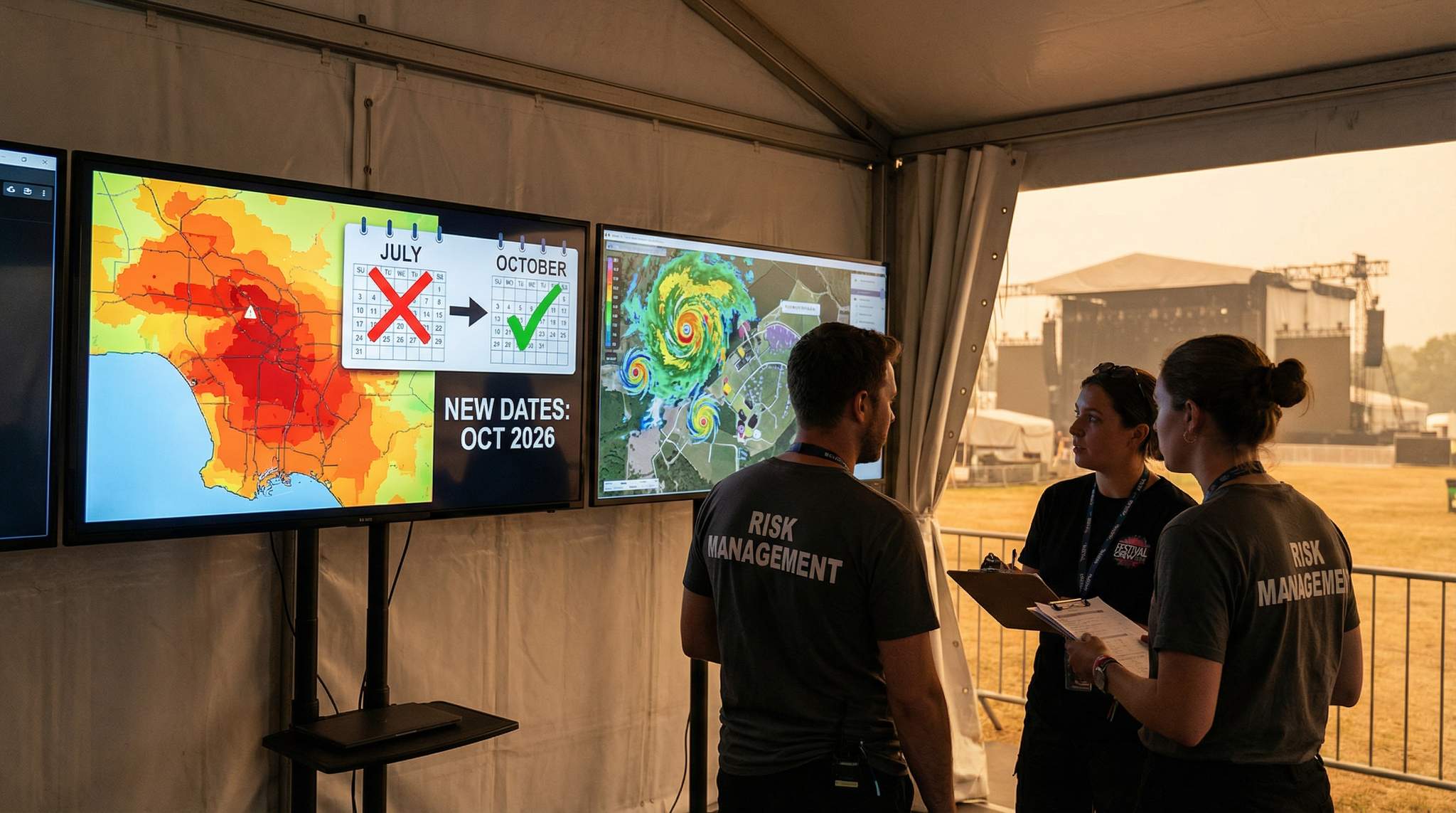
Extreme heat and wild weather are rewriting the rules for summer festivals. Around the world, record-breaking temperatures, sudden storms, and wildfire smoke have disrupted events once reliably held in June–August. In 2023 alone, 85% of festival-goers experienced extreme weather at a music festival and over a third became more hesitant to buy tickets due to weather risks, according to data on how extreme weather changes consumer engagement. From heatwaves topping 40 °C to flash floods turning fields into mud pits, today’s festival producers face a new climate reality where summer is no longer the assured “safe season” it once was. This article explores how rising climate extremes are forcing organizers to rethink traditional summer dates and shares strategies to “heat-proof” festival schedules – helping protect attendees, reduce cancellation risk, and ensure the show goes on despite unpredictable conditions.
Climate Extremes: The New Summer Reality for Festivals
Intensifying Heat Waves and Health Risks
Record-setting heat has become the norm during summer festival season. Global temperature records have been shattered in recent years, with regions from North America to Europe experiencing unprecedented heatwaves, as noted in reports on the climate crisis threatening festivals. For outdoor events, this translates to soaring on-site temperatures that can put attendees in real danger. Heat exhaustion and dehydration cases are rising at festivals; for example, a country music festival in Kentucky saw hundreds of fans treated for heat illness during a 2023 heatwave, highlighting the need for weather-proofing outdoor venues and amphitheaters. In the most sobering incidents, extreme heat has turned fatal – at a 2023 stadium concert in Rio de Janeiro, a young fan died and over 1,000 people fainted as temperatures hit 40 °C (105 °F) with scarce water available, a tragedy that emphasizes the importance of building weather resilience into event planning. These tragedies underscore that without serious precautions, extreme heat can be life-threatening at events. Even headline artists are taking note: in November 2023, Taylor Swift postponed a Rio show amid 35 °C heat after a fan’s death, forcing organizers to prioritize safety over show schedules, and in 2025 rock legend Steve Miller canceled an entire summer tour citing dangerous heat and weather for fans and crew, proving that managing sudden storms and temperature spikes is a core skill. The message is clear – blistering temperatures are now a critical safety threat at festivals.
The health risks aren’t limited to obvious heat stroke cases. Prolonged exposure to sun and high UV index can cause severe sunburn or heat rash among attendees (and staff), especially at all-day events with little shade. High humidity further exacerbates heat stress by impeding the body’s cooling – a 32 °C day with high humidity can feel like 40 °C+. Medical teams at festivals report upticks in dizziness, fainting, and severe dehydration whenever the heat index (combined heat and humidity) climbs into dangerous territory. Veteran festival producers now treat heat waves as a top-priority risk, on par with any crowd safety concern. Many events have begun implementing on-site cooling measures (misting tents, free water stations, shaded chill-out zones) to keep attendees safe in extreme heat, as savvy venue operators now treat heat mitigation as a priority. But as we’ll explore, producers are also looking beyond mitigation – they’re reconsidering when festivals take place to avoid exposing crowds to such perilous conditions in the first place.
Unpredictable Storms, Lightning, and Floods
Summer weather isn’t just about heat – it’s becoming wildly unpredictable. Sudden severe storms have struck festivals from Canada to Spain in recent years. In the UK, major festivals were wiped out by extreme weather in 2019 – Houghton Festival was flooded out and Boardmasters was canceled last-minute due to an incoming gale, leaving major festivals wiped out by extreme weather. More recently, in July 2023, heavy rains turned the Blue Dot Festival into a quagmire, forcing organizers to evacuate waterlogged grounds; the flooding was so severe the festival took a “fallow year” in 2024 to let the site recover, illustrating how the climate crisis threatens festival futures. These scenarios, once considered freak occurrences, are now regular threats. A study in Australia found weather-related festival cancellations jumped from 7 events (2012–2019) to 34 events between 2019 and 2023, reflecting a sharp rise in storms, floods, and fires derailing live events and placing strain on emergency responses. The climate that festival planners counted on for predictable summer sunshine has become a roll of the dice.
Smart Promo Codes & Presale Access
Create percentage or flat-rate discount codes with usage limits, date ranges, and ticket type restrictions. Plus unlock codes for private presales.
Thunderstorms and lightning are a particular menace. A sunny afternoon can suddenly turn into a dangerous electrical storm – and large open-air festivals must be ready to respond in minutes. Lightning not only risks direct strikes but also can cause stage equipment failures and power outages. Under dark thunderclouds, high winds have torn down stage structures and tents: one infamous example was Belgium’s Pukkelpop 2011, where a sudden storm caused a stage collapse that tragically killed five people, proving that extreme weather incidents are no longer freak occurrences. In the US, festivals like Lollapalooza have refined rapid evacuation protocols after experiences like a two-hour storm evacuation in 2012 that was executed smoothly, demonstrating that climate resilience pays off in the long run. The lesson from these incidents is that extreme weather can escalate with little warning, and traditional summer festivals – often scheduled in storm-prone months – must be prepared for anything. In some regions, late summer is actually peak thunderstorm season (e.g. the American Midwest in July, or European continental interiors in August), meaning festivals on those dates court a higher risk of lightning or torrential rain unless contingency plans are rock solid.
Flooding is another growing concern. Warmer air holds more moisture, so when storms come, they are dumping more rain than in decades past. Urban festivals have seen city streets turn into rivers, and rural festivals on fields have grappled with mud and standing water that shut down stages. In 2021, Bonnaroo Festival in Tennessee – postponed to late summer that year – was canceled at the last minute when Hurricane Ida’s remnants flooded the campgrounds, showing that weather incidents are no longer freak events. Organizers watching radar saw up to 7 inches of rain drown the site just before gates were to open, showing that even with excellent planning, a single extreme weather event can force a full shutdown. For every Bonnaroo or Tomorrowland (which faced severe mud in 2015) that had to cancel or evacuate, many other festivals have barely avoided disaster by the grace of weather shifts. The takeaway for risk management is stark: assume that a storm will hit at some point, and build your festival timing and layout with worst-case weather in mind.
Planning a Festival?
Ticket Fairy's festival ticketing platform handles multi-day passes, RFID wristbands, and complex festival operations.
Wildfire Smoke and Air Quality Challenges
It’s not just the weather we can see – the atmosphere itself is posing new risks via wildfire smoke and heat-related pollution. As global temperatures rise and droughts intensify, wildfires have become more frequent and far-reaching. Even if a festival isn’t near a fire, smoke can travel hundreds of miles, blanketing event sites in hazardous haze. In summer 2023, smoke from massive Canadian wildfires drifted into the U.S. Midwest and East Coast, causing apocalyptic orange skies and forcing outdoor event cancellations from New York to Wisconsin, as Canadian wildfire smoke disrupted major concerts. Live music events and even city festivals in places like New York City, Philadelphia, and Milwaukee were suddenly postponed or called off due to off-the-charts Air Quality Index (AQI) readings that made outdoor activity unsafe, with multiple live music events canceled. Festival producers who once only worried about rain now must have air-quality action plans for festivals.
The health stakes are significant: heavy wildfire smoke carries fine particulate matter (PM2.5) that can cause headaches, breathing difficulties, and serious complications for those with respiratory conditions. At high AQI levels (e.g. 200+ “Very Unhealthy” or worse), authorities recommend everyone avoid strenuous outdoor activities – hardly compatible with dancing at a festival. In recent years, major events in California and the Pacific Northwest have distributed N95 masks to attendees when wildfire haze moved in, and some have paused programming until air improved, adapting to the new reality of wildfire smoke at festivals. Poor air quality is now a trigger for festival delays in many regions. For example, a prominent music concert in Milwaukee was canceled in June 2023 when Canadian smoke pushed the AQI above 300 (“Hazardous”), a decision health experts applauded as putting safety first, noting that canceling for smoke is the right call. Producers are learning to monitor AQI forecasts as closely as weather forecasts, especially for summer events in fire-prone areas. The new reality is that a “clear sky” day isn’t truly clear if it’s filled with microscopic smoke particles – and festival timing may need to avoid the heart of fire season, or come with contingency plans for sudden smoke emergencies, utilizing wildfire smoke action plans.
In summary, climate change has upped the stakes for summer festivals. Heatwaves, violent storms, and smoky skies – once rare extremes – are now regular challenges. The year 2026 is expected to continue this trend of climate extremes, so festival organizers must anticipate and plan around these threats as a core part of event safety. The following sections will delve into how forward-thinking producers are adapting their scheduling and strategies to keep festivals safe and successful amid these environmental changes.
Analyzing Weather Data and Seasonal Patterns Before Picking Dates
Leveraging Historical Climate Data
Choosing when to hold a festival is no longer just about artist availability or avoiding competing events – it’s now a critical safety decision. Smart festival producers begin by analyzing decades of historical weather data for their region before committing to dates, often consulting a meteorologist during the planning phase. Key metrics include average temperatures, rainfall, storm frequency, and extreme records for each week of the year. For example, if a site’s last 30 years of weather data show that late July routinely brings 38 °C days and afternoon thunderstorms, while early June is milder and drier, that early June window might be a far safer bet, allowing organizers to schedule just before the peak heat. Many veteran organizers create climate matrices or consult local climatological reports to identify the “Goldilocks” period – not too hot, not peak storm season. In practice, this might reveal that moving a festival just 2–3 weeks earlier or later can dodge the worst heat or storm patterns. For instance, producers of a Texas outdoor festival found that the first week of May historically had average highs of 29 °C and low storm incidence, whereas June highs averaged 36 °C with frequent lightning storms. Armed with this data, they permanently shifted the festival from June to early May, significantly reducing weather-related risks in subsequent years.
Turn Fans Into Your Marketing Team
Ticket Fairy's built-in referral rewards system incentivizes attendees to share your event, delivering 15-25% sales boosts and 30x ROI vs paid ads.
Beyond basic averages, experienced teams use advanced indices like the Wet Bulb Globe Temperature (WBGT) when analyzing historical climate. WBGT accounts for heat, humidity, sun angle, and wind to gauge heat stress on humans more accurately than temperature alone, helping to gauge heat stress levels effectively. By reviewing past WBGT levels on prospective dates (if available from local weather stations or sports science data), organizers can identify periods where conditions regularly enter the “red zone” of heat risk, helping to pick a safer date range. If, say, mid-July afternoons at the venue have historically hit dangerously high WBGT readings (accounting for humidity and sun exposure), that’s a glaring red flag to avoid those dates or plan around afternoon hours. One hard lesson came from the 2023 World Scout Jamboree in South Korea, scheduled in early August despite relentless 38 °C heat and extreme humidity in that region, similar to issues seen at a major concert in Rio de Janeiro. Within days, over 600 attendees suffered heat-related illnesses and the event was thrown into chaos – a scenario that historical climate data could have predicted and prevented, reminding producers to always respect the climate data. The takeaway: No organizer wants to “learn the hard way” by ignoring climate statistics. Leverage the data up front to steer your festival toward historically safer weather windows.
Consulting Meteorologists and Forecast Tools
Data is valuable, but interpreting it correctly can be challenging – which is why many top festivals now consult professional meteorologists or climatologists during the planning phase to determine the temperature high for the event. These experts can provide localized insights into weather patterns that raw data might not reveal. For example, a meteorologist might explain how a coastal breeze often cools your site in late afternoons, or how a mountain range creates a rain shadow effect that reduces storm risk on one side. They also know the anomalies: perhaps every 5–7 years a freak heatwave strikes in what is usually a cool month, which you might miss if you only look at averages. Engaging a weather expert early on can help identify those “black swan” possibilities and advise on picking dates with the lowest probability of extreme conditions.
Need Festival Funding?
Get the capital you need to book headliners, secure venues, and scale your festival production.
Modern forecast technology is another asset. Seasonal forecasting models and climate trend projections for 2026 can hint at whether a particular summer might skew hotter or stormier than usual. While long-range forecasts are probabilistic, an experienced meteorologist can use them alongside historical trends to guide scheduling. Some festivals even commission custom forecasts for their event window as it nears, updating contingency plans if, say, an El Niño pattern is expected to make the summer hotter. Additionally, tools like climate analogues let you see how an upcoming season compares to past ones (e.g., “next summer is tracking to resemble the conditions of the 2016 heatwave year”). Incorporating this expertise means your festival date decision is grounded in science, not guesswork.
One practical approach is to set up a weather risk matrix for potential dates before finalizing booking. For each candidate weekend, assign risk levels for heat, rain, storms, etc., based on data and expert input. An example of a simplified weather risk matrix is below:
| Proposed Date | Avg High Temp (°C) | Extreme Weather Risk | Notes |
|---|---|---|---|
| Late June (Weekend A) | 29 °C (historical avg) | Moderate heat; Low storm risk | Most storms hit later in summer; crowds on holiday. |
| Late July (Weekend B) | 34 °C (historical avg) | High heat; Moderate storm risk | Peak heatwave season (past 3 years >38 °C). |
| Early October (Weekend C) | 22 °C (historical avg) | Low heat; Moderate rain risk | Cooler temps, but part of rainy season (30% chance of rain). |
| Early May (Weekend D) | 27 °C (historical avg) | Low–Mod heat; Low storm risk | Warm but not hot; historically very low severe weather events. |
In this example, Weekend D (early May) clearly has the lowest risk profile. By quantifying the risks of each option, you can make a more informed choice — often, safety dictates moving away from the peak summer slot if your region’s data shows high heat or storms in that period.
Recognizing Regional Weather Patterns
Climate risks vary widely by locale, so knowing your region’s specific patterns is crucial. Every area has its seasonal weather quirks that festival planners must heed. For instance, monsoon season in South Asia brings daily downpours and high humidity each summer, so major outdoor festivals in India or Thailand avoid May–August entirely, opting for dry-season months like December or February, as data helps festival producers avoid monsoons. In the Caribbean and southeastern U.S., late summer (Aug–Sept) aligns with peak hurricane season – thus some festivals schedule in spring to dodge hurricanes, or if they do take place in autumn, they invest in robust contingency plans and cancellation insurance, ensuring a far safer experience than an unprepared event. Desert climates (Las Vegas, Middle East) face extreme heat in July/August (40 °C+ days), which is why large events in those areas often occur in cooler months or at night, avoiding late July when heat indexes spike. For example, major UAE music festivals are held in November or February when temperatures are manageable, making them suitable for beach or outdoor settings. In Mexico’s Yucatán region, savvy organizers might target April – after the late winter storms but before the hurricane risk grows in summer, providing a far safer experience than peak storm season.
Even within one country, microclimates matter. In the U.K., June can often be drier and milder, whereas late July and August bring higher chances of rainstorms, so don’t ignore the weather data. (Glastonbury, traditionally in late June, often cites historical weather trends in justifying its dates – though as a 50-year institution, tradition also weighs heavily.) In the American Pacific Northwest, August might be dry but increasingly faces wildfire smoke, while September can bring the first autumn rains – posing a tough trade-off. Understanding these rhythms can guide date selection. Seasoned producers sometimes create “climate calendars” marking dangerous periods to avoid: e.g., noting when the local river usually crests (to avoid floodplain venues then), or when dry grasses tend to catch fire. If a certain weekend consistently showed issues (like three out of the last five years had storms on that date), it may be wise to move the festival to a different part of the season.
The key is not treating summer as one monolithic block. Early summer vs. late summer can be dramatically different. By recognizing, say, when the summer monsoon starts in your region, or when the extreme heat typically peaks, you can time your event in the relatively safer pocket just before or after those extremes. It might feel unfamiliar to break from the traditional “third weekend of July” slot your event has always used, but as climate patterns shift, flexibility on timing can make the difference between a smooth festival and a weather-plagued ordeal.
Choosing Safer Festival Dates: Shifting the Season
Avoiding the Hottest Weeks
With the data in hand, many organizers in 2026 are concluding that peak summer may no longer be the ideal time for their festival. One clear strategy is to avoid the hottest weeks of the year when possible, especially in heat-prone climates. This often means moving a festival out of late July and August, which historically are the hottest months in much of the Northern Hemisphere, into earlier or later dates. For example, Coachella in California is held in April – in the California desert, July can reach 45 °C, whereas April sees more moderate 30 °C days, avoiding the humidity and heat indexes of mid-summer. By staging in spring, Coachella avoids the lethal peak of summer heat. Similarly, many European festivals that used to target late July have edged into June or early July to sidestep the worst heatwaves. The producers of one electronic music festival in Southern Spain analyzed 20 years of temperatures and chose to permanently shift their dates from mid-July to the first weekend of June, finding that the historical chance of 40 °C+ heat dropped from 30% to under 5% by doing so. The difference on the ground was tangible – attendees in recent years enjoyed ~28 °C afternoons instead of suffering in 37 °C swelter that plagued past editions.
In regions like the Middle East and South Asia, avoiding hottest weeks isn’t just advice, it’s doctrine. Many Middle Eastern festivals simply will not operate during June–August at all. Instead, they flourish in cooler periods: for instance, the massive MDLBEAST Soundstorm festival in Saudi Arabia is held each December when desert nights are cool, and India’s Sunburn Festival smartly schedules for late December in Goa – after the monsoon and when temperatures are down in the 20s °C, providing a far safer experience than an outdoor rave in May’s 40 °C heat, ideal for beach locations. These examples show that success comes from aligning with your climate’s “good weather” window, even if that means shifting out of the traditional summer break. Attendees will adjust to a new annual timeframe if it means a more comfortable and reliable experience. In fact, many veteran festival-goers now appreciate events that buck the brutal heat of high summer – a festival in September or May can feel refreshing and attract those who might skip a mid-summer event due to heat concerns.
Of course, not every festival can simply move months, especially if tied to holidays or touring cycles. But even within the summer span, targeting the edges of summer can help. Early June and late August are often slightly cooler or less stormy than the mid-July apex. For example, one multi-genre festival in New York moved from the last weekend of July to the first weekend of June and saw far fewer weather issues. When they stayed in late July, they endured back-to-back years of heat advisories and a severe thunderstorm evacuation. In contrast, their early June editions faced only light rain at worst – avoiding the intense heat and pop-up thunderstorms that hit later in summer. The pattern is clear: if data shows the hottest, most volatile period in your locale, plan around it. A festival might lose the “school’s out” timing of late summer, but gain a safer environment that keeps fans coming back.
Listening to post-event feedback is often the catalyst for these major scheduling shifts. When post-event surveys and social media reviews repeatedly feature sentiments like “cooler temperatures would have made a difference” regarding the festival experience, promoters must treat it as a critical retention risk. Fans who spend half the weekend surviving rather than enjoying the music are far less likely to return the following year. Acknowledging that a cooler environment would have improved the event isn’t just about comfort; it’s a direct indicator of future ticket sales. By proactively moving to a milder month, organizers directly address this friction point, ensuring the weather enhances the programming rather than detracting from it.
Embracing Shoulder Seasons and Nighttime Events
Another strategy producers are using is to embrace shoulder seasons (spring and autumn) or off-peak times of day to dodge climate extremes. Spring (March–May) and fall (September–November) often offer milder weather – not as hot as summer and often outside the worst of storm or fire seasons. For instance, many U.S. festivals have popped up in October, a month that can bring pleasant temperatures after the summer heat has waned. Austin City Limits Festival in Texas expanded to October decades ago, and while 2023 still saw a heatwave even in October, generally that scheduling avoids the scorching 100 °F+ (38 °C) days common in August. By 2026, we’re seeing more events in traditionally “off” months: a new California camping festival launched in late September to leverage cooler evenings and the first autumn rains knocking down wildfire risk. Meanwhile, some European events are experimenting with spring dates – a UK rock festival moved to May and found it still attracted strong crowds, who enjoyed not standing in sweltering fields for once.
One creative adaptation in hot climates is shifting festival operating hours to evenings or overnight. If an event must happen in summer (due to local traditions or schedules), organizers can flip the script so that the main action happens after sunset. Night-time festivals or dusk-to-dawn programming have long been common in desert rave culture (for example, Nevada’s famous Burning Man and Las Vegas’ EDC both thrive overnight when the desert cools). Now, more mainstream festivals are adopting this model. In 2022, a Southern Europe dance festival under extreme heat moved its headline sets to start at 9 PM instead of the late afternoon, effectively turning into a night-focused event. Attendees were encouraged to arrive later in the day, and daytime stages featured only chill-out music and misting areas. The result was fewer medical incidents and a surprisingly positive response – people enjoyed partying under the stars, and the festival avoided the brutal 3 PM sun. EDC Las Vegas is a prime example of planning around climate: each May it runs from evening (~7 PM) until early morning, strategically avoiding the deadly midday heat of the Nevada desert (which can exceed 40 °C) by keeping crowds active during the cooler night hours.
Even if your festival doesn’t become fully nocturnal, you can adjust daily schedules to minimize afternoon exposure. This might mean starting the program later and ending later. Many European city festivals in heatwave-prone areas have begun opening gates around 5 PM, with music running until the local noise curfew late at night. In Mediterranean climates, it’s not unusual now for festival shows to continue past 2 AM – an accepted trade-off to escape the 1-6 PM heat peak. Of course, shifting to evening hours requires coordination with local authorities on noise permits and transport for late-night departures, but many cities are accommodating when it’s framed as a safety measure. (Working with officials on extended hours can be part of broader festival licensing efforts – see our guide on navigating festival permits and licensing without costly pitfalls for tips on negotiating such changes.) In summary, thinking beyond the traditional “noon to midnight” festival day and considering cooler times can significantly reduce heat stress on attendees and make your event more tolerable under extreme climate conditions.
Case Studies: Festivals Adapting Their Dates
Real-world examples illustrate how adjusting festival timing can pay off:
- Lightning in a Bottle (USA) – This boutique California festival traditionally took place over Memorial Day weekend in late May. In 2018, an experiment moved it to mid-July, but attendees and crew battled 100 °F+ (37 °C) heat and the vibe suffered. Organizers responded by shifting back to May in 2019, and have stuck to spring dates since. By avoiding the height of summer, LIB ensures warm-but-manageable weather and far less risk of wildfires or heat illness.
- Envision Festival (Costa Rica) – Held in the tropical dry season (late February), Envision chooses dates when the jungle is past peak heat and before heavy spring rains. Daytime temperatures still climb, so they program wellness activities (yoga, workshops) in the morning and keep afternoons relaxed, with main music stages igniting after sunset. This timing has built Envision’s reputation as an eco-conscious festival that lives in harmony with its climate – it would be untenable in the extreme humidity and monsoon rains of July.
- Splendour in the Grass (Australia) – This major Australian festival sticks to late July (mid-winter in Australia) to avoid the country’s summer heat and bushfire season. Normally that timing offers mild weather, but in 2022 freak rainstorms caused severe mud. Organizers responded by enhancing drainage and reviewing their site design for future years, yet they haven’t moved the winter timing – it remains far safer than risking 40 °C summer days. The 2022 lesson was more about infrastructure adaptation than date (as winter rains were unusually extreme), whereas summer in that region would raise heatstroke and fire hazards.
- Florida and Caribbean Festivals – Some festivals in hurricane-prone areas have shifted out of the late-August through September window after near-misses. A Caribbean music festival that once ran in early September (peak hurricane time) moved to early April; since then, it has avoided the forceful tropical storms that frequently hit in late summer, ensuring a far safer experience than an August event. For those events that remain in hurricane season, many have contingency venues or rain dates. For instance, certain coastal concerts in Florida scheduled during September now arrange backup indoor venues and communicate evacuation plans early to ticket buyers, knowing that weather can be volatile. This gives attendees confidence that even if a storm comes, there’s a Plan B.
These case studies highlight a common theme: flexibility and humility in the face of Mother Nature. Festivals that survived and thrived were willing to break tradition – shifting dates, months, or daily routines – when the climate signaled it was “too hot to handle” on the old schedule. The most seasoned producers treat scheduling as a dynamic part of risk management, not a fixed constraint. Next, we’ll look closer at how daily programming itself can be reshaped to mitigate heat once the festival date arrives.
Adjusting Daily Schedules to Beat the Heat
Moving Main Events to Cooler Hours
Even after selecting a cooler date, festivals often must contend with dangerous heat during certain hours of the day. The afternoon period (roughly 12 PM to 5 PM) is typically the hottest and most sun-exposed. A golden rule has emerged among experienced producers: avoid large crowds and peak activity during mid-afternoon heat whenever possible. This means rethinking the daily lineup and operations schedule to shift intensive activities to the cooler morning or evening hours, typically mornings and especially evenings.
Front-load and back-load the schedule: Many festivals now pack their headline performances and high-energy sets into late afternoon/evening slots, while keeping early afternoons lighter. For example, instead of a big-name DJ playing at 3 PM under a brutal sun, that set is pushed to 8 PM when temperatures have dropped. Mornings (if the festival starts that early) can be utilized for gentler programming: acoustic sets, wellness classes, or meet-and-greets – activities that engage early birds without generating heat stress or frenetic dancing. Some multi-day festivals have even delayed gate opening until mid-afternoon on the hottest days to discourage fans from arriving at noon and baking in the sun for hours before prime time. It’s better to have attendees come a bit later and stay safe than to have them queue in direct sun at 1 PM.
Another tactic is scheduling longer meal or rest breaks into the program during peak sun. Downtime in the schedule (e.g., no major acts between 2–4 PM) can encourage the crowd to seek shade, hydrate, and recharge. During these lulls, festival MCs and video screens often remind people to drink water, cool down and prepare for the evening. While it might seem counterintuitive for a non-stop music festival to intentionally insert a “siesta” period, many organizers find it’s far better than pushing through and seeing guests collapse from heat. As a bonus, when the music resumes as the sun lowers, the crowd often has more energy to enjoy it. Some festivals in Spain and the Middle East, inspired by local culture, explicitly promote an afternoon siesta: advising attendees to retreat to tents or AC areas, then rejoin for an extended nighttime party. The cost of a quieter afternoon is repaid by a safer, happier crowd come nightfall.
To illustrate how a heat-adjusted festival day might look, see the table below:
| Time (Hot Day) | Traditional Schedule | Heat-Adaptive Schedule |
|---|---|---|
| 10:00 AM – 12:00 PM | Gates open, minor acts on small stages. | Gates open earlier (10 AM) for camping festivals so attendees can settle while it’s cooler. Light morning activities (yoga, workshops in shade). Main stages idle. |
| 12:00 – 3:00 PM | Full programming on multiple stages; big-name acts might start. | Heat Pause: Minimal main-stage activity. Shaded tents host low-key sets or DJs. Encourage lunch, hydration & visiting cooling zones. Provide misting areas and water refills. |
| 3:00 – 6:00 PM | Mid-tier acts perform; crowd energy rising but sun at peak. | Gradually resume programming as heat slightly subsides. Mid-tier acts on secondary stages after 4 PM. Keep any intense shows until later. Staff do extra rounds with water. |
| 6:00 – 9:00 PM | Headliner-level and major acts on main stages (sunset into evening). | Prime Time Begins: Major acts timed at sunset or later (e.g., 7 PM onwards). Multiple stages active now that temperatures are cooler. Fans return from breaks, energized. |
| 9:00 PM – 1:00 AM | After-dark performances, DJs, late-night shows (typical festival end by around midnight). | Extended evening program since daytime was lighter. Headliners might play slightly later than usual. Event could run an extra hour into night, weather permitting, to make up for the afternoon pause. |
In this adaptive schedule, the midday slowdown is clear. High-intensity programming is concentrated in the evening when conditions are safer. Many festivals also adjust on the fly: if a particular day is unusually hot, they might delay a main stage act by an hour and announce, “Due to the heat, we’re pushing XYZ’s set to 7 PM – please use this time to cool off.” Flexibility and real-time weather monitoring go hand in hand here (and tech can help, as discussed later, with tools that alert producers when onsite temperatures or WBGT hit trigger levels). By proactively moving key events to the cooler hours, festivals dramatically reduce the number of medical incidents and discomfort among their attendees.
Siesta Breaks and Midday Cool-Downs
The concept of a “siesta” at a music festival might raise eyebrows initially, but it has proven effective in scorching conditions. A classic example comes from Mediterranean and desert festivals that adopted midday breaks. Instead of running continuous music across all stages, they intentionally schedule a gap or switch to low-energy content during the hottest part of the day. Attendees are encouraged to take this time to relax – perhaps at a cooling station equipped with shade, fans, and misting devices, or back at their campsite/hotel if it’s a multi-day event. Some events hand out free ice pops or electrolytes during this period to promote cooling off. By essentially pressing “pause” on the festival when heat stress is highest, organizers prevent a significant amount of heat-related illness.
A notable case was the 2019 Mediterranean Electronic Festival (a hypothetical example based on common practice): faced with a forecast of 38 °C, organizers announced each day from 2 PM to 5 PM would be a “Chill Zone” – only ambient music at a tented stage, with all other stages quiet. Attendees initially weren’t sure what to do, but the festival provided extra entertainment in shaded areas (like a misted art installation and hydration games). Many people simply relaxed under trees or took a dip in onsite pools. The result? Medical incidents plummeted compared to previous years when they ran full-throttle all afternoon. Feedback later indicated that attendees appreciated the break and felt better able to enjoy the night sets. This goes to show that continuous entertainment is not worth endangering health – a brief pause or shift to cool-down mode can be a lifesaver.
If a full pause isn’t feasible, even staggering stage schedules can help. For example, if you have multiple stages, you might rotate their “break” times: the main stage goes quiet mid-afternoon while a smaller tent stage with cover does an acoustic set, then later the main stage resumes and another stage pauses. This way there’s always something to do, but no one stage area is encouraging a huge crowd in direct sun at peak heat. Attendees will naturally gravitate to the comfortable spots – so providing at least one large shaded venue with programming during midday gives people a safe harbor. It’s important to clearly communicate this plan in the schedule and signage so attendees know it’s intentional and for their benefit, not a surprise gap or technical issue. When framed positively (“Enjoy our Afternoon Cool-Down Zone with chill beats and misting tents!”), these breaks become accepted as part of the festival culture.
Overnight Festivals: Pros and Cons
As mentioned, some festivals are taking the dramatic step of going fully overnight. Electronic music and art festivals, especially in hot climates, have long proven this model – they open gates in the evening and run through dawn, often then closing during the daytime entirely. The obvious advantage is avoiding the sun and heat: at night, temperatures can drop significantly (especially in arid regions where nights are cool). Attendees can dance all night in relative comfort and even need jackets by early morning. Additionally, darkness can enhance the atmosphere for light shows, fireworks, and immersive art, which is a bonus creatively.
However, an overnight schedule comes with challenges. Local noise ordinances and community relations are a top consideration – all-night music may disturb neighbors or violate laws, so organizers need permits or isolated locations (deserts, remote fields) to make it viable. Staffing overnight is another concern: crew members and security working through the night and sleeping by day requires careful shift planning to avoid fatigue. Promoters must comply with labor laws on overtime and provide ample breaks (see how festivals avoid crew fatigue and legal overtime traps for strategies). There’s also a different attendee safety dynamic at night – visibility issues, potentially cooler temperatures requiring different first aid prep (ironic, but attendees might get chilled by early morning after sweating all night). Transportation for late-night departure is a logistics factor too; organizers often arrange shuttles or encourage camping so attendees aren’t driving exhausted at sunrise.
Hybrid schedules can offer a middle ground. Some festivals do a late start (e.g., events begin at 5 PM and go until 5 AM). This way you’re not asking everyone to invert their entire life rhythm, but you still dodge the worst heat. In 2022, a desert festival in the Middle East tried a hybrid approach: gates at 6 PM, music until 4 AM, then a break. Attendees camped or rested in the early morning and ventured into the nearby town during the day, effectively treating it like an overnight/sunset event. Reviews indicated it was strange at first, but attendees quickly adapted their sleep schedules and appreciated that they never had to endure daytime desert sun at the festival. The festival’s post-event report showed far fewer heat-related medical incidents than comparable daytime events – proof that the timing shift worked.
In summary, while going fully nocturnal isn’t feasible for every festival type (family-oriented events or those with local residents nearby may not manage it), adjusting toward the cooler hours – even if not completely overnight – is a powerful tool. Festival producers should weigh the pros and cons for their specific event and audience. The key is to prioritize comfort and safety, even if it means breaking long-held scheduling conventions. Attendees ultimately want a fun experience, and heat stroke or sunburn is not part of anyone’s good time. By demonstrating flexibility in daily scheduling, festivals show attendees that their well-being comes first – which in turn builds loyalty and trust.
Weather-Triggered Policies and Contingency Plans
Defining Heat Thresholds and “Heat Refunds”
Even with ideal scheduling, there’s always a chance that an extreme heatwave could strike unexpectedly during your festival. That’s why progressive festivals are establishing heat-triggered policies well in advance. A crucial step is defining clear thresholds for when specific actions kick in. For example, a festival might decide that if the National Weather Service issues an “Excessive Heat Warning” for the event day (often meaning the heat index will exceed say 40 °C/105 °F), they will implement special measures – such as opening additional cooling centers, extending free water availability, and making schedule adjustments (like canceling the high-intensity 2 PM dance workout session). By having these thresholds set ahead of time, the team isn’t scrambling to decide what to do – it’s predefined in the heat action plan, where amphitheaters are implementing cooling strategies.
Some festivals are even tying these thresholds to customer-friendly policies like “heat refunds.” In a pioneering move, Hinterland Music Festival in Iowa announced a “90 Degree Guarantee” for 2025: any ticket-holder can get a full refund if the forecast high for the day they attend is 90 °F (32 °C) or above, an initiative that reflects the festival’s commitment to safety. This bold policy essentially acknowledges that intense heat might make the event unenjoyable or unsafe for some fans, and it gives them an option to opt out. Hinterland’s organizers reported that this move built goodwill – attendees know the festival puts safety over profit – and it actually boosted ticket sales among cautious buyers, since the risk of losing money to bad weather was reduced. Of course, offering refunds can impact finances, so it’s generally used when absolutely necessary (90 °F is a relatively moderate threshold, arguably – the festival chose it perhaps because Iowa humidity can make 90 feel awful). Other events have considered similar heat guarantees at higher temperature marks or offering exchanges (e.g., “if a heat emergency is declared, you can swap your ticket for our next festival edition”). The specifics will vary, but the principle is to be prepared to give attendees flexibility if conditions become dangerous.
Also critical is having an internal heat policy for when to pause or cancel performances. Many sports events use WBGT or heat index thresholds to suspend play; festivals can do likewise. For example, your policy might state that if on-site WBGT exceeds 30 °C for over an hour, all non-essential programming will halt and misting/emergency cooling protocols start until conditions improve. This kind of pre-written policy, ideally developed with guidance from health officials, takes the guesswork out of crisis moments. It can be communicated to artists and vendors in advance so they aren’t caught off guard when, say, the main stage schedule is suddenly delayed due to extreme heat – they will know that’s part of the agreed safety measures.
From a risk management perspective, document these trigger points in your Event Safety Plan. If you ever need to justify a tough call (like canceling a headline act due to heat), you can point to the fact that it was based on a predetermined safety threshold. It’s much easier to defend and explain a decision that stems from an established policy rather than an ad hoc call. Some festivals even share the basics of these heat policies with fans (e.g., in an email or website FAQ: “If temperatures are forecast above X, here’s what we’ll do…”). That transparency helps attendees understand what to expect and reinforces that safety comes first. One could consider it a counterpart to a rain policy (many festivals say “rain or shine, event goes on, except in dangerous weather” – now they might add heat to “dangerous weather” conditions explicitly).
Air Quality and Smoke Delay Protocols
Wildfire smoke incursions and poor air quality need their own trigger-action plans. An increasing number of festivals have defined AQI breakpoints at which they will take protective steps. For instance, a festival might decide: If AQI hits 150 (Unhealthy), they will start distributing masks and advise sensitive groups to go to a designated indoor area or seek medical tent if feeling unwell. If AQI goes over 200 (Very Unhealthy), they might suspend performances or delay entry until air quality improves, adapting to the new reality of wildfire smoke. At AQI 300+ (Hazardous), likely a full event shutdown or evacuation would be warranted in consultation with authorities. These decisions are tough, but having a plan and stating it clearly allows everyone (staff, attendees, artists) to react swiftly when needed.
Communication is especially key with air quality because smoke conditions can change throughout the day. Some festivals have adopted a tiered flag system (similar to many parks or schools): green, yellow, red flags indicating air quality safety level, displayed on screens or through an app. If it moves to red, fans know that the event might pause. Real-time monitoring is essential – assign a team member or use a tech solution to continuously monitor official AQI data and even on-site particulate sensors if available. (Modern event tech makes this easier; see how weather-proofing tech solutions provide real-time monitoring and alerts for tools that festivals are using to track conditions). When certain thresholds are crossed, automated alerts can notify the production team to take action immediately.
Festivals in wildfire-prone areas have also learned to build schedule flexibility on smoky days. For example, if thick smoke is expected to clear by evening when winds shift, an event could institute a “Smoke Delay” – perhaps postponing afternoon programming and extending the night schedule once air quality improves. In 2020, a California outdoor concert series faced unhealthy smoke at start time and delayed the show by 2 hours; the organizers communicated clearly via social media and their app that “We’re holding until 8 PM for the air to clear – the headline act will still perform, just a bit later.” Attendees appreciated the consideration for safety, and because the festival had lighting for the stage, the later end time was acceptable to all. The key is liaising with local authorities too – if air quality is bad, health departments may actually recommend or mandate closures, so staying in touch with officials and having a cancellation/postponement policy is wise. Some events secure “air quality insurance” or clauses in artist contracts that allow for last-minute rescheduling if AQI makes performing unsafe (for both crowd and singers’ vocal cords!). While insurance for smoke-specific issues is a nascent field, having financial contingency (reserves or flexible vendor agreements) for a smoke-out scenario is part of robust planning now.
In terms of attendee relations, consider offering refunds or exchanges if smoke causes a significant downgrade in the event experience. Much like heat refunds, smoke is something ticket-buyers worry about. For instance, one Pacific Northwest festival offered partial refunds to single-day ticket holders when smoke caused cancellation of one day’s lineup; weekend pass holders were given a discount code for next year as goodwill. By planning these gestures ahead of time (even if you don’t advertise them unless needed), you can quickly implement them and maintain customer trust should the worst happen. Fans will remember that you put their health first and handled the situation fairly, which helps with long-term loyalty.
Lightning, Storms, and Evacuation Triggers
Thunderstorms and severe weather require split-second decisions – which is why having predefined triggers and an action plan for storms is non-negotiable. Most large festivals now partner with a weather monitoring service or use lightning tracking apps to know if strikes are approaching. A common safety standard is the “30/30 rule”: if lightning is detected within 8 miles (roughly 13 km), halt the event and seek shelter, and only resume 30 minutes after the last strike within that range. Many events follow variants of this, some using 10-mile radius as a trigger. The key is that once that threshold is met, the evacuation or shelter-in-place automatically begins as per plan. For example, Lollapalooza (Chicago) has a well-drilled protocol: if lightning nears, they announce an evacuation, guiding tens of thousands of attendees to predefined shelters (parking garages, nearby buildings) and then resume once storms pass – which they did successfully in 2012 and several times since, proving that climate resilience prevents impassable roads. This is only possible because the festival had detailed evacuation routes, communication strategies, and staff assignments prepared for the storm scenario.
Your festival’s emergency plan should clearly answer: At what point do we shut down stages due to weather, and how do we direct people to safety? This involves working with meteorologists for real-time calls. Many festivals employ on-site meteorologists or subscribe to services that send alerts directly to the production team’s radios when dangerous weather is X minutes away. A crucial element is the “decision team” – usually the festival director, safety officer, and weather expert – who jointly decide to evacuate or pause. But they’re guided by those triggers: e.g., severe thunderstorm warning issued, or wind gusts over 40 mph measured, etc., could be automatic cues in the plan.
Once the trigger hits, execution is everything. All-staff communication is paramount – security, volunteers, stage managers should know their roles (like which exits to direct people to, or how to secure equipment quickly). Attendees need prompt and clear instructions. Pushing notifications through a festival app can help (if cell networks hold up), as well as announcements on stage sound systems and display screens. Some festivals use LED signage and recorded messages in multiple languages to tell fans where to go. The faster and calmer this is done, the better the outcome. One success story often cited is a 2019 stadium concert where organizers safely evacuated 60,000 people in under 20 minutes when a storm hit – a result of rigorous planning and clear messaging. In contrast, lack of planning led to chaos at TomorrowWorld 2015 when rain stranded attendees, showing that planning early for wildfire and rain costs less.
Aside from lightning, wind thresholds should also be established. High winds can force you to lower or drop stage scrims and video walls (most staging companies have wind ratings – e.g., screens must be dropped if winds exceed 30–35 mph). Your production schedule should allow time to secure structures if winds rise suddenly. Have a wind action chart: “At 20 mph, alert stage ops; at 30 mph, pause show and lower banners,” etc., so everyone knows the drill.
Finally, consider shelter and evacuation destinations ahead of time. If your site has permanent buildings or access to vehicles, factor those in. If not, the plan might be to evacuate to personal cars or buses (as was the case at some rural festivals). Work with local emergency management on this; they might designate nearby civic centers or safe structures where people can go if you have to clear the site for a tornado warning or similar. And of course, practice your plan at least in tabletop exercises with your team. It’s one thing to have it on paper, another to execute under pressure. The goal is for weather-related holds or evacuations to be handled so well that, although disappointing, they don’t devolve into injury or panic. When done right, you can even resume the festival after the weather passes – as many have – and attendees will commend how safely it was handled.
Upgrading Festival Infrastructure for Extreme Weather
Shade, Water, and Cooling Stations
If extreme heat is expected (or possible) despite date tweaks, festival infrastructure must rise to the challenge. Providing ample shade and water is the bare minimum now – and many organizers are going much further to keep attendees cool. Free water refills are increasingly mandated by health codes in hot weather, but even where not required, savvy festivals make water easily accessible throughout the grounds. Large hydration stations (taps or water coolers) should be as ubiquitous as bar tents; gone are the days when attendees tolerated hour-long lines for a small $5 bottle of water. Festivals like Burning Man and Bonnaroo have long encouraged hydration by letting people bring in empty bottles or camelbacks to refill freely, and most major events have followed suit. In addition, electrolyte beverage sponsors (or the festival itself) sometimes give out rehydration packets – a small investment that can help prevent heat exhaustion.
Shade is another literal life-saver. Open fields can be brutal under midday sun, so creating artificial shade is critical if natural shade is lacking. Many festivals now erect large shade sails over portions of the audience area, or set up designated cooling zones with tented roofs. For instance, Glastonbury Festival in the UK (which often deals with rain more than heat) still provides shaded areas knowing how intense the sun can be in the rare hot English summer. In California, Coachella expanded its shade structures and added more misting areas after attendee feedback about heat. One effective idea is the “chill-out tent”: a big tent (or series of tents) with open sides, tons of fans or mist machines, comfortable seating, and perhaps ambient music – a place specifically meant for overheated attendees to recover. Medical staff often position near these areas to catch anyone feeling faint. By advertising these zones in the festival map and signage (“Cool Down Tent here ->”), festivals encourage people to preemptively take a break before they get into trouble.
Misting fans and water features (sprinklers, splash pools) can also provide quick relief. At some events, a simple solution like spraying the crowd with water hoses (done carefully) during peak heat has an immediate cooling effect – like a giant, fun sprinkler. We’ve seen festivals set up inflatable pools or foam parties as daytime attractions that double as cooling opportunities. These playful additions not only reduce body temperatures but also add to the festival experience. For example, Tomorrowland in Belgium features a “watering hole” area where people can get wet and chill out; it’s become a popular daytime hangout when the sun blazes.
Beyond basic shade and water, modern production demands sophisticated approaches to events and festivals climate control. For enclosed or semi-enclosed spaces—such as VIP marquees, medical tents, and indoor secondary stages—temporary HVAC systems and high-capacity evaporative coolers are now standard deployments. Effective climate control for large-scale events goes beyond simply blowing cold air; it requires strategic airflow mapping to push ambient heat out of crowded tent structures. Some mega-festivals are even experimenting with localized outdoor climate management, utilizing massive industrial misting cannons and directional fans to create micro-climates within dense crowd pockets. Investing in robust climate control infrastructure not only mitigates medical emergencies but also significantly boosts food, beverage, and merchandise sales, as attendees are more likely to linger and spend when they aren’t desperately seeking an exit from the heat.
The cost of these heat mitigations is relatively low compared to the cost of processing dozens of medical emergencies – or the PR cost of being dubbed an unsafe event. Veteran producers advise allocating a healthy budget line for attendee comfort in weather (10–15% of site infrastructure budget, in some cases). This is especially prudent as part of climate resilience investments. And it doesn’t end with the audience: ensure backstage and crew areas also have sufficient water and shade. Crew often work the longest hours in the sun (during setup and breakdown too), so their safety is equally crucial (and regulated by labor laws). Simple things like shaded rest areas, electrolyte popsicles for crew, and rotating staff out of sunny positions can prevent exhaustion and accidents.
In conclusion, baking resilience into your festival infrastructure means attendees have places to escape the heat and resources to stay hydrated. Fans will remember these amenities. In fact, marketing can even highlight them (“Misting tents and free water at all our stages!”) to show that your festival cares about attendee well-being – a selling point as climate consciousness grows. The goal is an environment where even if the mercury soars, the festival community feels there are ample ways to stay safe and comfortable on-site.
Storm-Resilient Stages and Structures
While heat requires soft infrastructure (water, shade, etc.), storms demand hardening your physical setup. A festival truly weather-proofing itself will invest in storm-resilient staging, tents, and site design to withstand wind and rain. Start with stages: work with staging companies that provide wind-rated roofs and secure anchoring. Modern concert stages often have wind monitoring integrated, as mentioned, and can be designed to shed water quickly so it doesn’t pool and cause collapses. Insist on professional engineering; tragic stage collapses (like the Indiana State Fair 2011 incident in the U.S.) taught the industry to never skimp on stage safety – especially with severe weather frequency increasing.
Reduce flood risk by strategic site planning. If your venue has low-lying areas, avoid placing critical infrastructure or dense crowd areas there. Use drainage experts to improve runoff – many festivals after suffering a muddy year have regraded their fields or installed French drains and pumps. For example, after one UK festival had a parking field turn to mud bath towing chaos, they invested heavily in drainage and also now lay down trackway mats on main pedestrian thoroughfares preemptively. These plastic or metal mats provide solid footing and vehicle routes even if ground soil is soaked. It’s an expense that can save an event if rain arrives.
Tents and temporary structures need scrutiny too. Staking down tents for high winds is a must – double the stakes if a storm is forecast. Many events have a wind action plan for tents: sides are taken down if high winds approach, to let air through and avoid them lifting off like sails. Consider using structures rated for severe weather; for instance, some large tent suppliers offer models that withstand 60–70 mph gusts (with proper ballast), which might be worth it for key shelter areas or VIP lounges that can double as storm refuge.
Power infrastructure should also be weatherized. Distribute electrical generators and breakers on elevated platforms or at least wooden pallets if flooding is possible, to prevent water ingress. Secure cables and cover them where large water flow could occur. In lightning-prone areas, ensure your stages and metal structures are properly grounded and have lightning arrestors where appropriate, to reduce strike risks to attendees. It’s also wise to have backup power for emergency systems (like lights and PA for evacuation) in case a storm knocks out the main power – a small generator or battery backup dedicated to emergency lighting and sound can be a lifesaver during an evacuation at night.
Another component is insurance and vendor agreements: securing weather cancellation insurance can help recover financial losses if extreme weather forces a total shutdown. While not a physical infrastructure item, it’s a financial infrastructure that keeps your festival afloat through a catastrophe. In recent years, some insurers have even offered policies covering excessive rainfall amounts or dangerous winds on the event dates – essentially hedging weather risk. These can be costly, but for major events they are worth exploring. (Pro tip: Document all your weather mitigation measures; it can sometimes reduce insurance premiums or at least show underwriters you are a lower risk.)
In sum, bolstering your festival site for weather means thinking like an engineer and a pessimist: assume the storm will hit, and make sure nothing is left to chance that could turn weather into disaster. As the saying goes, “hope for the best, plan for the worst.” It’s exactly what top venues do – for insight into how fixed venues handle it, one can look at how outdoor venues weather-proof their operations in 2026 with upgrades and contingency plans. Festivals should adopt a similar mindset with their temporary setups.
Backup Plans: Alternate Venues or Dates
Despite all precautions, sometimes outdoor conditions become truly unworkable. This is where backup plans like alternate venues or makeup dates come in. It’s not always feasible to have a backup venue (especially for large festivals), but some medium-sized events do arrange a contingency location – for example, a nearby indoor arena or convention center – that could host a stripped-down version of the festival if the original site is hit by extreme weather. This was famously done by a Florida festival that had a hurricane approaching: they secured a local sports complex and moved key performances indoors, offering free shuttles for fans. Not everyone could attend due to capacity limits, but at least the headliners played and live-streams were made available for those who couldn’t get in, softening the blow of cancellation.
Having a rain date or reserve day is another strategy. A few festivals build an “if needed” extra day into their schedule or permit. For instance, a city might allow a festival to also hold the venue on Monday in case the weekend shows are rained out, enabling a postponed show. This needs clear communication to ticket buyers (and usually their ticket remaining valid for the new date, or a refund option if they can’t make it). It’s more common in one-day events or sports (like how some championships have a rain day), but multi-day festivals could potentially extend by a day if contracts and logistics allow. The cost and complexity are not trivial, so it tends to be considered only for high probability risks.
In crafting backup plans, artist contracts and vendor agreements should include weather clauses. Many artist contracts for festivals now have provisions for rescheduling within a window or agreeing to play an alternate indoor set if available. It may cost extra or require negotiation on the fly, but clarifying those possibilities in advance is wise. Vendors too (food, merch) might need flexibility – e.g., will they stay an extra day if asked, or relocate to a new site short-notice? Building a collaborative relationship with partners on this front can make a huge difference in a crisis. Some festivals even rehearse the idea of relocating certain activities: for example, “if lightning persists, we’ll move the afterparty to X nightclub in town and honor festival wristbands for entry.” The event isn’t the full festival, but at least fans get something and the community goodwill is preserved.
Ultimately, invoking a backup plan is a last resort. Canceling or moving a festival is expensive and disappointing. But as global weather grows more erratic, having these contingency options pre-planned is a hallmark of robust risk management. Festival directors with decades of experience always have a Plan B (and C). They hope never to use it, but sleep better knowing it’s there. If 2026 brings an unexpected calamity – be it a freak dust storm or an extreme heat dome – the festivals that succeed will be those that respond with a calm, pre-planned solution rather than panic. And audiences, while initially upset, will ultimately respect a festival that safely adapts over one that stubbornly forged ahead into chaos or gave up without a plan.
Communication: Keeping Attendees and Stakeholders Informed
Marketing Safer Dates and Policies to Attendees
When you make significant changes (like shifting dates to avoid heat or creating new weather refund policies), how you communicate it can determine public reception. It’s important to frame schedule changes as positive improvements for the attendee experience. For example, if you move your festival from mid-July to early June, your marketing can highlight “Enjoy milder weather!” or “We’re improving comfort by choosing the best weather weekend of the summer.” Educate your audience about the reason in a constructive way: “Based on 10 years of weather data, this timing will offer a cooler, more enjoyable festival for everyone.” By being transparent, you turn a climate adaptation into a selling point – your festival is the one that cares about fan comfort. In an age where attendees are increasingly aware of climate impacts (remember that over a third now say they’re cautious buying tickets due to weather, as extreme weather changes how consumers engage with live music), this messaging can build trust and even bring new customers who might have feared the old dates.
Similarly, if you introduce innovative policies like the heat-based refunds or flexible cancellation terms, promote them! Let your community know: “In case extreme weather strikes, we’ve got your back – check out our Heat Guarantee and Smoke Policy.” This not only sets expectations but could sway someone on the fence about buying a ticket. They’ll think, okay, if it ends up 42 °C that weekend, at least I can get a refund. It removes a barrier to purchase. Some festivals add a section on their website’s FAQ detailing all the weather preparations – from available shade and free water to contingency plans – essentially selling peace of mind along with the ticket. One could link to a comprehensive guide or a blog post on your site about building weather resilience into your festival planning to show that you are actively working on these issues. Attendees do read these things, especially after seeing news of festivals disrupted by weather elsewhere. Being proactive in communication sets you apart as a responsible organizer.
However, there’s a balance: you don’t want to scare people off by overemphasizing potential doom. Keep the tone positive and solution-oriented. For instance, rather than saying “We moved to May to avoid deadly heat,” you’d say “We picked a beautiful spring weekend for ideal weather – no scorching heat, just sunshine and comfortable vibes!” The underlying safety motive is implied but the tone remains upbeat. Internally, everyone can know the serious reasons; externally, focus on the benefits to the fan.
Lastly, don’t forget stakeholders like sponsors, local officials, and vendors in these communications. They should hear early on about date shifts or new policies, ideally in personal calls or meetings. Many will be supportive (who wouldn’t want a safer event?), but they need to plan accordingly. For example, a sponsor might need to adjust their campaign if the festival is now in September instead of July. Emphasize to them that these moves reduce the risk of cancellation and bad PR – a safer date means a more successful event for all involved. Most partners will appreciate the foresight when you articulate it this way.
Transparent Weather Policies Build Trust
In the past, festivals sometimes hid behind “rain or shine, no refunds” fine print. But with climate extremes, a new ethos of transparency is emerging. Clearly communicating your weather-related policies to ticket buyers can significantly build trust. Ticketing pages and confirmation emails are a great place to summarize these policies (briefly, with links to more details). For example: “Weather Assurance: In the event of dangerous conditions (lightning, government evacuation orders, etc.), the festival may pause or cancel performances for safety. If we must cancel an entire festival day before it begins, refunds will be offered for that day.” A statement like that tells fans their money isn’t wasted if the worst happens. Some events even preemptively state what is considered too dangerous – e.g., “We play rain or shine, but will delay for lightning within 8 miles or sustained high winds, with safety announcements on-site.” Such transparency ensures that if action is needed, attendees aren’t caught off guard; they already knew it was a possibility and were mentally prepared.
When you do have to enact a policy (say, a delay or an evacuation), continue to be transparent in the moment. Use all channels – your mobile app, social media, email, and on-site PA – to explain what’s happening and what attendees should do. One festival director who had to evacuate due to a fast-approaching storm made a notable choice to jump on the main stage mic personally. He quickly explained, “Folks, we have a severe storm about 10 minutes out with lightning. For your safety, we need everyone to head calmly to the exit and take shelter in your cars or the theater across the street. We plan to resume at 8 PM if it passes. Follow our app for updates. Your safety is our number one priority.” The crowd, though disappointed, complied in an orderly way – many later said the personal, honest explanation reassured them. After the fact, festival communications thanked attendees for their cooperation and, importantly, acknowledged the disruption: e.g., “We know that was stressful – thank you for putting safety first with us.” This humility and openness can turn a potentially negative experience into a point of community pride (we got through it together) rather than resentment.
For festival organizations that maintain mailing lists or communities year-round, it’s wise to follow up post-event about any major weather incident with a debrief. Outline what happened, why decisions were made, and how you will improve next time. If refunds or discounts are being offered for those affected, explain the process clearly. All these moves demonstrate integrity and keep your reputation intact. In an era where fans will broadcast their experiences on social media, being forthright is the best strategy – it leaves little room for misinformation or speculation. People might still be upset about a cancelled set or a hot day, but they’ll be less likely to blame the organizers if they feel the situation was handled transparently and competently.
Real-Time Alerts and Staff Training
In the heat of the moment (sometimes literally), effective real-time communication separates a safe outcome from chaos. Every festival in 2026 should have the ability to reach attendees instantly with updates. Mobile apps with push notifications are extremely valuable – if attendees are encouraged to download the festival app, you can send an alert like “?? Weather Delay: High winds approaching, head to shelter, stages paused. Stay tuned for resume time.” SMS texting systems can serve a similar purpose for critical alerts; some ticketing platforms (including the Ticket Fairy system) allow mass texts or emails to ticket holders on file, which can be clutch for urgent messages. Social media is useful too, though not everyone will see every tweet or post in time, so it’s more supplementary.
On-site, audio and visual alerts are vital. Have an easily accessible microphone hooked to all main stage sound systems for emergency announcements. Train a specific person (or a few) to be the voice of emergency info – they should remain calm, clear, and use simple language to direct the crowd. If your crowd is international or multilingual (like many European festivals), consider having recorded emergency messages in multiple key languages ready to play. Digital signage and LED screens can spell out instructions as well. The more channels, the better – repetition ensures more people get the message. Interestingly, some festivals have employed old-school air horn or siren systems as a signal to get attention before an announcement (for example, three loud blasts means “attention, critical announcement incoming”). This can cut through the din on a large site.
Communication is not just to attendees but also among staff and with external agencies. Equip your security and crew with radios or reliable communication devices, and establish a clear chain of command for relaying weather updates. Many festivals issue weather alert texts internally so that all department heads see the same info (e.g., “Lightning 8 miles – likely evacuate in 10 min”). Running communication drills in pre-production can help – do your staff know how to direct crowds if told to evacuate? Are customer service teams ready to answer questions about a delay? All staff should be briefed on key policies (like where are the storm shelters, what do we say if asked about refunds, etc.). A unified message prevents confusion. For example, if some security staff are confused and tell people differing info during a hold (“it’ll restart in 30 vs it’s canceled”), it can cause frustration or non-compliance. Make sure everyone from top to bottom is on the same page when a contingency plan is activated.
Training extends beyond just knowing information – it’s also about attitude. Emphasize a “safety first, no matter what” mindset in staff training sessions. Empower team members to act if they see weather-related danger (like stopping an artist from continuing if the stage becomes unsafe, rather than fearing to interrupt). The culture you create internally will reflect outwardly in how smoothly weather challenges are handled. Festivals that have nailed safe evacuations or smooth delays often credit the incredible work of their volunteers and staff on the ground. Those folks are the ones calmly guiding crowds, handing out water, or performing first aid – they need the knowledge and readiness to do so. Consider having specialized teams like a “weather response team” who might spring into action setting up extra tents or handing out rain ponchos when needed. The more prepared your people are, the more resilient your festival will be when nature throws a curveball.
Logistics, Legal, and Financial Considerations
Permits, Curfews, and Community Approvals
Adjusting dates or hours to mitigate climate risks can trigger a host of logistical and legal checks. It’s crucial to loop in your permitting authorities early if you plan to deviate from the norm. For instance, moving a festival from summer to spring might raise questions with the city: does it conflict with other events, does your permit cover those dates, will noise or crowd control plans need updates for a different time of year? Always review local regulations – some locales have specific “festival season” windows or limits on how many events can happen concurrently. Present your case to officials with the safety rationale front and center: “We’re proposing new dates to ensure a safer event given climate conditions.” Most authorities will appreciate the proactive approach if you back it up with data or precedent (perhaps mention similar events that had issues in heat). However, be prepared to possibly reapply for certain permits or amend agreements. For example, if your summer permit allowed music until 11 PM outdoors, a shift to spring might still allow that, but if you propose later hours at night to avoid daytime heat, you might need a special exception for the noise curfew. Engaging the community and demonstrating how you’ll minimize impact (like sound mitigation or transport for late-night crowds) can help win those approvals. We have guidance on working with local councils and permits that can be applied to festival adjustments as well.
Community relations are especially important if you’re extending into night hours. Residents who live near the venue might have expected quiet by midnight, and now you want to go until 2 AM due to heat delays. Early communication and perhaps even incentives can ease this. Consider community meetings or letters explaining the change (“We’re doing this to ensure attendee safety in the heat, and we’ll take steps to reduce noise spillover”). Offering perks like free or discounted festival passes to affected neighbors, or providing earplugs and a hotline for complaints, can show goodwill. Also ensure your noise control plan is solid – maybe you’ll deploy extra sound baffles or point speakers more downward at night to contain sound. Keeping the local community on your side ensures you’re not fighting battles on multiple fronts when you already have weather to worry about.
On the legal side, review all your supplier and venue contracts for date and time flexibility. If you have a long-term lease on festival grounds for certain dates, can it shift? If you’re using city services (police, medical), confirm their availability on new dates or extended hours. Some contracts have clauses specifying the exact date and time – those would need amendments if you change the schedule. Also consider government rules like labor laws: an overnight festival or extended hours means you might run into worker overtime limits or union rules (for example, some cities require police officers to not exceed X hours, so for a late-running event you might need a shift change). Being out of compliance can lead to fines or shutdowns, a nightmare scenario you can avoid by planning staffing in shifts and adhering to regulations. Document these changes in your operations plan and make sure regulators sign off if needed.
In summary, treat a major timing change like launching a new event from a permitting standpoint. Do all the due diligence: updated site maps if needed (e.g., showing new shade structures or different stage times), revised safety plans (for night operations, etc.), and submit them for approval with plenty of lead time. The due diligence you put in behind the scenes will ensure that your climate-driven adjustments don’t inadvertently cause legal problems or community pushback. And if you encounter officials who are skeptical, bring them into the fold of your safety logic – perhaps reference other festivals or guidelines (for instance, an Event Safety Alliance bulletin on heat) to validate your plans. Showing that you’re an informed, responsible producer can turn regulators into allies who help you achieve a safer festival timing.
Flexible Artist and Vendor Agreements
Rescheduling a festival or changing its hours means your talent and vendors have to be on board. It’s essential to account for this in your agreements with them – ideally from the very start of negotiations. For artists, a contract should include force majeure clauses covering weather, but beyond that, consider adding specific language about schedule flexibility. For example, an artist contract could state that the performance time may be adjusted on the day of show for weather safety (earlier or later within reason), and the artist agrees to cooperate so long as the total delay doesn’t exceed X hours. You might even specify that if a headline set is cut short or moved due to dangerous weather, and if the artist is still available on-site, they’ll do their best to do a make-up performance (even if abbreviated) when safe. Not all artists or agents will agree to extensive flexibility, but it opens a conversation. At the very least, everyone should be aligned that safety calls will override the schedule – most big artists get this, especially after seeing incidents like that storm at a festival which injured fans or the extreme heat death in Rio. They don’t want that liability or tragedy either.
For vendors (food, merch, equipment suppliers), discuss contingency plans. If the festival ends up delaying by a day (maybe extreme weather on Day 1 pushes it into the rain date), can they accommodate that? Make sure you know any hard stops – e.g., a stage rental company might have another booking the day after your festival, so an “extra day” could be impossible unless you arrange upfront. Some festivals now build an extra “hold day” into vendor contracts as a precaution, meaning they pay a bit more to reserve the gear/crew for one more day just in case. If unused, fine, but if needed, it saves a mad scramble. Similarly, food vendors should have guidance on weather scenarios: if high heat is forecast, will you allow them to shorten menus (since working a deep fryer in 40 °C is brutal), or provide additional cooling for them? Open dialogue ensures they can support any schedule tweaks. They also may need to know about extended hours – if you go late into night, can they stay open, do they have staff for that, and do health permits allow it? Sort these out ahead of time.
Don’t forget about volunteers and paid staff agreements. If you’re shifting to evening-heavy operations or an overnight model, your staff schedules will change. Ensure that volunteer sign-ups and staff contracts reflect possible late or early hours, and emphasize safety (like not driving home exhausted at 5 AM – maybe you provide a shuttle or hotel for staff if working overnight). For multi-day festivals, adjusting hours might affect when staff can rest, so plan in shifts and communicate that well in advance. We’ve written on preventing staff burnout with smart scheduling – those principles apply doubly if heat forces longer days or irregular hours.
One more angle: sponsorship agreements. If you have sponsors expecting peak crowds at certain times (perhaps they paid for a prime evening slot activation), a schedule change could affect deliverables. Keep sponsors in the loop and adjust their activation times if needed. Most sponsors are reasonable if it’s about safety (they don’t want their brand associated with a disaster), but they’ll appreciate being involved in the conversation. If a sponsor’s activation was outdoors at 2 PM but now that time is a rest period, maybe you offer them a premium evening slot instead, or let them move their setup into a shaded area to still get foot traffic.
In essence, build flexibility into every partnership. Festivals are complex ecosystems, and a change in timing reverberates through all departments. By negotiating flexibility and understanding upfront, you prevent conflicts later. Document any changes or understandings in addendums to contracts or at least in email confirmations so everyone is aligned. Then, if you need to execute the Plan B or C, you won’t face as much resistance or claims of breach of contract – everyone knew the playbook. This kind of preparation is what experienced producers consider the “quiet work” of risk management: if you do it right, nobody notices because things just work even in chaos, whereas if you skip it, that’s when very public problems arise (like an artist refusing to go on because their contract didn’t allow a delay, etc.).
Budgeting for Weather Contingencies and Insurance
Adapting to extreme weather isn’t just an operational challenge – it’s a financial one. Budgeting for contingencies is now a must-have line item in festival finances. When planning your festival budget, allocate a portion (some experts suggest around 5-10% of total budget) exclusively for weather-related expenses. This could cover extra infrastructure (shade tents, cooling stations), additional supplies (water, ponchos, sunscreen for staff), and emergency resources (like last-minute sandbags, rental pumps for flood, or portable AC units for cooling tents). If you don’t end up using all of it, great – but if you do get slammed with an extreme situation, having dedicated funds means you can respond quickly without begging for extra cash or cutting other essentials. For example, a festival in 2022 spent an unexpected $50,000 on wood chips and mulch to remediate muddy grounds after day 1 storms – something not budgeted, which put them in a hole. The next year, they wisely pre-allocated a “weather fix” fund so that such expenses wouldn’t threaten their solvency.
Another big consideration is event cancellation insurance and weather insurance. Full cancellation insurance will reimburse some losses if your festival has to cancel due to factors like weather (among other things, often). These policies can be expensive, but as climate risk grows, more events are opting for them as a safeguard – essentially transferring some risk to insurers. There are also specific weather insurance products (sometimes called parametric insurance) that pay out if certain weather thresholds are met. For example, you can insure against rain above X millimeters during event hours, or temperatures above Y degrees. If it happens, you get a payout that helps refund ticket holders or reschedule the show. In the case of Hinterland’s 90 °F refund policy, one might imagine the festival could insure against the probability of a 90 °F day – so if it occurs and they have to refund, an insurance payout covers those losses. Investigate what products are available for your region’s risks; insurance brokers experienced in live events can tailor coverage (though be mindful of exclusions and deductibles – read the fine print!).
Also, consider the financial impact of implementing those refund or exchange policies. Model a worst-case scenario: if you had to refund everyone for one day, or if 20% of attendees take the heat refund, can your cash flow handle it? Would you need reserve funds or quick loans? Some ticketing platforms (like Ticket Fairy) offer rapid refund processing and even festival financing options to help events in such situations – it might be worth exploring partnerships or arrangements in advance. Nothing is worse than declaring refunds but then struggling to actually pay them out – that double whammy can kill trust and your budget. So build a buffer or line of credit knowing extreme weather refunds, while hopefully avoidable, are a possibility.
Finally, view weather adaptation as an investment with ROI. Spending on shade, cooling, or flexible scheduling might have an upfront cost, but it can save huge amounts by averting cancellations (losing all revenue in a no-show day) or lawsuits from negligence if attendees get hurt. Not to mention, as attendee satisfaction rises with comfort, they’re likely to spend more on concessions and return next year. In fact, some festivals report that when they added substantial weather amenities, their guest satisfaction scores went up, leading to higher retention and word-of-mouth – which translates to stronger financial performance long-term. So, when making the case to budget committees or owners, highlight that climate resilience measures are not sunk costs, but protective and reputational investments. In an era where one bad weather mishandling can go viral and damage a brand, the money spent to do it right is worth every penny. For more insights on how festivals manage finances and controls to protect against such hits, see our deep dive on safeguarding festival finances with proper controls – many principles overlap with preparing for unexpected costs.