The Era of First-Party Data: Why Owned Audiences Matter in 2026
The End of Easy Targeting (and What It Means)
Digital marketing has been turned upside down by privacy changes in recent years. Targeted ads that once reliably reached ticket buyers have lost their edge. Third-party cookies – long the backbone of ad retargeting – are essentially gone by 2026 (Chrome finally phased them out, following Safari and Firefox), a shift that changes how event marketers can measure success in the privacy-first era. Meanwhile, Apple’s App Tracking Transparency (ATT) update slashed mobile tracking by as much as 60%, leaving social media algorithms starved for data, a challenge discussed in analyses of the future of marketing in a privacy-first world. Experienced event promoters have watched the death of organic social reach and rise of stricter privacy rules reshape how we reach audiences, one of the key event marketing trends to leverage for sold-out events. In short, it’s harder than ever to reliably target potential attendees through third-party platforms alone.
These shifts mean higher advertising costs and less precision. Meta (Facebook/Instagram) even cited Apple’s privacy changes as a reason for a $10B revenue loss in 2022, with reduced ad targeting precision identified as a primary cause. Many event marketers have seen customer acquisition costs creep up as ad platforms deliver fewer conversions per dollar. If you’ve relied on Facebook or Google’s algorithms to find ticket buyers, you’ve likely felt this squeeze. The old playbook of blanketing social media with ads and cookies is yielding diminishing returns.
Why Owning Your Audience Is the Answer
In this privacy-first landscape, building your own audience has gone from a nice-to-have to a necessity. First-party data – the information you collect directly from fans – is now every event marketer’s secret weapon. When you own the relationship with your attendees, you’re no longer at the mercy of an algorithm. You can reach people via email, SMS, or other direct channels whenever you need to, without paying each time for access. As platform targeting tools weaken, your in-house list becomes your most reliable marketing asset, helping you measure attribution in a cookieless 2026.
Owning your audience also boosts marketing efficiency. You’re not paying a middleman (like an ad network) to access these people – you already have their contact info and permission. This makes first-party campaigns extremely cost-effective. In fact, studies indicate first-party-driven marketing can be 2–3× cheaper to execute than third-party data campaigns, as first-party data strategies become the marketer’s secret weapon. It’s no wonder 78% of high-growth brands now say first-party data fuels most of their campaigns (up from 46% just two years prior), according to insights on post-cookie era strategies. Event organizers are increasingly shifting budget into nurturing their own databases of fans instead of throwing money at ever-pricier ads.
Turn Fans Into Your Marketing Team
Ticket Fairy's built-in referral rewards system incentivizes attendees to share your event, delivering 15-25% sales boosts and 30x ROI vs paid ads.
Perhaps most importantly, an owned audience is future-proof. Social networks may change their algorithms or ad policies overnight, but your email list and text messaging list are yours to keep. “Renting” an audience via ads is risky – a policy tweak or cost increase can torpedo your reach. In contrast, when fans have given you their contact info and preferences, you have a direct line that no algorithm can suddenly throttle. Savvy event marketers recognize that first-party data is an insurance policy against whatever Facebook, Instagram, TikTok or Google do next. As one industry report put it, first-party relationships form the backbone of reliable marketing attribution in a privacy-first world, a concept detailed in guides on attribution success for event marketers.
Moreover, building an owned audience creates a virtuous cycle: the more you nurture your fan database, the more responsive it gets over time. Big brands outside the event world prove this point. Starbucks’ Rewards app with over 60 million members and Nike’s popular loyalty program give those companies a massive direct marketing channel – they “own the runway because they own the relationship” with their customers, a key advantage of implementing a first-party data strategy. The live events industry is catching on fast. From indie promoters to major festivals, everyone is racing to cultivate their own first-party data goldmine so they can market on their own terms.
Ready to Sell Tickets?
Create professional event pages with built-in payment processing, marketing tools, and real-time analytics.
In short, 2026 is the year of first-party data in event marketing. If you want to keep selling out shows, it’s time to prioritize your owned audience. In the sections ahead, we’ll dive into exactly what counts as first-party data, how to collect it (ethically and effectively), and how to turn those fan details into ticket sales and ROI.
What Counts as First-Party Data in Events?
Defining First-Party (vs. Third-Party) Data
First-party data is any information you collect directly from your audience through channels you control. In the context of events, this includes things like names, email addresses, phone numbers, demographic details, ticket purchase history, and preferences that you obtained via your own websites, apps, ticketing pages, or in-person interactions. It’s data your fans willingly share with you – by buying a ticket, filling out a signup form, responding to a survey, etc. This is very different from third-party data, which is aggregated by outside parties (like data brokers or ad networks) and often collected via cookies or tracking scripts in someone’s browser without a direct relationship to the user.
To highlight the differences:
| Aspect | First-Party Data (Your Owned Data) | Third-Party Data (External Sourced) |
|---|---|---|
| Source | Collected directly from your attendees and fans | Collected by outside platforms or brokers |
| Consent & Privacy | User consent given (opt-in forms, ticket purchases) – compliant by design with GDPR/CCPA | Often collected passively, via cookies or tracking pixels – privacy consent issues common |
| Accuracy & Relevance | High accuracy – comes from actual fans’ behaviors or inputs, specific to your events, ensuring permission-based marketing precision | Approximate – modeled segments or lookalikes that may not precisely match your audience |
| Control & Ownership | You own it – stored in your CRM or email list, not dependent on a vendor | Vendor-owned – data lives with third-party provider, you have limited access |
| Cost to Use | Low cost – you can market to your list at minimal expense (no middleman fees), avoiding paying a middleman for access | High cost – often need to pay ad platforms or data providers repeatedly to reach people |
| Examples (Event Context) | Emails from your ticket buyers; survey responses about music preferences; RFID scans at your festival entrances | Ad network cookies identifying a “music lover” segment; purchased email list of “people in New York” (not recommended!) |
As the table shows, first-party data is permission-based and precise, whereas third-party data is increasingly blocked or unreliable in 2026. There’s also a middle ground known as second-party data, which is essentially someone else’s first-party data shared via a partnership. For instance, a festival might share attendee emails with a sponsor if attendees consented. While such partnerships can extend your reach, they still rely on explicit permission and trust. In general, building up your own roster of fans should take priority over chasing external data, especially now.
Built-In Email Marketing for Events
Send targeted campaigns, automated purchase confirmations, and post-event follow-ups directly from your ticketing dashboard.
Tip: You might hear the term “zero-party data,” which refers to information that a user proactively and deliberately shares (like preferences or intentions via a survey). This is really a subset of first-party data – it’s still data you directly collected – but highlights that the user voluntarily provided extra details. In practice, zero-party data (e.g. a fan tells you their favorite genre or that they’re interested in VIP updates) can be a goldmine for segmentation and personalization. We’ll discuss that more later. The key is that all of this data comes from a direct fan relationship.
First-Party Data Goldmines for Event Marketers
So, what kinds of first-party data should event promoters focus on? Here are the most valuable types of attendee data you can collect and use:
Grow Your Events
Leverage referral marketing, social sharing incentives, and audience insights to sell more tickets.
- Contact Information: At the core is a fan’s email address, which unlocks email marketing. Phone numbers are equally powerful for SMS campaigns. Mailing addresses might be relevant for local event promotion or sending physical merch. These are your direct lines to communicate.
- Ticket Purchase History: This includes which events someone attended, when they bought tickets, how many tickets, what type (GA vs VIP), etc. It tells you who your repeat attendees are, and can indicate preferences (e.g. this person always buys VIP or always comes to the Day 2 of a festival). Past behavior is one of the best predictors of future behavior.
- Demographics: Age, gender, location, and other basics can come from ticket registrations or surveys. Location (city/region) is especially useful – you can target promotions by geography or identify travel vs local audiences. Age can inform your messaging tone and channel (e.g. Gen Z vs Gen X might respond on different platforms).
- Engagement & Behavior Data: This is how fans interact with your channels. Examples: email engagement (opens, clicks by topic), website behavior (pages viewed, if you have analytics tied to a user profile), and app usage (if you have an event app, which features they use). Even in-venue behavior like RFID tap data or session attendance in a conference can feed into profiles. These insights show level of interest and help score who your most engaged fans are.
- Preferences & Interests: Any explicit feedback from fans about what they like. For instance, during signup you might ask “What genres of music do you love?” or “Which topics are you interested in at our conference?” Polls, surveys, or preference centers (where subscribers tick what content they want) all collect valuable zero-party data. Knowing an attendee’s favorite DJ, or that they care about sustainability initiatives, or that they prefer networking events over keynote speeches – those preferences let you tailor your marketing and even your event offerings.
- Referral Source or Invite Data: How someone found your event (if you ask or track it) can also be first-party data. For example, a field in your form “How did you hear about us?” or tracking referral codes/links. If John buys a ticket using Jane’s referral link, you’ve captured a relationship – Jane referred John. This data helps identify brand advocates and which channels are bringing in the best attendees.
Why is all this so valuable? Because it’s specific to your event and audience. You’re not guessing at who might like a drum & bass festival – you know who bought tickets to your drum & bass night and who clicked the “Artist Q&A livestream” email. That relevance translates into higher conversion rates when you do marketing. In one analysis, first-party data audiences were found to be three times more accurate than third-party audiences at predicting consumer preferences, according to benchmarks on data strategy effectiveness. And because you gathered it directly, you can trust it (assuming you keep it up-to-date). It’s recent and reflective of genuine interest, not some outdated or misaligned segment.
Another upside: first-party data is inherently privacy-compliant if handled correctly. Since these fans opted in with you, using their data within the scope of that consent (e.g. to send a newsletter or offer a presale code) complies with regulations like GDPR. You’re not quietly tracking someone across the web; you’re communicating with someone who asked to hear from you. We’ll talk later about making sure you honor that trust and follow the rules, but it’s a far cry from the murky legal territory of third-party tracking.
Quality Over Quantity
One caution: first-party data is not about hoarding every piece of info you can – it’s about collecting useful, high-quality data. A small list of 5,000 truly engaged subscribers is far more powerful than a stale list of 50,000 people who don’t even remember signing up. As one event marketing guide put it, “a thousand engaged subscribers are far more valuable than ten thousand people who don’t recall signing up,” a principle central to engaging your core audience through direct outreach. Focus on relevance and recency. That might mean occasionally pruning inactive contacts so your list remains vibrant (and to avoid spam traps). Or it could mean choosing to ask two or three key questions on a signup form instead of ten questions that overwhelm people.
Data you collect directly also carries responsibility. You become the steward of that attendee’s personal info. But done right, treating data as a treasured asset – and treating fans’ info with respect – will pay dividends in marketing ROI. Now let’s explore how to actually gather this first-party data in practice.
Collecting Your Own Audience: Proven Data Collection Tactics
Building a robust first-party database doesn’t happen by accident – you need intentional strategies to collect audience data at every stage of your event marketing. The goal is to convert people from anonymous viewers out in the digital wild into identified, contactable fans in your CRM. Below are some of the most effective tactics to grow your owned audience, along with real-world examples of how event marketers use them.
Website Sign-Ups and Presale Registrations
Your event website or landing page is a prime place to capture interested visitors before they buy a ticket. These are folks who are checking out your event – maybe they saw an ad or a friend’s post and want more info. Don’t let them leave without offering a way to stay in touch! The simplest method is adding an email newsletter sign-up form or pop-up on your site. To entice sign-ups, highlight a clear benefit for subscribing (beyond “join our mailing list,” frame it as value to the fan).
For example, many festivals and venues use language like: “Be the first to know about lineup announcements and early-bird tickets – sign up for our updates.” A 2026 festival marketing guide suggests including a call-to-action on the official site such as “Join our mailing list for lineup news and presale access”, a tactic that focuses on gathering core audience data. By promising subscribers they’ll get first access to important news or discounts, you create an incentive to drop their email. Make sure it’s obvious what they’ll receive (e.g. “monthly event updates” or “exclusive pre-sale codes”) and that it feels exciting or exclusive.
Real-world outcome: prior to its 2024 event, one UK music festival ran a homepage pop-up offering “24-hour early bird pre-sale access” for newsletter subscribers. Over a few weeks, they gathered 8,000 new sign-ups. When tickets went on sale, that email list drove 20% of first-day ticket sales – without spending a penny on ads to reach those people. The fans appreciated the early access, and the organizers effectively created a ready-made audience to launch tickets to. The lesson: capture web visitors while you have their attention, and give them a good reason to subscribe rather than just “contact us.”
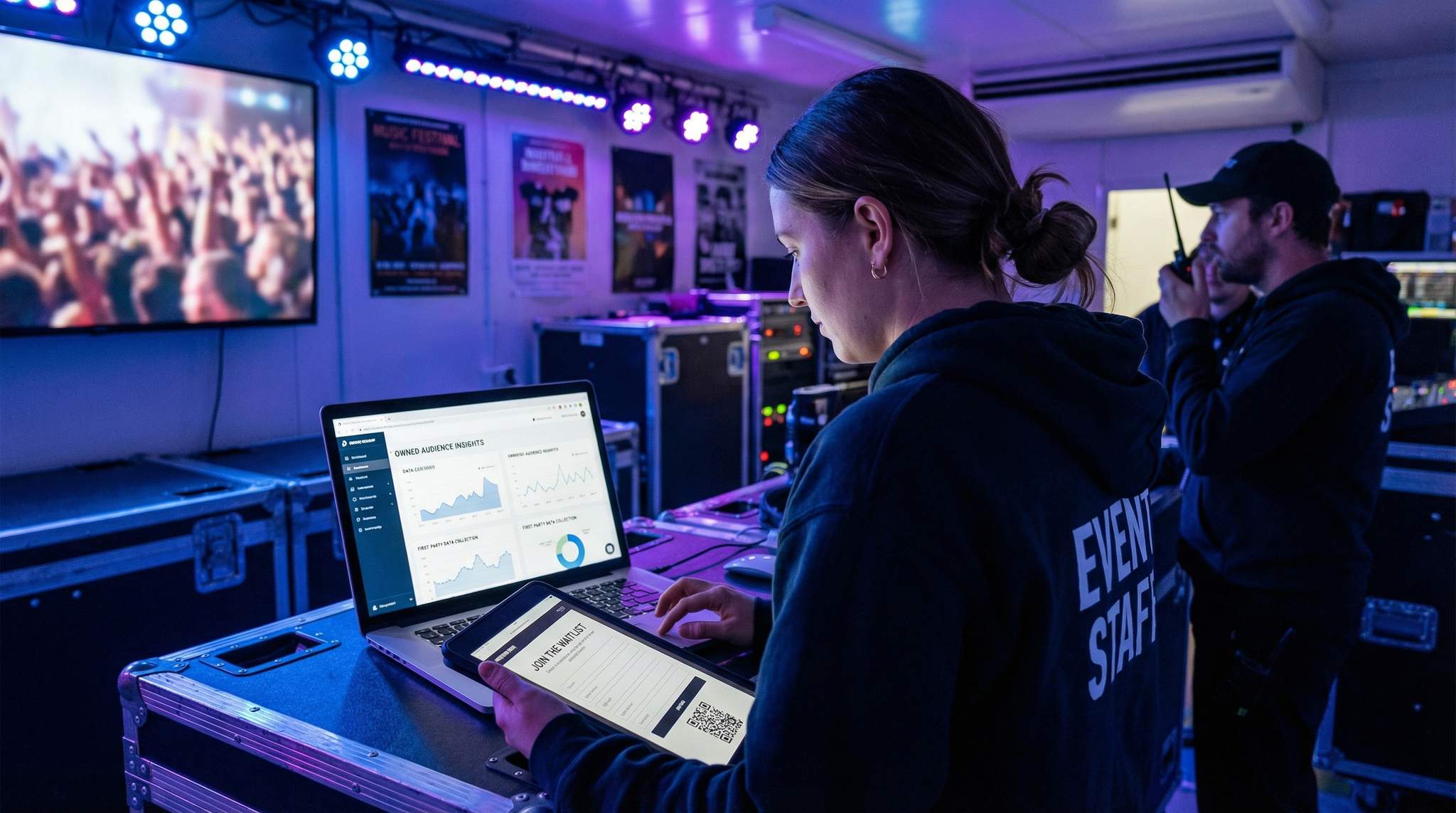
Another powerful approach is event pre-registration or waitlists. If your event isn’t on sale yet, allow people to “RSVP” or join a waitlist for updates. For instance, a conference might have a “Pre-register for updates and early pricing” form months before tickets are released. Or a festival might require fans to pre-register an account to be eligible for the ticket sale (major festivals like Tomorrowland and Glastonbury use this tactic to both gauge demand and collect data). Pre-registration not only builds hype and urgency – “sign up by X date for your chance to get tickets!” – but also yields a hefty list of interested leads you can later target. In 2025, Tomorrowland (a massive EDM festival) reportedly had over a million people pre-register for its global ticket sale, providing the organizers with a goldmine of emails and demographic info to market future events and merchandise.
Best practices for web sign-ups: Keep the form simple – name and email is often all you need initially. If you want to ask one preference question (e.g. “What types of events are you interested in?” with a few genres to choose), that can be useful for later segmentation but keep it optional. The less friction, the more sign-ups. Also, place the sign-up callouts prominently: consider a top banner, an exit-intent pop-up, or embedding the form in content (like midway through an event info page: “Enjoying what you see? Join 5,000 other fans getting updates”). Make sure it’s mobile-friendly. And of course, ensure compliance – include a note about agreeing to receive emails and link to your privacy policy.
Ticketing and Event Registration Data
Whenever someone actually buys a ticket or registers for your event, that’s a prime moment to collect first-party data. After all, the transaction requires them to provide at least an email and name – don’t waste that opportunity. Use a ticketing platform that gives you full access to purchaser data (some third-party ticket outlets have been notorious for limiting this, but platforms like Ticket Fairy are built to share attendee info with the event organizer by default). You’ll want to import or sync these ticket buyer contacts into your marketing database so you can continue the conversation beyond the sale.
For instance, experienced promoters will take the attendee list from this year’s event and immediately tag those as “past attendees” in their CRM. These are your warmest leads for the next event. One Las Vegas club promoter noted that every time they announce a new show, the very first email blast goes to last year’s ticket buyers – often with a “loyalty discount” or simply a thank-you + early access window. It’s common to see 15–20% of previous attendees jump on early-bird tickets when given a small nudge like that, generating solid baseline sales before broader marketing kicks in.
Make sure your ticket checkout flow asks buyers to opt in to communications (and make it sound enticing, e.g. a checkbox: “Yes, send me important updates and exclusive offers for future events”). Many people will leave it checked if it promises value. Also, consider collecting one or two preference points as part of the purchase process. For example, a registration form might include: “What’s your Instagram handle? (optional, for surprises)” or “Tell us your birthday (optional, for a special treat!)”. Some event ticketing systems even let you include survey questions at checkout. Don’t overdo it – remember data minimization – but if you have a loyal fanbase, a fun optional question can both engage them and give you extra data (like a favorite artist or t-shirt size for merch purposes).
Don’t forget on-site registrations. If your events allow walk-up registration or ticket purchase at the door, make sure you’re still capturing those folks. Using a digital ticketing app or at least a sign-in sheet for walk-ups is key – otherwise those attendees remain anonymous. Even something as simple as a fishbowl for business cards (for a corporate event) or a tablet sign-up at the merch table (“Join our VIP fan list for a chance to win a poster”) can turn walk-in foot traffic into future reachable audience.
Finally, after your event, leverage that attendee data. Send a follow-up “Thank you for attending” email (which doubles as a gentle way to keep them opted in for future announcements), a strategy that helps in engaging your core audience post-event. Many savvy organizers will include a teaser for next year’s dates or an offer (like “loyalty pricing” if you purchase next year’s ticket early). By doing this, you not only close the loop on the event experience, you seed the next event’s sales pipeline with an already engaged group. Past buyers are extremely valuable – in ticketing, they often convert for future events at much higher rates than new customers. Treat them like the VIPs they are in your marketing plan.
Contests, Giveaways, and Incentives for Data
One of the fastest ways to grow your marketing list is to harness fans’ excitement through contests and giveaways. People love the chance to win something – and you can love the influx of first-party data you get when they enter. The key is to design contests where signing up or sharing contact info is part of the entry.
For example, you might run a “Win 2 Free VIP Passes” giveaway a couple months before your event. To enter, fans provide their name, email, and perhaps phone (if SMS is part of your strategy) – typically through a simple landing page or a widget on your site. You can supercharge the campaign by also allowing bonus entries for referrals: e.g. “Get an extra entry for each friend who signs up with your link.” This turns your fans into ambassadors automatically and can exponentially increase sign-ups. In an interview with a festival marketer, they revealed using a referral-based contest that brought in thousands of new email addresses; each participant on average referred 2–3 friends who all became part of the marketing database, fueling friendly competition among fans and allowing organizers to leverage referral marketing insights to sell more tickets.
Social media is a great channel to promote these contests (people share contest posts naturally), but be sure to capture entries in a database you own. That usually means using a contest platform or a form that ultimately feeds into your CRM. There are many affordable contest tools that integrate with email services, or you can even use Google Forms + a script if on a tight budget. The point is to not only pick a winner but to end up with a big list of interested fans you can email or text later with “sorry you didn’t win…here’s a consolation discount” or other follow-ups. Everyone’s a winner in a data capture contest.
Another idea: in-person contests and activations. At your event, you could run a giveaway for those who sign up for your newsletter on the spot. For example, set up a QR code at the venue that opens a special sign-up form – “Enter to win a backstage meet-and-greet tonight! Just enter your email and we’ll notify the lucky fan.” Many people will jump at that chance, and you gain their info (make sure to mention they’ll also get future updates). For smaller events, even a paper sign-up sheet for a free merch drawing can work, but digital is easier to manage and you’ll capture more emails correctly.
Irresistible incentives drive sign-ups. Aside from free tickets or VIP upgrades, other prizes that work well include: exclusive access (e.g. meet the headliner, soundcheck access), merchandise bundles, drink vouchers, or “ticket + friend free” offers. Tailor it to your audience – the more the prize aligns with what your fans value, the more entries you’ll get. One caution: ensure the prize is for your event or at least related, so the people entering actually have interest in your experience (a generic iPad giveaway might attract random contest-hunters who will never become customers). A free VIP table at your club night, however, will attract people who want to attend your club night – perfect.
Contests and giveaways not only build your email/SMS list quickly, they also generate buzz. Fans share their excitement about the possibility of winning, which amplifies your reach at little cost. Just be sure to follow through and award the prize fairly – and thank everyone who entered. Post-contest, you might send a follow-up: “Jane from London won the VIP passes! Congrats Jane! Didn’t win this time? Stay tuned – we’ve got more excitement coming. Here’s £5 off early bird tickets as a thank-you for participating.” This kind of outreach keeps the goodwill going and often translates into sales, turning a contest entry into a paying customer.
(For a deep dive on running effective event contests, including legal rules and promotion tips, check out our guide on engaging fans with contests and giveaways to drive ticket sales.)
On-Site Engagement: Turning Attendees into Subscribers
Don’t overlook grassroots data collection at your events themselves. Every attendee physically on site is someone who could come back again – make sure you have their info! Beyond the ticketing data you captured at purchase, look for ways to get more folks signed up and engaged during the live event. This can both enhance their experience and feed your database.
Some tactics:
– SMS Opt-In at the Event: Use posters or screen visuals that say “Text DANCE to 12345 to get real-time updates and a special offer!” – Attendees send a text and opt in to your messaging (you instantly collect their phone number). The special offer could be a discount on merch or a chance to win an upgrade that night. This not only gives you first-party SMS contacts, it’s useful at festivals or multi-stage events to communicate changes or surprise announcements.
– Email Capture via Wi-Fi: If you offer attendee Wi-Fi, have a captive portal that asks for an email to log in. Many festivals and conferences do this. It’s a fair trade – internet access for data – just be sure to disclose that the email may be used for event updates. You can even add a checkbox for opting into newsletters (compliance check). The result: thousands of emails collected from on-site users who might not have bought tickets directly (for example, maybe their friend bought a multi-ticket order and you don’t have each individual’s email – this nets those missing contacts!).
– Interactive Kiosks or Photo Booths: Set up a selfie booth or VR experience that is free to use, but requires a quick sign-up. “Enter your email to get your photo and future VIP invites.” People have fun and you grow your list. Likewise, QR codes placed strategically (at bars, info desks, exit gates with a “scan to get a recap video and next year’s presale info”) can catch people in the moment.
– Old-School Sign-ups: Street team members with iPads or clipboards can roam the venue, especially in VIP areas or lines, asking people to join the community. This works best if they offer something immediate: “Hi! If you sign up for our email list, you’ll get a free sticker and we’ll send you a discount for the next event.” It’s surprising how many takers you’ll get for a small swag item. Even better, incorporate this into a friendly conversation about the event – it shouldn’t feel like a pure data grab, more like “We’d love to keep you in the loop – and hey, free sticker!”
Every on-site touchpoint is an opportunity to convert an attendee into a long-term fan. Just experiencing your event once might not guarantee they come back – but if you can reach them afterward with great content and offers, you greatly increase the chance of repeat attendance. Also, capturing more than just the ticket purchaser’s info helps you grow beyond the one contact per order limitation. For example, maybe one person bought 4 tickets for their friends – you have that buyer’s email, but not the other 3 people. If at the event you get those 3 others to sign up for something, boom – now you’ve expanded your reach to the whole group, not just the purchaser.
Partner Promotions and Cross-Event Data Sharing
While your primary focus should be collecting data directly, you can also augment your audience via strategic partnerships – done in a privacy-compliant way. For instance, if you’re running a joint event or have a sponsor deeply involved, there may be opportunities for mutual data growth. A common example is a co-hosted giveaway: you partner with, say, a local radio station or a brand relevant to your event to promote a contest or sweepstakes. Both of you share in the sign-ups collected (with clear disclosure to entrants). This way, you tap into each other’s audiences. Just ensure any partner you work with has a similar audience so the leads are likely to be interested in your event.
Another scenario is artist or influencer promotions. Let’s say you have a big artist headlining your festival. Often, artists drive sign-ups to their own fan clubs or text lists. Why not coordinate a campaign where the artist encourages their fans to sign up for your event updates? For example, the artist’s social post: “Join the XYZ Festival insider list and I’ll see you there! Link in bio.” In exchange, you might promote the artist’s newsletter to your attendees. These cross-promos can be win-win, as long as you keep it authentic and relevant.
Be mindful of privacy and only share data with partners when users have consented. If you plan any data sharing (like giving a sponsor the attendee list for a one-time email), it must be stated in your sign-up terms (“we may also send you offers from Sponsor X”). Many attendees will opt in if the sponsor is part of the experience (and if the offers are useful), but you must handle this transparently to maintain trust.
Turning Sign-Ups into Insights: Segmenting Your Event Audience Data
Collecting thousands of emails and phone numbers is fantastic – but the real power of first-party data comes when you organize and segment your audience. Segmentation means dividing your audience into meaningful groups based on their attributes or behavior, so you can target them with more relevant messaging. In 2026, one-size-fits-all blasts are a recipe for wasted potential; modern event marketing guides emphasize mastering email marketing automation for personalized campaigns to dramatically boost engagement. Let’s explore how to slice and dice your attendee data for maximum impact.
Demographic and Location Segments
Who your attendees are and where they come from can hugely influence how you market to them. Demographic segmentation might include age group, gender, or profession, depending on the event. For example, if you run a multi-genre music festival, you might find your under-25 attendees respond best to TikTok teasers and informal language, while the 40+ crowd prefers a Facebook update or email written in a more informational tone. By segmenting your list by age (when you have that data), you can adjust your content style and even the channel you use for different age brackets.
Location is one of the most practical segments for events. A local attendee versus an out-of-town attendee have different needs and motivations. Local fans might jump on late-release tickets since it’s easy to attend last-minute; they might also be interested in things like parking info or after-parties. Traveling attendees (say someone flying in for a festival) think months ahead – they care about accommodation packages, maybe airport shuttle info, and they often buy earlier to plan their trip. You can create segments like “radius 50 miles from event” vs “more than 50 miles away” using zip codes or cities collected at ticket purchase. Then tailor your campaigns: local segment gets a “last chance – just a short drive away!” message close to the event, while the distant segment gets messages like “Plan your trip – hotels selling out!” and early loyalty discounts. This kind of geo-segmentation was credited by one festival with boosting its out-of-state attendance by 30%, simply by addressing those fans with specific travel-related content that eased their decision to go.
Behavioral Segmentation (Past Purchases & Attendance)
One of the most powerful ways to segment is by what actions someone has taken in relation to your events. A first-time ticket buyer should not necessarily get the same message as someone who has attended five times and bought VIP each year. Consider creating groups such as:
- New Attendees: People who have just bought for the first time, or leads who have never purchased yet. These folks might need more event context (“what to expect at your first XYZ Fest”) or reassurance (social proof, testimonials) to nudge them to commit. If they’ve bought a ticket for the upcoming event and it’s their first event with you, send a warm welcome series explaining the event’s highlights, offering newbie tips, etc. This builds trust and reduces no-show rates.
- Loyal Returning Attendees: Identify those who’ve come to multiple events or repeatedly buy season passes. They deserve the VIP treatment in your marketing. You might create an exclusive segment like “3+ Events Attended” and reward them with early access to tickets, special pricing, or a simple recognition (“We notice you’ve been with us since 2019 – thank you! Here’s a sneak peek at this year’s lineup just for you”). This personal touch can turn loyal fans into lifelong evangelists.
- Big Spenders or VIPs: If certain customers consistently purchase high-end packages (VIP passes, bottle service, deluxe add-ons), segment them out. Your messaging to VIPs can highlight luxury experiences, exclusive upgrades, and insider opportunities (like meet-and-greets or premium merch). These fans have shown they’re willing to pay more for value, so cater to that in your communications.
- Last-Minute Buyers: Look at purchase timing. There may be a segment of your audience that always buys in the last week or day. It’s useful to tag these folks because you can approach them differently. For instance, you might not spend heavy ad dollars on them early on, since historically they wait. But when you hit the typical last-minute window, you can send a targeted “It’s now or never!” message to that segment, perhaps with an extra nudge like “Only a few tickets left – don’t miss out!” Conversely, identify early birds who always buy as soon as sales open – these are great people to recruit for referrals (“Thank you for being ahead of the game – share this referral code with friends so they can join you!”).
- No-Shows or Inactives: Though not always available, if you have attendance scans or certain customers who bought but didn’t attend (for free events or RSVP lists, etc.), that’s another segment. They showed interest but didn’t make it – maybe target them with “We missed you – here’s what happened at the event you signed up for” followed by “Hope to see you next time, here’s a special invite.” For email databases in general, you should separate those who haven’t opened or clicked in a long time (say 6-12 months) and attempt a re-engagement campaign or suppress them to maintain list hygiene.
Interest and Preference Segments
Remember that “zero-party” data we discussed? This is where it shines. If you’ve collected info on what people like or are interested in, use it to create segments that allow highly personalized content. Examples:
- Genre/Topic Preferences: Segment by stated interest. For a music event company, you might have one segment for “House Music Fans” and another for “Bass Music Fans” based on what people indicated or past events they attended. Then, when you announce a new house music show, you primarily send to that house segment (maybe with an exclusive presale) knowing they’re the most likely to convert. If you blast every single announcement to your whole list, people will start to tune out things that aren’t relevant. Segmentation prevents fatigue by matching fans with the content they care about. The same idea applies to conferences: e.g., at a tech expo, tag attendees by interest like “AI/Machine Learning” vs “Cybersecurity” based on either agenda choices or a survey. Then your email promoting an upcoming AI-focused meetup only goes to the AI-interested segment, who will appreciate it, instead of spamming your cybersecurity folks who might unsubscribe.
- Engagement Level: Some marketers create segments like “Engaged Subscribers” vs “Unengaged.” For instance, if a subset consistently opens/clicks emails or interacts with your posts, they’re prime candidates for new offers and referrals – they’ll amplify your message. You might send your highly engaged group extra content (behind-the-scenes videos, special surveys to get their feedback). Meanwhile, for those less engaged, you might try a different approach like a subject line “We Miss You – Here’s What’s New” or a re-engagement series to rekindle their interest. Essentially, treat your super-fans and your cold subscribers differently.
- Customer Lifecycle Stage: Is someone still a prospect (on your list but hasn’t bought a ticket yet)? Are they a first-time buyer? A repeat buyer? You can tailor messaging to where they are in the funnel. New prospects get more introductory content and social proof (“See past event highlights”), while repeat buyers might get loyalty rewards. Many email automation tools let you set up separate tracks for these stages, automatically moving people into the next segment when they purchase. According to Salesforce’s marketing research, leveraging first-party data to create these targeted segments can boost email open rates by +27% on average, as noted in reports on the future of marketing in a privacy-first world – a testament to how much people prefer relevant messages.
Below is a sample segmentation matrix for an event, showing possible segments and how you might approach each:
| Segment | Who They Are | Tailored Marketing Approach |
|---|---|---|
| First-Time Ticket Buyer | Never attended before; just bought or subscribed | Welcome email series introducing the event vibe, venue directions, newcomer tips. Build trust and excitement, maybe a new attendee discount for merch. |
| Loyal Multi-Event Attendee | Attended 3+ events or years | “VIP Insider” treatment – early lineup sneak peeks, loyalty promo code, thank-you messaging that acknowledges their support (e.g. “As a valued returning attendee…”). Encourage them to share feedback or refer friends. |
| Genre-Specific Segment | Interested in a specific genre/topic | Content focused on that interest. For example, send EDM news and DJ spotlights to “EDM Fans” segment, and send separate updates highlighting hip-hop artists to “Hip-Hop Fans.” Each segment feels like the event is catered to their taste. |
| Local Attendees | Lives near event city/region | Push last-minute sales (“It’s easy to join – you’re minutes away!”). Emphasize local community aspects, afterparties. Possibly less need for accommodation info, more about transit/parking. Use geo-targeted ads in their area in addition to email. |
| Traveling Attendees | From far away (out-of-town or international) | Send info on hotels, city guide, perhaps bundle deals (ticket + hotel packages). Communicate early about dates to facilitate planning. Highlight that the event is worth the trip (“Join fans from 20+ countries at our festival!”). |
| High Spenders (VIP) | Purchases VIP tickets or high-tier packages | Showcase luxury offerings: VIP lounge amenities, dedicated entrance, exclusive merch. Personal concierge communications if possible. Make them feel appreciated with VIP-only updates (“Your VIP schedule and perks”). |
| Dormant Subscribers | On list but no engagement in 6+ months | Re-engagement campaign: “We miss you – here’s what’s new since you last joined us.” Possibly a special offer to entice them back. If they still don’t interact, eventually suppress to maintain list health. |
The above are just examples – you should segment based on dimensions that make sense for your event and data. The main idea is to avoid blanket, generic messaging when you have the data to be smarter. As the saying goes, “market to somebody, not to everybody.” By sending targeted content, you’ll see better open rates, click-throughs, and ultimately more conversions to ticket sales, because each group feels like you understand what they care about.
Tools and Tips for Effective Segmentation
Managing segments might sound complex, but modern CRM and email marketing tools make it quite manageable. A few tips:
- Use Tags or Fields in Your CRM: Ensure your event CRM or email platform records key attributes (like last event attended, ticket type, etc.). You can then filter or create segments using these fields. For instance, add a tag for each event name when someone attends, or a tag “Subscribed via Contest” if you want to track that source.
- Automate Where Possible: Automation can move people between segments. For example, set up a workflow: “If contact buys a ticket, remove them from ‘prospect’ segment and add to ‘attendee’ segment.” This way your messaging adapts automatically after they convert. You can also automate messages for certain segments (like a drip series for new subscribers, a renewal reminder for past attendees around the anniversary of the event date, etc.). Many event marketers leverage personalized email automation to nurture new vs. loyal audiences differently.
- Track Engagement Metrics by Segment: Monitor how each segment responds. You might find your local segment has a higher open rate on Friday afternoon emails, whereas out-of-towners open more on Sunday nights (maybe planning their week). These insights help optimize send times and content. If a segment consistently underperforms (say, inactive segment barely opens even re-engagement emails), you might decide to sunset some of those contacts.
- Keep It Flexible: Segments aren’t permanent silos – they’re dynamic groups. People can belong to multiple segments or move between them. That’s fine. The goal is simply to be able to target those characteristics when relevant. Don’t over-segment into tiny groups unnecessarily (e.g., making a unique segment for 23-year-old UK females who attended in 2022 may be overkill unless you have a specific reason). Start with broader segments that have clear marketing differences.
- Test and Learn: Try sending a campaign targeted to a specific segment and see if it outperforms your generic campaigns. For example, send a personalized reminder to just last year’s attendees and measure the conversion. If it’s significantly better, that validates your segmentation strategy to continue and expand.
By developing a smart segmentation strategy, you transform your raw first-party data into actionable insights. You’ll be talking to the right people, at the right time, with the right message – which is exactly what drives higher ROI in event marketing. Next, let’s discuss leveraging these segments (and all your data) to craft personalized campaigns that truly move the needle on ticket sales.
Personalizing Campaigns for Maximum Impact
Having a rich dataset about your audience is half the battle – now you need to use those insights to personalize your marketing. In 2026, attendees are inundated with generic ads and emails daily. To stand out and convert, your messages should make people feel like you’re speaking directly to them. First-party data enables this at scale. Let’s break down how to execute personalized campaigns across key channels, and how doing so can dramatically boost your ticket sales.
Personalized Email Marketing that Sells
Email marketing remains one of the highest ROI channels for events, but simply blasting the same email to tens of thousands of people is leaving money on the table. By tailoring emails to each segment or even to the individual level, you can see major lifts in engagement. Basic personalization includes things like addressing the recipient by name – “Hey Alex,” – which every email platform can do with merge tags. But that’s just the start.
Consider incorporating dynamic content based on a subscriber’s data. For instance, you could send an email promoting your upcoming festival with a section that highlights artists of the genre that subscriber likes best. Subscribers tagged as “EDM Fans” see a block about the EDM headliners, while “Hip-Hop Fans” see a block about the hip-hop stage lineup – all in the same send, via dynamic content rules. This sounds advanced, but many email tools have drag-and-drop dynamic content features or at least conditional placeholders. The result is each reader gets an email that feels curated for their interests, which means they’re more likely to click through. One marketing study found that segmented, personalized emails drove a 27% higher open rate and substantially greater clicks than non-segmented emails, a statistic highlighted in discussions on the future of marketing in a privacy-first world.
Another strategy is to personalize based on purchase history or behavior. If you know someone attended last year, mention it: “Since you joined us last year, we wanted to give you first dibs on tickets for 2026…” This not only flatters the reader (acknowledging their loyalty) but also creates a sense of responsibility – they are part of the event’s story. If someone showed interest (clicked on certain artist info, or started buying a ticket but didn’t complete), you can send highly targeted follow-ups: “Still thinking about coming to XYZ Event? Here’s a recap of last year’s highlights [include images of the part they showed interest in]. We’d love to see you – let us know if you have any questions!” This kind of behavioral retargeting via email can recapture would-be attendees.
Automated email sequences help ensure personalization happens at the right time. For example, set up a welcome series for new sign-ups: Email 1 might be a warm welcome and brief intro to your event brand, Email 2 showcases upcoming events or testimonials from past attendees, Email 3 offers a first-time promo code to trigger a purchase. Automation can also handle post-purchase: buying a ticket triggers an immediate confirmation (of course), but then maybe a week later an email like “Get Ready for the Show – here are 5 tips to make the most of the event,” including things like parking info or a Spotify playlist of artists. Not only is that useful content, but it reinforces to the attendee that choosing your event was a great idea and keeps them excited (reducing any buyer’s remorse or chances they flake). Personalized touches like mentioning the exact event they bought for, the date, maybe a “See you in CityName!” subject line, all make the communication feel bespoke.
A/B testing can further optimize your personalization. If you’re unsure what personal detail resonates best, run tests. For instance, try one subject line that says “Your 2026 Festival Lineup Awaits, John!” versus “John, Your Favorite Artists Are Coming to 2026 Fest!” – one leverages name, the other leverages interest (favorite artists). See which gets a better open rate. Continuous testing helped one event organizer discover that including the city name in the subject line (for local segments) increased open rates by 10%, presumably because it caught locals’ attention (e.g., “New York VIP Party – Limited Passes Left” performed better than a generic “VIP Party – Limited Passes Left”). Little personalization tweaks like that can add up to significantly more eyes on your emails.
(For more on crafting effective event emails and using automation, read our in-depth guide on mastering email marketing and automation for events with personalized campaigns.)
Real-Time Connection with SMS and Messaging Apps
Email is fantastic for rich content and longer storytelling, but when it comes to immediacy and near-100% reach, SMS shines. Text messaging (and messaging apps like WhatsApp, Telegram, or Facebook Messenger) enable you to reach fans instantly on a device they always have in hand. Open rates for SMS are famously high – often cited around 95–98% open rates, with most texts read within minutes. For event marketers, SMS is perfect for timely, urgent, or exclusive communications, especially thanks to your first-party phone number list.
Personalizing SMS might simply mean using the person’s first name (“Hi Sam – just a heads up…”). You have far fewer characters to work with (and you must be extra respectful of frequency since texts feel even more personal), so pick your moments. Some effective personalized SMS use cases:
– Last-Minute Sale Push: Identify those who haven’t bought yet a week out. Send a friendly text: “Hey Alex, 2 weeks until DanceFest – tickets are almost gone. Grab yours if you haven’t! ?? We’d hate for you to miss out. – Team DanceFest.” Using their name and a casual tone feels like a friend reminding them, rather than a generic ad. You can include a short URL to the ticket page (use a URL shortener or the ticketing platform’s short link). Because SMS creates urgency, expect a flurry of clicks when you send these, especially if you imply scarcity or timeliness.
– Event Updates and Personal Touches: For those who have bought tickets (especially VIPs), an SMS during event week can enhance their experience. “Hi Jamie – Welcome to Tech Conference 2026 week! Check your email for your personal QR code ticket. P.S. We’ve reserved a front-row seat in your name. See you Friday!” This kind of message uses first-party data (knowing Jamie is VIP, for example) to add a personal concierge feel. It builds excitement and reassurance.
– Segmented Text Blasts: Because you can segment your SMS list just like email, you can target by interest or location here too. Let’s say you have a pool of phone numbers from a past festival. If you announce a spin-off event in the same genre, text only those likely interested: “Yo! We’re hosting a special Drum & Bass night next month at Club X. Since you raved with us at BassFest, here’s a pre-sale code just for you: BASSFAM. ? Tickets on sale tomorrow at noon. Don’t miss it!” This feels personal – it acknowledges their past attendance and gives them an insider perk. With SMS, the immediacy can drive very fast action on things like presales.
– Two-Way Engagement: Remember that many messaging platforms allow replies. You can set up a chatbot or even manually respond if feasible for a smaller event. Fans might ask questions (“what time do doors open?”) – how you handle these is also part of personalization. Responding with “Doors open at 8pm! Can’t wait to see you ? – John from XYZ Events” gives a one-to-one connection feeling that fans rave about. It’s not scalable for huge lists without automation, but even automated flows can use first names and keywords to give a semi-personal experience.
Always get explicit opt-in for SMS; it’s even more sensitive than email under regulations. But once someone opts in to texts from you, treat that as a special club – they’ve given you prime real estate on their lock screen. Don’t abuse it. Use SMS sparingly for high-value communications (e.g., important updates, exclusive offers) so that when a fan sees a text from you, they know it’s something worth checking.
(To explore more strategies for SMS and messaging apps in event promotion, see our guide on real-time audience connections through SMS and chat apps.)
Retargeting Ads with First-Party Precision
First-party data isn’t just for email and direct messaging – it’s incredibly useful for paid advertising as well. Most major ad platforms (Facebook/Instagram, Google, TikTok, Twitter/X, LinkedIn, etc.) allow you to upload your customer lists or integrate your CRM data, which they match (securely, via hashing) to user accounts. These are typically called Custom Audiences. By leveraging Custom Audiences, you can run ads that target exactly the people who have engaged with you before, yielding much higher relevance than broad interest targeting.
For example, you can upload a CSV of all email addresses who signed up for your festival pre-sale and create a “Festival Pre-registrants” audience on Facebook. Then serve those people an ad like “Pre-sale ends tomorrow – don’t forget your ticket!” to ensure they convert. This is far more efficient than hoping they randomly see your generic ad in the wild. In fact, internal data from Facebook has shown match rates often above 70% when using first-party lists, a capability that allows for highly effective retargeting strategies, meaning a large chunk of your list will see ads across Facebook or Instagram that you specify. And because these people already know your brand, click-through and conversion rates on these ads tend to be much higher than cold targeting, as noted in studies on post-cookie era marketing performance. Why spend money showing ads to random “music fans” when you can show them to people who have already been to your show or gave you their email because they’re interested?
A great strategy is to create segmented custom audiences that mirror your email segments. Most platforms let you upload multiple lists or upload one list with labels. You could have one audience for “Past Attendees – 2025 Festival”, another for “Prospects – signed up but not yet purchased”. The messaging in your ads can then speak to those groups differently, just like your emails do. “Welcome back! Relive the magic – tickets for 2026 on sale now” for the past attendees, versus “You’re invited! Don’t miss the experience everyone raved about last year” for the prospects.
Custom Audiences are also extremely useful for retargeting website visitors in a post-cookie world. With third-party cookies fading, the old way of auto-tracking site visitors with cookies is less reliable. But if you use tools like the Facebook Conversion API or Google’s Enhanced Conversions – which tie into your first-party data – you can still retarget folks who, say, visited your ticket page but didn’t buy. Essentially, when they entered their email on your site (maybe started checkout or subscribed), you got that data, and you can use it to find them on other platforms later. It’s not as automatic as cookies, but it works with privacy standards because the user gave you their email which you’re now using in a hashed manner to reach them on another platform – a method resilient to the cookie apocalypse, helping marketers measure success in a privacy-first era and maintain compliant attribution strategies.
Don’t forget Lookalike Audiences (or Similar Audiences on Google). This is where you feed the platform your first-party list, and it finds people who “look” similar in profile. While this technically ventures back into third-party data (since the platform uses its data to infer similarities), it’s a way to expand prospecting based on your first-party seed. For instance, upload your list of 1,000 best customers; Facebook might create a Lookalike of a few million people with matching traits (age, interests, online behavior). Lookalikes often outperform broad interest targeting because they use richer data points, especially now that your pixel might be limited. They’re a great way to acquire new attendees who resemble your proven fans.
One pro tip: use exclusion audiences too. If you have a list of current ticket holders, upload that and exclude it from your ad targeting when you’re running acquisition campaigns. No need to spend budget showing “Buy Tickets!” ads to someone who already bought – that can even annoy them. Instead, maybe target current ticket holders with a different message (like “Upgrade to VIP” or “Share this event with friends”). Excluding purchasers ensures your ad dollars go only to those who haven’t converted yet, improving your return on ad spend. This kind of precision targeting is only possible when you have solid first-party data to identify who’s who – another big advantage over purely third-party-based advertising.
(For more advanced tactics on using your data for paid ads, read our guide to Facebook & Instagram advanced targeting strategies for event promotion, which covers Custom Audiences, lookalikes, and more. Also see our piece on programmatic advertising with data-driven precision for using first-party data beyond the walled gardens.)
Multi-Channel Consistency
With multiple channels (email, SMS, ads, etc.) in play, strive to deliver a consistent personalized message across them. This is often called an omnichannel marketing approach – creating a seamless experience whether someone is reading an email, a text, or an ad. Your first-party data can be the common thread that ensures consistency. For example, if you know a particular fan is hyped about a certain artist, your email, your tweet, and your ad to them might all mention that artist’s appearance. Relevance repeated is powerful; it reinforces to the fan, “This event is exactly what I want.” According to experiential marketing studies, a unified message across multiple touchpoints significantly increases recall and conversion likelihood .
Being consistent also means timing and coordination. If you send a personalized discount code to someone by email, and the next day they see a generic full-price ad on Facebook, that’s a disconnected experience (and they may wonder “Why am I seeing an ad? I have a code in my email, maybe I’ll just ignore the ad”). Instead, you could exclude them from generic ads for a week to let them act on the email offer. Or vice versa – if you hit someone with a special offer ad targeted through your data, follow up via email to remind them of it. Using your CRM and marketing tools in harmony can automate a lot of this coordination.
Finally, personalize the on-site experience when possible, based on data. This goes beyond marketing, but it closes the loop of a personalized journey. For example, greet returning VIP guests by name at check-in (you have their name and photo from registration – train staff to say “Welcome back, Alex!”). Or, if you know certain attendees’ interests, you could invite subsets to secret shows or send them personalized schedules (“Don’t miss the crypto panel at 2pm, since you marked blockchain as an interest!”). These gestures, powered by your data, make attendees feel seen and valued, which in turn makes them more likely to keep engaging with you (and thus provide more data and purchases). It’s a virtuous cycle where personalization begets loyalty, which begets more first-party data as they interact with your brand community.
In summary, personalization is where first-party data translates into dollars. The more you can show the right content to the right person via the right channel, the more efficient and effective your marketing will be. Event marketers with 1:1 marketing mindsets (even if actually doing 1:many at scale) are filling venues while those relying on blast tactics find diminishing returns. Next, we’ll quantify how an owned audience and these personalized strategies boost your ROI and why it’s a long-term game-changer for event promotions.
Driving ROI: Repeat Attendance and Lifetime Value
At the end of the day, marketers have to justify budgets and show results. One of the strongest arguments for investing in first-party data and owned audiences is the boost in ROI and long-term revenue it can deliver. Let’s break down how leveraging your existing audience often yields far better returns than chasing new attendees from scratch every time – and how it future-proofs your event marketing against industry changes.
Retention Economics: Why Repeat Attendees Are Gold
It’s a classic marketing principle: acquiring a new customer is more expensive than retaining an existing one. This holds very true in events. Think of all the ad spend, awareness-building, and convincing needed to get someone who’s never heard of your event to buy a ticket. Now think of a person who’s already had a great time at one of your events – they likely need much less persuasion (maybe just a timely reminder) to buy again. In fact, statistics across industries show the probability of selling to an existing customer is around 60–70%, whereas the probability of selling to a new prospect is only 5–20%, according to customer loyalty and retention statistics. That’s a massive difference. For events, a past attendee has already overcome the trust barrier (“Is this event worth it?”) – they know it is, from experience. So when you present your next event, it’s a far easier sell.
We can quantify the impact too. Let’s say your concert series attracts 1,000 new attendees each time, with a ticket price of $50. If you convince even 20% of them to come back for the next show, that’s 200 repeat buyers, or $10,000 in revenue, you don’t need to spend heavy advertising to get – they’re yours via email or SMS. Meanwhile, to replace those 200 with new attendees, you might have to spend thousands on ads, promotions, etc., and still face that lower conversion probability. Many companies report that retention-focused marketing can be 5X more cost-effective than acquisition marketing. Or put another way, you might spend $1 in email marketing to re-engage a past attendee and get a sale, versus $5 in ads to acquire a newbie for the same ticket. Over time, that adds up to a significantly higher ROI on your marketing budget.
Additionally, existing attendees often spend more. If they loved the basic experience last time, they might upgrade to VIP the next. Or bring friends (effectively referring new customers to you at no cost). According to one analysis, 65% of a company’s business comes from existing customers on average, a key finding in customer loyalty research – a number events can certainly aim for by cultivating loyal attendees. For example, a nightlife promoter might notice that someone who comes back regularly also ends up spending at the bar or buying table service eventually. Or a conference sees past attendees bring colleagues with them the next year (referrals). These are all downstream revenue that stem from focusing on current fans.
There’s also the metric of Customer Lifetime Value (CLV) – the total worth of a customer to your business over the long term. By growing CLV, you increase profitability. First-party data helps boost CLV by enabling personalized retention strategies that keep people coming back. If the average festival-goer currently attends one event and never returns, their CLV is just their one ticket purchase. But if through targeted retention emails, loyalty perks, and community building you get that up to attending three events over a few years, their CLV triples. And those additional attendances likely cost you far less in marketing to achieve than the first one did. Some fanatical fans might attend annually for a decade – that’s the dream scenario of high CLV driven by brand loyalty.
It’s worth noting that focusing on retention doesn’t mean you ignore new audience growth. It means creating a balance where you’re not endlessly bleeding out past attendees and having to refill the bucket entirely with new ones. A healthy event brand has a core of repeat attendees plus a fresh influx each cycle. Your first-party data strategy ensures the core keeps coming and even growing (as referred friends join, etc.).
Lower Marketing Costs, Higher ROAS
Earlier we touched on cost efficiency, but let’s put it plainly: marketing to an owned list is incredibly cost-effective compared to paid advertising. Email marketing, for instance, has an average ROI of about 36–40x, meaning $36–$40 of revenue for every $1 spent, based on email marketing ROI benchmarks. That’s an average across industries; many event marketers see email ROI even higher since the cost to send additional emails is negligible. Even if your numbers are half that, it dwarfs typical ad ROI. If you spend $500 on an email campaign (between your email software cost and a bit of design/copy time) and that email blast brings in $20,000 in ticket sales, that’s a 40x return – spectacular by any standard.
We see the inverse on social ad platforms: costs are rising, targeting is less precise, and calculating true ROI is getting trickier with broken attribution. If your Facebook Ads are yielding 2x or 3x return (which can be the case in a post-ATT world), that’s not terrible, but it’s not 40x. So whenever possible, you want to drive conversions through your owned media – email, SMS, push notifications – because the cost per conversion tends to be much lower. One festival marketer noted that after heavily investing in their email list growth and engagement, they were able to cut their social ad budget by 30% year-over-year and still sell out earlier, simply because the email campaigns replaced a chunk of what ads used to do (at a fraction of the cost).
First-party data also improves the efficiency of any ads you do run. By uploading customer lists and focusing on those Custom Audiences and lookalikes, your ad spend is laser-focused on the most relevant people. You reduce waste on uninterested eyeballs. This boosts your ROAS (Return on Ad Spend). For example, a concert promotion that used broad targeting might have had a ROAS of 200% (i.e. $2 back per $1 spent, after all fees). But by switching to primarily custom audience retargeting and lookalikes of their buyers, they improved it to 500% (e.g. $5 back per $1 spent). That means with the same $1,000 ad spend, they now drive $5,000 in sales instead of $2,000. In tight-margin events, that can be the difference between profit or loss. Many marketers report seeing 2–3x higher click-through rates and conversion rates on ads targeted to their own lists versus general interest groups – it simply makes sense, as these folks have already engaged with your brand, making it vital to use custom audiences for festival marketing campaigns and leverage social media content effectively.
There’s also a snowball effect in savings: the more repeat business and word-of-mouth you generate from existing fans, the less you have to spend on paid marketing overall. If you deliver great experiences, those fans will bring friends and create organic buzz (which costs you $0). Your owned audience can help amplify your reach by sharing your content, redeeming referral codes, etc., all of which lower your effective marketing cost per acquisition. As your “house list” grows, you can rely a bit less on renting Facebook or Google’s audience. Many events aspire to reach a point where a majority of their tickets are sold via direct channels (email, direct site traffic, community) and only the remainder requires paid promotion to fill the gaps.
Building Community and Advocacy
While harder to quantify in pure dollars, an often overlooked benefit of building an owned audience is the community that can form around your event or brand. When you consistently engage your attendees year-round (not just when selling tickets), you foster a sense of belonging. People start to feel like they’re part of the “club” – whether it’s a fan club, a festival community group, or just an ongoing dialogue via socials and email.
This has real business benefits: a strong community means free marketing via advocacy. Your loyal attendees will proudly share your event announcements, create content (user-generated content like photos, videos, testimonials), defend your brand online, and even volunteer to help (like those fan ambassador programs). Essentially, your owned audience becomes a volunteer marketing army. This only happens if you nurture the relationship, which first-party data allows you to do at scale through personalized communication. In 2026, community-driven promotion is huge, with fans at the forefront of event marketing trends – fans trust other fans more than ads. By cultivating a community, you are indirectly boosting your marketing ROI because the community does some of the work for you (lessening how much paid or effort you have to expend).
One tangible program is referral or ambassador programs as mentioned earlier. A happy repeat attendee is likely to invite friends. By giving them referral links or codes, you track new sales and reward them – and the cost per new acquisition via referral (often just a small discount or perk) is far lower than by advertising. For example, a festival’s ambassador program might reward a free ticket for every 5 new tickets someone brings in. That’s effectively a 20% cost (one free for five sold), or a discount of 20% per referred ticket. Compare that to spending 50% of a ticket’s price on ads to convert a stranger – and the ambassador likely convinces their friends more effectively than an ad would anyway. One mid-size festival reported that their fan ambassadors drove over 1,200 ticket sales, at a cost far below their equivalent digital ad spend, proving how personal networks can multiply your reach and help you sell out without massive ad spend. That’s community power boosting ROI.
Long-Term Asset Value and Future-Proofing
Perhaps the most compelling argument: when you invest in building your first-party data and owned audience, you are building a long-term asset for your business. An email list, a mobile subscriber list, a CRM full of rich attendee profiles – these are assets that carry value year over year. Even if your lineup changes or you launch new event brands, you can tap into the audience you’ve built. It’s not starting from scratch each time; you have a foundation to build upon.
This asset also future-proofs you against the constantly shifting marketing landscape. We’ve already seen how algorithm changes and privacy rules undercut old marketing tactics. When (not if) more changes come – say, a new social platform rises or another one falls, or cookie rules tighten even more – your first-party database stays with you. You won’t be scrambling because you own a direct channel to your fans. Many promoters learned this when Facebook and Instagram’s algorithm updates throttled organic reach; those who hadn’t built an email list found it much harder to reach their followers unless they paid for ads. Those who did have a list could pivot and still drive traffic and sales via email. The same is now happening with cookie-based ad remarketing – the savvy teams who “owned their audiences” via CRM are navigating the cookieless world far more smoothly, successfully measuring success in the privacy-first era and avoiding mourning the loss of cookies.
Think of first-party data like a bank account that accrues interest. The more you deposit (i.e. the more audience you add and nurture), the more it pays back dividends in the form of easier sales later. If you ever plan to raise investment or sell your event business, that database can significantly increase your valuation – it’s proof of a loyal customer base and a channel to generate revenue. Some festival acquisitions, for instance, aren’t just about the event brand, but also about the customer list and data that the purchaser can then leverage for other ventures.
First-party data also future-proofs your measurement and strategy. Attribution of ad campaigns is getting tougher due to privacy (harder to see if a Facebook ad led to a sale, for example). But with your own data, you can implement things like unique promo codes or trackable links to your list, giving you clearer insight into what drives sales. You can measure the ROI of an email or SMS blast quite directly (you know who got it and if they purchased with, say, a code). This helps justify marketing spend and focus in areas that deliver (usually, your owned channels). In essence, you’re less blinded by the loss of third-party tracking because you have first-party tracking – you see what your known users do across touchpoints where they’re logged in or identified.
An Eye on Lifetime Value
A shift to first-party, owned audience marketing is a shift to a lifetime value mindset rather than a one-and-done campaign mindset. You start to think beyond just “how many tickets did we sell in this campaign?” to “how can we maximize the value of this attendee over years?” That might include tickets, merchandise, add-ons, and referrals. It leads to actions like starting a loyalty program for your events, offering membership or season passes, creating exclusive content for subscribers – all of which deepen engagement and revenue per customer.
For example, some nightlife promoters have launched membership clubs where fans pay a monthly fee to get access to all events plus perks. This model only works if you’ve built trust and a fanbase – effectively monetizing the audience asset in a new way. Another example: festivals creating off-season content (podcasts, mini online events) to keep fans engaged year-round, which keeps the community warm and ready to buy when festival season comes. These strategic moves are inspired by having that owned audience and wanting to maximize lifetime value. You stop thinking in terms of isolated events and start thinking about the fan’s journey with your brand over time.
One more note on future-proofing: having direct access to your attendees means you can handle crisis communication or unexpected changes far more effectively. If an event is postponed, you don’t want to rely on social media posts (which not everyone will see). With a solid email/phone list, you can reach out immediately to all ticket holders and followers with important announcements, thereby controlling the narrative and maintaining trust. This isn’t about marketing ROI in dollars, but it is about protecting the long-term health of your brand – which circles back to retaining that audience and their business.
In summary, focusing on first-party data and owned audiences is financially smart. It drives more revenue per marketing dollar (higher ROI), creates more reliable sales streams from repeat buyers, and builds an asset that protects and enhances your business’s value. It’s turning marketing from a pure expense (“how many ads must we buy to sell out?”) into an investment (“let’s grow our own channel so selling out gets easier each time”). Event marketers who adopt this mindset are the ones thriving despite tighter privacy and more competition for attention.
Managing Data Privacy and Trust
Building and leveraging first-party data brings great power – and with it, the responsibility to handle that data ethically and securely. In the era of GDPR, CCPA, and other privacy regulations, as well as heightened consumer awareness about personal information, how you treat your attendees’ data can make or break their trust (and your reputation). Let’s cover the best practices for data privacy, permission, and security that every event marketer must know when developing a first-party data strategy.
Transparency and Consent: The Foundations
First and foremost, always obtain clear consent when collecting someone’s data. This isn’t just a legal checkbox, it’s a trust-building step with your audience. When a fan signs up on your website, make sure it’s obvious what they’re signing up for. For example, have a small blurb like “By joining, you agree to receive our festival news and offers. We respect your privacy – unsubscribe anytime.” Avoid sneaky pre-checked boxes or burying consent in fine print. Those tactics can lead to people feeling duped, or worse, penalties under laws like GDPR which require affirmative opt-in. Instead, be upfront: people appreciate honesty, and the ones who opt in will be genuinely interested – which is what you want.
A great approach is to explain the value they’ll get by giving their data. We discussed offering incentives (news, presales, etc.) – when you fulfill those promises, it reinforces that exchanging their email or phone number was worth it. Also, if you ask for any info beyond basics, explain why. For instance, if you request a birthdate on a form, you could note in parentheses “(so we can send you something special for your birthday!)”. This way it doesn’t feel invasive; it feels purposeful and even delightful. In fact, one data ethics rule of thumb is: collect only what you need, and tell people why you need it. By following this, you demonstrate respect for your attendees’ personal info.
A real-world example: Glastonbury Festival requires ticket buyers to upload a photo and personal details in advance. That could seem intrusive, but Glastonbury explicitly states it’s “to prevent ticket touting (scalping)”, and fans widely accept it because it’s clearly tied to a benefit they support (fair ticket distribution), which aligns with building trust through festival data ethics. The lesson: when you frame data collection as a way to improve the fan experience or community (and actually use it for that stated purpose), people are comfortable sharing. Make transparency your policy – whether it’s on forms, in your FAQ, or in a welcome email (“Here’s what we’ll do with the info you gave us…”). It sets the tone that you’re a trustworthy steward of their data.
Of course, include a link to your privacy policy at sign-up points. And ensure your policy is up-to-date and compliant with relevant laws. It should cover what data you collect, how you use it, how someone can request deletion, etc. While many people won’t read the full policy, having a clear one is a must. In some regions (like the EU), you might also need to allow granular consent (e.g., separate opt-ins for email vs SMS, or for marketing vs sharing with partners). Compliance aside, offering fine-tuned preferences can be a good thing for trust. For example, let subscribers choose what they want to hear about – perhaps a preference center where they can check “I’m interested in Jazz events, Family events, and Food festivals.” This not only yields zero-party data for you, it shows you care about respecting their inbox and interests.
And always, always honor opt-outs. Make your “unsubscribe” link easy to find in emails. For SMS, allow replies like “STOP” to automatically opt out. It’s frustrating for users when unsubscribing is difficult, and it’s not worth trying to cling onto someone who clearly doesn’t want to be contacted – that can lead to spam complaints which harm your deliverability to others. It’s far better to lose an uninterested contact than to annoy them (they won’t buy anyway if they’re annoyed) and risk them bad-mouthing your brand.
Data Minimization and Relevance
A smart principle to follow: collect less, but better. Just because you could ask for a ton of data doesn’t mean you should. Each piece of data you collect should have a purpose. If you can’t answer “Why do we need this info and how will we use it to benefit the attendee or improve our marketing?” – then don’t collect it. Not only does this minimize privacy risk, it also reduces friction in sign-ups as noted earlier, helping you stay ahead of the curve in data ethics. Some events used to have long registration forms “for marketing purposes” asking everything from T-shirt size to favorite color – that era is over. People are protective of personal details unless there’s a clear benefit.
Perform regular audits of your data collection points. Check every field in forms and every data source. If you find you’ve been collecting, say, mailing addresses but you never use them (and perhaps never plan to), consider dropping that field. Why hold extra personal data that you don’t need? If you find you need it later, you can always ask then. Keeping data lean also limits the fallout if you had a breach (less sensitive info stored means less risk to individuals, hence less damage to your relationship and liability).
Also, ensure the data you keep is relevant and up-to-date. An outdated database full of old emails or incorrect info isn’t just ineffective for marketing, it can pose compliance issues (e.g., emailing people who never re-consented, etc.). Use double opt-in for email if you want to ensure they provided a valid address (user has to click a confirmation email). Periodically, reconfirm consent from older lists, especially if laws require it or if you haven’t emailed in a long time. It can be as simple as “We’d love to keep sharing upcoming events with you – click here to stay subscribed.” Those who don’t respond can be pruned. While it may feel painful to proactively remove contacts, it’s better to have a smaller list of engaged, consenting people than a massive list that mostly ignores you or marks you as spam because they forgot they signed up.
Remember, quality > quantity when it comes to first-party data. A smaller trove of well-permissioned, accurate data is more powerful than a huge blob of stale or dubious data. It also signals trustworthiness – you’re not hoarding data, you’re cultivating it.
Keeping Data Secure
All the goodwill you build with fans by collecting and using their data responsibly can vanish overnight if you suffer a data breach or leak that exposes that information. Event companies, big and small, have faced backlash and legal action after hackers stole ticket buyer info or an employee accidentally leaked emails by CC’ing everyone. To avoid being that headline, invest in data security appropriate to your scale.
Here are some essential practices:
– Use Reputable Platforms: Host your data in secure, reputable systems (CRM, ticketing platform, email service) that offer encryption and robust security measures. Don’t store sensitive data in plaintext on a random server or an unprotected Excel sheet. For example, Ticket Fairy (as a ticketing platform) will have security protocols for buyer data; likewise a CRM like HubSpot or Mailchimp handles a lot of security for you. Be wary of exporting data and keeping it on personal devices.
– Access Control: Limit who on your team can access the full customer data. Your marketing team might need emails and names for campaigns, but do they need raw credit card numbers? Certainly not. In fact, you should never see full payment data; that should be tokenized by your payment processor. Segregate duties – maybe only one or two key people have access to download the master list of contacts if needed. Others can use the data through the CRM without downloading it. Additionally, use strong passwords and two-factor authentication on any accounts with access to the data. It sounds basic, but so many breaches happen because of weak credentials.
– Encrypt and Protect: If you must store data files, encrypt them. If you’re sending a file to a partner (with user consent, of course) like a sponsor for a one-time email, use password-protected files or secure transfer methods – and ideally only share what’s necessary (e.g., maybe just email, no names or other PII, if all they need is to send an email). Ensure your websites where data is collected have SSL (HTTPS) so data isn’t intercepted in transit.
– Compliance with Laws: Know the data protection laws for your audience. GDPR (Europe) and CCPA/CPRA (California) are two big ones, but many countries have their own. These laws might require certain storage practices, breach notification protocols, and honoring user rights (like the right to access or delete their data upon request). In 2026, event organizers operate under stringent data protection laws worldwide – ignorance is not an excuse, especially when dealing with event tech security to protect attendee data. If you touch EU resident data, for example, you likely need to appoint a data protection officer (or at least have a clear process for handling personal data). The upside of complying is it largely aligns with doing right by the customer anyway – transparency, security, minimal use.
– Plan for the Worst: Consider having a basic incident response plan. If a breach happened, what would you do? Identifying and patching the issue, contacting affected users (as some laws require within so many hours), etc., are part of it. With first-party relationships, honest communication is key. If you ever had to notify fans of a data issue, doing so transparently and with empathy can mitigate trust damage. People understand that hacks happen even to good companies, but if you tried to hide it or were negligent, they won’t forgive.
A good example of proactive security is events using a ticketing system that hides personal details after a point. For instance, staff checking in tickets might see only a name and last 4 digits of phone for verification, not full addresses or payment info. That way, even if a staff device is compromised, the most sensitive data was never present. Similarly, when sharing data with partners or crew (like a list of VIPs to grant access), give them the minimum needed fields.
By demonstrating solid data security, you not only avoid crises, you can actually market your commitment to privacy as a selling point. We see more brands touting privacy – “Your info is safe with us, we’ll never sell or misuse it.” For a certain segment of consumers, this really matters. If your audience skews younger, they are quite privacy-conscious and will appreciate a brand that respects their data rights (given how they’ve grown up amid data scandals). Include a line on your site or forms: “We value your privacy and have strict policies to protect your personal data.” Then live up to it.
Ethical Data Use: Respect and Relevance
Ethical data use goes beyond just following laws. It’s about using data in ways that respect the individual and the context. For instance, just because you have someone’s phone number doesn’t mean you should bombard them with texts at odd hours or for trivial reasons. Or if someone gave you their email for a specific event, you should be thoughtful about how you then use that for other event promotions – it might be fair game (if your privacy policy says you’ll inform them of related events), but consider frequency and relevancy. If they signed up for a jazz festival newsletter, blasting them about a heavy metal concert might make them question your understanding of their interests (or at least lead to an unsubscribe).
In short, use the data to benefit the customer as well as you. Personalization should feel helpful, not creepy. An example of crossing the line might be using data in a way the person didn’t expect: imagine you got an attendee’s phone number for ticket delivery purposes, and then you start using it for promotional texts without clear prior consent. That could feel like a violation. Or taking information given for health/safety reasons (say, emergency contact or dietary restrictions at an event) and using it for marketing. Keep a firewall between operational use of data and marketing use unless consent covers both.
Another aspect of ethics: don’t sell your attendee data to third parties. It might be tempting if someone offers money for your email list, but doing so will destroy trust and likely run afoul of consent laws. Fans gave you their info for your event; passing it off to another company or unrelated event is a quick way to get people to never sign up again (and potentially to get fined under regulations). Even when working with sponsors, be cautious. Often sponsors want exposure to your attendees – that can be achieved through you sending emails on the sponsor’s behalf (so the data never leaves your hands), or via on-site activation where attendees knowingly engage and give data to the sponsor themselves. If a sponsor does get any attendee info, it should be only because the attendee explicitly opted in (like checking a box “I’d like to receive offers from Sponsor”). For example, a sports event could have a car company sponsor that offers test drives in exchange for sign-up – attendees who choose to do that are directly giving their info to the sponsor. That’s okay, but dumping your whole list to the sponsor is not.
Finally, consider ethical data enrichment and AI usage. Today, you might be able to match your emails with social media profiles or use AI to predict things about your attendees. These can be powerful tools (like knowing someone’s public social profile could help with targeting or inviting them to ambassador programs). But tread carefully: if you start leveraging data about people that they didn’t directly give you, be sure it’s publicly available and not sensitive. And even then, avoid the “we know everything about you” vibe. For example, you wouldn’t email a fan saying “We saw on your Facebook that you’re interested in scuba diving, maybe you’d like our beach party event?” – that would feel unsettling. Use insights internally to shape strategy (maybe you noticed a lot of your ticket buyers also like certain brands or artists, hinting at a good partnership opportunity), but maintain a customer-facing approach of consented data usage.
In summary, keeping the user’s perspective in mind is key. Ask, “If I were this attendee, would I feel okay with my data being used in this way? Does this communication or action provide value to me, or is it just exploiting my data?” When you use data to genuinely enhance the fan’s experience — whether through better personalization, timely info, or special perks — you’re practicing ethical data use and strengthening the relationship. When in doubt, err on the side of respect and caution. A positive reputation for how you handle data can be a competitive advantage, especially as consumers grow more selective about which brands they trust with their info.
By following these privacy and trust practices, you ensure that your first-party data strategy remains sustainable. Fans will continue to opt in and engage, knowing that you “get it” when it comes to their personal information. Trust is hard to gain and easy to lose — but with transparency, security, and respect, your event brand can become one that people trust implicitly, which means they’ll be happy to keep hearing from you (and buying tickets) for years to come.
Future-Proofing Your Event Marketing Strategy
First-party data isn’t just a tactic for this year – it’s a long-term strategy to future-proof your event marketing in a rapidly evolving digital landscape. We’ve touched on this, but let’s focus on how building an owned audience prepares you to weather whatever changes come next in marketing technology, social media, or consumer behavior. Think of it as “marketing insurance” that keeps your outreach effective even as external conditions shift.
Immune to Algorithm Upheavals
If there’s one constant with social and search platforms, it’s change. An algorithm tweak can send your organic reach plummeting or alter your ad performance overnight. We’ve seen Facebook throttle organic page reach to a trickle, Instagram pivot to favor Reels, Twitter (X) change feed algorithms – the list goes on. When you rely too heavily on those platforms to reach your audience, you’re essentially renting space that can be reclaimed or repriced at any time.
Building your own audience list makes you far less vulnerable to these changes. If tomorrow Facebook decided to prioritize cat videos over event posts, or TikTok’s algorithm no longer shows your content to followers, you still have direct contact with your fans via email, SMS, etc. It’s a liberating feeling as a marketer to not be completely beholden to third-party distribution. You can even frankly tell your followers, “Social media is unpredictable – join our mailing list to never miss an update.” Many fans understand this; they’ve missed posts from brands they care about due to algorithms. By bringing them into an owned channel, you ensure they get the important stuff. It’s like bypassing a fickle gatekeeper and having a guaranteed line of communication.
We can draw an analogy to how companies are trying to move from depending on, say, Amazon marketplace sales to getting customers to buy on their own website – owning the customer relationship is protective. In events, you’ll still use social media and external channels to attract new people, but as soon as you hook interest, your goal is to bring them into your own ecosystem (that mailing list, that community forum, etc.). Do that, and the next algorithm change or even the next platform dying (remember MySpace? Vine?) won’t sink your marketing. You carry on the conversation with fans no matter where the social winds blow.
Resilience in a Cookieless, Privacy-First World
We’re already deep into the transition to a world where third-party cookies and lax data sharing are fading. Google’s Privacy Sandbox, Apple’s continued push on privacy, and government regulations all point in one direction: marketers will have less and less third-party data to target and track users on the open web. Contextual ads and walled gardens might fill some gaps, but it’s clear that approaches from the 2010s won’t be as effective in the late 2020s. By investing in first-party data, you’re staying ahead of this curve.
Think about attribution and tracking. Where it used to be easy to see if a specific ad led to a ticket purchase (thanks to cookies), now you need new methods. First-party data offers solutions – like monitoring behavior of logged-in users on your site, or using unique identifiers in links, or leaning on surveys (“How did you hear about us?”). It’s not as seamless as old pixel tracking, but it’s under your control and often more privacy-compliant. For example, if you integrate your ticketing platform data with Google Analytics 4 using server-side tracking or their Conversion API, you’re feeding your own data into analytics rather than relying on browser cookies. It’s a way to keep measurement alive using first-party cookies/data, which are still allowed and powerful, enabling compliant attribution in a cookieless world and helping you measure success in the privacy-first era.
Retargeting, as discussed, will rely on customer lists uploaded to platforms, which is a privacy-safe method relative to third-party cookies. Platforms themselves, like Facebook, are building more tools for businesses to use their own data (because they know their old methods are eroding). By having a robust first-party dataset, you can plug into these new tools. Those late to the game – who haven’t built a list – will struggle to adjust once cookies are truly gone and they have no solid customer list to fall back on. In a sense, you are future-proofing by owning the data source instead of borrowing it.
Adapting to New Platforms and Technologies
Every few years, a new platform or format emerges that changes how we reach audiences. We saw the explosion of TikTok, the advent of podcast advertising, the rise of community platforms like Discord, and who knows what’s next (the metaverse events? new AR experiences? hyper-personalized AI agents?). The beauty of a strong owned audience is you can bring them along with you to new channels. If email open rates decline in favor of, say, a new messaging app, you can invite your subscribers to join you there (because you have that contact with them to even ask). If young audiences flock to a new social platform, you can use your email/SMS list to promote your presence there or to survey which platforms they prefer. Essentially, your direct connection allows you to be nimble and meet your audience wherever the next big thing is, without losing them in between.
Also consider content adaptation. When you know your audience and have that relationship, you can experiment with new content formats and get feedback quickly via your channels. For example, you might try a podcast for your festival – you promote it to your email list, many join, you see feedback, and you’ve now extended your brand into audio. Or you start a Discord server for super-fans (a current trend for events and artists). You initially recruit members by emailing your top engaged fans with an invite link. Now you have a real-time chat community – another owned space – that you can use for engagement and announcements. These expansions are only possible because you had the first-party data to leverage in rallying people to a new platform.
First-party data also gives you flexibility with paid media in the future. Imagine TV or digital out-of-home ads (billboards) become more programmatically accessible – you could use insights from your data to target cities with high concentrations of past attendees, for instance. Or if ad targeting shifts to more aggregated methods (like Google’s Topics API which clusters interests), your own data can validate which topics your audience falls into, so you optimize campaigns accordingly. Marketers who have zero clue about their customers (because they never collected the data) will be guessing; you’ll be acting on knowledge.
Surviving Industry Shocks
The events of 2020 (global pandemic) taught the event industry a hard lesson: you may one day face a scenario where traditional marketing and events themselves are disrupted. How do you keep your audience engaged when live events halt? Those who had an owned audience could still reach out, maintain connection (online events, content, merch sales to support, etc.). We saw artists doing email newsletters or SMS updates to stay in touch with fans when tours were canceled. Festivals did virtual festivals and needed to email attendees about new dates and policies. Without first-party channels, many would have been completely dark, losing momentum and goodwill.
While hopefully we won’t see such a shock again, other crises can happen – from natural disasters affecting event dates to social media outages (remember the day Facebook and Instagram went down for hours?). In those moments, having a direct line to your attendees is a lifesaver. You can quickly communicate changes, provide reassurance, and rally support if needed (like fundraising or postponement info). It’s a key part of crisis comms strategy, as outlined in introductions to event marketing resilience and strategies to ignite demand. On the flip side, if another platform skyrockets in popularity, you can capitalize faster via your channels (e.g., “Follow us on PlatformX for daily behind-the-scenes clips” sent to your list).
Also consider economic shifts. If ad prices soar due to inflation or a big event like an election (driving up demand for ad inventory), you can lean more on owned media instead of bidding in pricey auctions for attention. If certain targeting options you used get restricted legally (like you can’t target by certain demographics anymore), you have your database where people voluntarily provided info or you can segment by behavior which no law stops you from doing internally. In essence, you’re less at the mercy of external economic and regulatory swings because you’re not basing your strategy 100% on them.
Continual Audience Insights
Having first-party data also means you can continually learn and adapt from it, keeping your strategy fresh. By analyzing your own audience’s behaviors and responses, you might catch early trends that future-proof you creatively. For instance, maybe you spot that emails about sustainability initiatives had off-the-charts engagement. That could signal that your audience is increasingly eco-conscious – informing you to ramp up those efforts in marketing and operations (and thus staying ahead of a trend that by 2026 is indeed huge, as seen in key trends for sold-out events). Or your ticketing data might show an uptick in purchases from a new city – indicating a potential market to target with events or dedicated outreach. Without owning your data, you wouldn’t see these clues; you’d rely on lagging third-party reports or hearsay.
Your first-party data is like your marketing R&D lab. You can run A/B tests on your emails or landing pages, see actual sales impacts, and refine strategy in a continuous loop. The learnings you gather become a competitive advantage over others who operate more blindly. And because you know your audience deeply, you’re in a better position to experiment with new marketing methods in ways that resonate. For example, if and when AI-driven personalized content become mainstream (some would argue it already is), you’ll have the rich profiles needed to feed those AI systems to output highly tailored creative. Companies with scant data will not be able to leverage such tools effectively.
In conclusion, building an owned audience and first-party data reservoir is one of the best moves to make your event marketing durable and adaptable. It reduces dependence on any one channel, equips you with knowledge to navigate change, and ensures that no matter what external shifts occur – be it technology, regulations, or consumer habits – you have direct access to the people who keep your business alive: your attendees. By investing in those relationships now, you’re essentially “future-proofing” your ability to market to them later, come what may. It’s a long-term play that will pay off not just in the next campaign, but for years and events down the line.