Introduction
The High Stakes of Accurate Ticket Forecasts
Every event promoter knows the uneasy feeling of watching ticket sales and wondering if the event will sell out or fall short. In 2026’s live events landscape, this uncertainty is heightened – buying patterns have shifted and accurate ticket sales forecasting has become mission-critical to avoid nasty surprises. Underestimating attendance can mean long entry lines, food shortages, or overwhelmed staff, while overestimating leads to empty seats and budget waste. Experienced event marketers treat forecasting as an essential part of campaign planning, not an afterthought. If you can predict final attendance and revenue with reasonable accuracy, you can calibrate your marketing spend, staffing, and venue prep for success.
One cautionary tale illustrates the stakes: an event promoter once assumed everything was on track – only to discover three weeks before showtime that ticket sales had flatlined for a month. Because no one was actively monitoring the numbers, a critical issue (a glitch in the mobile checkout) went unnoticed, costing untold sales. The lesson? You can’t afford to “fly blind” and simply hope for the best. Setting up data-driven forecasting early on – and tracking sales pace continually – lets you catch red flags in time to act. In 2026, gut instinct alone isn’t enough; data-guided predictions are the lifeline that ensures your brilliant event plans translate into packed venues.
Evolving Ticket-Buying Habits in 2026
Attendee behavior has changed dramatically in recent years, directly impacting how we forecast sales. Traditionally, many events saw a steady build-up of sales over months. Now, we’re in the era of the last-minute ticket rush. Industry data confirms a sharp shift: according to Pollstar’s analysis of 2022–2024 ticketing trends, 57% of tickets are now sold in the final week before a show, and the average on-sale period has shortened by 26%, forcing organizers to adapt their 2026 event marketing strategy. Even marquee events feel this change – for example, The Guardian’s analysis of Coachella 2024 ticket sales revealed the festival had its slowest sales in a decade, with 125,000 passes taking 27 days to sell (versus four days the year prior). This late-buying phenomenon makes forecasting both more challenging and more crucial. Promoters can no longer assume an early sales slump means doom – it might be the new normal – but they also can’t sit back and wait without a plan.
Why are people waiting longer to buy? Post-pandemic uncertainty and flexible planning are big factors. Fans have learned that if an event isn’t sold out, there could be last-minute deals, or they simply hesitate to commit in advance after years of unexpected cancellations. Some hold off hoping for price drops or promos, especially where dynamic pricing or resale sites encourage gambling on late discounts. Many make event decisions closer to the date based on work schedules, friend plans, or even weather forecasts. And in an age of endless options, fans often delay committing until they’re sure your event is the winner – leading to a huge surge in the final days, a trend confirmed by Softjourn’s insights on ticketing industry trends. All these factors mean your sales pace may follow a very non-linear curve.
Data-Driven Event Marketing
Track ticket sales, demographics, marketing ROI, and social reach in real time. Exportable reports give you the insights to make smarter decisions.
The savvy event organizer anticipates these habits. Instead of panicking at a mid-campaign plateau, they analyze whether it aligns with modern trends and adjust tactics accordingly. For instance, if you know many ticket buyers are procrastinating, you’ll plan a major marketing blitz in the last 2 weeks (rather than spending your entire budget early) to capture that late surge. In short, forecasting in 2026 requires understanding new buying psychology. It’s about blending data and intuition – as one industry CEO explained, most shows now see an initial spike then a quiet period until a final 2–3 day sales frenzy, making it an anxious wait for those without a plan. The good news is that with the right data and mindset, you can predict these patterns and even turn them to your advantage.
Data Insights vs. Gut Instinct
Forecasting ticket sales is part science, part art. On one hand, we have more data than ever – real-time ticket dashboards, historical sales curves, web analytics, and social media buzz – to inform projections. On the other, experienced promoters bring invaluable intuition about their audience and market. The key is not choosing between data or gut, but combining both. The smartest event decisions blend analytical insights with human experience. Data can reveal patterns (e.g. a trend that 30% of tickets consistently sell in the last week) while a veteran’s instinct can sense when this year might behave differently (perhaps due to a weaker lineup or economic downturn).
What’s dangerous is relying solely on one or the other. Ignoring data and “flying blind” is obviously risky – as we saw, you could miss that sales have stalled or that a certain ad campaign isn’t converting until it’s too late. But blindly trusting a spreadsheet without context can also lead you astray; models might assume past patterns will repeat perfectly when real life has other plans. The solution is a balanced approach: use data as your compass, and your industry knowledge as the guiding hand on the wheel. For example, if analytics show web traffic is high but conversions are low, data flags a problem – maybe your checkout flow or message – and your experience helps pinpoint the fix (perhaps the ticket page copy isn’t compelling).
Event marketing veterans recommend establishing a baseline forecast using data, then updating it with real-world feedback as the campaign unfolds. Treat your forecast as a living tool, not a static prediction. Each week, ask: Are we ahead of pace or behind? Why? If a metric looks off (like strong engagement but weak sales), dig in with both analytics and on-the-ground insight. Maybe fans love your posts but find tickets too pricey – or maybe a tech glitch is to blame. By marrying numbers with nuance, you build forecasts you can trust and create the agility to pivot promotions at the right moments. In the following sections, we’ll dive into exactly how to do this – how to map your sales curve, leverage historical data and benchmarks, and respond in real time whether sales are lagging or surging.
Mapping the Ticket Sales Curve
Typical Ticket Sales Phases (Launch to Last-Minute)
Most events follow a familiar sales curve with distinct phases. Understanding these phases is the first step to forecasting where you’ll end up:
- Initial Launch Surge: Right when tickets go on sale, there’s often a spike of purchases. Your most eager fans, early-bird deal hunters, and loyal attendees jump in immediately to secure their spot. This is why a well-executed on-sale launch campaign is so crucial – a strong start can account for 20-40% of total ticket sales in the first few days for a hot event. For example, major concert tours might sell 50%+ of tickets in the first week after announcement if the artist has a devoted following. An effective early-bird promotion or teaser campaign can further boost this rush. (On the flip side, if your launch week sales are soft, that’s an early warning sign to investigate.)
- Mid-Campaign Plateau: After the initial excitement, it’s common to see a slowdown or plateau in sales. The graph flattens as the “low-hanging fruit” of enthusiastic buyers is exhausted and the more casual prospects take a wait-and-see approach. This mid-campaign slump can last weeks or even months, especially for events announced far in advance, requiring strategies to overcome the mid-campaign slump. Don’t be alarmed – nearly every event from club shows to festivals experiences this lull. Many potential attendees are deliberating: checking schedules, waiting on friends, or simply procrastinating because the event date feels distant. However, you can’t just ignore this phase; it’s the perfect time to re-engage your audience (more on that later) to ensure the lull doesn’t extend too long.
- Final Countdown Surge: In the last few weeks – and especially the final 7-10 days – sales often skyrocket. This is the era of the procrastinator’s golden rush. All those fence-sitters suddenly make up their minds, friend groups finalize plans, and the looming event date creates urgency. It’s not unusual now to see a huge percentage of tickets move at the end. For instance, festival organizers report that 50% or more of tickets can sell in the last month for late-buy markets like Latin America, and as we saw, over half of tickets across many events are sold in the final week. That translates to daily sales spikes that might dwarf the early weeks. Moreover, any remaining discount deadlines (“Last day for regular pricing!”) or simply FOMO kicks in during this stage, driving a torrent of last-minute buyers. If you’ve done your job building awareness, this is when it pays off – but you also need to be ready to capitalize on it with a strong final marketing push.
It’s important to note that while this three-phase pattern (early surge – mid plateau – final spike) is common, the height and length of each phase can vary greatly by event. Some events have almost no plateau (just a steady climb after launch if interest remains consistently high), whereas others have a very long flat middle and an explosive last-minute climb. By plotting out these phases for your specific event – either based on past editions or industry norms – you can create a sales timeline model to compare against as real sales roll in.
Built-In Email Marketing for Events
Send targeted campaigns, automated purchase confirmations, and post-event follow-ups directly from your ticketing dashboard.
Variations by Event Size and Type
Not all events sell the same way. A 200-capacity club show and an 80,000-seat stadium tour have very different sales dynamics, as do a multi-day festival versus a one-night conference gala. To forecast accurately, you must account for your event’s scale, genre, and audience behavior. Here are a few typical patterns:
- Local Club Nights & Small Shows: Small, local events (think bar gigs, club nights, community theater) tend to see most sales at the last minute – often literally in the final days or at the door. Many attendees decide spontaneously or wait to see if their friends are going. It’s not uncommon for a local show to be only 10-20% sold a month out, then fill up in the last 48 hours. As an event marketer, you’d keep a close eye on week-of-show sales and be ready with heavy promotion during that time (and ensure door sale logistics are smooth). The good news is this pattern can be anticipated – if you know most people buy late, you won’t panic early, but you also won’t ease up on marketing until the very end.
- Concerts & Tours: For concerts, especially those with popular artists or tours with on-sale dates, there’s usually a big launch spike. Fans rush for tickets when the tour is announced – sometimes causing an instant sell-out if demand far exceeds supply (think Taylor Swift or BTS levels of hype). For many concerts, 30-60% of tickets might sell in the first week or two. After that, sales might trickle in slowly. Some concerts then have a second bump close to show day if tickets remain, driven by last-minute deciders. The forecasting challenge here is gauging the true demand during the launch: if you sell only 20% at on-sale for an arena show, you know you have work to do, whereas 80% sold early indicates you’ll likely hit capacity well before the event. Multi-city tours require forecasting city by city – savvy promoters use early sales in the strongest markets as a benchmark and adjust marketing in slower markets accordingly.
- Festivals & Destination Events: Festivals often launch with early-bird tickets and lineup announcements far in advance. A strong early-bird phase can move 20-30% of tickets months out (sometimes more if it’s a beloved fest with loyal attendees). Then there might be a long quiet period (aside from perhaps smaller spikes when you drop lineup news or tier price increases). A massive surge typically comes in the final 4-6 weeks as attendees finalize travel, time off, and hear the hype building. For example, a festival might be only 50% sold two months out but still reach 100% by showtime, with half of the tickets selling in that home stretch. The forecast here must consider external factors like travel plans and accommodations – e.g. if you see a spike in hotel bookings or flight searches to your festival city, it can precede ticket buys. Also, festivals in some regions have culturally last-minute buyers (more on that in the regional section). Many festival promoters plan marketing spend in two big waves: at launch and about 1-2 months before show.
- Conferences & Corporate Events: Conferences often have deadline-driven sales patterns. You’ll see bumps around early registration deadlines, discount cut-offs, or as certain sessions/speakers are announced. For instance, a business conference might sell 30-40% of passes early to “super early-bird” buyers who want the best price, then slow down, then see another bump when early-bird pricing is about to end, another lull, and finally a rush in the last 2 weeks as professionals wait for management approval or final schedules. There’s also often a high no-show or last-minute substitution rate to consider. In forecasting conference attendance, factor in these multiple mini-surges and historical show-up rates. If by the final week you’re at say 90% of your registration goal, you might actually be in great shape because a wave of on-site registrations can occur too (many conferences allow buying tickets at the door). The key is to use past delegate behavior as a model – e.g. “We expect 25% of tickets to come in the last 10 days, because that’s what happened last year.” If you’re a new event, lean on industry benchmarks from similar events.
These are generalizations, but they highlight why forecasting must be tailored. A mistake would be to assume your timeline will look the same as a different type of event. Always ask: How does my target audience typically behave? For example, younger audiences (18–24) often buy later and via mobile at the last second, whereas older or family audiences might secure tickets earlier to arrange logistics. Segmenting by ticket type can also help your forecast – maybe VIP tickets sell out early (since die-hard fans snap them up) while standard tickets sell closer to the date. If you notice 80% of VIP tickets are gone but only 30% of general admission are sold, you might project GA sales will catch up during the late surge and adjust your marketing to push those specifically.
To visualize different trajectories, consider the simplified comparison below of two extreme scenarios: an advance-buy culture event (like a big concert in a market where people buy early) vs. a late-buy culture event (like a festival in a market where last-minute is the norm). Both events may end up selling out, but their paths to get there look very different:
| Time Before Event | Advance-Buy Market (e.g. USA/UK typical pattern) |
Late-Buy Market (e.g. Latin America typical pattern) |
|---|---|---|
| 3+ months out | ~20% of tickets sold | ~5% of tickets sold |
| 2 months out | ~50% of tickets sold | ~20% of tickets sold |
| 1 month out | ~80% of tickets sold | ~60% of tickets sold |
| Final week | ~100% (sell-out reached) | ~100% (sell-out reached) |
Table: Example of how ticket sales timing can differ in an early-buy culture vs. a late-buy culture. The late-buy scenario might look scary if you didn’t know the context – only 20% sold by 2 months out! – but veteran promoters in those markets expect it and plan accordingly. The advance-buy scenario front-loads much more of the sales. Your job as a forecaster is to identify which scenario (or a mix) applies to your event. If your data shows an advance-buy pattern but sales are lagging, that’s a sign to worry. Conversely, if you’re in a late-buy market, slow early sales are normal, but you better be ready to push hard late.
Real-World Example: Reading the Curve
To illustrate, let’s say you’re organizing a 2-day techno music festival in Brazil, and it’s 8 weeks out from the event. You’ve sold 25% of your tickets so far. If this were a similar festival in the UK or US, 25% at 8 weeks might be a red flag (since perhaps 50%+ would be gone by now). But knowing the local market’s habits, you realize Brazil has a heavy last-minute buying culture – it’s common for 50% of tickets to sell in the final month. Thus, your 25% sold at 8 weeks might actually be on track or even slightly ahead for that market. You’d forecast final attendance optimistically but still execute a strong late-stage marketing plan (because “last-minute surge” doesn’t happen by magic – it’s fueled by a timely blitz of ads, reminders, and content in those final weeks).
On the other hand, imagine a famous DJ’s club show in London that expects 500 attendees. You put tickets on sale and 300 sell in the first 48 hours due to fan club promotion – a great start (60% sold). Then sales slow down. By 2 weeks out, you’re at 350 (70%). If history tells you London club events usually sell ~30% of tickets in the last two weeks from door sales and procrastinators, you can forecast that you’ll likely hit around 100% (500) by showtime. You might still add a little extra promo to be safe, but you don’t need to panic or discount heavily. In fact, seeing that strong early 60% might prompt you to shift some budget to a different struggling event, and just keep lighter promotional touch on this one (maybe focus on engaging those attending rather than pure awareness).
The takeaway is: know the curve for your event. Reference points from similar past events, your venue’s typical on-sale patterns, and industry data help you sketch an expected curve. Then, continually measure your actual sales against that curve to gauge if you’re ahead, on track, or behind. In the next sections, we’ll explore how to set up those benchmarks and what to do as the numbers roll in.
Setting Benchmarks and Milestones
Establishing Ticket Sales Goals and Timeline Milestones
Forecasting begins with defining where you’re trying to go – your target final attendance or ticket revenue – and the key milestones on the way there. Start by setting a clear ticket sales goal for your event. This could be a number of tickets (e.g. 5,000 tickets) or a revenue target (£250,000 in ticket sales), depending on your priorities. This goal is often determined by venue capacity, budget break-even points, and desired profit. For instance, if your venue holds 500 and you need to sell at least 300 tickets to cover costs, those numbers anchor your goals.
Once you have a final goal, break it down into timeline milestones. These are checkpoints in time by which you expect to have sold a certain percentage of tickets. Milestones serve as early warning systems; if you miss one, you know to react quickly. How do you choose the right milestones? Look at historical data and benchmarks. If last year’s event sold 30% of tickets in the first month and ended up 100% sold out, that can inform a milestone (perhaps aiming for ~30% in month one again). If industry research or similar events suggest that by one month out you should be around 75% of capacity, use that. The idea is to map an “ideal” pace line against which actual sales will be compared.
For example, you might create a simple timeline like:
– Launch Day: Aim for 15% of tickets sold (with the on-sale buzz and early-birds).
– 1 Month in (e.g. 3 months before event): 40% sold.
– 2 Months in (2 months before event): 60% sold.
– 1 Month before Event: 80% sold.
– Event Week: 100% (sell-out).
These numbers will vary widely by event type and market (as we’ve discussed, some might be much lower earlier and then jump). The point is to have a roadmap. Many seasoned promoters use an internal spreadsheet or dashboard with these milestones clearly laid out. They might even label them with traffic light colors – green if on or above target, yellow if slightly behind, red if significantly behind. For instance, if by 1 month out you’re only 50% sold but your plan called for 80%, that milestone would flag red and trigger immediate interventions (like ramping up promos or offers). Conversely, if you hit 80% two months early, you know you’re ahead and can allocate resources differently (maybe marketing dollars shift to upselling VIP or go to another event that needs help).
When setting milestones, be realistic but a bit aspirational. Consider your marketing calendar: do you have waves of promotion that will naturally spike sales at certain points? Align milestones with those. For example, if you know a big artist announcement is coming 2 months out, you might expect a sales bump then – set a milestone to capture the boost after that announcement. Also factor in external dates: perhaps payday cycles (end of month paychecks) often see more ticket purchases, or holiday periods might slow sales. An experienced event marketer in Australia might set slower milestones in December when people are distracted by holidays, then a big jump in January when attention returns to events.
Finally, communicate these targets to your team. Everyone from marketing to production should know the sales pace expectations. This manages internal expectations (“we’re only at 50% now, but that’s okay because we planned for late sales”) and ensures that if things go off track, everyone is mobilized to fix it. Treat your milestones as a part of the campaign’s KPIs – just like you’d watch ad click-through rates or email open rates, you watch percentage to ticket goal at each time mark.
Leveraging Historical Data for Benchmarks
Your own past event data is a goldmine for forecasting – it provides empirically grounded benchmarks. Historical sales data tells the true story of how your audience buys. If you’ve run the event (or similar events) before, start by graphing the cumulative ticket sales of those previous instances over time. Look for patterns: what percentage was sold at various intervals, and how did final sales pan out?
Ready to Sell Tickets?
Create professional event pages with built-in payment processing, marketing tools, and real-time analytics.
Suppose last year’s edition of your event ended up selling 10,000 tickets. By 6 weeks out, it had sold 7,000 (70%). By 2 weeks out, 9,000 (90%). That suggests a roughly 20% final push in the last two weeks. If this year’s event is similar in nature and market, you might use that as a baseline. So if now you’re 6 weeks out and at 6,000 tickets, you’re behind last year’s pace (6,000 vs 7,000). Your forecast might then predict perhaps only 9,000 final unless you take action – alerting you to ramp up marketing to close the gap. Conversely, if you were at 8,000 by 6 weeks out this time, that’s ahead of benchmark, suggesting a potential sell-out above 10,000 (or that you could even dial back spend slightly to not overshoot budget unnecessarily if you’re capacity-limited).
What if you’re doing a new event with no direct history? You can use analogous events as a reference. Find data (or at least anecdotes) from events of a similar genre and scale. Maybe a friendly promoter in your network can share that “for our conference of 5,000 people, we usually have only 50% registered one month out, then mostly walk-ups at the event.” Industry reports and case studies can help here too. In some cases, your ticketing platform might provide aggregate benchmarks – e.g. “events of this type tend to have X% sales by 30 days out.” If you’re on Ticket Fairy’s platform, you have access to real-time analytics and could compare trends from other similar events if provided.
Be sure to adjust historical comparisons for any differences in context. If last year’s event had a superstar headliner and this year’s lineup is a bit weaker, you can’t expect the same sales pattern; you might build a buffer (e.g. assume a slower rate). Or if you significantly changed your marketing strategy – say, this year you started advertising earlier – factor that in. The pandemic is another example: if comparing to pre-2020 patterns, remember that now people buy later on average, so you might shift those benchmarks accordingly.
A helpful practice is to create multiple forecast scenarios using historical data:
– Best-Case Curve: perhaps based on your fastest-selling past event or an optimistic take (e.g. “If we follow the pattern of our 2019 event which sold out quickly, we’ll hit 50% sales by two months out and be nearly sold out a week ahead”).
– Worst-Case Curve: maybe using an event that struggled or just a very conservative assumption (e.g. “sales stay flat until last week, then we only hit 80% of target by event day”).
– Most Likely Curve: what you truly expect, perhaps similar to last event’s actual trajectory.
By laying these out, you can see a range and plan for contingencies. If you start sliding toward the worst-case line, that’s a big warning to boost your efforts. If you’re tracking near best-case, you might prepare your “sold-out” messaging or even consider releasing more tickets if possible.
Historical data isn’t just about sales speed, either. It can inform where sales came from (maybe last time 30% of tickets sold were during a specific promo or via a certain channel). That might hint at where to focus your marketing at certain times. Also look at when the sales didn’t come – for example, perhaps nothing much sold in the two weeks around the winter holidays, so you won’t freak out when you see a similar flat line this year in that period.
Grow Your Events
Leverage referral marketing, social sharing incentives, and audience insights to sell more tickets.
Keep in mind external differences year-to-year: Economic conditions (is there a recession making people buy later or fewer tickets?), competing events (if a rival event isn’t happening this year, your sales might accelerate), even weather (a particularly rainy season last year might have slowed festival sales until forecasts cleared). Annotate your historical sales graph with key events (marketing pushes, lineup drops, etc.) to truly understand why the curve was the shape it was. That annotated historical chart becomes a powerful template for forecasting and for scheduling your 2026 marketing tactics at the optimal moments.
Using Industry Benchmarks When You Lack Data
If you don’t have past data to draw on – perhaps you’re launching a brand-new event or entering a new market – you’ll need to lean more on industry benchmarks and general research. While every event is unique, there are some useful benchmarks in the events industry that can guide your forecast:
- Booking Window Averages: Research often cites typical booking windows for event types. For example, pre-2020 data from ticketing firms might say something like “on average, 50% of concert tickets are sold by 2 weeks out” or “most conferences see 70% of registrations in the last month.” Post-pandemic, these numbers have shifted later, but you can still use them as a starting point. A 2024 industry report noted many events now see over half of tickets sold in the final 7 days.
- Regional Differences: As covered earlier, know the norm for the region. If you’re marketing in Western Europe or North America for a high-demand event, early sales might be stronger. In contrast, many organizers in Latin America, the Middle East, or parts of Asia report slower early sales and massive last-week turnouts. For instance, an industry webinar might mention “In India, expect a huge walk-up crowd; pre-sales will look low until the week of.” These insights might come from industry conferences, articles, or networking with other promoters (don’t be afraid to ask around in promoter forums or LinkedIn groups for anecdotal benchmarks in a given market). Also, adapting your marketing strategy to local buying habits is crucial – benchmarks elsewhere won’t apply if the culture differs.
- Event Type Benchmarks: As we outlined, a music festival vs. a gala dinner vs. a marathon all have different booking curves. Look for case studies or reports on events like yours. Expo and trade show organizers, for example, often share stats like “X% of attendees register during early bird, Y% in final week.” If you can find a similar event’s marketing recap, it can be a goldmine. Publications like Event Marketer, BizBash, or association reports (IAEE for expos, PCMA for conferences, etc.) sometimes publish these figures. Even without exact numbers, they often discuss trends (e.g. “executive conferences are seeing attendees register later than ever”). Use those cues to adjust your expectations.
- Venue and Ticketing Partners: Sometimes the venue or ticketing platform can provide benchmarks. A venue box office manager might tell you “for shows of this genre here, usually we’re at 30% a month out.” Ticketing platforms (like Ticketmaster or Ticket Fairy) often have lots of data – they might publish insights or be willing to share aggregate trends, especially if you’re a client. For example, Ticket Fairy’s analytics team might note that events in your category tend to have a certain conversion rate on their event pages or that email campaigns typically boost sales by X%.
- Surveys and Studies: Keep an eye out for relevant studies. For instance, a 2025 Live Nation or Eventbrite survey might reveal “70% of millennials now decide on events less than two weeks in advance.” A Marketing Week article might cite that “corporate event budgets have led to 35% of attendees booking last-minute to capitalize on discounts.” While you must take generic stats with a grain of salt, they can validate or challenge your assumptions.
When you have these benchmarks, calibrate them to your scenario. If an average concert sees 50% sales by two weeks out, ask yourself: Is my event average, or do I have reason to believe it will be slower or faster? Perhaps you have a superstar headliner (so you’ll be ahead of average early), or conversely it’s a niche genre (so maybe slower until fans are sure nothing else is competing). Benchmarks are a starting point – adjust up or down based on your read of your event’s appeal.
Using industry benchmarks can also help educate stakeholders who might not understand why you’re forecasting a certain way. For example, if your boss expects 80% of tickets to be sold a month out “because that’s how it was 5 years ago,” you can point to current industry data showing that’s no longer typical and explain your forecast is aligned with where the market is now. This way, forecasting also becomes managing expectations – you’re ensuring everyone from the finance team to the venue owner is on the same page about likely sales timing.
Accounting for External Factors in Your Forecast
No event exists in a vacuum. External factors can heavily influence ticket sales velocity, so a good forecast accounts for these variables as much as possible. Some factors to consider:
- Economic Climate: In times of economic uncertainty or recession, people tend to book later and be more price-sensitive. If 2026 has economic headwinds (inflation, layoffs, etc.), your forecast might assume a slower on-sale and more last-minute bump, as consumers delay discretionary spending decisions. You might also forecast a slightly lower final conversion rate (some potential attendees will drop off because they decide they can’t afford it). On the flip side, if consumer confidence is high, you might see earlier commitments.
- Competition & Calendar: Look at what other events or major happenings coincide with your timeline. If a competitor event goes on sale around the same time, it could either slow your early sales (fans making choices) or, if it sells out, potentially push extra demand your way later. If your event date is near other big events (sports finals, holidays, concerts in the same city), people may hold off buying yours until closer when they finalize their schedule. A forecast should be adjusted knowing, for example, “We’re competing with a free city concert series that runs up to our event date, which might distract our audience until that’s over.”
- Seasonality & Weather: Seasonal behavior affects sales. A beach festival in summer might sell steadily as people plan vacations, but if that same event were in hurricane season, late weather forecasts could make people wait. If part of your audience is traveling, watch for when they typically book travel – many wait to see a weather forecast if the event is outdoors. If the forecast the week before is rain, you might predict a slight drop or slower last-minute sales (and perhaps plan a weather reassurance message to mitigate it). Also factor in seasonal ticket-buying lulls – e.g. January often sees lower discretionary spending right after holidays, so an event in March might have slow January sales then a jump in February.
- Promotional Schedule & Media: Align your forecast with your marketing plan. If you know there’s a huge PR announcement or an influencer campaign hitting two weeks from now, anticipate a sales uptick then. Essentially, “bake in” the effects of your planned promotions. If a big artist in your lineup has an album release or is playing the Super Bowl halftime, those external media moments can cause spikes in interest for your event tickets. A skilled forecaster will say, “We expect a mid-campaign jump around XYZ date, because that’s what happened last year.”
- Ticket Release and Pricing Changes: If you will release tickets in tiers (e.g. Early Bird, Tier 1, Tier 2) or plan price increases on certain dates, forecast sales jumps before each price hike deadline. Many people purchase just before a price goes up. For example, you might see 15% of your sales on the day before an early-bird deadline. If you know these patterns, include them in the model. Similarly, if you might add a second show or more tickets if the first sells out (common for tours), forecasting when you’ll hit that threshold lets you prepare to announce the extra show to capture overflow demand.
- Social and Community Buzz: It’s not purely quantitative, but keep a pulse on your social media and community chatter. If you have a fan forum or track event hashtag mentions and they suddenly spike, a surge in sales often follows. You could incorporate a “hype factor” into forecasts qualitatively – e.g. “There’s huge buzz after we leaked the lineup, so I predict a stronger than usual early sales this week.” Conversely, if sentiment is weak (maybe initial lineup feedback was “underwhelming”), anticipate slower sales unless marketing changes the narrative.
A practical way to integrate these factors is to create a quick reference table during your planning:
| External Factor | Expected Impact on Sales Pace | How We’ll Adjust |
|---|---|---|
| Major competing event same month | Slower early sales as audience weighs options | Increase differentiation in marketing; expect more last-minute deciders |
| Forecast of rain on event day | Potential drop in final week sales or no-shows | Emphasize rain-or-shine plans; forecast attendance at 90% of capacity |
| Economy (high inflation) | Later purchases, sensitivity to price | More promo codes/offers; modest forecast until final surge |
| Artist buzz (Grammy nomination) | Boost in interest and credibility | Expect sales bump when news hits; adjust forecast upward slightly |
In short, contextualize your numbers. A raw historical curve is immensely useful, but layering on these real-world factors makes your forecasting far more accurate. Essentially, you’re teaching your forecast model to “think” like an event-goer in 2026 with all the influences they face. This way, you won’t be blindsided by something foreseeable, like an entire region waiting till after a national festival to buy tickets to yours, or a predictable surge when paychecks deposit on the 1st of the month.
Real-Time Monitoring of Sales Pace
Building a Daily/Weekly Sales Dashboard
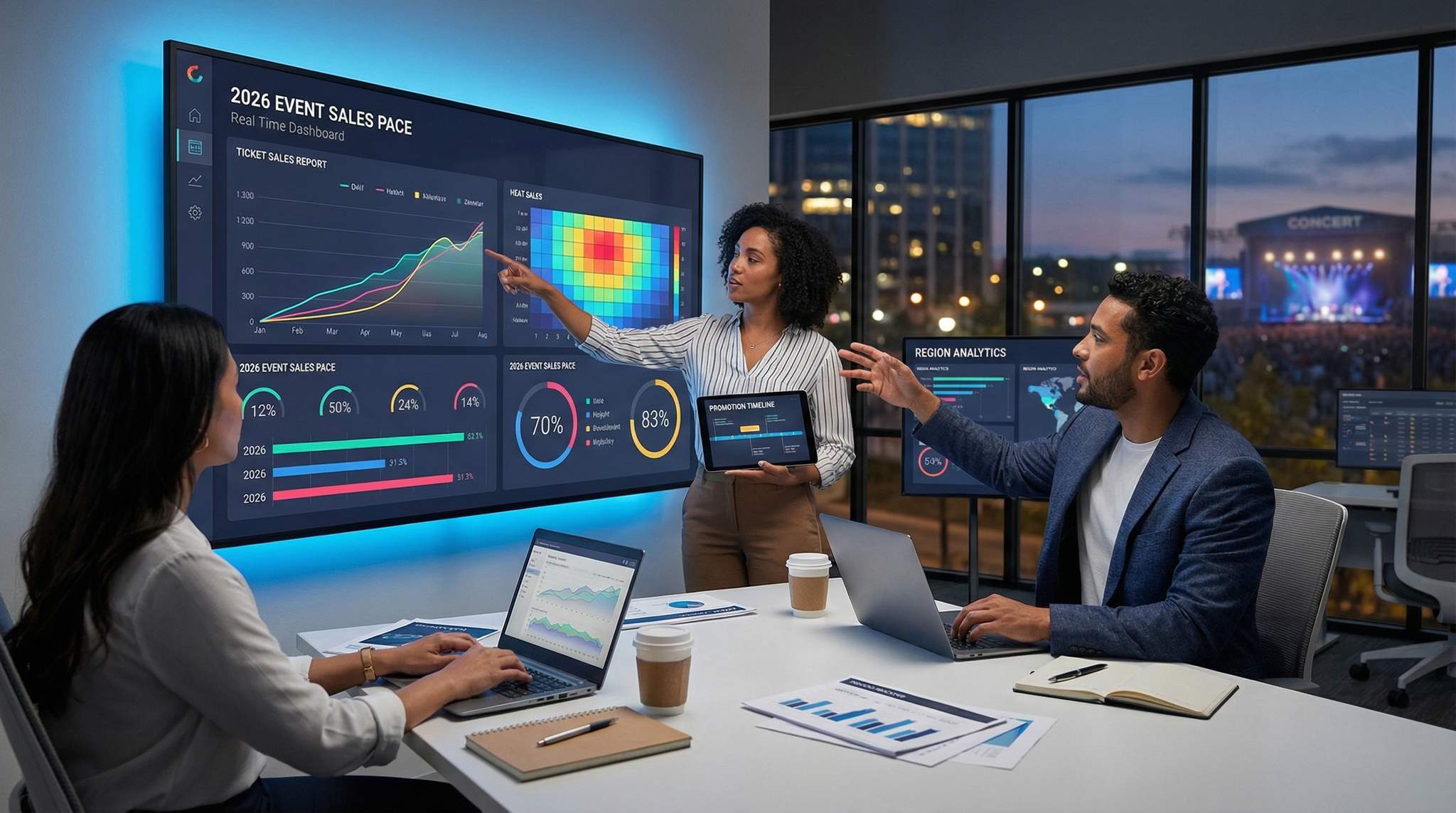
Forecasting isn’t a one-and-done exercise – it requires continuously tracking ticket sales and comparing them to your expected pace. That’s where a ticket sales dashboard comes in handy. Savvy promoters set up a live dashboard (or at least a daily updated report) that shows key metrics like tickets sold to date, revenue to date, and % of goal achieved, often alongside the forecast or target line for that date. Many modern ticketing platforms, including Ticket Fairy, offer built-in real-time analytics and reporting that make this easy. If your platform provides a live sales widget or allows exporting data, take advantage of it. For instance, on Ticket Fairy’s dashboard you can see sales by day, cumulative sales, and even set up alerts – giving you an instant read on whether you’re tracking toward that sell-out by setting up proper tracking from the start.
Your dashboard should ideally update daily, especially as you get close to the event or if you’re running a short campaign. Early on (say 6+ months out), checking weekly might suffice, but as you enter the critical last few weeks, daily – or even intraday – monitoring can be valuable. Some organizers even monitor hourly during an on-sale day or final sales push. At minimum, each week input the new numbers and see how they stack up against your planned pace. Visualizing it on a graph is useful: plot “actual cumulative sales” vs “forecast cumulative sales” over time. Is the actual line above or below your forecast line? The gap quantifies how far ahead or behind you are (e.g. 200 tickets behind pace as of today).
Key metrics to include on your dashboard:
– Tickets Sold (Cumulative) – The total number sold to date (and what % of your final goal that represents). This is the main indicator of progress.
– Tickets Sold (Daily or Weekly) – Plot how many tickets were sold each day or week. This helps spot spikes or slowdowns. For example, if daily sales suddenly drop to near zero, that’s a red flag (maybe a tracking pixel broke or an ad campaign ended unexpectedly). A rolling 7-day sum can smooth out day-of-week variability.
– Revenue Generated – If you have multiple ticket tiers or upsells, track revenue as well. It’s possible you sold fewer tickets but higher-priced ones, which could offset in money terms. If your goal is revenue-based, watching average order value is important.
– Conversion Rate – If available, track the conversion rate of page visitors to ticket buyers (if 100 people visit your ticket page today and 5 buy, that’s 5%). A dropping conversion rate could indicate growing hesitation or a technical issue turning people off. Many platforms let you embed Google Analytics or similar to get this data. A sudden dip might mean something broke on mobile checkout (as in the earlier anecdote) or your messaging needs adjusting.
– Site Traffic & Engagement – Not sales per se, but monitoring website visits, add-to-cart, and other engagement metrics can provide early signals. If lots of people are checking out your event page but not converting, investigate why. If page views are dropping, maybe your marketing isn’t reaching new eyeballs. Also watch email engagement: open and click rates on your promotional emails show if people are interested in your updates.
– Segmented Sales (if applicable) – If your event has different ticket types (VIP vs GA, weekend vs single-day passes), break those out. It can be revealing if, say, VIP is 90% sold but GA is 50% – maybe you forecasted wrong on demand mix. Or if one day of a multi-day festival is lagging, you might promote that day more. Also segment by source if you can: tickets sold via your website vs a reseller vs a street team code, etc. This attribution helps you know which channels to push (though attribution in 2026 can be tricky with privacy changes, unique tracking links and codes can help tie sales to channels).
Many organizers use a simple spreadsheet for their dashboard, updating it regularly. Others integrate tools like Google Data Studio or specialized event BI tools if available. The exact format matters less than the habit of looking at the data regularly. As one mantra goes: “If you can measure it, you can manage it.” Here, measuring ticket pace means you can manage your marketing responses effectively.
One pro tip: set thresholds that trigger alerts. For example, program an email or Slack alert if daily sales drop below a certain number or if you hit a milestone (like 75% sold). Hitting 50% of tickets could automatically notify the team – “Time to start the second-phase promo!” Modern ticketing systems or a bit of scripting can achieve this. It saves from having to stare at graphs 24/7 and ensures rapid response if something’s off.
Most importantly, don’t just gather data – act on it. Your dashboard review meeting each week (or each morning during crunch time) should end with decisions: Are we on track? If not, what’s our next move? That brings us to interpreting the pace and making those adjustments.
Metrics That Signal a Sales Surge or Slump
Not all metrics are created equal when it comes to forecasting final outcomes. There are a few high-impact indicators that event marketers monitor like hawks because they strongly signal whether you’ll meet your goals or need to intervene.
- Sales vs. Goal (Pace): We’ve discussed this, but to re-emphasize – the running percentage of tickets sold relative to time remaining is your primary health check. For instance, being at 50% sold with 50% of your timeline elapsed seems on track, but if you know most sales come at the end, you might actually be ahead. The opposite is true too. Create a pace report: “We are X% toward our target, with Y weeks to go.” If X% is significantly less than the % of time elapsed (adjusted for known late surges), that’s a warning. For example, at halfway through the campaign, if you’re only 25% to goal and you expected to be 40%, you either need a huge late surge or you won’t make it – time to implement booster tactics.
- Week-over-Week Growth: Are sales accelerating or decelerating as the event draws nearer? If each week you sell more tickets than the last, momentum is building (a great sign). If weekly sales are flat or shrinking, interest could be stagnating – you may need to inject new excitement to reignite ticket sales growth. For example, if you went from selling 500 tickets last week to only 200 this week (and there was no intentional reason like a promo that ended), that’s a potential slump forming.
- Conversion Rate Changes: A stable or improving ticket purchase conversion rate (visitors ? buyers) means your funnel is working. If you see conversion dropping, something is up. Maybe your ads are reaching less interested people, or your checkout UX has an issue, or people are on the fence (perhaps waiting for payday or more info). A falling conversion rate while traffic stays high is a classic indicator that messaging or external factors are causing hesitation. It’s a cue to adjust your approach (maybe simplify the purchase process, add urgency messaging, or troubleshoot technical problems). Remember the earlier story – a glitch cut mobile conversions and flatlined sales. Watching conversion metrics would catch that almost immediately.
- Engagement and Chatter: This is more qualitative but still measurable in ways. If your social posts about the event are getting fewer likes/comments over time, or your email open rates are dropping, it could signal waning interest – possibly forecasting slower sales ahead unless reversed. Conversely, a spike in engagement (tons of people sharing your event announcement, joining your Facebook event, saving the date, etc.) may indicate an uptick in sales is coming. Also watch direct indicators like waitlist sign-ups (if you allow people to register interest when a tier is sold out or pre-registration before launch). A long waitlist or strong RSVP counts on platforms often foretell strong ticket sales.
- Geo or Segment Trends: If your dashboard lets you see where sales are coming from, pay attention to anomalies. Say you planned for 70% local attendees and 30% out-of-town, but so far 90% of sales are local. That could mean your broader outreach isn’t working yet, and you might fall short on those travelers (unless you boost marketing in other regions). Each segment not hitting their forecasted contribution might result in an overall shortfall. Identifying “which part of my audience isn’t buying as expected” allows targeted remedies (e.g. run ads in that region, or if students aren’t buying, perhaps price is an issue – time for a student discount promotion).
- Customer Feedback Signals: Are you getting messages like “When is the lineup coming?” or “Is there a promo code?” Many inquiries might imply that people are interested but waiting for something (more info, a friend to commit, a cheaper price). That in itself is a metric – if you see a pattern in questions, it hints at barriers to purchase that you can address. For example, multiple inquiries about refund policy might mean people are afraid to commit – maybe you introduce a ticket insurance option or highlight your refund policy clearly.
It’s also wise to monitor metrics in context. A dip in daily sales isn’t concerning if you expected it (e.g. right after early bird ended, a brief lull is normal). But a dip against expectations is the issue. Likewise, a sudden surge in traffic without a surge in sales means trouble converting – address it fast.
One useful approach is to set up a simple table of metrics and thresholds, like:
| Metric | Healthy Range / Expectation | Action if Out of Range |
|---|---|---|
| Ticket % sold (today vs plan) | On track (±<5% variance from forecast pace) | If >10% behind pace: activate extra promo; If >10% ahead: prepare sell-out contingencies |
| Conversion rate (visit?sale) | e.g. 3-5% (baseline), trending upward slightly | If drops below 2% for 3 days: investigate funnel for issues or barriers |
| Weekly sales growth | Increasing as event nears (or as planned spikes) | If plateauing too early: inject new campaign element (new ads, artist announcement) |
| Social/email engagement | Steady or rising as new content released | If declines: refresh content strategy or add interactive elements to re-engage |
This kind of cheat-sheet lets your team quickly identify if the sales campaign is humming along or needs attention. It’s essentially a scorecard for momentum.
By closely watching these signals, you’ll catch the story behind the numbers: maybe “people are interested but not buying yet” (fixable by adding urgency or incentives), or “our reach is too low” (fixable by broadening marketing channels), or “we’re crushing it, might sell out early” (actionable by maybe adding a second date or upselling VIP experiences). The earlier you catch a negative trend, the more time you have to course-correct your marketing to still hit your final targets.
Tools and Tech for Tracking (GA4, CRM, and More)
Thankfully, you don’t have to track all this by hand. Technology tools can automate and enhance your sales monitoring and forecasting:
- Ticketing Platform Analytics: As mentioned, use the analytics provided by your ticketing partner. A robust platform will show real-time sales and allow you to filter by ticket type, date range, etc. Some even predict final sales using their data models. Explore features like sales heat maps (sales by geography), time-stamped sales (to correlate with marketing send times), and channel tracking (promo codes or referral links to see where sales are coming from). If you’re using Ticket Fairy, for example, you can take advantage of its real-time analytics and marketing tools built into the event dashboard, which help you see ticket sales alongside referral traffic and even manage promo codes on the fly.
- Google Analytics 4 (GA4): Installing GA4 on your ticket purchase site (or integrating if the ticketing platform allows) is extremely useful for deeper insights. GA4 can track pageviews, button clicks, and e-commerce events. Define a conversion event for a ticket purchase, and you can then slice and dice your audience data. You can see things like: which marketing channels are driving the most engaged traffic, how long people spend on the purchase page, where international traffic drops off, etc. GA4’s event-based model is great for funnel analysis – you might find, for example, lots of people add tickets to cart but don’t complete (maybe indicating a problem at payment step). By mastering GA4, you gain data-driven insights to boost ticket sales throughout the campaign. You can even use GA4 to build remarketing audiences (e.g. target ads to those who visited but didn’t buy).
- CRM & Email Analytics: If you have a CRM or email marketing system, track engagement metrics there. Many event marketers build segmented lists (e.g. people who clicked the “Tickets” link in an email but didn’t purchase can be sent a follow-up offer). Your CRM can also track first-party data like which past attendees haven’t bought yet – those are hot leads to target with personal messages (“We noticed you came last year but haven’t got tickets for 2026 yet…”). By integrating CRM data, you can forecast likely sales from your core audience vs. new audience, etc. For instance, if only 30% of last year’s attendees have bought so far and usually 50% return, you know there’s a chunk that might still convert – maybe it’s time for a targeted “loyalty discount” to nudge them. Owning your audience data and using it smartly often leads to maximum ROI in ticket sales.
- Attribution Tools: With ads on multiple platforms, consider using UTM parameters or affiliate tracking links for each channel. This won’t capture 100% (due to cross-device or privacy settings), but it helps. You can then see in GA or your CRM how many purchases came from “Facebook Ads” vs “Email Newsletter #2” vs “InfluencerJohn’s promo code.” There are also specialized attribution tools that try to consolidate event conversion data. In 2026’s privacy-first environment, attribution is tough, but using a combination of tracked links, promo codes, and post-purchase surveys (“Where did you hear about us?”) can still give you a directional insight into what’s driving sales. That way, if you’re behind pace, you can put your resources into the channels that are actually yielding buyers (for example, if your forecast is lagging and you see almost all current sales are coming from email and hardly any from Twitter, you’d likely double down on email where ROAS is higher).
- Third-Party Analytics & AI: Some promoters use more advanced forecasting tools – even AI-driven models – that take in social media trending data, Google Trends, etc., to predict ticket demand. For instance, tools might analyze sentiment or volume of online mentions of your event to forecast if sales will spike. While fancy, these can add a layer to your forecasting arsenal. If you have the budget or skillset, you could even run a regression model that looks at variables like ad spend, website visits, etc., to predict daily sales. But even without data science, a good old Excel linear projection or logistic curve fit can act as a rough forecast model. Just remember to update it with actuals frequently.
- Collaboration & Alerts: Use project management or communication tools to keep everyone in the loop. For example, set up a Slack channel that posts daily ticket sales numbers automatically. Or use Google Sheets with conditional formatting for pace vs goal (so the cells turn green/yellow/red as you update, visible to the team). When everyone has visibility, you’ll foster a proactive culture. A marketing team member might notice “Hey, we sold almost nothing in Paris this week, maybe our targeted ads there aren’t running?” and catch an issue.
One thing to note: ensure data accuracy and consistency. If your tools aren’t hooked up properly, you might act on wrong info. For instance, double-check that your GA4 isn’t double-counting a single sale as two events, or that your ticketing report’s time zone matches your GA time zone (to align daily counts). Regularly reconcile your sources – your ticketing platform is the source of truth for sales, so make sure your other monitoring aligns with it.
By mastering these tools, you effectively create a command center for your event sales. It empowers you to not just passively read numbers, but to gain insights like a detective: which audience segments are converting best, which marketing messages spike sales, what time of day people buy tickets, and more. The result? You can refine your marketing mid-stream – allocate budget to the best channels, tweak your messaging, adjust your forecast and strategy on the fly. An event that might have underperformed can transform into a sell-out success simply because you had the timely data to make the right calls and promote smarter, not just harder.
Forecasting Methods to Project Final Sales
Ratio Method: Extrapolating from Current Pace
One of the simplest yet effective forecasting techniques is the ratio method – using the proportion of tickets sold by a certain date to extrapolate the final outcome. Essentially, you ask: historically or typically, what fraction of total tickets is sold by now? Then divide the current sales by that fraction to estimate 100%. This works best when you have past event data or reliable industry ratios.
For example, if you know from previous events that by 1 month out you usually have sold about 70% of your tickets, and today you’re at 7,000 tickets sold at that 1-month mark, you’d forecast roughly 10,000 tickets final (since 7,000 is 70% of 10,000). If instead you only had 5,000 sold by the 1-month point, using the same ratio, you’d project about 7,143 tickets final – well under your goal of 10k, indicating a shortfall if nothing changes. This method is straightforward and gives a quick reality check. Promoters often do this mental math at various milestones: “We’re at 40% with two months to go, last time we were at 50% by this time, so likely we might land maybe 20% lower than last year’s final attendance unless we boost things, utilizing data analytics for smarter planning.”
To use the ratio method properly, you must have a solid reference point. That could be last year’s ratio, an average of multiple past events, or an external benchmark. If you lack specific data, you might use a generic ratio (e.g. “50% sold by event week” as some reports suggest). But the closer the reference matches your event’s context, the better. Sometimes, organizers use a blended ratio – for instance, if this is an annual festival that’s growing, maybe two years ago by this time it was 60%, last year 70%. You might assume this year should be around 75% by now if growth continues, etc. If you find you’re at 65%, then you could forecast final attendance will likely fall between last year’s and your goal (and then strategize accordingly to push it up).
The ratio method is especially handy when communicating with stakeholders because it’s intuitive. Instead of just saying “we have sold 5,000 tickets,” you can say “we’ve sold 5,000, which is about 50% of our expected total based on historical pacing – we’re projecting about 10,000 final if trends hold.” It quantifies the outlook in a way that management can grasp quickly. It also helps answer the common question: “Are we ahead or behind where we should be?” by putting a number on it, not just a feeling.
However, be aware of the ratio method’s limitations: it assumes the future will mirror the past proportionally. If something fundamentally changes (like you inject a huge new marketing campaign or there’s a sudden surge of interest because an artist blew up in popularity), the old ratios might no longer apply. So use it as a baseline, but adjust if you have reason to believe “this time is different.” For instance, if half of your sales typically come in the last month but you just got news coverage that’s sending sales through the roof earlier than expected, your final will exceed the naive forecast – update the ratio or switch to a different method.
To refine the ratio method, you can use multiple reference points. For example, check the ratio at 3 points: 3 months out, 1 month out, 1 week out. If all point to roughly the same final number, you have more confidence in the forecast. If they diverge, investigate why (maybe one period had an outlier effect). Many promoters maintain a pacing table like:
- “By 90 days out we were at X%, historically that means Y final.”
- “By 30 days out we’re at A%, historically that means B final.”
- “By 7 days out we’re at M%, historically that means N final.”
If X, A, M are all lower than historical norms, you know final will likely undershoot unless last-minute dynamics change dramatically – in which case, plan a big last-week push to try altering that fate.
In summary, the ratio method anchors your forecast in a tangible way – it’s basically applying known completion percentages to current progress. It’s quick, doesn’t require fancy software, and often surprisingly accurate (assuming consistent conditions). Just be ready to tweak the ratios if real-time evidence suggests a different curve this go-around.
Trendline Projection and “Curve Fitting”
More advanced than a simple ratio is plotting a trendline or fitting a curve to your sales data to project forward. If you have enough data points (like daily or weekly sales numbers), you can use statistical methods or even Excel’s trendline feature to extend the line into the future. This can capture acceleration or deceleration in sales, rather than assuming a fixed ratio.
For instance, maybe your sales are gradually accelerating (each week’s sales are 10% higher than the last in a pattern). A linear trendline might under-predict the final surge because growth is exponential as you near the event. In such cases, fitting an S-curve (logistic curve) or an exponential model could be more appropriate. Event sales often follow an S-curve: slow start, then faster, then slow finish as you approach a sell-out or saturation. If you have historic cumulative sales data, you can try to fit a logistic function to it, which inherently forecasts a plateau at the maximum capacity. But that’s quite technical; a simpler approach is to use polynomial or exponential trendlines in a spreadsheet as a proxy.
Let’s say you plot cumulative tickets sold vs. time and it looks kind of like a shallow curve then steep rise near the end. Excel or Google Sheets can add a trendline – you might choose a second-order polynomial that best fits the curve so far. By extending that polynomial to the event date, you get a forecast final number. This can sometimes overshoot or undershoot, so treat it as one input. Or use a tool like Tableau or a Python script (for the data-savvy) to fit nonlinear models. Some ticketing analytics and startups even offer predictive analytics that inherently do curve fitting for you, often based on industry data and your current pace (essentially an AI forecasting your final sales – for example, predicting you’re trending toward 8,200 ± 300 tickets based on similar events’ trajectories).
Moving averages and momentum analysis can also help. Calculate the average daily sales over the last 2 weeks, then assume that is the rate that will continue (or increase) for the remaining days. You might notice an upward trend – e.g., 100 tickets/day a month ago, 150 tickets/day now. If it’s increasing as you approach the event, you could project maybe 200/day in the final week. Summing those up yields a forecast. This method tries to capture momentum. If momentum is increasing, a conservative forecast adds the current momentum; an aggressive one projects even faster final sales (given procrastinators, sometimes an aggressive final week assumption is warranted). Conversely, if momentum is flat or slowing, you might cap your projections or even foresee a battle to reach the goal.
One neat trick is to overlay your current event’s sales curve with that of a past similar event (or an idealized curve) on the same time axis. As time goes on, see if the shape is parallel, converging, or diverging. If by mid-point your line is consistently below the last event’s line, you can draw a parallel and end up below at the end too, estimating how far below based on the gap. Some call this the “mirror method” – mirroring a prior trajectory and adjusting if you’re lagging. If you’re 500 tickets behind where the last event was each day, you might end 500 behind at the end unless something changes.
Forecast ranges are also important. Instead of a single number, provide a likely range (e.g., “We’re on track for 900–1,000 attendees”). You can derive this by assuming best-case and worst-case continuations of your trend. For instance, take your highest daily rate observed and assume it continues, versus your lowest. Or use confidence intervals from a statistical model if you have one. People understand that forecasting isn’t crystal ball magic, so a range with an explanation (“80% confidence we’ll fall in this range”) is often appreciated in reporting. Just avoid being overly broad or it loses utility.
One must caution: purely statistical trend extrapolation can be thrown off by deliberate marketing actions you might take. If your trend assumes an ad campaign keeps running at current levels but you decide to double your ad spend in the last week, the actual sales will exceed the unadjusted trend. So, incorporate known future actions. Some advanced planning even builds a sales projection model tied to marketing spend – e.g., “for every $X in ads we get Y tickets, and we plan $Z more spend, therefore boosting final sales by Q.” This merges marketing planning with data trends.
In summary, trendline and curve-fitting methods add nuance by accounting for how sales velocity is changing over time. They’re great for seeing if you’re picking up steam or losing it, and quantifying that forward. While not every event marketer will dive into logistic regression models, even a simple visual extension of your sales graph can yield a decent gut-check forecast. Combine that with ratio methods and insights, and you’ll be forecasting with a multi-tool approach – the most robust way to anticipate your final outcome.
Real-Time Forecast Adjustments
Forecasting is not set-and-forget; you should be updating your predictions in real time as new data comes in and conditions change. Think of it as recalculating your route (like a GPS) whenever there’s a detour or acceleration. By adjusting your forecast regularly, you avoid clinging to outdated assumptions and you can promptly inform your strategy and stakeholders about the new expectations.
Here’s how to implement a real-time forecast adjustment loop:
- Weekly Forecast Revisions: At least once a week (more often during critical periods), re-run your numbers. Plug the latest sales data into whatever method or model you’re using and see what the new forecast is. Compare it to last week’s forecast. Did it go up, down, or hold steady? If you had a big promotional push and sales jumped, your forecast should improve – great. If sales came in lower than forecasted, the model will likely revise the final number down – that’s a warning sign to take action. Treat each update as a chance to course-correct. For example, “We were forecasting 5,000, but after a slow week, it’s looking like 4,500 unless we do something different – let’s plan an extra email blast or flash sale.”
- Incorporate New Info Immediately: Forecasts should adapt not just to numbers but to events. Say one of your headliner artists suddenly cancels (knock on wood), you must adjust down your expectations (and also adjust marketing messaging). Or if you just secured a last-minute media partnership that will put you on the radio daily, factor that upside in – perhaps expecting a bigger late surge than originally thought. Another case: your competitor event across town got canceled – you might suddenly gain some of those ticket buyers, so bump your forecast and aim marketing at them quickly. Essentially, any significant news or change in circumstance should trigger a manual tweak to your model outside of the usual cadence.
- Different Scenario Projections: Update not just a single forecast but multiple scenarios. For instance: “If our upcoming promotion performs average, we end at 8,000 tickets. If it really takes off, maybe 8,500 (best case). If it flops, perhaps only 7,500 (worst case).” By updating these scenarios in real time, you can prepare contingency actions. If you’re trending toward the worst case, you might have an emergency marketing budget ready to deploy, or call in favors with partners to boost reach. If trending best case, you might arrange to open up some production holds (extra tickets) or at least prepare a waitlist communications plan for when you sell out early, rather than reacting last minute.
- Team & Stakeholder Communication: Regularly share the updated forecast and its implications. For example, in weekly meetings: “Based on sales to date, we’ve updated our projected attendance to ~950 (+/- 50). This is down from 1,000 projected last month. To close that gap, we’re launching a friend-referral campaign next week. If that succeeds, we could still hit 1,000. If not, we’ll likely finish in the 900s.” This transparency builds trust – everyone sees you’re actively managing the situation. It’s far better to adjust expectations earlier than to surprise everyone late (“We thought we’d sell out but we only got 90% – now it’s too late to fix”). With early warning via forecast adjustments, you might even rally more internal resources (“maybe the sales team can call up corporate clients to sell group tickets if we see we’re behind”).
- Keep an Eye on Sell-Out Pace: If you’re on track to sell out, adjust your timeline accordingly. For instance, your forecast might show you hitting 100% capacity three days before the event. That tells you to be ready to announce a sell-out (and cut off marketing spend to avoid waste) around that date. If tickets are moving so fast you might sell out weeks in advance, you can plan waitlists or even add a second show if feasible – a fantastic scenario that only a good forecast will clue you into early enough to take advantage of. On the flip side, if you forecast not selling out, you might plan tactics to maximize attendance even if tickets remain (like offering last-week discounts to students or at-door sales strategies) to avoid wasted empty seats.
- Learn and Iterate: As you update forecasts and then see actual results, learn from any deviations. If you overshot or undershot, why? Did you overestimate the impact of a certain campaign? Underestimate the last-minute spike? These insights can refine your forecasting model for the next event. After the event, definitely compare final actuals to your various forecasts over time. If you initially forecasted 5,000 and ended at 6,000, what factors did you undercount? Maybe you’ll tweak how you incorporate social buzz or give more weight to that channel that performed beyond expectation. Over time, this cycle makes you a sharper forecaster – you’re essentially calibrating your prediction engine with real outcomes.
Real-time adjustment is about being proactive vs. reactive. It’s much like a sailor trimming the sails continuously to catch the wind changes, rather than setting them once and hoping for the best. In marketing terms, it means you are constantly aligning your strategy with the evolving reality of consumer response. If sales are slower than hoped, you still have time to pivot – maybe intensify digital ads, adjust your messaging (“only 100 tickets left!” to drive urgency if nearing the end), or add value (bonus perks) to persuade fence-sitters. If sales are faster (a good “problem”), you can smoothly shift to strategies that maximize revenue and experience – like upselling premium packages, and making sure operations are ready for a full house.
The net effect is fewer surprises and more control. By the time you reach event day, you should feel that the attendance is almost exactly as expected because you’ve been tuning that expectation all along. And in the dynamic environment of 2026, that agility is what separates campaigns that sell out with confidence from those that scramble in panic.
When Ticket Sales Are Behind Pace
Diagnosing the Causes of Lagging Sales
Despite our best forecasting and marketing efforts, there are times when sales simply lag behind the desired pace. The key at that moment is not to succumb to panic but to diagnose why the tickets aren’t moving as fast as expected. Pinpointing the cause guides the solution. Here are common culprits for slow sales and how to identify them:
- Low Awareness: The simplest reason – not enough people know about your event or they aren’t reminded of it enough. Signs include very low website traffic and few social mentions about the event. If you see that your ad impressions are low or your reach isn’t broad, it could be a budget or targeting issue. Essentially, if people aren’t visiting the ticket page, they can’t buy. Running a quick awareness check (surveys or social listening for mentions) might reveal that large swathes of your target audience just haven’t heard about the event yet.
- Poor Value Proposition or Creative: People may know about the event but aren’t compelled to buy. This can happen if your marketing message isn’t resonating or the event’s lineup/program hasn’t excited people. One indicator is lots of page visits but low conversion – they check it out and leave. Or perhaps initial social feedback is lukewarm (“Looks cool, but not sure it’s worth $X.”). If you’re marketing a festival and comments are “the lineup is underwhelming,” you’ve identified the issue: line-up perception. Sometimes the cause is in your control (messaging) and sometimes not (actual event content), but you need to know which it is.
- Timing Issues: Maybe you launched your campaign too early or too late. Too early and people forget before they buy; too late and many made other plans. Comparing to benchmarks helps here – if you see competitors for similar events already selling strongly while you’re lagging, maybe you missed the ideal launch window. Conversely, if you’re out early and people aren’t buying, they might be waiting for more info or just not in purchase mode yet. Also consider seasonality: if tickets went on sale during a notoriously bad time (holidays, exam season for student audiences, etc.), the timing could be the drag.
- Channel-Targeting Mismatch: You might be talking in the wrong place or to the wrong people. For example, if you put most of your budget into Facebook Ads but your audience is primarily on TikTok or Discord communities , sales will lag. Look at which marketing channels are converting. If one channel is producing near-zero results, that’s a red flag – either the execution is off or that channel isn’t right for this event. Also check your geographic spread: are you focusing on a region that isn’t responding while ignoring one that might? A ticket heatmap can show if certain cities or zip codes have unusually low sales (maybe your message or media didn’t reach them effectively).
- Price or Economic Factors: Sometimes people are interested but price is a barrier. Economic signals might be gleaned from engagement (tons of interest on social, but when you drop a promo code, suddenly some sales happen – indicating price sensitivity). Also direct feedback: any comments like “I’d go if it were cheaper” or an unusually high number of people starting checkout but not completing (could mean they balked at final price with fees). If inflation is high, maybe your audience just doesn’t have the spare cash until last minute (paycheck timing). Monitoring and even asking via polls “What’s holding you back from buying?” can surface if price is a main issue.
- External Competition or Clutter: If sales are slow, see if the target audience might be distracted by something else. For instance, maybe another huge event (or multiple events) around the same date is splitting the audience. If you notice on forums or groups that people are debating between your event and another, you have a competition issue. Or if a lot of your core demographic is currently busy with, say, final exams or a major product launch at work (for tech conferences, e.g.), that’s a situational cause. These factors often emerge in the conversations of your community – keep ears open.
- Trust and Uncertainty: In emerging markets or in the post-pandemic era, some ticket buyers wait because they aren’t sure the event will actually happen or be worth it. If your brand is newer or last year you had some hiccups (like delays or cancellations), people might hold off. Clues include questions asking “Is this event confirmed? Any chance of cancellation?” or lower sales in demographics more sensitive to risk. If so, you may need to bolster your credibility – perhaps through testimonials, early content, smaller pre-events, or simply consistent communication to build trust that this event is solid.
By digging into these factors, you move from symptom (“sales are slow”) to diagnosis (“sales are slow because our message isn’t hitting the right audience” or “because lots of people are waiting for pay day”). Typically, you’ll find more than one contributing factor. Maybe you discover your digital ads have been underdelivering (awareness issue) and also that people are commenting about high prices. Address both!
Use data wherever possible to support your hunches: If conversion rate on the ticket page is low (check your analytics), that could indicate messaging/value/price issues. If traffic itself is low, that’s awareness or reach. If certain segments (like VIP tickets or certain cities) are selling fine but others aren’t, it could be a targeting issue or appeal issue specific to segments.
Once you have a handle on the likely causes, you can formulate a targeted plan rather than blindly flailing (discounting randomly or spamming more ads without strategy). For example, diagnosing “low awareness among college students” leads you to perhaps engage campus ambassadors or pump up TikTok content specifically to reach that crowd. Or diagnosing “lineup not resonating” might push you to announce more artists sooner, or highlight the most popular acts in marketing. In essence, diagnosing prevents wasted effort and allows you to apply the right remedy to the sales slump, possibly turning it around swiftly.
Promotion Tactics to Boost Mid-Campaign Sales
If your sales pace is lagging mid-campaign, all is not lost – it’s time to re-energize demand with smart promotion tactics. Here are proven strategies event marketers deploy when ticket sales need a shot in the arm:
- Flash Sales & Limited-Time Discounts: A short, urgent promotion can jolt people into purchasing now instead of “later.” This could be a 24- or 48-hour sale where you knock a certain amount or percentage off the ticket price, or a “buy one, get one free” offer, which are effective emergency strategies to boost attendance. The key is to communicate the urgency and scarcity: e.g. “Flash Sale! 25% off tickets until tomorrow midnight only.” Promote it heavily via email, social, SMS – whatever channels reach your fence-sitters fastest. Flash sales work because they give procrastinators a deadline and an incentive. We’ve seen festivals move thousands of tickets in a single day with well-timed 2-for-1 deals (especially early in the week when people plan their weekend). Just use them sparingly to avoid training your audience to always wait for a sale. Also, frame it in a positive way (celebration, holiday special, etc.) so it doesn’t devalue the event.
- Group and Referral Deals: Harness the power of social groups by incentivizing attendees to bring others. If sales are slow, try a limited “Friends Bundle” (e.g. 4 tickets for the price of 3) or activate a referral program where existing ticket holders get a reward (like a merch item or partial refund) for each new person they refer who buys. Ticket Fairy’s platform, for example, has built-in referral tracking so you can easily credit fans for spreading the word. People are more likely to commit if they can convince friends to join, and a referral bonus gives your current fans motivation to become mini-marketers for you, helping to overcome the mid-campaign slump. Ensure the referral ask is simple: provide a unique link or code and a clear reward (“Get $10 back for each friend who buys with your code – up to getting your ticket free!”). This not only boosts sales but also taps into new networks you might not reach with ads alone.
- Surprise Content Drops: Sometimes reigniting interest is as simple as giving people something new to be excited about. Mid-campaign, drop a juicy lineup addition or a special guest announcement, release a sneak-peek video (maybe a hype reel from last year or a message from the headliner), or tease new event features (“Just added: VIP lounge with free drinks”). New news can spur coverage and sharing, reminding those who tuned out that your event is not to be missed. For example, adding a trending local opener to a concert bill, and announcing it mid-way, can prompt that artist’s fanbase to jump on tickets. Or revealing the daily schedule for a festival might push people to grab single-day tickets for the day their favorite plays. If you planned any surprises, time some for when you need a momentum boost.
- Influencer & Artist Pushes: Rally your lineup and partners to help promote when sales lull. Perhaps your event speakers or artists can do a round of social posts (“I can’t wait to perform at X – get your tickets now before they’re gone!”). Or engage a few influencers who resonate with your target demo to talk up the event and their plans to attend. Authentic endorsements can move the needle, especially if the message addresses why now is the time to buy. For instance, an influencer might emphasize: “I just got my ticket for X festival – prices go up next week, so snag yours ASAP and party with me there!” This leverages both FOMO and urgency. Make sure to give your influencers a trackable link or code so you can gauge results and perhaps sweeten the deal for their followers (like a 10% off code unique to each influencer’s audience). In 2026, micro-influencers in niche communities (like a local food blogger for a food festival, or a gaming YouTuber for an esports event) can have a direct impact on their engaged followers.
- PR Stunts and Partnerships: If traditional ads aren’t cutting through the noise, try a creative PR move. Perhaps organize a pop-up event or stunt – e.g. a free teaser show, a flash mob, a live Q&A with a headliner on Instagram Live – something that generates buzz and media coverage, reminding everyone your event is coming. Local media partnerships can amplify this: get on a popular radio show or podcast to talk about the event and mention any special offers. Another angle: partner with a sponsor or local brand to do a ticket giveaway or contest that gets attention. For example, a local brewery (if they’re a sponsor) might run a “Win VIP tickets!” promo – their marketing spreads word to craft beer fans, some of whom may just buy tickets if they don’t win. Media and brand partnerships often have reach you don’t, and when sales are slow any increased awareness can help.
- Enhanced Urgency & Social Proof: As you approach the event or ticket milestones, lean into ethical urgency. If you’ve sold, say, 70% of tickets, start communicating that: “Tickets are 70% gone – don’t miss out!” If there’s a price rise coming (“Last chance for regular pricing – prices go up Friday”), broadcast that widely to drive a sell-out. People sometimes just need that little push of “oh, it might sell out or get more expensive, I better act.” Combine urgency messaging with social proof: highlight any positive momentum (“Over 4,000 people are already attending” or testimonials from those who have bought like “I just got my ticket, can’t wait!”). Seeing that others are committing reduces hesitancy. You can even showcase live stats if appropriate (some events have a page counter like “__ people are viewing tickets right now” or “100 tickets sold in the last 24h”). The idea is to create a bandwagon effect – nobody wants to be left behind if it seems everyone else is jumping in.
- Expand Your Audience: If you’re not hitting numbers with your original target market, consider adjacent audiences who might be interested with a bit of repositioning. For example, if a music gig’s core fans are slow to convert, maybe target general nightlife lovers in the city with messaging like “Looking for an epic Friday night? Check out this show!” Or offer group discounts to corporate or alumni groups if it’s a conference or gala. Sometimes tapping a secondary market (with the help of a community group or a last-minute affiliate deal) can give the extra hundreds of tickets needed. A real example: a festival struggling to sell final tickets partnered with a local university to offer students a special price; they gained hundreds of young attendees in the final week who otherwise wouldn’t have considered going – filling the venue and also boosting concession sales.
When implementing these tactics, coordinate the timing and channels for maximum impact. A mid-campaign slump can be reversed by a well-timed intensive push. For instance, line up a flash sale with an influencer blitz and a fresh PR story all in the same 2-3 day span – a multi-front attack can break through where isolated efforts might fizzle.
Also, track the results of each tactic. Which ones gave you the best uptick in sales? A/B test if possible – e.g., one week try a discount code, another week try a new content drop – measure which drove more conversions. This not only helps in this campaign but builds knowledge for future ones. Often, you’ll find a combination of incentives (discount or value-add) and messaging shifts (urgency, new info) does the trick. And don’t neglect the basics during a push: ensure your ticket purchase process is frictionless (nothing worse than energizing demand only for buyers to hit a tech snag), and customer questions are answered fast (perhaps extend customer service hours during a big promo).
The mid-campaign is your chance to rewrite the story if the first chapters were slow. Many events that eventually sell out had a mid-way panic moment – it’s the response that matters. With the right tactics, you can turn a slump into a surge and carry that momentum forward to the final phase of your marketing campaign.
Optimizing Channel Strategy Under Pressure
When sales are behind, it’s crucial to make every marketing dollar and effort count. This means shifting your channel strategy to double down on what works and cut anything that isn’t pulling its weight. Here’s how to optimize channels when you’re under the gun:
- Identify High-Performing Channels: Use your tracking and attribution data to see which channels have actually driven ticket sales so far. Maybe your Google Ads are yielding a good number of purchases with a decent cost per acquisition, whereas your Twitter (X) ads haven’t converted any. Or perhaps email has brought in a lot of sales (common if you have a strong subscriber list). Whatever it is, plan to allocate more budget and effort to the proven channels in the remaining time. If Facebook/Instagram ads have a high click-to-purchase rate, consider expanding those campaigns (broaden targeting, increase budget, refresh creatives for better frequency). If an influencer’s promo code was used by many, engage them (or similar profiles) for another post. By focusing on ROI-positive channels, you get more bang for your buck when it matters most.
- Cut or Fix Low-Performing Channels: For channels that haven’t delivered, decide whether to cut them off or adjust strategy. If you’ve spent a chunk on, say, display banners or print media with little to show, re-route those resources. However, do a sanity check: was the channel ineffective because of the medium or because the execution was off? For instance, maybe your search ads weren’t converting because the keywords were wrong or the landing page was poor. If a quick fix is possible (like improving ad copy or enabling retargeting on a platform), try that; if not, stop the bleeding and move on. Remember that sometimes a channel might not drive direct tracked sales but still be important for awareness (e.g. PR or radio). In a crunch though, prioritize trackable conversion drivers.
- Explore Niche Channels & Communities: Under pressure, think outside the usual channels. Where does your specific audience hang out? Perhaps a subreddit or Discord server is full of potential attendees; engaging there (genuinely, not just spamming) could rally a niche crowd. Or local community Facebook groups, WhatsApp broadcasts, university forums, etc. For example, if you’re promoting an esports tournament, posting in popular gaming forums or sponsoring a Twitch streamer for a shoutout might give a late sales bump. These targeted efforts often have low or no cost besides time and can directly reach the superfans who just need a nudge. The key is to come with an offer or message that resonates with that group specifically.
- Leverage Retargeting: People who showed interest but didn’t buy are your hottest leads; ensure you have retargeting ads running. If someone visited the ticket page or added to cart and left, hit them with ads reminding “Don’t miss out!” Possibly present a sweetener like “Still thinking? Here’s 10% off, good for 48 hours.” Retargeting across platforms (Facebook, Google Display, even LinkedIn for professional events) can efficiently convert those who are on the fence. Similarly, use your email list: send a targeted email to those who clicked a ticket link before but haven’t purchased (most email tools let you segment by who clicked on prior campaigns). Tailor the message like, “We noticed you checked out tickets – secure them now before it’s too late! Reply if you have any questions.” That personal touch can tip them over.
- Optimize the Message per Channel: Under time pressure, polish your creatives and copy for each channel to make sure you’re putting forth the most compelling case. On social media, that might mean using short video snippets of past event highlights to grab attention. On email, it means a clear subject line and prominent CTA (“Only 5 days left to get tickets!”). On PPC search ads, ensure you emphasize keywords like “official tickets” and any scarcity (“limited seats”). A/B test rapid-fire if you can – for example, run two versions of an ad for a couple of days to see which yields better conversion, then put your remaining budget on the winner. When time is short, you can’t be shy about iterating quickly. Also, align landing pages to match the urgency and offer: if you send a special promo code to a group, the landing page they hit should remind them “Use code COLLEGE20 by Friday for 20% off student tickets.” Eliminate any disconnect that might slow a user down.
- Coordinate a Multi-Channel Blitz: One channel rarely does it all. Plan an aligned push across channels so your target audience hears your message in stereo. For instance, a 3-day push could involve: a personal email to your list on Day 1, a social media ramp-up with posts and stories on Day 2 (plus your influencers posting), and retargeting ads peaking on Day 3 – all carrying a consistent urgent message (“Final days to save your spot”). This repetition across touchpoints reinforces action. An attendee might see the email but ignore it, then see your Instagram ad and recall the email content, then finally click a retargeting banner later that evening to purchase. We want to surround the indecisive customer with reasons to act. Just be careful to not come off as spammy or desperate – keep communications enthusiastic and confident (“It’s almost here – act now to join the party!” rather than “Tickets not selling, please buy” obviously).
- Reallocate Budget Smartly: If extra budget remains in those underperforming channels, reinvest it wisely. Often, paid social and search can scale up quickly – you can raise daily budgets or expand targeting criteria to reach more people similar to those who converted. Also consider shifting some spend into a last-minute reminder via SMS or push notification (if you have an app or permission-based list). SMS, in particular, has high open rates – an SMS like “SummerFest is 1 week away! Only 100 tickets left – grab yours: [short link]” can convert well, albeit with a small cost per message. Essentially, flood the channels that have a direct line to your likely buyers in these final days.
Optimizing channel strategy under pressure is a bit like triage: attend to the most critical and impactful areas first. The beauty of digital marketing in 2026 is the real-time flexibility – you can shift budgets today and see results tomorrow. Contrast that with print or outdoor ads where once it’s out there, you can’t tweak it. So use that flexibility to your advantage.
Case in point: a concert promoter in Auckland noticed 2 weeks out that most sales were coming from Facebook Ads and almost none from a radio sponsorship they’d paid for. They promptly increased their Facebook Ads budget by 50% and negotiated some last-minute geo-targeted mobile ads instead of continuing radio. The result? An immediate uptick in daily sales that helped sell out the show, whereas sticking with the original plan would’ve left seats unsold. They also paused a broad banner ad campaign and redirected that budget into a direct email marketing blast using a local ticketing partner’s newsletter – again, targeting people who actually buy event tickets. The targeted blitz closed the gap just in time.
In summary, when the clock is ticking, put your resources where the data shows they’ll convert best. Be ruthless about cutting what doesn’t work, creative in finding untapped channels, and consistent in messaging across the board. This agile re-optimization is often what separates a campaign that recovers and thrives from one that stagnates. By the finish line, you’ll know you left no stone unturned in reaching every possible attendee.
When Ticket Sales Are Surging Ahead
Leveraging Scarcity and FOMO (Ethically)
It’s a good “problem” to have: ticket sales are surging and perhaps you’re nearing capacity sooner than expected. When demand is high, you can strategically use scarcity and FOMO (fear of missing out) to drive the remaining sales and even amplify the buzz. The key is to do it authentically and ethically – you want to excite fans, not manipulate or upset them. Here’s how to handle it when tickets are flying off the shelf:
- Announce Low Ticket Warnings: Don’t be shy about letting the public know that tickets are running out, as long as it’s true. A simple message like “?? Only 100 tickets left!” or “90% sold out – last chance to secure your spot!” creates urgency for those who haven’t purchased yet. You should blast this across your channels – social media, email, website banner, even via PR (“Event X is almost sold out due to unprecedented demand”). People who were on the fence will realize they might miss out entirely if they don’t act immediately. This taps into the classic FOMO trigger: nobody wants to be the one who hesitated and then couldn’t go because it sold out. Since it’s based on real numbers, it comes off as helpful information rather than a gimmick. One pro tip: if your ticketing system allows, showing a live count or percentage on the purchase page (e.g. a progress bar “90% sold”) can push indecisive buyers over the edge to complete checkout.
- Highlight Social Proof of Popularity: When sales are beyond expectations, you can bet people are talking about the event positively – leverage that. Share user-generated content or comments like “Got my ticket, can’t wait!” or “All my friends are going to this – it’s gonna be epic.” This social proof reinforces that your event is the place to be. And as it starts selling out, new posts from fans who missed tickets (“Oh no, I waited too long!”) ironically also drive home the message for future events — though for now, focus on those who can still buy. You might even create a bit of fun competition, like “Who got tickets already? ? Drop a comment!” People love to brag that they’re “in,” which fuels others to hurry up so they’re not left out. Recognizing and thanking your early ticket buyers publicly also fosters goodwill (“Shoutout to the first 5,000 ticket holders – we see you and we’re pumped to party with you!”).
- Limit Promotions and Discounts: When sales are hot, you typically should avoid further discounting, as it’s unnecessary and could even annoy those who paid full price early. If you had any planned late-stage promo codes, you might quietly cancel or expire them (or limit them to minor perks like a free drink rather than lower price). High demand is an opportunity to maximize revenue – most people are willing to pay standard price or more when they know something is in high demand (look at how VIP upgrades often sell out first for popular events). Ethically, you don’t want to raise prices on people last-minute unless you communicated a tiered pricing scheme from the start. But you can certainly hold the line on price and use the “we’re almost sold out, no need for discounts” reasoning if anyone asks. In dynamic pricing models (which, side note, Ticket Fairy doesn’t do – and fans appreciate no surprise price hikes), many would jack up prices. Instead of that, you might simply cut off any remaining lower tier if you had one and sell the rest at standard or last tier price. The lack of deals itself signals that the event is popular enough not to need them.
- Upsell and Add Value for Those Who Have Tickets: This doesn’t directly drive more ticket sales since you’re already surging, but it maximizes the opportunity. With a near sell-out, shift some focus to enhancing the experience for attendees and upselling premium options to those who already bought (if applicable). For example, if you have merchandise pre-orders, VIP upgrades, or add-ons (parking passes, afterparty tickets), now’s the time to market those. People who are excited about attending often want to amplify their experience. Also, a fully sold event means you might have disappointed folks who missed out – consider offering them something to keep them in your community, such as access to a livestream (if you have one) for a fee, or a discount on a future event newsletter signup, etc. This way, you monetize the demand without overselling capacity and set the stage for next time. The friends of attendees who missed tickets are prime targets for future events – maybe create a waitlist for cancellations and also to gauge interest for adding a second show (more on that soon).
- Gracious Messaging: Keep your tone appreciative and excited, not gloating. For instance, “Wow – tickets are almost gone! We’re thrilled by the amazing response ??” shows gratitude while reinforcing scarcity. If/when you fully sell out, celebrate it: “Sold Out! You guys are incredible – we can’t wait to see a full house!” and provide any next steps (like join the waitlist, or “follow us for future event announcements so you don’t miss out again”). Being humble and acknowledging the fans’ role in the sell-out maintains goodwill. Think of how Glastonbury Festival thanks fans every year when tickets (which typically sell out in minutes) are gone. They often tweet, “Tickets have now sold out. Thank you for your incredible support and see you next year!” It feels communal – like everyone achieved something together. That’s the vibe you want.
- Ethical Consideration: One thing to avoid is manufacturing false scarcity. Don’t claim “only 10 tickets left” if in reality you have a few hundred – that can backfire if people catch on. False urgency erodes trust and can permanently damage your event’s reputation. Similarly, if you technically could release more tickets but you’re at a comfortable profit, resist overselling to the point of overcrowding or compromising experience. Part of trustworthiness in event marketing is ensuring a good experience when attendees show up. So use scarcity that’s real and in service of delivering a great, full event.
An example of leveraging high demand well is how tech conference organizers often operate: if early-bird tickets fly off and regular tickets are about to sell out earlier than expected, they’ll publicize it and often close registrations with a waitlist in place. Then they might use the waitlist count to justify adding a bigger overflow room or an encore mini-event. Another example is from the music world: when a concert tour date sells out quickly, promoters blast the achievement on socials (free PR: “Sold Out in 2 days!”), which then fuels ticket purchases in other cities on the tour because fans see it’s selling out elsewhere and hurry to buy in their city. It also creates clout for the artist – being part of a sold-out event feels like being part of something special.
In summary, ride the wave of demand by highlighting how hot the event is in a positive way. Scarcity and FOMO marketing aren’t dirty tricks when they reflect reality – they’re simply informing and nudging those who truly will regret missing out. By being transparent and enthusiastic, you’ll sell those last tickets faster and build hype that carries into the event itself. And nothing attracts a crowd like a crowd – a sold-out event often generates post-event buzz that makes your next one even easier to market.
Managing Budget and Expectations with a Sell-Out Likely
When sales are ahead of schedule or a sell-out seems imminent, your approach to marketing spend and stakeholder management should adapt. Essentially, don’t waste resources where they’re no longer needed, and make sure everyone internally is aligned on the success and its implications. Here’s how to navigate this scenario:
- Optimize (or Cut) Remaining Marketing Spend: Take a hard look at any ongoing campaigns. If you’ve hit your attendance goal or are close to it without needing the full campaign budget, you can pull back on ads to save money or reallocate it to future events. For instance, if you had weeks of digital ads planned but you’ll sell out this week, pause those ads once you’re sold out (no point in generating demand you can’t fulfill – that could even create frustration among fans who learn about the event too late to get tickets). Some portion of marketing budget might be non-refundable (like certain sponsorship deals or pre-committed media buys), but you can often dial down open-ended spend like PPC ads, social ads, or postpone some content drops that were meant to spur sales. Calculate your CAC (Customer Acquisition Cost) at this point – it’s probably very healthy if you sold faster than expected, meaning you spent less per ticket sold than budgeted. Highlighting that is great for proving event marketing ROI. If you want, you can shift some marketing effort from sales-driving to engagement-driving: for example, pivot your social media from ticket promos to hyping the event experience (to keep the buzz for those attending and keep those who missed out interested for next time).
- Avoid Overspending on Unnecessary Channels: Sometimes out of habit, marketing teams continue executing the plan (“we always do heavy radio ads right up to the event”). If you’re already sold out, those become sunk costs with no return. It may be worth reaching out to media partners to see if you can swap ad inventory – e.g., replace a “buy tickets” message with a branding message or teaser for next year’s event, or maybe promote a related product (like an official aftermovie release or merch store). Many media partners will accommodate if you explain an adjustment (“tickets sold faster than anticipated, can we change the ad copy to ___”). Same with influencer or PR efforts – if someone was slated to post “get your tickets” next week but you’ll have none left, have them post something else, like excitement that it’s sold out and maybe plugging the artists or sponsors positively. Utilize remaining commitments in a way that keeps momentum without pushing for sales you can’t make.
- Communicate Internally (and to Partners): Make sure all stakeholders are aware of the good news and its consequences. Inform the venue, security, operations teams that a sell-out or capacity crowd is expected – they might need to adjust plans for crowd management, more staff, etc. There’s a big difference between prepping for 70% full and 100% full. Sponsors and vendors might want to know too so they can stock up or activate accordingly (e.g. a food vendor might bring more inventory knowing the show is packed). Internally, finance will be happy to know revenue targets are met or exceeded – you could even decide to cap sales slightly below max to leave some breathing room (like sell at 98% and keep a couple dozen tickets for VIPs or last-minute needs). Marketing team should brief customer support/frontline folks that they may now get lots of inquiries like “Any tickets left? Can I be on a waitlist? Will more tickets be released?” – have a clear and polite response ready (e.g., “We’re at full capacity, unfortunately. We’ll let you know if any extra tickets become available or if any current purchasers refund tickets.”). Perhaps have a plan for handling any refund/resale in an official way if you want to accommodate latecomers safely.
- Consider If a Second Event or Session is Viable: If the sell-out happened extremely fast and demand far exceeded supply, is there an opportunity to add another date or session? Many tours and festivals have done this – the famous “second weekend added” scenario, or an encore performance. Of course, this depends on logistics: artist availability, venue availability, budget. It might not be possible for this edition, but at least note it as a consideration. If not this time, perhaps it means scaling up next time (larger venue or more days). If you do add another date, you’d essentially restart a condensed version of your marketing push for that date, and you can use all the extra demand you captured (waitlist, social followers clamoring for tickets) to convert into that second show quickly. It’s a high-class problem but requires quick decision-making and coordination. Only pursue it if confident you can maintain quality; you don’t want a poorly executed add-on to tarnish the overall event experience.
- Maintain Marketing for Brand Value: Just because you don’t need to sell more tickets doesn’t mean you go completely dark on marketing. Shift the tone to building brand value and hype. For example, keep posting engaging content about the event – artist spotlights, behind-the-scenes peeks at preparation, fan polls (“Which song do you hope [Headliner] plays first?”). This keeps those with tickets excited (reducing any buyer’s remorse and encouraging them to talk about it) and those without tickets still feeling included in the story (so they’ll want to attend your next event). Document the journey towards the event day. Also, start subtly laying groundwork for loyalty: mention that you’ll have future events and that people should subscribe or follow to catch the next one (so they don’t miss out again). Essentially, with sales work done, marketing can focus on experience and community building, which pays off in retention and word-of-mouth.
- Budget Reallocation to Experience: If you saved money by cutting unnecessary promotions, consider reallocating some of that into the event experience itself. Could you add an extra special effect, a freebie for attendees, or improved amenities? For instance, if you have an extra $5k that would’ve gone to late ads, maybe that funds free water bottles or better signage or a photo booth on site – something that makes the full-house event even more memorable. These surprises can turn a great event into an unforgettable one, and all those happy attendees will become your ambassadors in the future. Of course, clear this with finance – some budgets can shift like that, others can’t – but if permissible, investing in attendee happiness can yield great ROI (in social media love, repeat attendance, etc.).
One real-life scenario: a conference expected 300 attendees but got to 300 a month early. They cut off registration at ~320 to avoid overcrowding. They then halted all PPC ads and re-targeted that money into printing nicer badges and hiring a professional photographer/videographer for the event (to capture content for marketing next year). They informed sponsors that full attendance was guaranteed (pleasing them) and used “sold out” messaging to build prestige around the event brand. Next year, they increased capacity to 500 and sold out again, largely because people heard it was a packed, high-quality event last time. This is how you turn a one-time success into sustained growth – by managing the sell-out smartly and not treating it as an excuse to coast.
In short, shift from acquisition to fulfillment mode. Ensure the resources align with delivering on the promise of a sold-out event (which includes safety, satisfaction, and setting up future loyalty). Communicate transparently with all parties so no one is left out of the loop. And if you have money left on the table from marketing, think how it can be best used to amplify either the current event’s experience or your brand’s future prospects. It’s all about maximizing the upside of an early success.
Building Waitlists and Future Demand
When your event is surging toward a sell-out (or already sold out), it’s the perfect time to think beyond the immediate event and capture the excess demand for the future. Successfully sold-out events often have more people interested than there are tickets available – which is a good problem, but only if you channel that interest rather than lose it. Here’s how to build waitlists and sow the seeds for your next event’s success:
- Implement a Waitlist System: As soon as you announce “sold out” (or even when you’re down to the very last batch of tickets), offer a waitlist sign-up. This can be as simple as a Google Form or a built-in function on your ticketing platform (many have “Join Waitlist” buttons). Essentially, people provide their name and contact (email, maybe phone) to be notified if tickets become available. This serves two purposes: A) If any tickets are returned/refunded or if you release production holds, you can sell to eager folks in an organized way. B) You capture contacts of folks who really wanted to attend but couldn’t – making them golden leads for your next event. When you do this, communicate clearly: “Join the waitlist and we’ll let you know if any tickets open up. Plus, you’ll be first to hear about our next events.” This sets expectations that they might not get in this time but won’t miss out next time. Some events even collect a small deposit to gauge seriousness (refundable or applied to future ticket) – but that’s optional and depends on your context.
- Engage the Waitlisters: Don’t just collect waitlist info – engage those people so they remain enthusiastic. Perhaps send a follow-up email like “Thank you for your interest! We’re blown away by demand. We’ll keep you posted if tickets free up. Meanwhile, here’s how to catch some highlights from the event online” (if you plan any streaming or content). You could also encourage them to follow social channels for live coverage or to participate in any contests (some events run contests where waitlisters can win a pair of tickets if, say, a sponsor allocated some or etc.). The idea is to not let that FOMO turn into frustration directed at your brand. Instead, show empathy – “We wish we could have everyone there, and we truly appreciate your excitement.” People will remember that and feel positively despite missing out.
- Capture Feedback from Missed Audience: If appropriate, you might ask those on the waitlist a question or two: e.g., “Were there any particular reasons you missed tickets this time? (e.g., heard about it too late, planning conflict, etc.)” or “Would you be interested in a second show or similar event in the future?” This can give insight. Perhaps many respond “If you add another date, I’m in” – valuable data for deciding on an encore or planning a bigger venue next time. Or if they mostly say “I found out after it sold out,” then next time you know to start marketing earlier or more widely. But keep surveys very short and optional – they’re already disappointed, don’t burden them.
- Promote Next Events Early to This Group: When you announce any future event (next year’s edition, or a related gig in a few months), your waitlist should be among the first to know, and they should feel special about it. You can send a “first dibs” email – “As someone who was on our waitlist, we want to give you an exclusive 24-hour presale for our next event.” Or offer a small discount for their loyalty if you want (though scarcity alone might drive them without discounts). Providing this VIP treatment can convert that pent-up demand from last time into early sales for next time, essentially using one sold-out event to jumpstart another. This is how festivals build die-hard communities – the ones who missed out are now highly motivated to secure their spot, sometimes even more than those who attended because psychologically, missing out can spur stronger desire to not miss again.
- Document Success (for Marketing): Use the fact that you sold out as marketing collateral for the future. Put “Sold Out in 2026!” badges on your website or sponsorship decks. Media often cover that angle too (“This festival sold out 2 weeks in advance, a sign of the live event resurgence…”). Mention it in press releases or recap posts. All this builds cachet – your events become known as hot tickets that people need to grab early. It’s a virtuous cycle: success breeds more demand. Just ensure future events live up to the hype; you want return attendees to confirm to others that it was indeed worth it.
- Community Building: Don’t forget those who did attend – they are as important as the waitlisters for future sales. After the event, engage attendees with follow-up emails, ask for feedback, share highlight reels, etc. Happy attendees will often be the ones to say to their friends who didn’t go, “You have to come next time.” Meanwhile, those on the waitlist who didn’t go will see the post-event excitement and be even more determined to go next time. This dynamic can double your demand for the next round (and yes, you might have to scale up accordingly!). For example, Burning Man, though not a commercial “marketed” event in the traditional sense, has far more people wanting to go each year than tickets due to community and mystique – so they do lotteries and such. Your event might not be Burning Man, but you can still cultivate an image of something worth waiting for.
A quick anecdote: A tech conference I know of had 1,000 seats and got 1,500 waitlist sign-ups after selling out early. The organizers messaged the waitlist offering them a guaranteed spot for next year’s conference if they registered within a special early window – over 800 pre-registered (and even paid a deposit!). That gave them a huge base of committed attendees and cash flow well in advance, which also attracted sponsors because they could say “we already have 800 sign-ups for next year.” That’s the power of harnessing surplus demand.
In conclusion, don’t waste the wave of interest that comes with a sell-out event. By capturing data on those who couldn’t attend and treating them well, you turn a missed opportunity into a future opportunity. Building waitlists, exclusive previews, and loyalty perks creates a cycle where each sell-out feeds the next event’s momentum. It’s far easier to market an event when you have a built-in list of people who’ve essentially raised their hands saying “I want in!” – even if last time they couldn’t make it. This strategy ensures that success compounds rather than peaks and fades.