Embracing Data-Driven Venue Management in 2026
In 2026, live venue operators have unprecedented access to data – and those who harness it effectively are pulling ahead. The post-pandemic boom has seen record-breaking tours and sky-high ticket prices, which means fan expectations are higher than ever. For instance, the average concert ticket price hit an all-time high of $127.38 globally in 2024, up 9.4% from the year prior, as detailed in Pollstar’s mid-year market analysis. At the same time, many independent venues are barely breaking even, operating on razor-thin margins despite surging demand. In the UK, grassroots music venues achieved an average profit margin of just 0.5% on £501 million turnover, according to Music Venue Trust’s annual report, and nearly half actually lost money. In the US, industry surveys found almost two-thirds of independent venues made no profit in 2024, highlighting the need for operational lessons for scaling venues. In such a climate, measuring what matters isn’t just smart – it’s survival.
With more venues and events competing for audiences, a data-driven approach becomes a competitive advantage. Instead of relying on gut instinct alone, savvy venue managers are using Key Performance Indicators (KPIs) to get a clear, objective picture of their business. Every aspect of venue operations – from ticket sales and bar revenue to crowd flow and customer satisfaction – can be quantified and optimized. As one guide to thriving in a crowded market notes, delivering an exceptional attendee experience consistently can be a key strategy for standing out amidst rising competition and leveraging the technological advantages of new venues. In short: numbers don’t lie. Tracking the right numbers allows you to spot trends, make informed decisions, and prove your venue’s value to owners, investors, and stakeholders.
This article breaks down the most important KPIs for venue success in 2026, with practical advice on setting measurable goals for each. From revenue per attendee and average dwell time to customer satisfaction scores, we’ll explore how to collect reliable data and – crucially – how to turn those insights into action. You’ll see how real venues, from 200-capacity clubs to 20,000-seat arenas, are using data-driven decision-making to boost revenue, streamline operations, and elevate the fan experience. Ready to let the data guide you? Let’s dive into the numbers that matter.
Identifying the KPIs That Matter Most
Not all metrics are created equal. The key is to focus on actionable KPIs that align with your venue’s goals and drive success. While every venue is unique, most performance indicators fall into three core categories: financial performance, operational efficiency, and audience experience. Below, we break down the essential KPIs in each category, explain why they’re important, and how to measure them.
Financial Performance KPIs
1. Revenue per Attendee (RPA): This metric tells you how much money you earn per person at an event. It’s calculated as total revenue divided by the number of attendees (often using paid attendance). RPA encompasses ticket income plus ancillary sales like food, beverages, and merchandise. It’s a powerful indicator of how effectively your venue is monetizing each guest. For example, if a concert with 500 attendees generates $25,000 in total revenue, the RPA is $50 per attendee. Tracking this over time shows if you’re improving at getting fans to spend more, and it normalizes performance across events of different sizes.
- Why it matters: Ticket sales alone rarely tell the whole story – many venues actually rely on secondary spend to turn a profit. It’s common for on-site spending to contribute 15–30% of total live event revenue, and mastering event upselling strategies can significantly boost this figure. In fact, industry data shows organizers now generate an average of about $26.62 additional revenue per attendee beyond the base ticket price. Organizers can boost revenue with VIP upgrades and merchandise. At major concerts and festivals, on-site spending (upgrades, F&B, merch) often exceeds $40 per fan. Learning how to effectively upsell attendees is crucial. If you increase RPA even modestly – say by boosting merch sales or offering VIP upgrades – those dollars go straight to the bottom line.
- How to improve it: Look for upselling opportunities that enhance the fan experience. Offer VIP packages, merch bundles, parking passes or drink deals that fans want to buy. According to event case studies, well-designed upgrades can boost revenue per fan by 20% or more without raising base ticket prices. Being crystal clear about value-added extras helps conversion. The key is to focus on value-added extras (e.g. a fast-track entry, exclusive lounge, or souvenir bundle) that fans find worth the money. Also, minimize anything that deters spending – long bar lines, cash-only concessions, poor product variety – because these factors cap your per-capita sales. (We’ll discuss tools and tech to address such issues later.)
2. Total Event Profit & Margin: While revenue is vanity, profit is sanity. Tracking each event’s profit (or net income) and profit margin (net income as a percentage of revenue) shows the true financial success. A concert that brings in $100,000 but costs $95,000 to produce isn’t a win – that’s only a 5% margin. Veteran venue operators know that margins in this business can be painfully slim, especially for small venues, a struggle documented in Music Venue Trust’s 2024 annual report. Keeping a close eye on profit per event and overall venue EBITDA (earnings before interest, taxes, depreciation, amortization) is crucial for sustainability.
- Why it matters: If you don’t measure profitability, you can’t manage it. Detailed profit analysis by event lets you identify patterns – for example, perhaps comedy shows have lower production costs and yield higher margin than live bands, or maybe that big-name artist sold out but heavy staffing and a high guarantee fee ate up the profits. These insights inform booking strategy and pricing. They also feed into higher-level KPIs like annual venue profit margin. (Notably, the UK’s Music Venue Trust found the entire grassroots sector recorded a collective profit margin of just 0.5% in their latest report, which notes 16% of venues permanently closed, highlighting how little room there is for error.)
- How to improve it: First, accurately allocate all event costs so your data is sound – include staffing, security, rental gear, marketing, fees, etc., not just obvious costs. Then explore ways to increase revenue or trim costs for tighter margins. This could mean negotiating better deals with suppliers, optimizing staff scheduling to avoid overtime, or adjusting ticket pricing. Be careful with price hikes, though – while dynamic pricing is used by some arenas to maximize yield per seat, it can backfire if fans feel gouged. Many independent venues instead focus on boosting ancillary spend (which fans control voluntarily) and cutting waste. For instance, smarter inventory management can directly improve profit: wasted drinks, spoiled food, and unsold merch can quietly erode up to 20% of a venue’s revenue if not managed. Implementing smarter inventory management for venues prevents pouring profits down the drain. Reducing that wastage through better stock control, portioning, and tracking immediately bumps up your true profit.
To truly master profitability, operators must also understand the standard concert ticket revenue breakdown percentages among artist, promoter, venue, and ticketing platforms. In many modern deals, the artist might take 70% to 85% of the gross ticket sales after taxes and facility fees, leaving the promoter and venue to split the remaining 15% to 30%. Ticketing fees are often negotiated separately, sometimes providing a rebate back to the venue. Because the venue’s slice of the base ticket is often heavily squeezed by artist guarantees, maximizing those secondary on-site revenue streams becomes the primary driver of actual net profit.
3. Capacity Utilization (Ticket Sell-through Rate): How full are your events on average? Capacity utilization is typically measured as the percentage of available tickets that are sold for each show. A venue that consistently sells 95%+ of its capacity is maximizing its potential, whereas one averaging 50% has significant room to improve ticket sales. This KPI is especially useful for programming and marketing teams.
- Why it matters: It’s a direct measure of demand and marketing effectiveness. Low sell-through might signal issues like weak promotion, misaligned booking (the wrong act for the market), or simply too many shows on the calendar diluting your audience. High sell-through coupled with quick sellouts could indicate an opportunity to raise ticket prices modestly if the market can bear it, or to book additional shows by similar artists. Promoters and artists also look at these figures – consistently high sell-through makes your venue more attractive for repeat business. Moreover, if you report to investors or a city council, attendance figures and % capacity are key metrics of community engagement and success.
- How to improve it: Track sell-through by event type, artist, day of week, etc., to spot trends. You might find your venue is 90%+ full on weekends but only 60% on weeknights – leading you to focus on boosting weekday events with special promotions or alternative programming (for inspiration, some music venues turn traditionally slow nights into popular events like comedy showcases. This aligns with strategies for standing out in 2026 by adding unique value to your venue’s story). Strengthen your marketing by analyzing which channels drive the most ticket sales – your ticketing platform’s analytics or Google Analytics can reveal conversion rates from social media, email, and ads. If certain shows consistently underperform, gather feedback and rethink those bookings. The goal is not 100% at all costs (papering the house with freebies can fill seats but won’t pay the bills) – rather, optimize paid attendance relative to realistic demand. Even incremental improvements matter. For example, raising average utilization from 75% to 85% over the year could yield tens of thousands in extra revenue without adding any new events.
4. Secondary Revenue Breakdown: Digging deeper into revenue per attendee, it helps to segment by source. Common sub-metrics include food & beverage per head and merchandise per head. For instance, a venue might track that “average F&B spend per attendee = $18” and “avg. merch spend per attendee = $5” for a given show. These figures let you pinpoint where you’re excelling or lagging. Perhaps your bar sales are great but merch is underperforming (or vice versa).
- Why it matters: Each revenue stream has different cost structures and growth levers. Concessions might have a 60-70% profit margin, whereas merch sales often yield 15-30% commissions. Knowing the breakdown helps in resource allocation (e.g., staffing more bartenders if bar spend is high, or increasing points of sale if lines are long). It also provides insight into audience behavior – e.g. metal shows might have high merch per cap, while EDM shows drive more drink sales.
- How to improve it: Once you measure where each dollar comes from, you can strategize accordingly. If F&B per head is low, evaluate pricing (are you overpriced for the demographic?), product mix (do you offer enticing options like local craft beer, non-alcoholic trendy drinks, vegan snacks?), and speed of service. Data has repeatedly shown that fans spend more when lines are shorter – in fact, one study found attendees would spend up to 42% more on concessions if wait times were cut. Studies on stadium concession revenue optimization suggest attendees spend more when friction is removed. When the NFL’s Denver Broncos introduced cashless, contactless payment systems and halved their concession wait times, they saw a 34% spike in sales. This proves that reducing wait times boosts revenue significantly. That’s a huge revenue jump purely from operational improvement. Similarly for merch: Are you giving fans easy opportunities to buy? Offering online pre-orders for pickup, or roving sellers in the venue? Tracking these metrics over time also reveals impacts of changes – for example, a venue might notice merch per cap jumped from $4 to $7 after adding a card payment option at the merch stand and expanding shirt designs. Measure, tweak, and measure again is the mantra.
When analyzing these secondary streams, pay special attention to the profit margins on VIP merch bundles. Bundling a premium ticket with exclusive merchandise (like a signed poster, limited-edition apparel, or early-access laminate) often yields significantly higher margins than selling those items a la carte. While standard apparel might offer a 20-30% margin after production and artist splits, a well-positioned VIP bundle can achieve margins upwards of 50%, as fans are paying for the perceived exclusivity and convenience rather than just the physical goods.
Data Table: Key Financial KPIs for Venues
(Typical ranges vary by venue size and type)
Financial KPI What It Measures Example Benchmark (2026) Revenue per Attendee Total event revenue ÷ number of attendees. Captures how much revenue each guest generates on average, including tickets and ancillaries. $25–$50 at small clubs;
$50–$100 at arenas (higher if high VIP/merch sales)Profit Margin Net profit ÷ total revenue (for an event or period). Indicates what percentage of income is kept as profit after costs. 5–15% for many indie venues;
15–30% for efficiently-run larger venues (in good year)Capacity Utilization Percentage of tickets sold out of total capacity (per event or average). Shows how fully the venue is being used. 70–80% average is decent;
90%+ is excellent (industry leaders strive for >85%)F&B Spend per Head Average food and beverage sales per attendee. Reflects concession performance and attendee spend habits. $5–$15 at small venues (limited menu);
$20–$30 at big venues (more offerings, longer events)Merch Spend per Head Average merchandise sales per attendee. Indicates merch appeal and sales efficiency. $2–$5 at typical concerts;
$5–$10 at merch-heavy genres/eventsAncillary % of Revenue Portion of total revenue from non-ticket sources (F&B, merch, parking, etc.). Shows diversification. 20–40% for many concert venues;
50%+ for some sports arenas (with high F&B and sponsorship)
Operational Efficiency KPIs
Behind the scenes, great venues run like clockwork. Operational KPIs help you measure how efficiently and reliably you’re delivering events. In 2026, multi-use venues are hosting concerts one night, esports tournaments the next day, and corporate galas the day after – operational excellence is a must. Operators are increasingly optimizing multi-purpose venue operations to handle diverse events. Here are key metrics to track:
Ready to Sell Tickets?
Create professional event pages with built-in payment processing, marketing tools, and real-time analytics.
1. Event Turnaround Time: For multi-purpose venues or clubs with back-to-back events, turnaround time (or changeover time) is critical. This is the time it takes to transition the venue from one event setup to the next. It could be measured in hours (for overnight changeovers) or days for larger reconfigurations.
- Why it matters: Every hour spent on changeover is an hour your venue isn’t open to the public. Slow turnovers can limit how many events you can host (and thus limit revenue). On the flipside, rapid changeovers mean you can utilize the space more frequently and robustly. Top arenas pride themselves on flipping from a hockey game to a rock concert in mere hours. A near-zero downtime operation is the holy grail for busy arenas. Achieving this feat is detailed in reports on managing multi-role venue logistics. Even for smaller venues, turning a room from a wedding setup in the afternoon to a live gig at night efficiently can double your bookings on a given date.
- How to measure and improve: Track the hours between an event ending and the next event being “show-ready.” Break it down by task (e.g., stage teardown, floor change, cleaning, soundcheck) to see where bottlenecks occur. Engage your production crew in continuous improvement – for example, maybe investing in quick-release staging or better lifting equipment could shave an hour off setup. Alternatively, refining your changeover protocol (as outlined in rapid event changeover playbooks that facilitate rapid event changeovers at multi-use venues) and increasing cross-department coordination (through clear comms and checklists) can speed things up. Just be cautious: “fast” must never compromise safety or quality. The goal is efficient, safe turnarounds, not reckless rushing. Some venues even set KPI targets like “room changeover in under 2 hours” and train staff on drills to achieve it.
2. Staff Utilization & Labor Cost Ratio: Your team is one of your biggest assets – and expenses. It’s useful to track metrics like labor cost as a percentage of revenue and staff hours per event. You can further break it down into departments (security, tech crew, front-of-house) to see where you’re heaviest. Another useful metric is the staff-to-patron ratio for front-of-house (e.g., number of bartenders or ushers per 100 guests) to ensure adequate service without overstaffing.
- Why it matters: Inconsistent staffing levels lead to either overwhelmed staff (if too few) or wasted payroll (if too many). High labor cost ratios can sink profitability. By benchmarking these, you might find, for example, that labor runs 30% of revenue on club shows but 20% on theater shows – perhaps because of economies of scale or more volunteers at larger events. Understanding these dynamics helps in budgeting and scheduling. It also ties into customer experience; e.g., too few bartenders means long lines (hurting that F&B per head), whereas too many means people standing around.
- How to improve: Use data to schedule smarter. Modern venue management software can forecast optimal staffing based on expected attendance and even historical sales per head. If you notice, for instance, that bar sales peak at 9pm, ensure more staff coverage during that window and scale back later. Track metrics like revenue per staff hour to gauge productivity. Also invest in staff training – well-trained staff are more efficient and can handle higher service loads. In some cases, technology can augment human labor: kiosks for self-service merch or mobile ordering apps can allow one bartender to manage more orders at once, effectively improving the staff-to-guest service capacity. The aim is to achieve a consistent level of service quality with an optimal number of staff hours. Many veteran venue managers create detailed staffing KPIs and review them post-event to adjust schedules (e.g., “We scheduled 50 staff for 1,000 guests, but only needed 40 until encore”). Over time, you’ll zero in on the sweet spot that keeps both costs and queues low.
3. Queue Lengths and Wait Times: In venue operations, time is money – especially when it comes to queues. Two specific KPIs are valuable: average entry wait time (how long it takes for a guest to go from the end of the entrance line to inside the venue) and average concession wait time at peak. These can be measured via periodic observation or tech solutions (some venues use Wi-Fi or camera analytics to estimate queue lengths in real time).
- Why it matters: Long waits frustrate customers and also reduce spending opportunities. If a fan spends 20 minutes in a beer line during the opener, that’s 20 minutes not enjoying the show (hurting experience) and possibly the only drink they’ll buy (hurting revenue). Fans have been found to spend significantly more when wait times are minimal – as noted earlier, shorter lines can lead to over 40% higher concession sales in some cases. Queue times also impact safety and security; excessive entry waits can create crowd management issues or late ingress surges.
- How to improve: First, measure it: have staff or cameras track how fast the line moves at doors and at bars during a few events. Use that data to set targets (e.g., “95% of guests through the entry gate in <10 minutes after doors open” or “Bar wait time under 5 minutes at intermission”). Then tackle the bottlenecks. Common fixes include adding more entry lanes or bartenders, using touchless payments and pre-poured drinks to speed up transactions, implementing line management systems (like express lines for cashless or for simple items), or staggering entry times by encouraging early arrivals (perhaps via a happy hour). Technology like streamlined ticket scanning and biometric payments can dramatically cut transaction times. For instance, many venues in 2026 have adopted mobile ticketing with QR codes and facial recognition payments to expedite entry and purchases. The NBA broke records by adopting frictionless concession technology and ensuring food and drinks are accessible and unfiltered on the court. Monitor the impact of any changes on your wait time KPIs and iterate. The goal is to make every customer’s journey from gate to seat to bar as frictionless as possible.
4. Equipment & Maintenance Metrics: A smoothly running venue also depends on reliable infrastructure. Tracking technical downtime (e.g., hours of A/V system being down for repairs) or maintenance resolution time (how quickly issues are fixed) can be insightful. Similarly, energy usage per event could be a metric for eco-conscious operations, though it’s more about cost saving and sustainability than guest experience.
Data-Driven Event Marketing
Track ticket sales, demographics, marketing ROI, and social reach in real time. Exportable reports give you the insights to make smarter decisions.
- Why it matters: If your sound system fails mid-show or an escalator is frequently out of order, it negatively impacts both customer experience and potentially your finances (repair costs, refunds, etc.). While these issues might not happen often, having a KPI around them enforces vigilance. It’s about being proactive vs. reactive. For example, an increase in equipment failure incidents might indicate aging infrastructure needing replacement or better preventive maintenance schedules.
- How to improve: Implement routine checklists and maintenance logs. Many large venues use a CMMS (Computerized Maintenance Management System) to track equipment health and schedule preventive tasks. As a smaller venue, even a simple monthly audit of critical systems (sound, lights, HVAC, safety equipment) can prevent calamities. Track how often you have show delays due to tech problems or how many work orders are open vs closed. If that “tech issue per event” metric drops over time, you know your maintenance regime is working. Additionally, keep an eye on safety compliance metrics – e.g., percent of staff with up-to-date safety training, or time to complete emergency evacuations in drills – to ensure you’re operationally prepared for incidents. Safety lapses can be catastrophic, so many venues treat those metrics as non-negotiable targets. This is part of succeeding with municipal venue management by adhering strictly to safety protocols.
Audience Experience KPIs
Finally, the heart of your venue’s success lies in the experience of your attendees. Happy fans become repeat customers and vocal promoters for your venue, driving long-term success. Experience-focused KPIs can be a bit more qualitative, but they can still be measured and tracked over time.
1. Customer Satisfaction Scores (CSAT) and Net Promoter Score (NPS): These are typically gathered via post-event surveys. CSAT might be a direct question like “How would you rate your overall experience?” on a 1–5 scale, while NPS asks how likely they are to recommend the venue/event to others (yielding a score from -100 to +100). You can also track average ratings from online reviews (Google, Facebook) as an external metric of satisfaction.
Grow Your Events
Leverage referral marketing, social sharing incentives, and audience insights to sell more tickets.
- Why it matters: These scores distill a wide range of factors (sound quality, staff friendliness, cleanliness, value for money) into a single indicator of fan sentiment. A high NPS means your audience not only enjoyed themselves but is willing to advocate for your venue – a strong predictor of growth through word-of-mouth. Conversely, if your satisfaction metrics are slipping, it flags that something is amiss even if sales seem fine. Perhaps the crowd didn’t like the new security screening process, or felt beverage options declined – issues that could hurt loyalty if unaddressed. In an era when fans are quick to share experiences on social media, maintaining a stellar reputation is gold. As noted in guides on standing out amidst rising competition, fan experience is your edge. Measuring it via CSAT/NPS ensures you keep that edge sharp.
- How to improve: Solicit feedback consistently and act on it. Use email surveys or app push notifications shortly after events to capture attendees’ impressions while fresh. Make the survey short and sweet – a couple of rating questions and one optional comment text box. Look for patterns in the feedback. If multiple people mention “sound was muffled on the balcony” or “bar line at intermission was too long”, you have concrete areas to fix (technical adjustments, more staff, etc.). Share these insights with your team and make improvements, then communicate back to your audience (“We heard you – we’ve upgraded our speakers/added more bar staff for faster service!”). Over time, track your CSAT and NPS; set goals like “Maintain an average 4.5/5 satisfaction” or “Achieve NPS of +50 or higher each quarter.” These targets make customer experience a quantifiable objective. Many successful venues even tie staff bonuses or incentives to hitting satisfaction targets, underlining that every employee contributes to the fan experience.
2. Average Dwell Time: This metric measures how long attendees stay at your venue during an event, from entry to exit. For concerts, dwell time might be just the show duration plus some pre/post-show loitering. But for formats like music festivals or club nights, it could be several hours. Longer dwell times often correlate with higher spending and satisfaction – if people linger, they likely buy more drinks or merch and are enjoying the ambiance.
- Why it matters: If fans are rushing out the door immediately after the headliner’s last song, you might be missing an opportunity. Alternatively, a short dwell time might indicate they showed up late (perhaps due to slow entry lines or low interest in openers) or they didn’t stick around after because there’s no reason to. Tracking dwell time can reveal such trends. For example, a venue notices the average dwell is only 15 minutes post-show – meaning the crowd evacuates quickly. That might hint at lack of an encore or aftershow experiences, or maybe egress is so efficient that people just leave (not a bad thing, but could they be persuaded to hang out and spend a bit more?). On the other hand, if dwell time is very long, ensure that’s by positive choice (fans enjoying a post-show DJ in the bar) and not due to something negative (like parking lot traffic jams keeping them stuck on premises!).
- How to improve: To encourage longer (and more enjoyable) stays, some venues add post-show attractions – e.g., keep the bar open with background music or a DJ, host meet-and-greets, or open a late-night food stall. Gamification is a trend here in 2026: venues worldwide are using AR and gamification strategies to engage audiences. For instance, a theater might run a trivia quiz people can play on their phones during intermission, or a stadium could integrate an AR scavenger hunt that keeps fans exploring the venue after the game. You can level up your venue experience by integrating gamified experiences into your events. These fun additions not only boost dwell time but also on-site spend (by double-digit percentages in some case studies involving photo challenges and interactive apps). To track it, you can use methods like scanning tickets on exit (to timestamp how long each guest stayed), or use Wi-Fi analytics to see how long devices remain connected. Even an observational approach (staff noting when most people have left) can give a rough sense. Use this data to set a baseline, then implement some engagement strategies and see if it nudges up. Of course, the goal isn’t to trap people – it’s to make your venue so welcoming and entertaining that they want to stay longer.
3. Repeat Attendance and Loyalty Metrics: These tell you how well you’re turning first-time attendees into regulars. Metrics can include percentage of attendees who have been to X or more events in the past year, or tracking specific individuals’ return rate via your ticketing CRM. If you have a membership or season ticket program, renewal rates and membership growth are key KPIs too.
- Why it matters: Acquiring new customers is costly; getting existing fans to come back is far more efficient. If your data shows that 40% of this month’s ticket buyers have attended an event at your venue before, that’s a sign of strong loyalty and brand affinity. If it’s only 10%, you’re churning through attendees or relying on one-off visitors – which could indicate issues with experience or simply a lack of identity/community. Loyal patrons also tend to spend more per visit and promote your venue to friends. Many of 2026’s most successful venues foster fan communities and track engagement beyond ticket sales – from social media followers to email open rates – as part of understanding loyalty.
- How to improve: Use your ticketing platform or CRM to identify repeat buyers and reward them. Something as simple as a “Thank You for attending 3 shows this quarter – here’s a free drink on us next time” email can deepen loyalty. Launching a formal loyalty program (e.g., attend 5 shows get 1 free, or a tiered VIP club with perks) can also incentivize returns. Keep an eye on your Net Promoter Score here as well, since promoters are likely to be returners. Additionally, engage with your audience outside of show nights: active social media, behind-the-scenes content, and venue-hosted communities (like Facebook groups or Discord channels for fans) keep people connected to your venue brand. These qualitative efforts show up quantitatively in repeat attendance stats over time.
4. Fan Engagement & Feedback Metrics: Beyond the big numbers, there are other experience indicators you might track: for example, social media engagement during events (posts, tags, check-ins at your venue), uptake of venue mobile app features (if you have an app for ordering or AR content), or simply the number of complaints vs compliments received. Tracking the ratio of positive to negative comments in post-event feedback can be an interesting KPI to gauge how issues are trending.
- Why it matters: Engagement metrics add colour to your understanding of fan experience. If hundreds of attendees are tagging your venue on Instagram with smiling selfies, that’s a strong endorsement (some venues now track social media mentions as an event success metric). If your event app shows 80% of attendees played the in-app game or responded to a live poll, that indicates high involvement. On the flip side, if you’re getting a spike in complaint emails or refund requests after events, that’s a red flag signalling something to address immediately.
- How to improve: Encourage engagement by providing share-worthy moments (unique decor, photo booths with your venue logo) and by actively interacting with fans online. Use event hashtags and see how they trend. For complaints, of course, fix the root causes, but also consider the response time as a KPI – how fast do you reply to attendee issues? A quick, helpful response can turn a dissatisfied guest into a loyal one. Some venues set targets like “respond to all customer inquiries/complaints within 24 hours.” Meeting such service KPIs boosts your venue’s reputation for care and can indirectly improve those NPS and repeat attendance numbers.
Marketing and Promotional KPIs
While operational and financial metrics keep the doors open, marketing metrics ensure people actually walk through them. Tracking how effectively your venue attracts new audiences is a critical component of the key KPIs to measure event success in 2025 or 2026. As digital discovery becomes the primary driver of ticket sales, operators must monitor their online visibility and promotional ROI.
1. SEO KPIs and Digital Visibility: Search Engine Optimization isn’t just for tech companies; it’s vital for venues. Important SEO KPIs include organic website traffic, keyword rankings for local event searches (e.g., “live music venues near me”), and conversion rates from organic search to ticket purchases. Monitoring a specific SEO KPI like “organic ticket sales” helps you understand if your website is effectively capturing high-intent local searchers. Additionally, tracking PR KPIs—such as media mentions, backlink growth from local press, and social share of voice—reveals how well your venue’s brand is resonating in the broader cultural conversation.
Setting Measurable Goals and Benchmarks
Identifying KPIs is step one – setting targets and benchmarks is step two. A KPI is only useful if you have something to measure it against, be it an industry benchmark or your own historical performance. Here’s how venue operators can establish meaningful, measurable goals:
1. Use Industry Benchmarks (but Adjust for Context): Industry averages and benchmarks provide a starting point. Organizations like the International Association of Venue Managers (IAVM) aggregate data so venues can see how they stack up on metrics like attendance, revenue per event, etc. For example, you might learn that the average mid-size concert venue (~2,000 capacity) in North America sells 78% of tickets per show and has an average per-person F&B spend of $18. Such figures give context – if you’re at 60% or $10, you know you’re below par. However, use benchmarks carefully; factors like region, genre, and venue type matter. Compare with peers: a 500-cap rock club will have different benchmarks than a 5,000-seat theater or a sports arena. Whenever possible, find the “apples to apples” comparison – e.g., data on other independent venues in your country, or insights from a venue alliance or network you belong to. Industry conferences and reports (Pollstar, VenuesNow, NIVA, Music Venue Trust, etc.) are goldmines for this kind of data.
2. Set SMART Targets: Apply the classic SMART goal framework to your KPIs – make targets Specific, Measurable, Achievable, Relevant, and Time-bound. Don’t just say “increase ticket sales” or “improve satisfaction.” A concrete example would be: “Increase average capacity utilization from 75% to 85% by Q4 2026” or “Boost NPS from +40 to +50 within 6 months.” Ensure the targets are realistic. Using your own baseline and any external benchmarks, choose an improvement that’s challenging yet attainable with effort. For instance, if your bar spend per head is $12, setting a goal of $15 (a 25% increase) might be reasonable through upselling and menu tweaks – but aiming for $30 would be unrealistic without major changes. Make the time frame clear too (“by the end of the year” or “within 3 months of new program launch”), so you can periodically assess progress.
3. Break Down Big Goals into Sub-Goals: High-level KPIs like total revenue or overall satisfaction can be influenced by many factors. It helps to break them into sub-targets for different teams. For instance, to increase overall revenue per attendee, you might set sub-goals for the bar manager (“raise F&B per head from $15 to $18 via new cocktail menu and faster service”) and for the marketing team (“drive merch per head from $3 to $5 by promoting online pre-event merch sales”). If you want to improve on-time performance, give the ops crew a target (“reduce average show start delay from 10 minutes to 5 minutes by next quarter”) and the tech team another (“achieve zero soundcheck overruns that push doors late”). This way, everyone knows their role in hitting the big KPIs. Many veteran venue operators emphasize making these metrics part of the team culture – discuss them in staff meetings, post dashboards in back offices, and celebrate wins (“bar spend up 10% this month – great job team!”). When goals are shared and specific, your staff are more likely to take ownership of them.
4. Account for Venue Type and Mission: “Success” is not one-size-fits-all. Your KPIs and goals should reflect your venue’s mission and business model. A privately-owned nightclub will prioritize profitability and attendance growth, whereas a municipal performing arts center might put weight on community outcomes and diversity of programming. For example, a city-owned theater might set a goal to increase community event days from 20 to 30 per year, or to host 5 free cultural events annually, even if those don’t maximize revenue. These are valid KPIs for a public venue. As a real-world illustration, veteran managers of city-owned venues focus on city-owned show-ready management strategies to balance public service with financial health – ensuring the venue thrives as a community asset while also meeting budget targets. Similarly, an independent DIY venue might value an “artist satisfaction score” (from post-show artist surveys) as a key KPI because building a reputation among artists keeps the bookings healthy. The takeaway is: align KPIs with your strategic objectives. It’s fine for different venues to have different North Star metrics.
Go Cashless With RFID Technology
Enable contactless payments, faster entry, and real-time spending analytics with RFID wristbands and NFC-enabled ticketing for your events.
5. Monitor Trends, Not Just Endpoints: When setting goals, also consider the trend and velocity. If your attendee satisfaction is at 80% this year, you might target 85% next year – but watch the quarterly trend. A dip followed by a sharp rise contains a story (perhaps a one-time issue was fixed), whereas a steady plateau suggests you need a new strategy to move the needle. Set milestone targets if needed (e.g., aim for 82% in six months, 85% by year-end) so you can course-correct sooner. The live business can be seasonal, so compare year-over-year for the same period (don’t panic if Q1 satisfaction is lower – maybe you host tougher events in Q1 – but do investigate if Q1 dropped compared to Q1 last year).
Finally, stay flexible. If a goal proves too easy (you hit it in half the time), raise the bar or refine the metric. If it proves too hard due to unforeseen circumstances (say a recession dampens spending across the board in 2026), adjust to keep goals motivating but fair. The purpose of targets is to drive improvement, not to punish. As long as you’re using data to continually push for a better venue experience and bottom line, you’re on the right track.
Tools and Tech for Tracking Venue Performance
How do you actually gather all this data? In 2026, venue operators have a wealth of modern tools to monitor KPIs in real time. The days of gut-feel and after-the-fact reports are over – today even a single-room club can deploy tech solutions that were once reserved for stadiums. Below are some of the key tools and technologies for tracking (and acting on) your venue metrics:
1. Integrated Ticketing & CRM Systems: Your ticketing platform is a primary source for sales data – make sure you’re leveraging its full reporting capabilities. A good system will show you not just how many tickets sold, but the timing of sales (sales curves), sources of sales (which marketing channel or referral), and buyer demographics. Platforms like Ticket Fairy provide promoters and venues with real-time dashboards of ticket sales, revenue, and even referral tracking that shows which fans are driving additional sales. This kind of data helps identify patterns (e.g., a particular promo code or influencer yielded 100 extra attendees – track that ROI!). Moreover, a ticketing system that doubles as a CRM (Customer Relationship Management) tool will let you capture buyer info and attendance history. That’s essential for tracking repeat attendance and segmenting your audience for targeted marketing. Ensure your system allows full data access – some major ticket providers have been notorious for hoarding customer data, whereas others like Ticket Fairy prioritize giving venues 100% ownership of their ticket buyer data (names, emails, purchase history, etc.). Having that data in hand means you can measure and act on KPIs like customer lifetime value, marketing email open rates, or geographic draw.
2. Point-of-Sale (POS) and Inventory Tech: To track F&B and merch KPIs, you need a modern POS that logs every sale in detail. Ditch the old cash box – even food trucks these days run on iPad POS systems that generate real-time reports. Use a POS that can categorize sales (beer vs food vs merch) and integrate with your inventory management. Many venues now use cloud-based bar management software that automatically updates inventory levels with each POS sale and can flag variance (shrinkage) in seconds. These systems often come with dashboards showing live spend per head during an event – useful for making on-the-fly decisions (“Halftime is almost over and per cap is lagging – deploy the hawker trays into the stands to sell drinks now!”). Some also support RFID wristbands or cashless payment integrations, which not only speed up transactions but also provide incredibly granular data: you can see how each individual attendee spends money across the venue. Such data was a luxury a decade ago; in 2026, even mid-sized festivals use RFID cashless systems yielding heat maps of spending. The technology investment can pay for itself by illuminating where to optimize. For example, if data shows one bar location consistently underperforms on sales per attendee, maybe its location is hard to find or the staff there are slower – insights you can act on.
3. Audience Measurement Tools: How do you measure things like dwell time, crowd flow, or engagement? Here, venues are getting creative. Wi-Fi analytics are one approach: if your venue offers free Wi-Fi (or even if not, many smartphones ping Wi-Fi networks), systems can estimate the count of devices present and for how long. This can serve as a proxy for crowd size and dwell time. Another approach is video analytics – modern security camera systems with AI can estimate queue lengths, crowd density in areas, etc., without violating individual privacy. There are specialist tech solutions that track queue wait times using camera feeds and AI to count people in line; others use thermal imaging to gauge crowd distribution. For engagement, if you have a mobile event app, its usage stats (time spent, features clicked) are a trove of data. Even social media scraping tools can quantify engagement by counting check-ins or geotagged posts at your venue during events. The key is to choose tools that fit your needs and budget. A small club might simply use manual methods – e.g., have staff note the time the first guest arrived and last guest left (for dwell), or do a quick headcount of the bar line every 15 minutes as a sample. A large arena might invest in a full venue analytics platform that consolidates data from ticketing, POS, Wi-Fi, etc., into one dashboard. The good news: in 2026 there are many all-in-one venue management systems emerging that attempt to bring these data streams together. When evaluating tech, consider whether all-in-one vs best-of-breed event tech works better for you. An all-in-one can simplify data collection (one login for all metrics) but might not be as deep in each function; a mix-and-match approach could give you superior point solutions but requires integration. There’s no right answer – choosing the right approach for your tech stack depends on your team’s tech savvy and the complexity of your venue’s operations.
Unlocking deep in-venue audience insights is rapidly becoming a differentiator for top-tier operators. By leveraging venue Wi-Fi networks, Bluetooth beacons, and RFID tracking, organizers can generate real-time heat maps of attendee movement. These in-venue analytics reveal which activations draw the biggest crowds, where bottlenecks form during intermissions, and how fans navigate the space from the moment they scan their tickets. Armed with this behavioral data, promoters can optimize floor plans, adjust dynamic digital signage to redirect foot traffic, and even send location-based push notifications with exclusive merch discounts to fans standing near a specific vendor.
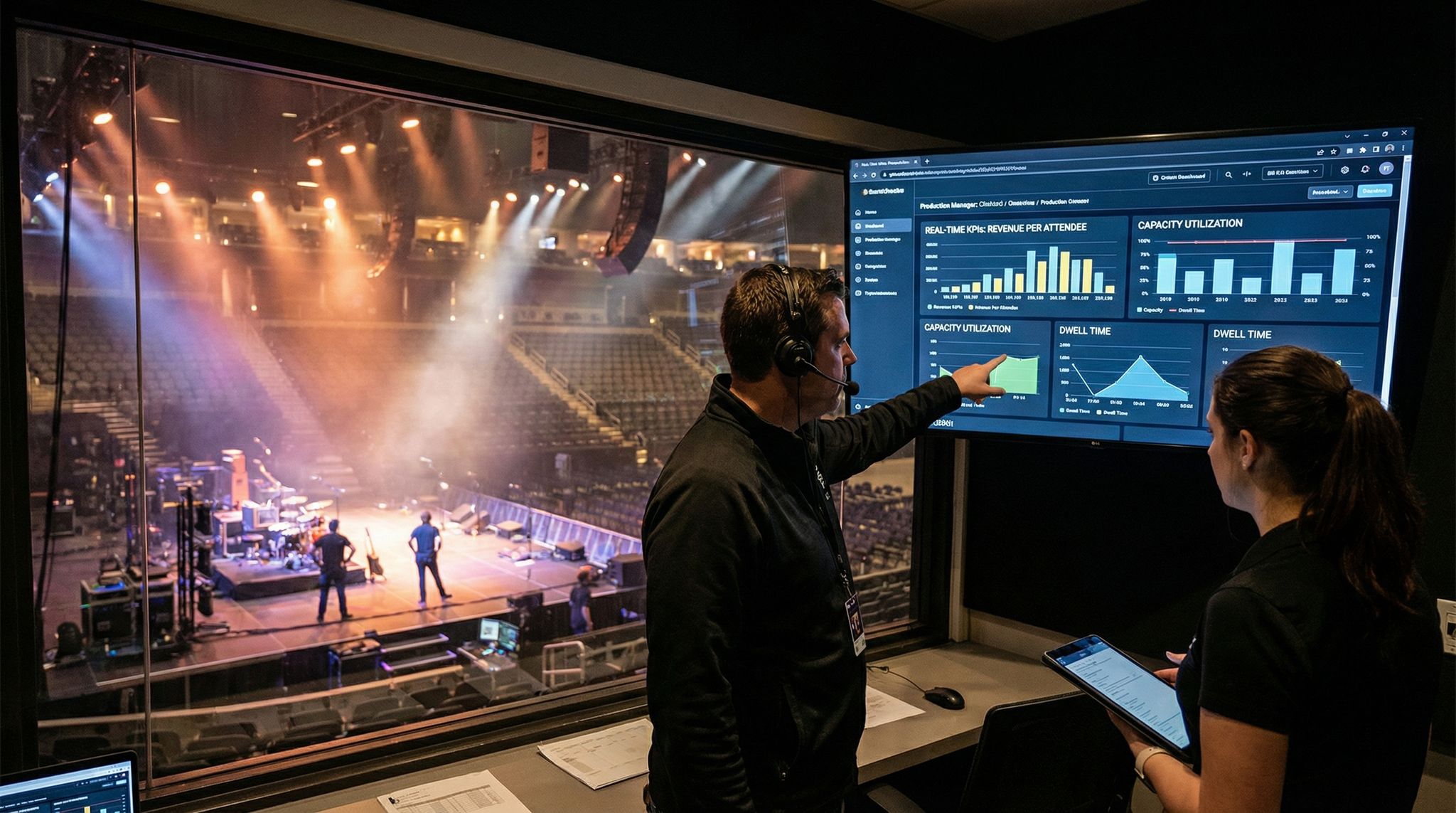
4. Data Dashboards and Visualization: Raw data is not useful until it’s digestible. Setting up a dashboard that displays your core KPIs in real time (or close to real time) is incredibly effective for keeping everyone focused on the numbers. This could be as simple as a Google Sheet or as fancy as a customized Tableau or Power BI dashboard pulling from your various systems. For example, you might have a dashboard that, during an event, shows ticket scan count (so you know current attendance vs expected), average spend per head updating as sales roll in, and any alerts (like “low inventory on product X” or “door delay: show started 15 min late”). After events, dashboards can show trends over time – e.g., a monthly summary of all your KPIs against targets, with green/up or red/down arrows highlighting where things improved or slipped. Some venues display certain metrics publicly for transparency, especially municipally-run venues which might share stats with a board or community (like total attendance YTD, number of local hires, etc.). Internally, consider a weekly KPI report email that auto-sends to management – it keeps everyone on the same page and sparks regular discussion on performance. The mantra is: if you can measure it, you can manage it. But since there’s endless data available, configure your dashboards to spotlight the key metrics that truly drive your venue’s success (the ones we’ve been discussing). Too much data without context can overwhelm. It often helps to have comparisons built-in – yesterday vs today, this quarter vs last quarter, your venue vs an industry benchmark – to make the numbers meaningful at a glance.
5. Feedback Collection Tools: For the experience KPIs (satisfaction, NPS, feedback themes), deploy tools to gather and analyze feedback efficiently. Online survey platforms (SurveyMonkey, Google Forms, Qualtrics, etc.) can be integrated into your post-event communications. Some ticketing providers (including Ticket Fairy) allow automated post-event surveys emailed to attendees. Make sure to actually analyze the results: a simple spreadsheet of ratings over time can show your trajectory. Text analysis tools or just manual reading of comments can surface common keywords (“bathroom,” “sound,” “security attitude,” etc.). There are even sentiment analysis services that can read open-ended comments and score them as positive/negative – useful if you have high volume of feedback. And don’t forget to monitor review sites and social media mentions. Setting up Google Alerts or using social listening tools can effectively expand your feedback collection beyond official surveys. All these qualitative inputs round out the quantitative KPIs, giving you a full 360° view of performance.
6. Security and Safety Tech: This might not sound like a KPI tool, but ensuring safety and compliance often involves metrics (number of incidents, response times, etc.) and technology. Incident tracking software lets you log any security or medical incidents and then run stats (e.g., incidents per 1,000 attendees, average response time by security to an issue). Mass notification systems can measure how quickly you can communicate to all attendees if needed. Research on emergency notification systems in venues emphasizes the importance of speed. These tools not only help keep people safe but also provide data that you can review to improve (for instance, if the average evacuation drill time is 6 minutes, can you get it to 5? If first aid responses are slow in one area of the venue, maybe reposition the medic station). Remember: a safe event is the ultimate KPI. One major incident can negate years of success, so while we mainly talk business metrics here, always give safety metrics the highest priority.
In summary, invest in a tech stack that suits your venue’s scale and needs. Many independent venues on tight budgets start with affordable, modular tools – a decent cloud ticketing/CRM here, a good iPad POS there, perhaps a free version of a survey tool – and then integrate as they grow. Larger venues often opt for enterprise solutions or even custom in-house systems. Whatever the approach, ensure the systems can talk to each other or that you have a way to compile the data. Even a manual weekly consolidation of reports from different systems is fine if that’s what it takes. The insight you gain is well worth the effort. As the saying goes, “what gets measured gets managed” – and with modern tools, you can measure just about everything.
From Data to Action: Turning Insights into Results
Collecting data is only half the battle – the real payoff comes from translating insights into decisions and operational changes. The top venues of 2026 treat their KPI reports as living documents that drive continuous improvement. Here’s how you can turn cold numbers into positive action:
1. Regular Performance Reviews: Make KPI review a routine. Many venue managers hold a weekly or monthly “metrics meeting” with key staff to review recent data. For example, you might meet every Monday to go over last week’s event stats: attendance vs goal, revenue per attendee, any notable variances. Use a simple scoreboard or dashboard as the agenda. In these meetings, ask the “why” behind the numbers. Why was merch spend higher on Friday than Saturday? Why did we get a spike in complaints for that one show? Treat it as a problem-solving session, not a blame game. When you identify an issue, assign an action. If bar wait times were long and hurt sales, perhaps the action is “test a satellite beer kiosk at the next show” or “hire 2 more temp bartenders for the rush.” If a certain promoter’s shows always have low attendance, maybe “meet with promoter to discuss marketing strategy or consider diversifying partners.” Write down these actions and follow up next time. This closed-loop process is how incremental improvements are made. Venues that do this consistently often see compounding gains – a few percent uptick in various KPIs each quarter adds up to big wins annually.
2. Experiment, Measure, Iterate: Data-driven decision-making thrives on a test-and-learn mindset. Use your venue as a laboratory. For instance, if your data indicates that merch sales are underperforming, formulate a hypothesis (“Maybe it’s because people don’t want to carry shirts around or our designs are outdated”). Then run an experiment: perhaps offer merch pre-orders for pickup (so fans can buy before the show and grab items after, avoiding lines and inconvenience). Measure the impact: did merch per head increase at the shows where we tried this? If yes, double down. If no, try a different tactic (maybe a limited edition item or better point-of-sale placement). Another example: if customer satisfaction is dipping, identify a likely cause from feedback (“Bathrooms were dirty”). Test a solution: increase cleaning staff or frequency, or even something creative like restroom attendants or a fun signage that encourages better behavior. Then watch the next batch of surveys – did the “bathroom” complaints vanish and scores rise? By treating changes as experiments with KPIs as the scorecard, you take the guesswork out. Some venues formalize this by running A/B tests: e.g., two different bar pricing strategies at two events and see which yields higher spend and satisfaction. Technology and data make this feasible – a far cry from the old days of making one change and hoping for the best.
3. Learn from Successes and Failures: Data will tell you not just what’s wrong, but what’s right. Identify bright spots in your KPI data – maybe one particular genre of event consistently yields higher NPS and spend. What are you doing well there that can be replicated elsewhere? Perhaps those shows have a house DJ after-party that keeps energy high (leading to dwell and bar sales) or maybe the crowd skews older and appreciates the comfortable seating you put out. Conversely, look at the low points. If your only events with sub-70% attendance are a certain niche, it might be time to discontinue that series and focus efforts elsewhere. If one staff shift had unusually high sales per customer at the bar, find out why (a superstar bartender upselling effectively? a new product that night?). Use those insights to train others. Real-world case: A mid-sized arena noticed their Thursday shows had the highest merch sales – digging in, they found the vendor started a “Merch Thursdays” promotion with a small discount and free souvenir. Armed with that data, they expanded the promo to other days, boosting merch revenue venue-wide. In another instance, a small club might find that shows where they booked a local food truck outside had 15% higher dwell time and spend – aha, maybe offering food (when you don’t have a kitchen) was the difference. So next year, they schedule food trucks for every weekend. These feedback loops powered by data are how you systematically make your venue more successful.
4. Empower Staff with Metrics: Don’t keep the numbers locked in the ivory tower – share relevant KPIs with those who can influence them. Bar managers should know the pour cost percentage and shrinkage figures; it might motivate them when they see that reducing waste saved $500 last month (essentially extra profit). Frontline staff might be interested in knowing the average customer satisfaction or feedback comments; a security team might take pride in a stat like “100% ID checks compliance” or reducing ejections through better crowd management. Many venues create internal contests or incentives around KPIs: e.g., a bonus for the bar team if they hit a target revenue per head while maintaining high customer satisfaction, or an award for any staff suggestions that lead to KPI improvements. When employees see the direct link between their actions and results, it fosters a culture of accountability and excellence. It also makes work more rewarding – they’re not just pouring drinks or scanning tickets, they’re contributing to tangible success metrics. One venue GM shared that after posting the monthly NPS score publicly and challenging the whole team to help improve it, staff began proactively finding ways to delight guests (one usher started a trivia game with early lineup fans, a bartender created a “drink of the night” themed to the artist). The result: NPS climbed and everyone celebrated the win together.
5. Adjust Strategy, Big or Small: Over time, KPI trends might signal the need for strategic shifts. If despite your best efforts a certain revenue stream remains low, consider new revenue opportunities (maybe your venue could add VIP table service, or start renting the space for private events on off nights to increase utilization). Data might reveal an untapped market – e.g., if your attendance data shows a large portion of fans traveling from a neighboring city, perhaps organizing shuttle buses or targeting marketing in that area could boost attendance further. Or if your analysis of events finds that comedy nights on Wednesdays consistently outperform band nights on Wednesdays, perhaps reallocate bookings to have more comedy mid-week and move band showcases to another slot. At the extreme end, if KPIs reveal fundamental issues – say, consistently poor profit margins and attendance despite various fixes – it could inform a bigger decision like a venue format change or renovation. (For instance, if your 800-cap venue only fills 300 seats on average, maybe reconfiguring the space to a cozier 400-cap setting will improve atmosphere and reduce costs, leading to better metrics across the board.) The beauty of data is that it grounds these decisions in evidence. Stakeholders are much more likely to back a major change if you can show the numbers and a projection of improvement.
6. Celebrate Improvements and Communicate Success: Lastly, use your KPIs to tell a success story. When you hit a goal or see a positive trend, share it widely – with your team, owners, sponsors, even the public if appropriate. “This quarter, our average attendance is up 15%” or “Customer satisfaction ratings hit a new high for our venue” are powerful messages. They validate the hard work your team has put in and build trust with stakeholders (promoters love to hear that fans love the venue; investors love to hear that revenue is rising). Many venues compile an annual report or summary of key metrics – especially useful for sponsored venues or those seeking grants, where you can show community impact (total attendees, number of local artists featured, jobs created, etc. alongside financials). Celebrating success isn’t just patting yourself on the back – it reinforces the value of being data-driven. It shows everyone that the numbers aren’t just academic; they translate to real-world success and recognition.
In essence, data-driven management is an ongoing cycle: Measure ? Analyze ? Act ? Measure again. The venues that embrace this cycle have been thriving. They were able to navigate disruptions like the pandemic recovery by monitoring new metrics (e.g., livestream attendance, social distancing compliance) and pivoting quickly. They respond to economic changes by keeping an eye on consumer spending patterns and adjusting pricing or offerings accordingly. They enhance fan experience by listening to feedback metrics and never staying complacent. Whether you run an intimate indie club or a massive arena, this proactive, numbers-informed approach will position your venue to succeed in 2026 and beyond.
Frequently Asked Questions
What are the most important KPIs for venue management?
Venue success relies on tracking metrics across three core categories: financial performance, operational efficiency, and audience experience. Essential indicators include revenue per attendee, capacity utilization, event turnaround time, and Net Promoter Score (NPS). Monitoring these data points allows managers to optimize operations, identify trends, and maximize overall profitability.
How is revenue per attendee calculated for live events?
Revenue per Attendee (RPA) is calculated by dividing total event revenue by the number of paid attendees. This comprehensive metric encompasses ticket income plus ancillary sales like food, beverages, and merchandise. Tracking RPA helps venues understand how effectively they monetize each guest beyond the base ticket price and normalizes performance across different event sizes.
Why does event turnaround time matter for multi-purpose venues?
Minimizing event turnaround time allows multi-purpose venues to host more events and increase revenue potential. Efficient changeovers reduce downtime between bookings, enabling a venue to switch from a corporate setup to a concert configuration quickly. Faster transitions maximize asset utilization and booking frequency without compromising safety or production quality.
How can venues increase revenue per attendee without raising ticket prices?
Venues increase revenue per attendee by offering value-added upsells like VIP upgrades, merchandise bundles, and fast-track entry. Additionally, reducing friction points such as long bar lines or cash-only concessions significantly boosts per-capita spending. Industry data suggests minimizing wait times and offering desirable upgrades can increase concession sales by over 40%.
How do queue wait times impact venue concession sales?
Long queue wait times directly reduce venue revenue and customer satisfaction. When fans spend excessive time in line, they miss the event and purchase fewer items. Studies show that reducing friction through cashless payments, optimized staffing, and streamlined entry can increase concession sales by up to 34% while improving the overall guest experience.
What is dwell time and why is it important for venues?
Dwell time measures the duration attendees remain at a venue, correlating strongly with higher spending and satisfaction. Venues encourage longer stays by offering post-show attractions, such as DJs or late-night food options. Tracking this metric via Wi-Fi analytics or ticket scans helps operators gauge engagement and identify opportunities to increase on-site revenue.
What technologies are used to track venue performance metrics?
Modern venues track performance using integrated tech stacks including ticketing CRMs, Point-of-Sale (POS) systems, and Wi-Fi analytics. These tools capture real-time data on sales, attendance, and crowd flow. Advanced solutions also utilize video analytics to monitor queue lengths and centralized dashboards to visualize Key Performance Indicators (KPIs) for immediate decision-making.
What is a typical profit margin for independent music venues?
Independent venues often operate on razor-thin margins, with some grassroots sectors averaging profit margins as low as 0.5%. To ensure financial sustainability, operators must track net income and EBITDA closely. Improving margins requires accurate cost allocation, reducing inventory waste, and maximizing high-margin ancillary revenue streams like food and beverage sales.
How can data improve venue staffing efficiency?
Data-driven staffing involves using historical attendance and sales data to forecast labor needs accurately. By tracking labor cost ratios and revenue per staff hour, managers can schedule optimal coverage for peak times while avoiding overstaffing. This approach balances operational costs with maintaining high service levels and short wait times for attendees.
What are the key KPIs to measure event success in 2025 and 2026?
The most critical indicators for the upcoming years blend financial health with digital visibility and attendee experience. Operators should track revenue per attendee, capacity utilization, SEO KPIs for organic ticket discovery, and Net Promoter Score (NPS). Balancing these metrics ensures both immediate profitability and long-term brand growth.
What are typical profit margins on VIP merch bundles?
Profit margins on VIP merchandise bundles can often exceed 50%, which is significantly higher than standard a la carte merch sales. Because fans value the exclusivity and convenience of a bundled package, venues and promoters can price these offerings at a premium, offsetting the lower margins typically seen on base ticket sales.
What is the standard concert ticket revenue breakdown percentage?
While deals vary widely, a common concert ticket revenue breakdown allocates 70% to 85% of the gross ticket revenue (after taxes and facility fees) to the artist. The promoter and venue typically share the remaining 15% to 30%. Ticketing platform fees are usually handled separately, highlighting why venues must rely heavily on high-margin secondary spend like food, beverage, and VIP upgrades to achieve profitability.
How do operators capture in-venue audience insights?
Venue managers capture in-venue audience insights by utilizing a combination of venue Wi-Fi analytics, RFID wristbands, Bluetooth beacons, and mobile app engagement data. These technologies track attendee movement, dwell times, and interaction points throughout the physical space. By analyzing this behavioral data, operators can optimize crowd flow, strategically place concessions, and deliver personalized, location-based marketing to fans during the event.