Global Vision, Local Approach
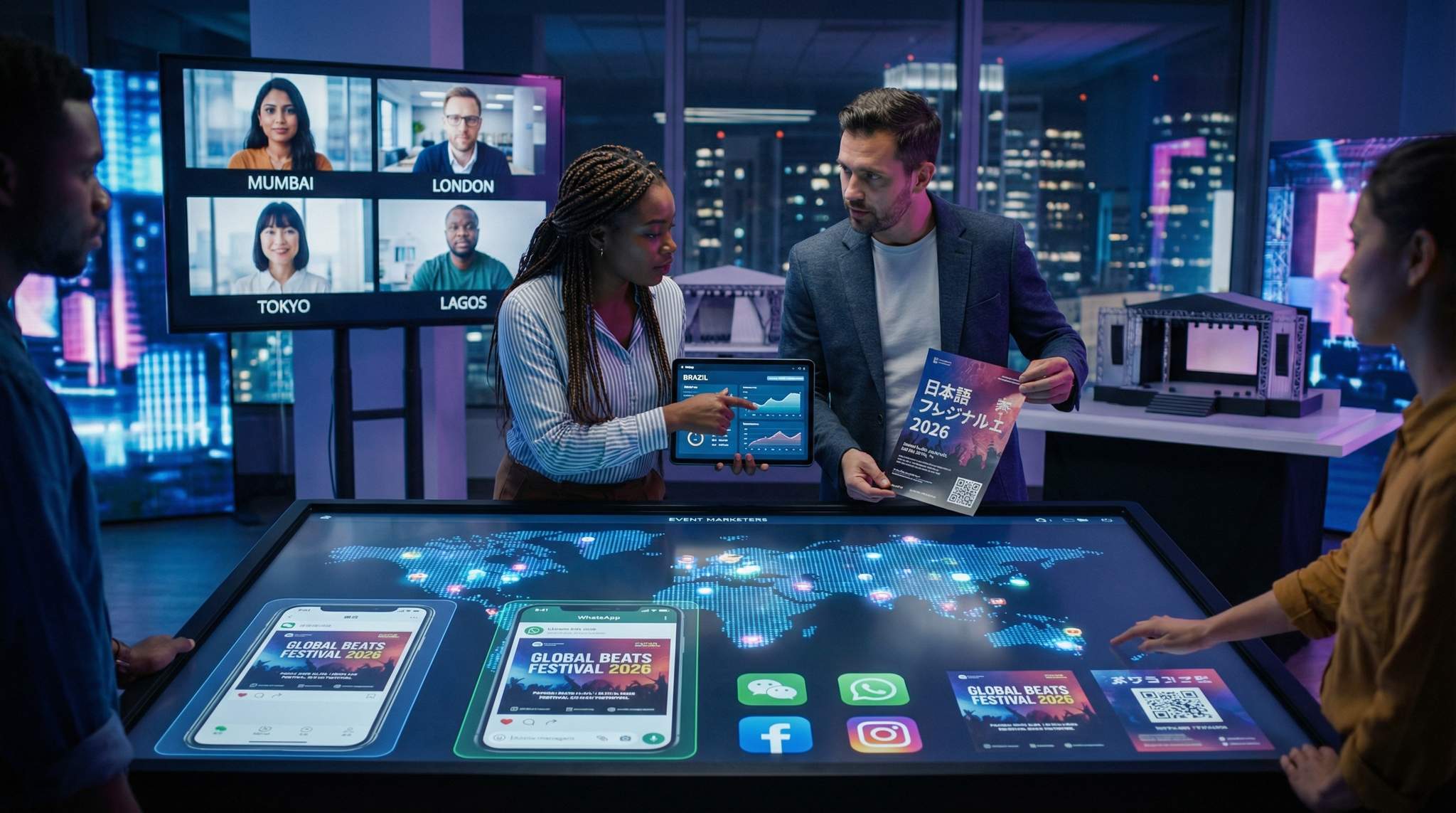
Expanding an event to new regions in 2026 is an exciting growth opportunity – but seasoned event marketers know that success abroad requires more than copy-pasting your domestic playbook. Cultural nuances, platform ecosystems, and consumer behavior vary widely around the world. One-size-fits-all campaigns rarely resonate; instead, winning strategies “think global” in ambition but “market local” in execution, a concept explored in successful localized marketing strategy examples. In an era where over two-thirds of the world’s population (5.66 billion people) are active on social media, according to Digital 2026 global population reports, reaching international audiences is easier than ever in theory. The challenge is crafting messages that feel authentic in each locale.
Experienced event promoters emphasize the importance of local insight. Many major brands have learned the hard way that a campaign that packed venues at home can fall flat – or even offend – if simply translated overseas, as highlighted in localized marketing examples. For event organizers, this means adapting every element of marketing to the target market: the channels you use, the language and imagery in your ads, the timing of announcements, and even the partners you work with on the ground. The payoff for getting it right is huge. Emerging markets across Asia, Latin America, the Middle East and Africa are booming with new festival audiences, driven by rising consumer demand in these regions. By localizing your approach, you can turn global interest into real ticket sales rather than letting cultural disconnects hinder your growth. As we’ll explore, “think global, market local” isn’t just a catchphrase – it’s a proven formula to connect authentically with fans anywhere in the world.
The Global Opportunity (and Obligation) to Localize
The live events industry has never been more globally connected. Fans in far-flung countries watch Coachella and Glastonbury livestreams, sparking demand for similar experiences at home, as noted in analysis of emerging festival markets. Ambitious promoters are responding by taking festivals and tours to new continents. However, with this global reach comes an obligation: respect your audience’s local context. In 2026, simply running English-language Facebook ads for every market won’t cut it. Audiences are bombarded with content daily, and they scroll past anything that doesn’t speak directly to them. Marketers who do invest time in localization are reaping rewards. For example, when a major festival expanded to West Africa, they co-branded with local stars and tailored all messaging to local culture – selling out their debut show while building community goodwill, a strategy detailed in emerging festival market trends. By contrast, other events have flopped internationally by neglecting local customs and preferences. The lesson is clear: global vision must be executed with local precision.
Research Drives Relevance
Before diving into any multi-market campaign, experienced promoters insist on rigorous research. This means analyzing data to understand who your potential attendees are in each target region. Where are your ticket buyers and social followers coming from? If your event website sees heavy traffic from, say, Brazil and Japan, that’s a signal to include those markets in your strategy when marketing your festival to international audiences. Use every insight available – ticketing reports, Google Analytics, social media demographics – to map out your international fanbase. One recent festival marketing guide recommends starting with a deep dive into interest by region and audience personas, so you can prioritize the markets that show the most organic enthusiasm, helping avoid what most festivals get wrong about marketing and breaking language barriers effectively.
Turn Fans Into Your Marketing Team
Ticket Fairy's built-in referral rewards system incentivizes attendees to share your event, delivering 15-25% sales boosts and 30x ROI vs paid ads.
Crucially, research means talking to locals, not just crunching numbers. Savvy event marketers often consult with regional experts or even informal focus groups of fans in the area. What do people value in events like yours? Do they prefer communication via email, messaging apps, or community forums? What price points are realistic given the local economy? Locals can reveal subtle preferences that aren’t obvious from data alone – saving you from costly missteps. The work you put into market research upfront will pay off in highly relevant campaigns that make potential attendees abroad feel “this event is for me,” rather than a generic blast from an outsider.
Research and Understand Each Market
Analyze Your Global Audience Data
Start by examining where your current interest is coming from. Dig into your ticketing platform and web analytics to identify international traffic and sales. Experienced event marketers always quantify their audience by region. For instance, if 15% of your ticket sales or website hits are coming from Germany or Japan, those markets deserve attention in your plan. Look at social media insights as well – are you seeing an uptick in followers from Latin America or Asia? Tools like Instagram’s audience breakdown or Spotify’s listener locations (for music events) can highlight fan pockets abroad. According to campaign veterans, this kind of data-driven approach ensures you focus efforts where real demand exists, rather than making blind guesses. As the saying goes, go where the fans are already raising their hands. If analytics show a surprising number of newsletter signups from Canada or comments from Brazil, investigate further. Those insights might lead you to craft specific ads or content for that region, or even influence where you choose to host future events, as suggested in guides on marketing your festival to international audiences. In short, let the data guide you on which markets are worth targeting and how.
Ready to Sell Tickets?
Create professional event pages with built-in payment processing, marketing tools, and real-time analytics.
Once you’ve identified key regions, refine the profile of your audience in each. Are your potential attendees in India mostly college-age, or in their 30s? Do Australian fans discover events through Google searches, or via friends on social media? Use surveys, past attendee records, and public research to flesh out these personas. For example, a tech conference expanding to Europe might learn that their German followers highly value detailed agenda information (so translate and localize that content), while their Spanish audience engages more with exciting video clips. Understanding these distinctions will allow you to tailor messaging that truly resonates in each locale. The goal is to know your audience so well that your marketing feels native to their experience, not an export from somewhere else.
Identify Key Languages and Local Lingo
Language is the most obvious barrier when marketing globally, yet it’s one that events still get wrong. Simply put, people are far more likely to engage with content in their own language. If you’re promoting a festival in Montreal or a tour in Mexico City, English-only ads will miss a huge segment of interested fans. Identify the primary languages of each target market and plan to create marketing materials in those tongues. This might mean Spanish and Portuguese for Latin America, German and French for Western Europe, and Mandarin or Hindi for parts of Asia, a necessity emphasized in strategies for breaking language barriers. Don’t forget subtleties like British vs. American English if you market in the UK, or the mix of English and local languages common in places like India or Singapore.
Translation needs to go beyond literal words – local phrasing and slang can make a big difference. For instance, younger audiences in Australia might respond better to a casual, humor-filled tone, whereas in Japan a more polite and official wording is expected in marketing. Whenever possible, work with professional translators or bilingual marketers who can capture not just the meaning but the tone of your message, as recommended when marketing your festival to international audiences. They’ll avoid those infamous gaffes where a slogan translates awkwardly or offensively. And remember, it’s not just about language – it’s about lingo. Even within the same language, the way you refer to something can signal whether you “get” the local culture. Is it a “music fest” or a “rave”? “Football” or “soccer”? Localize terminology to fit what locals say. These small tweaks show respect and build trust with your audience.
Understand Local Media and Communication Habits
Media consumption varies widely across regions. An advert strategy that works in one country might barely register in another because people use different channels. Knowing where your target audience gets information is crucial. Start by researching the dominant social networks, messaging apps, and media outlets in each market (more on platform differences in the next section). For example, if you’re trying to reach festival-goers in South Korea, you’ll find that Twitter and native platforms like Kakao are more effective than Facebook, according to international festival marketing insights. In parts of Africa and South Asia, Facebook and WhatsApp groups might spread the word fastest, as noted in emerging festival market reports. In Germany, many people still rely on email newsletters from promoters or clubs. In the Middle East, Instagram and Snapchat have enormous traction, while radio and billboard advertising also carry weight for reaching mass audiences.
Data-Driven Event Marketing
Track ticket sales, demographics, marketing ROI, and social reach in real time. Exportable reports give you the insights to make smarter decisions.
Don’t rely on assumptions – get actual data or local expert input. Industry reports and surveys (e.g., from Global Web Index or DataReportal) often detail social media usage by country, which can guide your channel selection. Also, be mindful of offline vs. online balance. In some markets, old-school street marketing, flyers at campuses, or partnerships with community organizations can be as important as digital ads, especially if internet penetration isn’t universal. A veteran marketer who promoted concerts across Latin America noted that in certain cities, local radio giveaways and posters at universities were key to supplement Facebook ads, because they reached younger fans where they actually hang out. The bottom line: meet your future attendees on the channels they already use, a core principle of marketing your festival to international audiences. By aligning your marketing mix with local media habits, you’ll maximize your relevance and efficiency in each market.
Platform Preferences by Region
North America & Europe: Meta, TikTok… and Niche Communities
In North America and much of Europe, the social media landscape in 2026 will look familiar to many marketers – but with nuances. Facebook and Instagram (Meta’s platforms) remain powerhouses for event promotion in these regions, especially for reaching a broad age range. Instagram is prime for visually showcasing event experiences, and Facebook (despite declining youth usage) is still valuable for its event pages, groups, and older demographics. The important tweak is localization by language within Europe: while English works for a pan-European reach, targeting specific countries with native-language posts or ads (French in France, German in Germany, etc.) significantly boosts engagement, as advised in international festival marketing guides. Savvy European festival promoters often maintain multi-lingual social media accounts or at least mix languages in their content to show inclusivity. For example, a German techno festival might post in German to excite local fans while also posting in English to attract international travelers, a tactic discussed in breaking language barriers for festivals.
Grow Your Events
Leverage referral marketing, social sharing incentives, and audience insights to sell more tickets.
Beyond Meta, TikTok and YouTube are universally popular in the West, especially among Gen Z and Millennial audiences. Short-form video can ignite global buzz (a viral TikTok of your festival can reach users in any country), but to convert that into ticket sales you should tailor some content by region – such as featuring local influencers or trends in your TikTok posts for a given market. Twitter (now X) remains a key platform for real-time updates and community chatter, with particularly strong usage in the UK and urban USA. And don’t ignore niche communities: Reddit, Discord servers, and specialized forums (from EDM communities to cosplay boards for fan conventions) can be highly effective channels to target the exact subculture your event appeals to. Experienced event marketers in North America often partner with these niche communities early, seeding content or doing AMAs (Ask Me Anythings) to build grassroots excitement beyond just blasting ads on the big social networks.
Latin America: WhatsApp, Instagram and Word-of-Mouth
Latin America is a vibrant and socially connected region, but you must adjust your approach to its unique platform mix. Facebook and Instagram have massive reach across Latin American countries, and running localized ads on them (in Spanish, Portuguese, etc.) is a starting point for marketing your festival to international audiences. However, the real secret weapon in LatAm is WhatsApp. Throughout Latin America, WhatsApp isn’t just a private messaging app – it’s effectively a social network and a commerce tool rolled into one, as detailed in WhatsApp usage trends in Latin America. In countries like Brazil, Colombia, and Mexico, fan communities often form WhatsApp groups to share news and hype about upcoming events. In fact, WhatsApp penetration is over 75% of the population in many Latin American markets, compared to just 23% in the US, according to global digital trend insights. Smart promoters leverage this by creating official WhatsApp broadcast lists for announcements, or by seeding content to fan group admins who can spread it for you. Personal referrals carry a lot of weight here – a friend forwarding an event flyer in WhatsApp can be more convincing than a polished ad.
Latin American audiences also respond to community engagement and influencer marketing. Micro-influencers on Instagram or TikTok, who share the same language and cultural references, can ignite interest quickly. It’s common for music festival campaigns in LatAm to involve popular regional DJs, YouTubers, or even telenovela stars to promote an event, lending local credibility. And don’t underestimate offline channels: Latin America still has a strong culture of street marketing. For example, promoters in cities like São Paulo or Mexico City often hire street teams to hand out flyers at universities, put up posters in nightlife districts, and coordinate with nightlife promoters to mention events in the weeks leading up. These grassroots efforts, combined with digital, make sure you cover the heavy social media users and those who rely on community buzz. The key is speaking the language (literally and figuratively) – campaigns in LatAm should feel culturally enmeshed, celebratory, and personable to tap into the region’s enthusiasm.
Asia-Pacific: China’s Walled Garden vs. The Rest
The Asia-Pacific region presents perhaps the greatest contrast in platform preferences – especially China versus everywhere else. In China, global social media giants are blocked, so you must use local platforms to have any presence, a critical point in marketing your festival to international audiences. The trifecta for reaching Chinese event-goers is WeChat, Weibo, and Douyin. WeChat serves as a do-everything app (social feed, group chats, ticket sales via mini-programs, etc.), and having an official WeChat account to post updates and engage in group chats is essential for breaking language barriers in China. Weibo is akin to a hybrid of Twitter/Instagram for public-facing content – promoting your lineup or announcing ticket on-sales there can reach millions, especially if amplified by Chinese influencers (KOLs, or Key Opinion Leaders). Douyin (the Chinese version of TikTok) is ideal for sharing teaser videos, artist shoutouts to Chinese fans, and behind-the-scenes clips. It’s worth noting the scale: WeChat alone boasts over 1.4 billion active users, according to WeChat user statistics and demographics, so an investment in mainland China’s ecosystem can unlock a massive audience – but you’ll likely need a local partner or agency, as everything from language to marketing regulations differ (e.g. content about certain topics is censored; promotional contests might require permits).
Outside mainland China, many Asia-Pacific countries do use the global platforms, yet each has its own flavor. India, for example, is huge on Facebook, Instagram, and YouTube, but notably TikTok is banned as of 2026 (after 2020’s ban). Successful events targeting India have leaned on Instagram Reels for short video content and tapped YouTube influencers for long-form promotions. Japan has an incredibly high Twitter usage – it’s often said Twitter is bigger than Facebook there, as noted in international festival marketing research. A music event in Japan might trend on Twitter if marketed cleverly (e.g. during lineup drops). Plus, Japan’s LINE messenger is ubiquitous for direct communications and brand updates, so consider a LINE Official Account. South Korea revolves around platforms like KakaoTalk (messaging) and Naver (online forums/blogs), alongside Instagram, as detailed in marketing your festival to international audiences. In Southeast Asia (Indonesia, Philippines, Malaysia, etc.), Facebook and Instagram are widely used, but TikTok and YouTube have exploded in popularity for youth audiences. Also, countries like Thailand and Indonesia show high engagement on TikTok for event content, according to emerging festival market trends. Across Asia-Pacific, adjusting to these preferences is non-negotiable – if you run ads only on Western networks, you’ll simply miss much of the conversation. Instead, localize your social media mix: for instance, a campaign for a tour in Tokyo might combine YouTube artist interviews (with Japanese subtitles), tweets in Japanese, and ads on Instagram; whereas a push in Seoul would involve Kakao channels and perhaps Naver blog reviews in Korean. Each country’s digital society is distinct – embrace that diversity in your channel strategy.
Middle East & Africa: Instagram, WhatsApp and Local Networks
The Middle East and Africa encompass many different countries and cultures, but one commonality is that mobile-first communication is king. In the Middle East/North Africa (MENA), platforms like Instagram, Facebook, and Snapchat enjoy immense popularity, especially among the large youth demographic. For example, Instagram leads the pack in many Gulf countries for event discovery – it’s visual, influencers are active on it, and it supports Arabic content well. Pair Instagram with WhatsApp for more personal outreach (since WhatsApp usage is extremely high in MENA too) and Twitter for real-time buzz around event announcements or on-sale moments. Moreover, countries such as Saudi Arabia and the UAE have very high YouTube viewership per capita, so trailer videos or artist greetings on YouTube (with Arabic captions or subtitles) can gain traction. Notably, MENA’s weekend is typically Friday–Saturday (with Sunday as a workday), so remember to time your big social media pushes accordingly, as advised in emerging festival market guides – a Thursday night announcement may outperform a Sunday, opposite to Western norms.
Sub-Saharan Africa is rapidly coming online, and Facebook and WhatsApp are often the foundational channels across many nations, as highlighted in emerging festival market analysis. In fact, Facebook is frequently the gateway to the internet for many African users due to past programs like “Facebook Free Basics” and the ubiquity of Android phones. Event marketers report that Facebook events and pages are crucial for audience engagement in countries like Nigeria, Kenya, and South Africa. WhatsApp again plays a central role for spreading event news peer-to-peer (with usage in some African countries also reaching ~80-90% of internet users, according to LinkedIn market insights). That said, Africa is far from monolithic – be alert to local social networks or forums that matter. For instance, in Nigeria, Telegram groups and Twitter are influential among music fans; in South Africa, Instagram and YouTube are very popular, and there’s a culture of radio and TV coverage for big events which can dramatically boost credibility. Traditional media might have more sway in parts of Africa than in hyper-digital European markets. Adapt to connectivity realities too: outside major cities, internet access may be spottier, so ensure your promotions (and ticket purchasing process) are lightweight and mobile-friendly. Some events even run SMS campaigns or use community radio for remote regions. The guiding principle is to be platform-agnostic and audience-centric – use whichever channel best reaches the local fans, whether that’s a WhatsApp blast, a spot on a local radio breakfast show, or a post on the village Facebook group.
Below is a snapshot of dominant social platforms by region in 2026 and considerations for marketers:
| Region | Top Social/Messaging Platforms | Notes for Marketers |
|---|---|---|
| USA/Europe | Facebook, Instagram, TikTok, YouTube, Twitter (X) | Use native languages in Europe for ads; tap niche forums for subcultures. Facebook events still useful for general reach. |
| Latin America | WhatsApp, Instagram, Facebook, YouTube | WhatsApp is core to communication – leverage group sharing and broadcast lists. Local Spanish/Portuguese content is a must. |
| China | WeChat, Weibo, Douyin, Tencent Video | Western platforms blocked – invest in local channels and KOLs. WeChat for community building; Weibo for public buzz. |
| Rest of East Asia (Japan, Korea) | Twitter (Japan), LINE (Japan), KakaoTalk (Korea), Instagram, YouTube | Extremely high Twitter usage in Japan. Use local apps (LINE/Kakao) for direct updates. Korean audiences respond to Naver and local influencers. |
| South & SE Asia | Facebook, Instagram, YouTube, TikTok (except India), WhatsApp | Facebook & IG are widespread. India uses Instagram Reels/YouTube (no TikTok). Tailor content to local languages (e.g. Hindi, Bahasa). |
| Middle East (Gulf) | Instagram, Snapchat, Twitter, WhatsApp | Post around Thurs/Fri to align with weekend. Partner with regional influencers. Arabic content significantly boosts engagement. |
| Africa | Facebook, WhatsApp, Instagram, YouTube | Mobile-first approach. Facebook/WhatsApp vital for reach. Consider radio and SMS in regions with limited internet. Local language content (e.g. Swahili, Hausa) builds trust. |
Table: Dominant social media platforms by region and notes on how event marketers should adapt channel strategy.
Tailoring Content and Messaging to Culture
Translate, Transcreate, and Localize
Once you have the right channels, the next critical step is speaking in a way that connects. This starts with translating your content, but goes well beyond it. Straight translation is rarely enough – instead, aim for transcreation, meaning you adapt the message to fit the cultural context. For example, the tagline for your EDM festival might be “An epic bass experience.” Translating that into Spanish or Korean word-for-word could come out awkward or lose impact. A skilled translator will find an equivalent phrasing that evokes the same excitement in the target language, even if the words differ. This might involve changing idioms or references entirely. The extra effort pays off by avoiding cringe-worthy or confusing copy. A notorious example marketers cite is when a car company’s slogan “Every car has a high-quality body” translated into an Asian language as “every car has a high-quality corpse” due to a single word mismatch, a classic case of international marketing translation fails. Don’t let your event messaging suffer a similar fate – invest in quality human translation and review by native speakers who also understand your brand voice.
Localization also means adapting units, formats, and visuals. Use local currency in prices; use the metric system for dimensions; and check that dates and times are formatted in the local way (for instance, many countries write day/month/year instead of month/day/year, which can trip people up for event dates). If you produce posters or videos, consider localizing text on graphics, and dubbing or subtitling video content as needed. An experienced event marketer will build localization into their content pipeline from the start, budgeting time and money for multi-language versions of key assets. The goal is for a fan scrolling your ad in Bangkok or Berlin to get the info immediately with no extra mental gymnastics to interpret a foreign language or unusual format. When you make your promotion seamless to digest, you remove barriers that might otherwise cause potential attendees to hesitate or ignore your message.
Respect Cultural Norms and Sensitivities
Beyond language, cultural sensitivity is paramount in crafting marketing that resonates and doesn’t backfire. Symbols, colors, and phrases carry different meanings in different cultures. What’s edgy and funny in one country might be considered rude or tone-deaf in another. For instance, using a skull imagery might be fine for a rock concert poster in the US, but in some Asian cultures it could be seen as ominous or in poor taste outside of Halloween. Likewise, the color white is associated with weddings in the West but with mourning in China. Do your homework on local norms: something as simple as a hand gesture (?? or ? in your ads) might be offensive in certain places. An infamous case was a tourism campaign that used a hand sign meaning “OK” – unaware that in Brazil that gesture is vulgar. Avoiding such blunders is step one to being accepted by the local audience.
It’s not just about avoiding offense; it’s also about striking the right tone. Different cultures respond to different emotional appeals. American marketing often thrives on bold claims and FOMO-inducing hype (“the biggest, best party of the year!”). In contrast, Japanese audiences might respond better to messages emphasizing uniqueness, quality, or tradition in a more understated way. German audiences appreciate precision and facts (like detailed schedules or tech specs for a festival), whereas Brazilian audiences might respond more to passion and community vibe in the copy. Tailor not only what you say but how you say it. Veteran marketers will often A/B test messaging in each locale to find the perfect angle – be it humor, prestige, urgency, or friendliness – that clicks with the local psyche.
Also, pay attention to local values and sensitivities around content. In more conservative countries (parts of the Middle East, Southeast Asia, etc.), you may need to dial back imagery or themes that would be fine elsewhere. For example, promotional materials showing excessive drinking, revealing outfits, or overt political statements might face pushback or even legal barriers. Saudi Arabia only recently began allowing large music festivals, and they enforce strict rules about behavior and attire on promotional content, as noted in emerging festival market reports. Successful events in such markets work within cultural expectations – highlighting aspects like the music, art, and production value while steering clear of taboos. On the flip side, in Europe or North America, culturally sensitive marketing might mean demonstrating inclusivity (e.g. showing diverse attendees) and alignment with local social causes (like sustainability or community givebacks) to build goodwill. The key is showing respect – when locals see that your event promotion respects their culture and values, they are far more likely to trust and support it.
Highlight Locally Relevant Selling Points
When you market globally, you’re not just selling the same experience copy-pasted; you’re selling what that experience means to that audience. Thus, tweaked messaging can highlight different facets of your event depending on what’s attractive locally, a strategy recommended for marketing your festival to international audiences. For example, suppose you run a touring comic convention. In the US, your marketing might emphasize celebrity guest panels and exclusive merch (huge draws for American con-goers). But when promoting the same convention in France, you might lean more into the artists’ alley and European comic art tradition, because French fans have a deep appreciation for the art form and might care less about Hollywood stars. Similarly, a music festival in Asia might want to spotlight any local cuisine or cultural activities at the event – “enjoy authentic regional street food while you dance!” – as that could be a unique selling point for attendees who cherish their food culture.
A powerful tactic is to integrate local talent or themes and promote them. Many globally expanding festivals have learned this one. Lollapalooza, when launching editions in Chile, Brazil, and Argentina, didn’t just import a U.S. lineup – they made sure to add famous Latin rock, pop, and electronic acts to the bill, then highlighted those names in local ads, a move detailed in emerging festival market case studies. That told local fans, “this festival is as much about our music as it is about foreign stars,” which drove engagement. If your event can include local partnerships – say a stage co-hosted by a local promoter brand, or a segment of programming curated by a local celebrity – trumpet that in your messaging. It signals you’re not just parachuting in; you’re collaborating with the scene. Even if the core of your event remains international, find relevance hooks for each market. Is your conference taking place in Singapore? Mention how this is a rare chance for regional professionals to network without flying overseas. Is your rave landing in Australia for the first time? Maybe highlight stage production by an Aussie design team, or simply convey the historic nature: “our first-ever Down Under edition, created with Aussie fans in mind!” People love feeling like an event was made for them – show them why it is.
Two-Way Engagement in Local Languages
To truly adapt your marketing, think of it not as a broadcast but as a dialogue with your new audience. This means being responsive and interactive in the local language. If you’re running social media accounts for a festival across different countries, try to have community managers or team members who can reply to comments, answer DMs, and engage in discussion in the native tongue, a best practice for marketing your festival to international audiences. Fans will be asking questions – about set times, age restrictions, travel, etc. – and a reply in Spanish or Japanese (rather than an English copy-paste) makes a world of difference in customer service perception. Even basic efforts like replying “¡Gracias!” to a excited comment from a fan in Mexico, or “??” (“Thank you”) to a Chinese fan’s post, show that you acknowledge and welcome those attendees.
Another great approach is to incorporate user-generated content from different regions into your campaign. For instance, if you notice a group of bloggers in Brazil wrote about your event, share their article (if positive) or highlight quotes from it – in Portuguese – on your channels. Or encourage fans abroad to share why they want to attend, perhaps via a contest, and then feature those stories. One major festival created country-specific Facebook Groups for fans (France Fans, Japan Fans, etc.) and nurtured those communities with exclusive news in the local language, turning them into passionate advocates. Empowering local fan ambassadors in this way can exponentially extend your reach. When people see someone from their own country raving about your event, it builds trust far more than any ad copy you write. All these efforts boil down to a simple principle: make international fans feel like they’re an equal part of your event’s story. When marketing becomes a conversation and not a lecture, you’ll build genuine enthusiasm that crosses language barriers.
Timing and Scheduling Differences
Timing is everything in event marketing – and “perfect timing” isn’t universal around the globe. The schedule of your promotional campaign should account for local calendars, holidays, buying behaviors, and even daily routines. Seasoned campaign managers stress that a winning timeline in one country may flop elsewhere if it ignores local timing norms, as discussed in emerging festival market strategies and cultural event planning guides.
Align with Local Seasons and Holidays
One of the first considerations is the local calendar of holidays and seasons. Every region has peak festival seasons and dead periods, often corresponding to weather and cultural holidays, a factor highlighted in emerging festival market trends. For example, trying to host (or heavily market) a music festival during the monsoon in Southeast Asia is a recipe for disaster – not only would weather wreck the experience, but fans know better than to plan big outings then, as noted in emerging festival market analysis. Similarly, an outdoor event in the Middle East is usually unthinkable in the scorching summer; the season shifts to cooler months (fall or early spring). From a marketing perspective, you need to schedule your ticket launches and promotional peaks at times when people are receptive. Avoid major local holiday periods unless your event is tied into them. In China, for instance, expect slower engagement during Lunar New Year when many are with family (unless your event is right after and you’re using the holiday to tease a “new year celebration”). In predominantly Muslim countries, promoting a festival during Ramadan would be both insensitive and ineffective, according to emerging festival market guides – nightlife pauses, and people focus on fasting and family. Savvy promoters in these markets instead plan around such holidays, perhaps launching campaigns just after Ramadan or during other festive times when people are eager to go out again, a tactic suggested in emerging festival market planning.
Conversely, you can piggyback on holidays if appropriate. European organizers often announce lineups or drop special promos around Christmas/New Year, knowing fans have free time and are thinking ahead to summer festival plans. In Latin America, one might leverage Carnival season (late Feb/early Mar) as a thematic tie-in – if not directly during Carnival, maybe an “after Carnival” event push. Always check the local events calendar too: are there school holidays, exam periods, national election dates, or other big events that clash with your timing? You wouldn’t want your big ticket sale to start on the same weekend as a major national festival or a sports final in that country, if it will divert attention. Marketers who localize their calendars and adjust drop dates or ad flights to avoid (or utilize) local milestones see far better results than those who choose dates based solely on their home country’s schedule.
Work with Local Weekends and Daily Rhythms
Even the concept of the “weekend” differs globally, which can affect how you schedule events and marketing pushes. Western countries follow the Saturday-Sunday weekend, but as noted, many Middle Eastern countries break on Friday and Saturday, a crucial detail in emerging festival market logistics. Israel’s weekend is Friday-Saturday as well (with workweek Sunday-Thursday). This means if you usually send your big email blasts on Friday at noon New York time, that might be hitting Israel on a Sabbath when people are offline. Or if you post on Sunday assuming people are free, in Dubai that’s the start of the workweek. Align your communications to local days off for maximum eyeballs – for instance, targeting MENA audiences with Thursday social posts that say “this weekend’s ticket alert…” etc.
Daily cultural rhythms matter too. Think about what time of day people engage with media. In Spain or Argentina, prime social media hours might be later at night because of the culture of late dinners and nightlife (people may be scrolling at 11pm). In contrast, in countries where early commutes are common, a lot of engagement might happen at 7-8am or during lunch breaks. Some cultures have siesta or midday breaks, others have long afternoon work hours. If you’re running timed announcements (like a live lineup reveal) or flash sales, schedule them at a local hour when your audience is attentive. Many global marketers solve this by staggering announcements by time zone – e.g., drop news at 7pm local time in each region, rather than a single global time. Yes, this means multiple “announcements” instead of one, but each region feels like the news was conveniently timed for them. The same goes for ad scheduling: use your ad platform settings to run campaigns during the hours local users are most active online (Facebook and Google Ads both allow dayparting and country-specific time targeting). These tweaks prevent wasting impressions at 3am or during prayer times or other low-attention periods.
Understand Ticket Buying Behavior
One of the biggest timing adjustments is how far in advance people buy tickets. Advance sales windows differ widely by market. In many Western countries (and for highly anticipated events), fans buy early – securing tickets months in advance to guarantee their spot. However, in a lot of emerging markets, there’s a strong last-minute buying culture, as observed in emerging festival market behavior and global audience trends. This has huge implications for your marketing timeline and cash flow planning. For example, event promoters across Latin America often report that a majority of tickets sell in the final few weeks or even the last days before an event. It’s not uncommon to see 50% or more of sales come in the last month. In parts of Asia, a similar trend can hold, especially for newer events where audiences aren’t yet trained to trust that something won’t be canceled – they wait until closer to the date.
What does this mean practically? You might need to sustain your marketing push longer and later in those markets. A common mistake is to mirror a US campaign schedule (big early announcement, early bird sale, then assume steady sales) in a late-buy market – only to panic when early sales are soft. Instead, veterans adapt by concentrating spend and hype closer to the event date for late-buy cultures, a strategy detailed in emerging festival market guides. You still market early to build awareness, but you may hold back some budget for a major blitz in the final 2-3 weeks when procrastinators finally make their decision. Email reminders, retargeting ads saying “just 10 days left!”, local influencer posts counting down – these become crucial to capture the late surge. Additionally, consider tiered pricing that respects this behavior: maybe you don’t penalize late buyers as heavily with huge early bird discounts, because so many will buy late no matter what (instead, offer modest early discounts and a strong last-call campaign).
From a financial standpoint, be prepared for cash flow crunches if pre-sales are slow in those regions – you might rely on other markets or sponsors to carry costs until the last-minute revenue comes in. Communicate with your team and stakeholders so everyone understands “slow early sales are expected in this market; we anticipate a big last-minute bump.” Managing expectations and having data from similar past events can back this up. To illustrate the difference, here’s a simplified comparison of ticket sales timing in an advance-buy market vs. a late-buy market:
| Time Before Event | Cumulative Tickets Sold (USA/Europe example) | Cumulative Tickets Sold (Late-Buy Market example) |
|---|---|---|
| 3+ months out | ~20% of tickets sold | ~5% of tickets sold |
| 2 months out | ~50% sold | ~20% sold |
| 1 month out | ~80% sold | ~60% sold |
| Final week | ~100% (sell out reached) | ~100% (sell out reached) |
Table: Illustrative ticket sales timeline for a Western market vs. a market where most sales occur closer to the event. Marketing plans should accommodate these differences.
As you can see, the late-buy market might have only 20% of tickets sold by two months out – which would be alarming if you expected Western patterns, but ends up selling out in the last week with a well-timed final push. The takeaway is to adjust your marketing cadence: perhaps keep some lineup announcements or new content in your pocket to drop late in the game as a catalyst, and don’t go silent in the weeks when in some regions the real decision-making is happening.
Consider Time Zones and Support Hours
If you’re managing campaigns across continents, it’s easy to fall into the trap of operating on your own time zone and forgetting others. But fans won’t wait – they expect timely info and support in their timezone. This means if you announce ticket sales start at 10:00 AM, clarify 10:00 AM in which time zone (and provide local time equivalents for key markets). If you have a global on-sale, you might even do staggered on-sale times to give each region a fair shot during their daylight hours (e.g., Europe tickets on sale 10am CET, North America 10am EST, etc.). Furthermore, ensure your customer support or ticketing help is accessible for the waking hours of your international buyers. If someone in Sydney has an issue buying a ticket and your support team only works 9–5 New York time, that Aussie customer is left waiting nearly a full day – possibly long enough to give up or have a change of heart. Consider having at least email support coverage that spans key regions, or set up automated FAQ chatbots that operate 24/7, as suggested in influencer and creator partnership guides. Some event companies hire part-time remote staff in other countries just to cover support during their peak hours.
Even your content scheduling should factor in time zones. Use social media management tools to publish posts at optimal local times. If you’re doing a live stream or AMA with organizers or artists, try rotating the times to accommodate different continents (you might do one session at a Europe-friendly time, another on a different day at an Asia-friendly time). Audiences really appreciate when they don’t have to wake up at 3am to catch an announcement or Q&A. It signals you’re a global brand that cares about all your fans, not just those in your HQ’s country. A pro tip from veteran promoters: create a world clock cheat sheet for your team with all key time zones of your audience, including differences during daylight savings. This avoids embarrassing mistakes like advertising the wrong local time. In summary, respect the clock of each market – timing communications right is an easy win for good will and can directly impact sales when urgency is involved.
Leveraging Local Partners and Influencers
Entering a new market is a lot easier when you have allies on the ground. Top event promoters frequently partner with local experts rather than going it completely alone, especially for first-time expansions, a strategy emphasized in emerging festival market reports and global event expansion guides. The right local partner can provide instant credibility, market know-how, and access to networks of eager attendees.
Team Up with Local Promoters and Media
One of the smartest moves is to collaborate with an established local promoter or event company. These are the people who’ve already been throwing shows or festivals in the area – they understand the permit process, reliable vendors, pricing norms, and crucially, how to market to the local audience, as noted in emerging festival market analysis. For example, when the iconic Lollapalooza festival expanded to India for the first time, they partnered with BookMyShow, a dominant ticketing and events platform there, to co-produce and promote the festival, a case study found in emerging festival market trends. BookMyShow’s team knew the nuances of reaching Indian music fans (from what cities to focus on, to which media channels to buy, to how to price different ticket tiers for the market). The result? Lollapalooza India welcomed around 60,000 attendees in its debut – a number that would have been hard to hit without local promotional muscle and know-how, as detailed in emerging festival market reports. This pattern repeats in many success stories: Ultra Music Festival’s global expansions often operate through joint ventures with local companies, ensuring someone in-market is handling the outreach with cultural context, a key lesson from emerging festival market strategies.
Aside from promoter partnerships, consider media partnerships. Are there popular local radio stations, magazines, or event discovery websites that align with your target demographic? Getting a local media partner on board can amplify your reach significantly. Perhaps a well-known city magazine or entertainment blog becomes the “official media partner” of your event, meaning they’ll run feature stories, ticket contests, or special coverage. In exchange, you might offer them branding presence or exclusive interviews with artists. These partnerships essentially tap into pre-existing audiences that trust those media brands. It’s an invaluable shortcut to legitimacy. For instance, a corporate conference expanding to Dubai might team up with a leading business publication in the region to announce the event and co-host a networking mixer beforehand – instantly putting the conference on the radar of the publication’s readership. When selecting partners, look for those with a strong track record and a genuine connection to your event’s genre or industry. A niche music festival would do better partnering with a local music blog or alternative weekly, rather than a generic Top 40 radio station, for example. By building local alliances, you gain built-in promoters who have a stake in your success and who can open doors to audiences you’d struggle to reach as an outsider.
Harness Influencers and Artists with Local Pull
Influencer marketing is ubiquitous these days, but to be effective internationally, you need to enlist influencers who are influential where you’re marketing. It’s not about raw follower numbers globally; it’s about relevance in that region. Micro-influencers (5k–50k followers) in a specific country might have more sway than a big global celebrity who isn’t deeply tied to local fans. Identify creators, bloggers, YouTubers, TikTokers, or even popular community figures who align with your event. For instance, if you’re promoting a food festival in South Korea, a Korean-American Instagram chef with a global following is nice, but a native Korean food vlogger with a loyal local audience may drive more ticket sales by speaking directly to Korean fans in their language and context. Localization of influencer strategy means sourcing the right voices country by country, a tactic emphasized in marketing your festival to international audiences and leveraging local creators.
Don’t forget that your event’s talent can be influencers too. If any performers, speakers, or artists on your lineup hail from the target country (or nearby), leverage them in your marketing for that region. Have them create a shoutout video in their native tongue: “Hey Brazil, we’re coming to RockFest – see you there!” These feel authentic and exciting. Even international artists can record tailored messages: e.g., a DJ learning a few lines in Japanese to promote the Tokyo stop – fans eat that up because it shows effort and respect. Many K-pop events mastered this by having group members invite their “fan armies” in different countries with localized videos, fueling immense turnout. Also consider appointing local ambassadors – passionate fans or influencers who aren’t official performers but love your brand – to spread the word. Major festivals sometimes have “street ambassador” programs where superfans in various cities get perks (free merch, tickets) in exchange for promoting the event in their community, a strategy noted in marketing your festival to international audiences. These folks might host local meetups, run fan pages, or simply blast their own social channels with content. Word-of-mouth from a peer can be extremely persuasive, especially in cultures where personal networks are emphasized.
When engaging influencers, give them creative freedom to adapt the message. Provide key points, but allow them to speak in their usual style and language. Their followers will trust a message that feels like the influencer’s genuine voice much more than a rigid script. And of course, track the impact – use unique promo codes or links for each influencer so you can see who drives ticket sales. According to event marketing experts, an effective influencer campaign isn’t just about impressions, it’s about conversions, as detailed in influencer and creator partnerships at festivals. If one local creator’s posts result in 100 ticket sales, that’s gold (and you’ll want to work with them again), whereas another might get likes but no conversions – different markets respond differently to various influencer personas, so learn and iterate. By weaving local influencers and artists into your marketing tapestry, you turn your promotion into a chorus of native voices rather than a lone foreign voice shouting into the void.
Grassroots and Ambassador Programs
No matter how much you spend on ads, nothing beats genuine enthusiasm from fans on the ground. That’s why grassroots tactics and referral programs can be incredibly powerful when entering new markets, as suggested in marketing your festival to international audiences. One proven approach is to set up a referral incentive or ambassador program tailored to each region. Essentially, you recruit enthusiastic early supporters to be your evangelists – and reward them for it. For example, you might offer a free ticket or VIP upgrade to anyone who refers 5 new ticket buyers. With a platform like Ticket Fairy, you can easily generate tracked referral links or codes for each ambassador (e.g., a local fan shares their code, and every time it’s used for a purchase, they get credit), a feature explained in creating a data-driven event marketing plan and analyzing marketing performance. This not only boosts word-of-mouth, but also gives you valuable data on who your top local advocates are. In 2026, many event promoters are turning fans into micro-affiliates in this way – essentially crowd-sourcing the marketing. It works wonders in tight-knit communities; for instance, a gaming convention in a new country teamed up with local fan club leaders, granting them special status and rewards for bringing their members along. The result was hundreds of ticket sales driven by fan-to-fan outreach, which felt organic rather than corporate.
Street teams are another grassroots tactic, slightly more old-school but still effective in certain markets. This involves hiring or volunteering a small team in the city or country to physically spread materials (flyers, stickers, posters) and hype up the event in person. While digital reigns supreme, in some places the street culture is alive and well. A street team can visit universities, popular cafes, concerts, or related events to hand out promotional material and talk to people about your event. They can also assist with on-site activations or stunts – for example, doing a pop-up DJ set in town as a teaser, or a flash mob dance relevant to your festival’s theme, attracting local media attention. Just be sure any on-site promotions respect local laws (permits for public performances, etc.). Grassroots efforts show potential attendees that your event isn’t just a distant entity – it’s present in their community. That presence builds familiarity and trust. When someone has a flyer on their fridge or keeps hearing peers mention an upcoming event, it creates social proof that “everyone’s talking about this, maybe I should go too.”
Local PR: Speak to the Press (in Their Language)
While digital and influencer strategies often hog the spotlight, traditional PR is far from dead – especially for establishing credibility in a new market. Earning media coverage in local publications, news sites, or popular blogs can massively amplify your reach and lend authority to your event. But to crack local press, you need a tailored approach. Start by crafting press releases or media pitches in the local language (or at least bilingually) and framing the story in a way that matters to that audience, as recommended in marketing your festival to international audiences and leveraging press releases and PR. International journalists won’t care that “BigFest is coming to town” unless you give them a compelling angle. Perhaps it’s the first event of its kind in the region, or it features an unusual collaboration of local and foreign artists, or it ties into a trend (like “part of the growing K-pop wave in Europe” or “boosting tech tourism in the city”). Localize the narrative.
It might be worth hiring a local PR agency or consultant who has media contacts. They can help place stories in the right outlets – from national newspapers to city event guides. For example, if you’re launching a large festival in Africa, an agency with ties to media across Nigeria, Kenya, South Africa, etc., can secure interviews or features in those countries’ lifestyle magazines and radio shows. Also consider non-traditional press: travel bloggers if you expect international attendees, expatriate community newsletters (if marketing a western event to expats in Asia, say), or industry journals if it’s a niche event. One tech conference expanding to Brazil made sure to get a segment on a popular local tech podcast and a mention in the São Paulo Tech Journal – these were channels their target attendees trusted deeply.
Whenever doing PR, offer something newsworthy or unique: a human-interest story (maybe a local fan who campaigned to bring the event, now it’s happening), a big economic impact angle (“expected to bring X tourism dollars”), or access to speak with event founders or headlining artists. Press in many countries also love exclusives, so you could give a major outlet an exclusive first look or a special interview. And of course, be mindful of cultural press etiquette. For instance, in Japan, formal press conferences or at least a very well-prepared press kit in Japanese would be expected for a big announcement. In the UK, a cheeky publicity stunt might get tabloids talking. Adapt your PR tactics to how media operates in that region. Done right, local PR not only drives awareness but positions your event as important and relevant – after all, if respected media voices are covering it, it must matter.
Case Studies: Localization Wins and Missteps
Learning from real-world examples is invaluable. Many experienced event marketers carry a mental library of case studies – both triumphs and cautionary tales – that inform their approach to new markets. Let’s examine a few illustrative cases where events went global and what we can learn from their strategies (or mistakes).
Success Story: Lollapalooza’s Global Expansion
Lollapalooza began as a U.S. rock festival, but it has become a textbook example of successful localization as it expanded to South America and beyond. When Lolla first ventured into Chile (in 2011) and then Brazil and Argentina in subsequent years, the organizers didn’t assume a U.S.-centric approach would work as-is. They partnered with regional promoters (Chile’s Lotus Productions, Brazil’s T4F) who deeply understood their markets, a key factor highlighted in emerging festival market case studies and global festival expansion analysis. These partners guided decisions on everything from venue choice to pricing in local currency. Crucially, Lollapalooza crafted its lineups to mix global headliners with top local artists. In Brazil, that meant global rock icons alongside Brazilian punk and funk carioca acts; in Chile and Argentina, international EDM stars plus beloved Latin rock bands and indie artists, as noted in emerging festival market trends. The marketing highlighted those local names just as much as the foreign headliners – the message was “this is your festival, not just an import.” It paid off. Each Latin American Lolla grew rapidly, drawing 70,000+ attendees and selling out multiple days. The brand gained a reputation for culturally integrating into each country’s music scene.
Marketing-wise, Lolla’s teams created country-specific social media pages and websites, all in the local language and with local staff running them. They ran ad campaigns targeted to each city (Santiago, São Paulo, Buenos Aires), using slang and references that felt native. For instance, Brazilian ads incorporated festival footage with Portuguese voiceovers and captions, and tapped Brazilian music influencers for promo videos. Lolla also timed announcements to each country’s schedule – dropping the Argentina lineup on an Argentine holiday when fans had time to buzz about it online. By treating each edition as a unique product catered to the local audience, Lollapalooza built strong local followings. Fans in those countries feel pride and ownership of “their” Lolla. The end result: Lollapalooza is not seen as an American festival brand dragging a cookie-cutter show abroad, but rather as a global festival family with local flavor in every city it touches. The lesson for promoters is clear: local partnerships and cultural customization can turn a global brand into a local institution.
Success Story: Ultra Music Festival – Hitting the Right Notes in Asia
Ultra Music Festival, a Miami-born EDM festival, expanded worldwide with mixed results – providing a great contrast of a hit and a miss. First, the hit: Ultra Japan. Launched in Tokyo in 2014, Ultra Japan quickly became a staple, drawing over 100,000 attendees annually by blending Ultra’s high-octane production with Japan’s electronic music fervor. How did Ultra nail it? They teamed up with a local event company and respected figures in Japan’s dance music scene to co-organize, ensuring they navigated local regulations and etiquette smoothly. The marketing for Ultra Japan was fully localized – all promotion was in Japanese, from the official website to social media feeds on Twitter and Line. They leveraged popular Japanese EDM DJs (several were on the lineup) as ambassadors; these DJs went on TV and radio to hype the festival, speaking directly to fans. Ultra’s global brand provided the draw of international superstar DJs and the cachet of a world-famous festival, but on-ground they ran it like a Japanese festival, with meticulous attention to attendee experience (including more orderly crowd management and amenities aligned with local expectations). They even integrated aspects of Japanese culture, like anime-style graphics in some merchandise and stage visuals, subtly tailoring the vibe. The result: Ultra Japan thrived and still draws massive crowds, becoming a model for how Ultra approaches other Asia markets like Korea and Singapore.
Now the miss: Ultra in India (2017). Ultra attempted a foray into India with a one-day “Road to Ultra” event in New Delhi. Despite India’s huge EDM fanbase, the event did not meet expectations and was not repeated in subsequent years, as discussed in emerging festival market analysis. What went wrong? In hindsight, Ultra’s approach in India lacked the depth of localization that other expansions had. While they did attract a decent crowd (estimates around 10–15k), they encountered logistical and marketing challenges. Some attendees and industry watchers felt the event was rushed with little adaptation – just a smaller touring version of Ultra plopped into India without sufficient local collaboration. Promotion relied heavily on Ultra’s global social media and some local EDM promoters, but they didn’t onboard a strong Indian partner early enough who could navigate the complex venue regulations, shaky infrastructure, and competitive festival scene. Additionally, ticket prices were quite high for the market, and many potential fans balked. The lineup had big international DJs, but included no notable Indian artists to draw local fan communities. Come show day, there were reports of technical hiccups and long entry delays (logistics is part of the “marketing” experience too – a bad first impression hurts word-of-mouth). Ultimately, Ultra didn’t build the same grassroots excitement or trust in India, and the market proved challenging. The one-off event “happened” but left no strong foundation to grow on; Ultra has not returned in full festival form since, illustrating that even giant brands can’t rely on name alone, a lesson reinforced in emerging festival market case studies. The lesson: Each market demands its own strategy. What works in Japan or the US doesn’t necessarily land in India without adjustment. Ultra’s contrasting outcomes highlight how vital proper local partnerships, adapted pricing, and cultural inclusion are in determining whether an expansion sticks or fizzles.
Cautionary Tale: When Copy-Paste Marketing Failed
It’s also instructive to consider a more general cautionary tale – an amalgam of mistakes events have made when they assumed one size fits all. Picture this scenario (drawn from real examples): A successful European festival decides to launch a U.S. edition. They assume the brand reputation in Europe will carry over, so they copy the same advertising materials and schedule. They announce the lineup and tickets in the U.S. on the same timeline as they would in Europe – about 4-5 months in advance – and run digital ads mirroring the Euro campaign. But ticket sales are sluggish. Why? They didn’t account for differences in the U.S. market. The festival’s genre (say techno music) has a passionate but smaller following in the States, and those fans actually plan their festival trips much closer to the date (since techno events happen frequently and last-minute decisions are common). The European marketing team also neglected to build relationships with U.S. media or influencers; they figured press releases in English would do, but they didn’t target the niche American blogs and community forums where techno fans swap info. Meanwhile, they priced tickets in Euros converted to USD, forgetting to adjust for the fact that U.S. events often add hefty fees late (which annoyed buyers) and that American fans expect early-bird tiers much further out. The result: the U.S. edition had mediocre attendance and the organizers were puzzled that their formula didn’t translate.
Another example: a North American comic-con expanded to a city in Asia but brought along a very American style of marketing – loud, celebrity-focused, meme-heavy – which didn’t click with the local audience who were more interested in anime artists and expected a different tone. Locals perceived it as an invasive foreign event not attuned to them, and attendance suffered despite significant ad spend. Across these tales, the common thread is a failure to localize messaging, channels, and cultural appeal. As one marketing director put it, “We fell into the trap of believing our own hype internationally, without doing the homework on what the locals actually respond to.” The recovery, if possible, involved going back to basics: hiring local staff, translating all materials properly, engaging community groups, and rebranding parts of the event to feel more local. These cautionary stories reinforce that no matter how strong your event is at home, international audiences need to be won over from scratch with a tailored approach. Global expansion is not a copy-paste project – it’s a ground-up marketing reboot for each market.
To summarize some of these case studies and lessons:
| Event Expansion | Outcome | Localization Lesson |
|---|---|---|
| Lollapalooza to Latin America | Multiple sold-out festivals since 2011 (Chile, Brazil, Argentina, etc.) | Partnered with trusted local promoters; blended global headliners with top Latin American acts to engage local fans; ran fully localized marketing campaigns. |
| Ultra Music Festival in India (2017) | One-off event, not continued | Direct “copy-paste” approach without strong local partner or tailored strategy struggled to sustain interest. High prices and lack of local artists hurt fan connection. |
| Ultra Music Festival in Japan | Now an annual event with 100,000+ attendees | Embraced Tokyo’s EDM culture; collaborated with local organizers; delivered communications and on-site experience in line with Japanese expectations, building a loyal following. |
Table: Examples of global event expansions and key takeaways from their marketing approaches.
Budgeting and Coordination for Global Campaigns
Adapting your event marketing for different markets isn’t just a creative challenge – it’s a logistical and financial one too. Global localization requires resources, so it’s critical to plan budget and team organization accordingly.
Allocate Budget for Localization
When setting your marketing budget, explicitly carve out funds for international localization efforts. It’s easy to underestimate these costs if you lump everything together. Experienced marketers treat localization as a line item, not an afterthought. This budget should cover professional translation services, multilingual copywriters, possibly hiring local marketing consultants or agencies, and creating variant designs for different regions. If you need to run separate ad campaigns per territory (which is often advisable for precise targeting), allocate spend to each rather than blindly using one pool for all. Also consider currency differences and economic conditions – your cost per click or per impression might be lower in some developing markets (a plus), but you might need higher volume to educate the market (so total spend might still be significant). On top of that, factor in costs for local payment methods and transaction fees if you’re selling tickets in multiple currencies – e.g., supporting AliPay/WeChat Pay in China, or local debit card systems in India, might incur extra fees or setup costs. However, offering these options can significantly boost conversion rates, as highlighted in what most festivals get wrong about marketing, so it’s money well spent. In Brazil, for example, offering boleto bancário (a popular pay-by-cash voucher system) is often necessary to capture sales from people without credit cards.
Another budget consideration is on-the-ground promotion. As discussed, you might run physical marketing like posters or launch events in some countries. Allocate for printing, local PR events or media tours, and influencer fees if you plan to pay creators for their work. Many companies also underestimate travel costs – if you or your team will visit the region to coordinate marketing (meeting press, doing site visits, etc.), include those flights and hotel costs. Similarly, shipping of promo materials or merch internationally can add up (sending flyers or swag bags to local influencers, for instance). It might help to create a mini-budget for each major market so you can track ROI by market. For example, you might invest $20k to market your event in Australia and $50k for a broader campaign across Europe – later you can compare that to ticket sales from those regions to gauge effectiveness.
Balance Central Control with Local Flexibility
Structuring your marketing team for global campaigns is a balancing act. On one hand, you want a unified brand and message – it’s still one event or tour, and it needs a consistent identity. On the other, each market’s execution should have the freedom to adapt. Many organizations find success with a hub-and-spoke model: a central marketing team sets overall strategy, branding guidelines, and provides core assets (like the official poster, logo, video trailers), while local “spokes” or regional teams/partners adapt and deploy them. For example, the central team might produce a generic promo video, and then your local French team adds French subtitles and swaps in a shot of a French flag or landmark subtly to localize it. The central team can also coordinate big announcements to avoid confusion (ensuring, say, that the lineup isn’t leaked in one country ahead of another) and maintain quality control – you don’t want a random overseas ad going out with incorrect info or off-brand messaging.
Communication is key in this structure. Set up regular check-ins with all regional marketers or partners. Share knowledge of what’s working where – maybe your German ads are performing great on YouTube; the Australian team might try that too. Conversely, if something bombs in one place, others can learn to avoid it. Localization doesn’t mean reinventing the wheel from scratch in each market; it means fine-tuning and customizing the master game plan. Use collaborative tools to keep everyone aligned (shared calendars of marketing activities in each time zone, shared asset libraries for different language materials, etc.). Some organizers create a “localization playbook” – a document where each region’s team contributes tips like best platforms, best times to post, words to use or avoid, etc., so everyone can reference these insights. As the campaign progresses, empower local teams to make real-time decisions too. If your local partner in Dubai says “Facebook engagement is dropping, but everyone’s talking on WhatsApp about our event, let’s pivot some budget to WhatsApp ads or a chatbot,” trust their read of the market and be agile. The central leadership should provide the vision and brand voice, but the local marketers provide the ears and accent. The harmony of global consistency with local authenticity is what you’re after.
Monitor, Measure, and Adapt by Market
Any good marketing strategy relies on data, but when operating across markets you need to slice that data wisely. During and after your campaign, monitor performance metrics for each region or country as separately as possible. That means looking at ticket sales by market, conversion rates of ads by locale, email open rates by language segment, etc. If you use a robust ticketing platform like Ticket Fairy, you can often see breakdowns of sales by country (through billing addresses or attendee surveys) and track which referral links or promo codes were used most, as explained in creating a data-driven event marketing plan and analyzing marketing performance. Set up your Google Analytics to track site visits segmented by user location and language, and match that to when you ran certain local campaigns. This way, you might discover that your spend in Market A yielded a 5:1 return on ad spend (ROAS) while Market B yielded only 2:1 – insight that will guide future allocation. Or maybe the click-through rate (CTR) on your Japanese ad creative was double that of the English one, indicating the approach in Japanese was particularly compelling.
Don’t wait until the end to evaluate; monitor in real-time and be ready to adapt mid-campaign. If you see that one message isn’t landing in France (low engagement on social posts, for example), workshop with native speakers to tweak the wording or imagery and test a new variant. Perhaps an external factor hit – say a local news story or a competing event popped up – and you need to adjust your strategy (maybe amplify different selling points or shift dates). Flexibility is the name of the game when managing multiple markets. It can be useful to run small pilot campaigns in a new market to gauge response before committing major budget. For instance, try a modest $500 ad test in a country with two different slogans/visuals and see which gets traction, then put the bigger budget behind the winner.
Crucially, collect learnings for the future. Document what you’ve observed – e.g., “Spanish email campaigns had a 28% open rate vs 18% for English – likely due to less competition in inbox and novelty of content in Spanish.” Or “Our choice to use influencer X in Australia resulted in 200 ticket referrals, far exceeding influencer Y in New Zealand who only got 30 – perhaps Australian audience is more influenced by social proof.” Over time, these insights make your next international campaign more efficient and effective, as you’ll know what to repeat and what to avoid. Global event marketing is a continuous learning process; even the pros refine their playbook with every new market entry. By treating measurement not just as validation but as a feedback loop to inform immediate action, you’ll stay ahead of the curve in each locale.
Invest in Localized Customer Experience
Marketing doesn’t end when the ticket is purchased. The experience customers have in the purchase process and the communications thereafter also needs to be tailored – and this often requires investment in the right tools or platform features. Ensure your ticketing and website UX is localized. This means offering multiple languages on your website or checkout page, so potential attendees don’t drop off because they can’t understand the info or form fields. It also means accepting local currencies and payment methods which we touched on, as this significantly increases conversion rates in international markets, a point stressed in what most festivals get wrong about marketing and optimizing the online ticket buying experience. Studies and festival case studies have shown that simply allowing people to pay in their home currency (instead of forcing, say, USD) can reduce cart abandonment. In some markets, cash-based or installment payment options are common – if you can integrate those (even if it’s manual via a local partner), you open your event to a wider audience who might not have a credit card or who prefer paying over time.
Look at your email sequences and customer support as well. If someone from Mexico buys a ticket, do they get a confirmation email in Spanish? If not, consider drafting templated emails in key languages and setting up rules (many email systems allow sending variant emails based on user’s location or selected language). The same goes for pre-event info packs, FAQs, and customer service responses. Some festivals create multilingual FAQ sections covering travel, lodging, and event rules specifically for international visitors – extremely helpful for non-locals and shows you care about their whole journey, not just the sale. If your event draws a lot of travelers, provide info about visas or local accommodations in their language; if it’s a local audience you’re reaching in their own country, provide info useful to them (like directions in local terms, public transport guides, etc.). All of this is part of marketing too – it shapes how people feel about your brand. A trustworthy, smooth pre-event experience in their own language builds confidence that attending will be worth it. It’s about making the customer journey culturally comfortable end-to-end.
Finally, consider the on-site experience and how you’ll continue marketing on the ground to different nationalities. At the event itself, having signage or announcements in multiple languages (where relevant) is a welcoming touch. Some global festivals have volunteers or staff who wear badges indicating what languages they speak, so foreign attendees can easily find help – a practice attendees absolutely rave about in feedback. These operational details loop back into marketing because a positive experience means people will become return customers and word-of-mouth ambassadors. In an age of social media, if an international guest feels out of place or uncatered to, their negative posts can tarnish your reputation in that market. But if they feel “this event thought of everything for us”, they’ll sing your praises online and off. In essence, budget for customer experience localization as part of your marketing spend – it’s often the best investment for long-term growth in a new market.